July 29 – August 15, 2012
Summer in the Sea of Cortez has been phenomenal. Way back when we were at La Paz and making the decision whether to head south to Central America or stay here I was racked with indecision having a hard time figuring out what was the right thing to do. Now, I know we unquestionably made the right decision. After reading this you might think I’m crazy… the bugs, the Chubasco scares, the heat, etc. However, this summer gave us a fantastic opportunity to continue to get to know Exodus and to also experience some adversity while still being pretty close to home. Having these experiences and gaining confidence in Exodus and in ourselves as cruisers will be invaluable as we continue south further away from home and ultimately cross the pacific into much more foreign (to us) territory. And as an added bonus we got to spend the summer with a small group of fantastic cruisers and are making great friendships along the way.
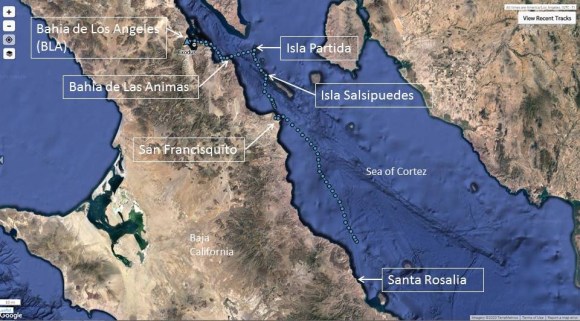
We prefer to arrive at an anchorage during daylight hours, so we departed Santa Rosalia in the evening and had our first overnight passage since we were coming south on the Pacific side of the Baja Peninsula. We waited until after the Chubasco report on SSB radio to make sure we were likely to have a convection free passage, so we pulled out of the Santa Rosalia breakwater at about 9:30 pm. As soon as we were out of the breakwater we were surprised by the surreal vision of what seemed like a hundred lights on the water. They were fishermen out in the pangas trying to catch squid that are predominant in that area. Navigating that was a bit tricky, but I’m thinking, hey, at least they have lights (you can’t always take that for granted). The passage was pretty uneventful after that, starting out with light wind on the nose, so I practiced tacking in these light conditions. The wind picked up and then died again, but we arrived at San Francisquito at about 5:30pm. As usual the boys were in the water about a split second after the 2nd engine was cut off (they have to wait until we are completely done anchoring and engines are off before swimming). Bahia San Francisquito is a large, predominantly NE facing bay with two main anchorages: one good for southerly winds and one good for west and northwesterly winds. We parked at the latter one just off a white sand beach about 1/2 mile long. There is also a small cove hanging off the SE corner of the bay were small boats can enter with great protection. I paddle boarded into this cove and there are residences along the south end as well as a small base for some sort of Naval operations. The Navy did circle through the anchorage past all of the boats (there were 4 of us there) but they didn’t stop or board any of us. They had a dog in the boat, so we suspect they were sniffing for drugs and didn’t get any whiffs from our crowd. The second or third day there, the wind shifted on us and we were getting pretty good swell so we all weighed anchor and joined S/V Interabang at the other end of the bay with better protection. They had just pulled in and we turned their secluded anchorage into a party of 5, including 2 noisy kid boats. I’m sure they were ecstatic!
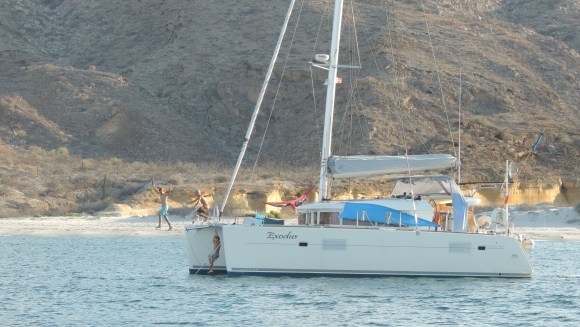
When we left San Francisquito we regretted that we never went ashore, but the bug situation somewhat dictated it. We departed bound for Isla Partida along with Lady Carolina. (Recall that there is an Isla Partida that we spent a fair amount of time at down by La Paz. We have learned that it is quite common in Mexico to have multiple places with the same name. Keeps people on their toes, I guess.) We didn’t make it all the way there, though, because the wind just wouldn’t cooperate, so we stopped on the south side of a small island called Isla Salsipuedes. It was a narrow, rocky anchorage, quite beautiful and somewhere I would have loved to stay several days. But we ended up staying just one night there, because it really was good for just fair weather and the wind picked up the next afternoon, not to mention the no-see-ums (bugs of the devil!) We did celebrate Alex’s 12th birthday in that anchorage, and we weighed anchor immediately after the celebration concluded because that’s when the wind shift came.
Our next stop was Isla Partida, which is also a small island. It has a large crescent-shaped anchorage with excellent protection from all directions except due north. We stayed here a few nights and the highlights include long paddleboard excursions, huge fish, and a mini-Chubasco. After that we headed back to the Baja Peninsula to Animas Slot. We didn’t check our map very well before heading out, though, because we were operating under the subconscious assumption that southish winds would be preferable for this passage since our overall general direction has been north from Santa Rosalia to Bahia de Los Angeles. It turns out that from Isla Partida to Animas Slot is actually a SW passage, so with S winds, we had a close reach and even had to tack to get to the anchorage. Live and learn (although I take a much more active role in passage planning after that.) Animas Slot was a fantastic little anchorage, long and narrow, and we knew it would be tight for both boats to fit. We arrived slightly ahead of Lady Carolina so we tried to tuck in as close to the beach as possible. Tim even got in the water and moved the anchor manually. Seriously, he dove down picked up the anchor and walked it closer to shore. In the end, when Lady Carolina got there they figured out the bottomed deepened too quickly so they couldn’t find a spot where the could put out adequate scope and not swing into the sides of the anchorage. Sunset was looming so they moved around the corner to Cala Puertocito de Enmedio. Of course, we took an infinite amount of crap for taking the best anchor spot for ourselves. And there was no doubt about that, Animas Slot was breathtaking. There was excellent snorkeling and paddleboarding, and I even hiked up to the top of the ridge between the two anchorages for some phenomenal views. And even though we were separated from Lady Carolina by a ridge and a reef, it didn’t stop us from gathering for potluck dinners and evening cocktails on the foredeck of Exodus.
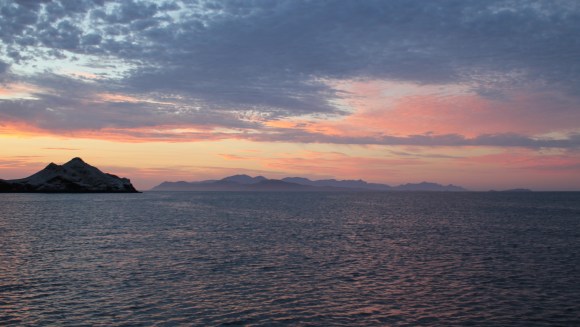
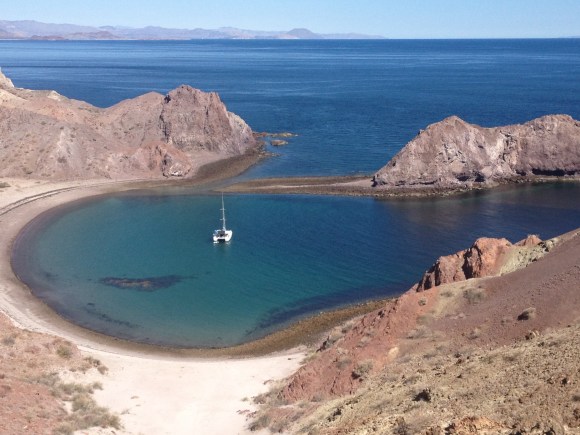
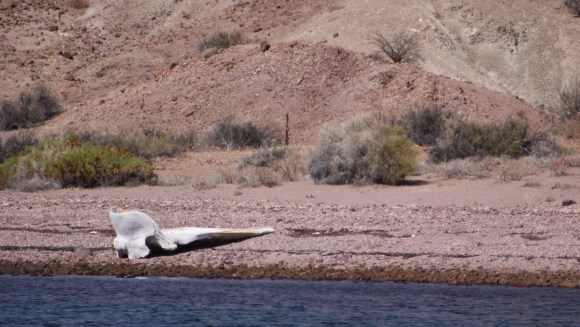
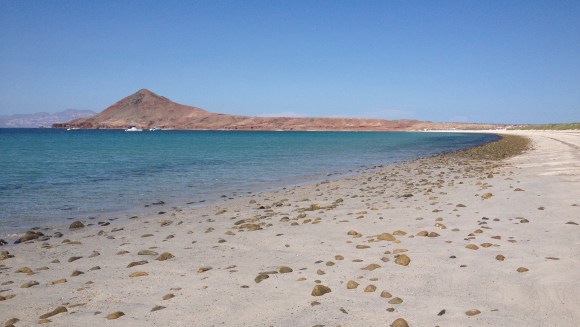
We pressed onward, but not very far this time. We stopped at Bahia de Las Animas which is just a few nm away from Animas Slot. In contrast to Animas Slot, Bahia de Las Animas is a huge bay open to the NE, and we chose one of the anchorages on the SE side, also open to the NE. We stayed a couple nights here, but there wasn’t much to see aside from a whale skeleton and a coyote on the beach. We were starting to get that sense of urgency to get to the village at Bahia de Los Angeles because we were down to bare bones of fresh fruits and veggies, but we decided to make one more stop at Ensenada el Quemado. Lady Carolina left a few hours before us and had no wind, and by the time we got our act together and got underway we had 20 kts. Sometimes, it’s better to be lucky than good. Our navigation system communication network has been having some issues, and on this passage we were without GPS. It’s funny how you get so dependent on seeing that little boat icon move across the chart plotter. El Quemado faces north and we tucked in at the SE corner of the anchorage. While the boys were out spearfishing (as usual) Carolina and I hiked to the SE across to Ensenada el Pescador. Well, calling it a hike is a little generous. It was really a walk across flat, desert terrain, but the beach on the other side was fantastic. It had white sand and was a deep enough beach for some bocce ball or beach football. We decided we would definitely need to visit that anchorage at some point. There was also an abandoned resort where the rooms were small, individual, structures along the beach, and we noticed that some of them were occupied. It’s not clear if the people there are squatters or what, but they have million-dollar views every day. When we left El Quemado we were bound for the village at Bahia de Los Angeles, but we did a drive-by survey of Puerto Don Juan along the way. Puerto Don Juan is a natural “hurricane hole” that provides excellent protection from all directions. This is where we would all flock should the unlikely event of a tropical storm make its way this far north into the sea. We wanted to check it out and be familiar with the entrance and the depths of the anchorage in case we ever had to enter in a hurry. Bahia de Los Angeles (henceforth referred to as BLA) is a very large bay and the village is up at the NW corner with a sand spit providing a little added protection from the NE. We made it to the village just before noon and had time to check out the town in the afternoon.
 Gresham Family Exodus