Raroia was our reward for the awful bash down from Nuku Hiva. It is a large atoll, but not really one of the largest, which will give you a sense of just how big these things can be. It’s oval shaped and about 21 nmi long and 6 nmi across oriented in a SSW to NNE direction. It has a single pass for yacht transit called Passe Garue, which is situated on the NW side. This is good, because since the trade winds blow from the E or ESE the pass entrance is in the lee of the atoll, so the sea conditions were calm as we waited to go through. It is a deep pass with just a few exceptions, and according to Charlie’s Charts, “Tidal streams and currents can reach 8 knots and slack water is usually of short duration.” Eight knots would be tough for Exodus, but luckily, we were there in much more benign conditions.
There is a single village called Garumaoa, which again, according to Charlie’s Charts has a population of about 50. I’m guessing since the publication is slightly dated that the population estimate is on the low side. The village is located on the West side, down a well-marked channel about 1.8 nmi south of the pass. This is also the atoll where Thor Heyedrdahl’s Kon-Tiki (google it) grounded on the eastern side of this island, and supposedly there is a little “monument” and even though we had GPS waypoints for it, we never went to see it.
I don’t have great notes on all of this, but my recollection is that we arrived at the pass entrance just about when we anticipated slack tide to be, but a quick look with the binoculars showed that it was still an incoming tide. Since winds were blowing from the East we had the situation of current opposite wind, which every guidebook said you should avoid. So, we slowed down and pondered what to do. First, we radioed for “any station inside the Raroia lagoon” because we were told that when you pull up to a pass you can always reach another cruiser inside who can give you any necessary tips and intel about slack tide. All we heard were crickets. Well, after that we didn’t ponder too much longer, because Tim’s assessment based on the visual with the binoculars of the standing waves on the inside of the pass (they were on the inside since the current was flowing in) was that it was something Exodus could easily handle. Neither the wind nor current appeared very strong, so even with the opposing condition, it really didn’t look that bad. Me, I probably would have waited around for slack tide before going in, if for no other reason than we’ve never done this before, and even though it doesn’t look that bad, what standards are we really judging this by?
So, we went for it. Tim was at the helm, and I was drinking rum. No, not really, I was on the bow, and I’m not kidding, we were through the pass in about 2 seconds. We had about a 2-3 knot current with us, so we just zipped right through. Piece of cake. Tim was right. (He doesn’t read these essays, so don’t tell him I said that.) Our drama didn’t start until we were inside the pass, and we saw black clouds looming and we checked the radar and could see a huge squall approaching us from across the lagoon. I was seriously worried about lack of sunlight and our ability to see the coral heads as we tried to cross the lagoon, but we would deal with that after the giant squall passed over us. So, we held position just inside the pass, in amongst about 3 coral heads, charted luckily, for about 20 minutes as we sustained pouring rain and 20+ knot winds. It seemed like it would never end, but when it did, it did so rather abruptly, and the winds died and the sky cleared up and we suddenly had fantastic overhead sunshine, and the bombies were lighting up with the sun’s reflection. Before arriving, I was actually more nervous about navigating the coral heads once inside the lagoon than I was about the pass entrance. For some reason I was picturing us having to go like a half a knot with one of us on the bow giving quick directions to go this way then that way through a narrow winding lane of clear water surrounded by millions of coral heads. I laughed at myself when we got there. The coral heads were large and easily visible with lots of room, in fact Tim even used the autopilot and just changed 10 deg this or that way well in advance of a bombie that would be visible a half mile away. So, Tim made a joke that we had mastered the first two dangers of the fire swamp (Princess Bride reference for any losers who didn’t get it), and we all wondered what the third might be. We found it soon enough. It was the underwater lines and bouys of the pearl farm, and our route across the lagoon had us going right through it and we didn’t notice until it was too late. The boys and I had to be even more diligent on the bow and yell if we thought a line was going to be too shallow so Tim could put the engines in neutral as we skidded over it. We never wrapped a prop or anything, but it seemed to take forever to get through it all.
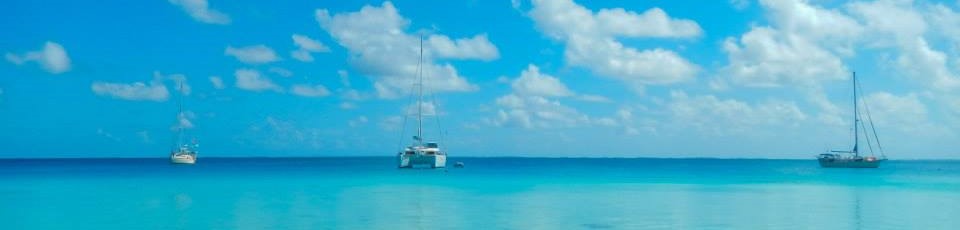
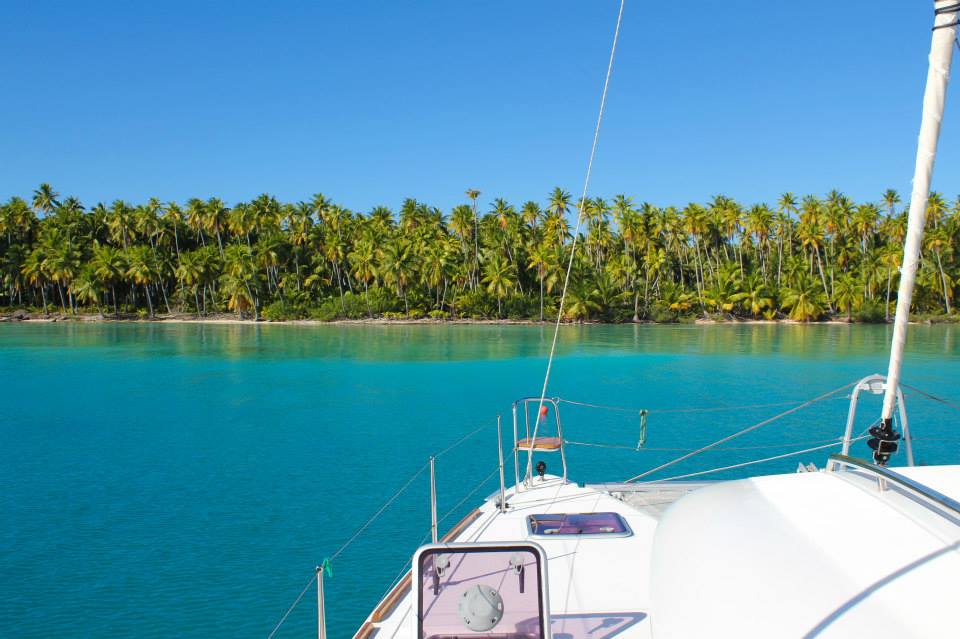
We had picked out an anchorage from the Soggy Paws Compendium, and when we arrived, it was jaw droppingly brilliant. It was out of a postcard or a professional photograph, not a place that you actually get to visit in real life. There was a white sandy beach, palm trees swaying, and crystal-clear turquoise water that beckoned you for a swim. We were totally protected from the ocean swell bashing against the other side of the reef, and the low lying motu and palms also provided protection from the wind, so the closer you got to shore, the glassier and clearer the water was. And there was absolutely no one else there. Certainly not in this anchorage, and since no one was on AIS and no one answered our VHF call, it’s possible we were the only cruising boat in the entire lagoon. It was amazing. We were sitting in a stereotypical remote tropical paradise with a slight breeze and water lapping on the swim step. The weather was a bit cooler than The Marquesas, having dropped so many degrees in latitude. Tim and I spent the evening on the net (Exodus foredeck) after sundown, and I was actually a bit chilled, a sensation I hadn’t experience since way back in San Felipe in October. The solitude lasted only one night, but that’s OK, we were joined by the rest of our “clan” Lady Carolina, True Blue V, and Eleutheria. We had a potluck on Exodus the first night after everyone arrived, and all the guys went stumbling around the motu hunting coconut crabs. Steve from Lady Carolina did a write up on this, which a must read and follows down below.
Speaking of Lady Carolina, having arrived the following day, earlier in the morning, than we did, their experience coming through the pass was, well, a bit different than ours. They arrived in the morning, near a slack tide, with the current flowing out of the lagoon. So, they went for it, and it was like treading water. Carolina said at one point she was pretty sure they were going backwards. The boat didn’t point where they wanted, and it was a pretty stressful operation. Then those showoffs on True Blue V passed them on the left. Damn Aussies. Now, Lady Carolina was following the path down the middle of the pass, just as we had done, and it had worked pretty well for us. But since we were going in on an incoming current, our experience was like riding the rapids in, while since they had an outgoing current, they had those rapids against them. True Blue V stayed further to the outside, where they ran the risk of being in shallower water, but where they also enjoyed less current flowing against them. Anyway, obviously Lady Carolina made it through the pass and across the lagoon in order for Steve to go hunting for coconut crabs.
One of my favorite activities in this anchorage was paddle boarding, as long as I stayed between Exodus and the motu in front of us. The wind protection was excellent, and the water was glassy and there were tons of coral teeming with fish life scattered around in shallow water, so that paddling around wasn’t that different from snorkeling around. It was serene to the point of almost being meditative. Then one morning I ventured a little too far south out of the wind shade of the coconut palms and towards a little gap in the atoll, a “mini-pass,” if you will. The current must have been flowing in that mini pass, because within single digit seconds I was blown well into the lagoon, well behind Lady Carolina, who, as usual, was anchored well behind us. The paddle back to the anchorage was the most difficult paddle I’ve ever had. More difficult than paddling upwind in a squall at Las Rocas (Mexico, northern Sea of Cortez) to be sure. I had to get down on my knees to decrease my windage and increase my paddling moment arm. Once back in the anchorage it was glassy and serene again, so I could go back to my meditation pretending I didn’t really know how ugly it was out there.
The snorkeling in Raroia was most excellent. Especially after spending so much time in the black sand and murky water of The Marquesas. Tim and Steve (Lady Carolina) did some advanced scouting to find the best snorkeling spots for the rest of us, and they did not disappoint. They found a little mini pass, further south than the one that almost swept me out in the middle of the lagoon on my paddle board, and it made for really fun snorkeling. You could ride the little rapids down the middle and jet past all kinds of fish and coral, and then swim around and do it all over again. Here is where I swam with sharks for the first time. It’s starts out a bit unnerving, but you learn right away that these reef sharks are more afraid of you than you are of them. As long as you don’t have a bleeding, gaping wound, and as long as you don’t have a wounded, struggling fish, they will totally leave you alone. They swim around simply ignoring you. On this dive, there were only about 3-4 at a time and they were the black-tipped reef variety, only about 3 feet long, so it didn’t take long for us to ignore them just like they were ignoring us.
Next up on the snorkeling docket, we officially achieved snorkeling bliss. We snorkeled on and around one of the bombies and it was the most amazing snorkeling I had ever done. Water clarity was infinity. (OK, I’m exaggerating, but in a relative sense compared to Mexico, it may as well have been infinity.) There was both soft and hard coral and thousands of aquarium type fish. My favorite part were the giant clams with colorful wavy “lips” kind of like in a cartoon. I just kept swimming laps around the coral head, and I was actually the last one out of the water and back in the dinghy, and that just never happens. I’m usually the first to get cold or bored or both.
And last but not least, the winds died down just a hair and we were able to move back over to the other side of the atoll in order to do some pass diving. The skies were a bit clouded over for our passage across, which made it a little nerve racking. The sun would be out, and you could see every bombie clearly in your path, and then the sun would hide and the bombies would simply disappear. We also had more pearl farm buoys to contend with, but somehow, we made it all the way across with very little drama. We thought we would anchor near the town, but when we got there, we found the anchorage pretty deep and close to shore, so we were just a bit concerned about swing radius and being on a lee shore. Also, it would still be a bit of dinghy ride to the pass, so we opted to go see if there were any better anchor spots closer to the pass. There weren’t. We ended up anchored on small coral pinnacles (Lady Carolina on one, Exodus on another.) Tim dove in and inspected before we dropped anchor, and then he got back in the water when we anchored so he could place the anchor exactly where he wanted it. This is a good example of how Alex and Brenden make us *not* a shorthanded crew, because we never could have done such a precision anchoring job without them. The wind blew about 15 knots steady the whole time we were anchored there, and since we had no protection from wind or fetch from across atoll, so was a bit bouncy. But the location was great for staging for the pass dives, of which there were numerous. I only went on one of them, and wow, what an experience. We arrived at the pass in the dinghies pretty much right at slack tide, and once the current started up again (flowing into the atoll) we drove outside the pass, jumped in the water (each having our own line tied to the dingy), and rode the incoming tide all the way in. The visibility was amazing, and we saw all kinds of sea life. I was especially captivated by all the sharks. Not because I was afraid, but just because I’d never been so near so many at one time. I saw my first white tipped ones and even a nurse shark. We did this three times, and I have to say Tim and the boys enjoyed the dive WAY more than I did, since they dive deeper and can hold their breath longer. But I had a lot of fun too, up until the end of each ride when we were in standing waves getting tossed around like a mixed salad. Anyway, it’s definitely one of those not to be missed experiences, and the boys went several more times, once even with the hookah.
Overall, Raroia was an excellent introduction to The Tuamotus. There were so many options of where to go first, but I think we nailed the decision and ended up in a place that had the best of everything. My only regret is that we didn’t visit the small village there, and the only downside of the whole place was the flies. I’m not kidding, they were everywhere, and they were numerous. It’s like nature’s cruel joke, and idyllic tropical paradise, but we can’t make it too nice, so let’s add flies.
Our pass exit was just as easy as the entrance. We rode a dropping tide, so we had the current in our favor again, and we were out in seconds. I even drove Exodus this time.
 Gresham Family Exodus