Originally posted on October 24, 2014, by cruisingrunner
Tonga calls itself “The Friendly Islands,” but of all the places we’ve been so far, I’d say they actually seem to be the least friendly. However, the longer we’ve been here, and the more people I interact with, the more I have started to notice a pattern. There seems to be a direct correlation between how “friendly” someone seems and how confident they are in their English speaking skills. So, I’ve come to the conclusion that people who may on the surface appear unfriendly, or at least less friendly, are really just shy and self-conscious. Contrast that with Pago Pago, American Samoa, where everyone speaks very good English and everyone is super friendly, including the many Tongans I met who live there. Also, contrast that with French Polynesia, where there simply was no expectation of them to speak English. They spoke French, and it was up to us to try our best not to butcher the language too badly, all with varying degrees of self-consciousness.
Now that we are out in the much more remote areas of Tonga, we are finding this even more. It’s quite possible to walk through an entire village without speaking to anyone, which creates a dilemma for us. We aren’t exactly the most friendly or outgoing people ourselves, but we recognize how rude it is to go to a village without talking with the people who live there, if for no other reason than to thank them for letting us be there. Luckily, we’ve got a couple of good ice breakers: Kids and fish.
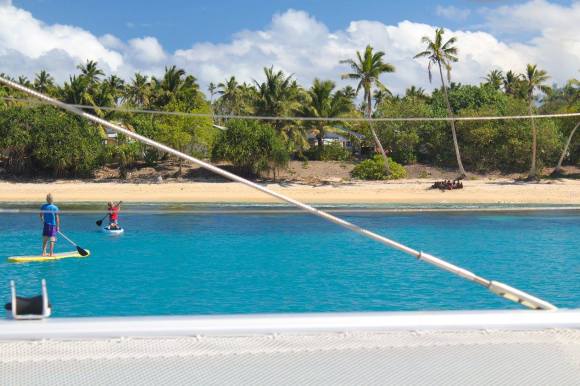
Every village has kids. Usually a lot of them. And kids seem to be less concerned about whether or not they can speak the same language with other kids. For example, when we were approaching the island of Matuku, we could see right away that there was a group of about 12 to 15 kids on the beach watching us. They were waving politely, but once they saw Brenden and Alex, they started running around the beach and they took their waving up a notch. They were obviously excited to see other kids. Shortly after getting the anchor set the boys got on the paddle boards and headed to shore, one of them with a beach soccer ball situated between his feet. I’m not sure if it was just the excitement of the boys heading to shore, or if someone caught a glimpse of the ball, but whatever it is, we could hear the squeals of delight from the kids on the beach loud and clear. And when we looked towards shore we saw them all running towards Alex and Brenden and helping them get their boards up. Shortly after they arrived, all the kids, including Alex and Brenden, vacated the beach, presumably to somewhere suitable for a game of barefoot soccer. The village teacher, Isaac, ended up paddling out to visit with us, and he invited us to school the next morning too. The boys ended up spending quite a bit of time on shore during our stay there, and when they weren’t on shore, three of the older boys from the village would come out to Exodus to visit. They sang jingle bells with Brenden, played with legos, and even taught a little bit of Tongan. Isaac ended up going spear fishing with Tim and our friend, and in the end he gave us many coconuts and kasava root. I could go on, but the point really is just that the kids were our opening for interaction. When you have kids, you automatically have something in common, and it makes overcoming the language barrier and getting a out of your comfort zone a little easier for the shy and self-conscious. I’ve heard babies and young children are even better for this, but I’ll just have to take that on faith.
Every village likes fish, too. Bringing a fish to shore to share with the people of a village can get you an audience with the chief and usually lots of island fruit in return too. Too bad the mangoes aren’t ripe yet.
-D.
 Gresham Family Exodus
One reply on “Fish and Kids are Good Icebreakers”
[…] D/Camille – walk to town. Store closed 😦 Relatively large, sprawling village. People seem shy, not too friendly. […]
LikeLike