October 15-19, 2014
We had a blustery day sail from Uonukuhihito to Ha’afeva, making the jump from the eastern to the western island group of Ha’apai. However, when we arrived at the Ha’afeva anchorage on the west side of the island, we found that it would be an uncomfortable spot in the strong southerly wind that we were having. So, instead of dropping anchor, we just did a drive by and then proceeded just about 2 miles to the southwest to the small island of Matuku. Matuku is a rectangle shaped island with its long side lying east to west and reefs sticking out from the corners. While not an ideal anchorage, it provided reasonable protection from the strong south winds.
As we were nearing the anchorage, we could see that there was a village there, and there was a group of children on the beach huddled in the shade of a palm tree. As we got closer and Alex and Brenden came out on deck, there was obvious excitement among the kids on shore and they shouted and waved. As soon as our anchor was set the boys took the paddle boards ashore, and they took a soccer ball. You should have heard the squeals of delight from the village children as Alex and Brenden approached the beach; it was too cute. While the boys were ashore, the schoolteacher, Isaac, borrowed one of the paddle boards and came out to Exodus for a visit. He was quite young, early thirties, and from the capital city of Tonga, Nuku’alofa, so this teaching assignment in a small village in the Ha’apai was a big change for him. He explained that usually the new teachers get these assignments. He told us that he had seen many yachts, but he had never been aboard one, so he was glad to get to come see Exodus. He was also very interested in going spearfishing with Tim and Jack, and he also invited us to the school in the morning.
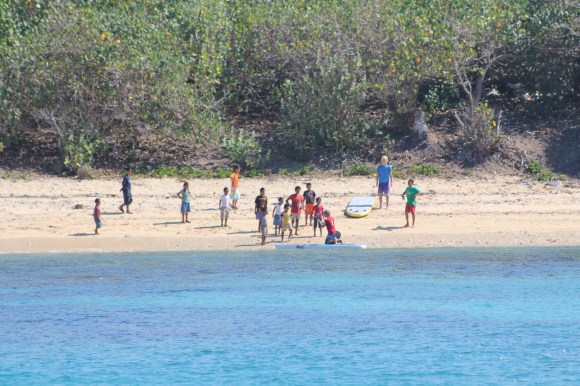
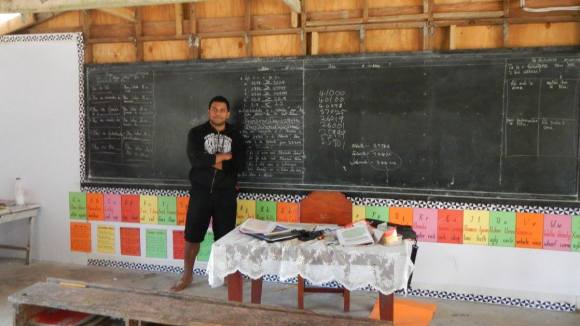
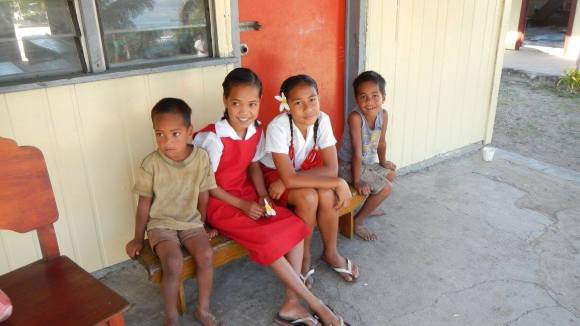
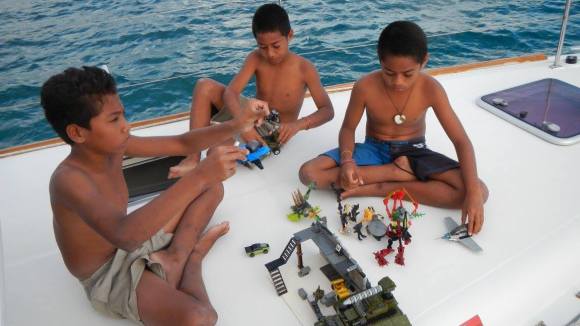
The village was small with a total of 14 children aged 12 and under. Older children go to one of the bigger cities for school, so Alex was the biggest kid on the island. We had to get up and get ready for school by 8:30 (not an easy task, especially for Brenden who likes to sleep in well past 9). When we got there it turns out they didn’t really have school since they finished exams and were having a little break. So, they just played some more soccer. I took a few small items for the school (pencils, paper, crayons), and Camille (our friend on s/v Iguana) took some lollipops, which were a huge hit. And we also gave them the soccer ball, which was accepted with applause. The kids mostly don’t speak English, so it’s even harder than when we were in Makemo, because at least we knew a few catch phrases in French, but I don’t exactly have a book called Tongan for cruisers. When I asked Alex if it was hard, his response was, “when you have a (soccer) ball, you don’t need to speak the language.” Three of the older boys (12 yrs. old) came out to visit Exodus a few times when the boys were not already on shore. They used the lids of ice chests as kick boards to get to us. They seemed to be especially fond of Brenden, which I thought was maybe because he’s exactly their size, but Alex told me it’s because Brenden sang Jingle Bells with them. Of course! Brenden entertained them for a couple of hours on Exodus one afternoon, and they even taught him a little Tongan. The sat on deck outside his bedroom hatch and he handed them Legos to play with, since they couldn’t go in his room because they were wet. They kept asking us if we were going to leave the next day and all of them, including Brenden, were begging us not to. He was having fun with his new friends. Of course, when we would leave was solely dependent on the wind.
When Tim and Jack went spearfishing in the morning, they came back with a tuna (Tongan – Atu) and two huge red snapper (Tongan -Fongamea) and they took them to shore to share with the village. I didn’t go, but apparently it was very well received, and they even got to meet the chief. In the afternoon they went spearfishing again with Isaac, the teacher. Isaac was totally amazed at how deep they dive and for how long they can hold their breath.
The winds stayed strong but they shifted from the south to the east, so we moved back up to anchor off the west side of the island of Ha’afeva. The village is on the east side of the island, so we took about a 20-30 minute walk along an easy trail to get there. A little girl immediately approached us and asked us if we wanted mangoes, and of course the answer to the question, “Do you want mangoes,” is always, “Yes!” so she climbed a tree and brought down several green, hard as a rock mangoes and wanted to charge us for them. We passed and asked where the store was. When we got to the building we thought was the store, it was locked up, so we just kept walking. A Chinese guy was walking along in our direction, so we asked him about the store, and he gestured for us to follow him, and it turned out he was the store owner and opened up for us. In Neiafu, there were many Chinese people running the shops, but I was surprised to find it the same in a small village in Ha’apai. The store was organized so that everything is behind the counter, and you have to ask for what you want, which was slow and frustrating for us, because the Chinese guy didn’t speak English, and well, we don’t speak Tongan or Chinese. However, soon a Tongan man came in who spoke English, so he helped us out.
We didn’t really do much during our stay at Ha’afeva, mostly because of the weather. I was able to get in a few good runs on the system of trails, trying to avoid the village in my running clothes. Other than that, we mostly had lazy rainy days on board catching up on school, playing games, and making cookie dough. We had planned to snorkel on the wreck of an old Korean fishing boat that is near the anchorage, but we never did get around to it. Tim and Jack finished a few boat projects together, and I made one more trip into the village store, because Brenden was concerned about how low we were on ramen noodles.
 Gresham Family Exodus