Originally posted on March 5, 2015, by cruisingrunner
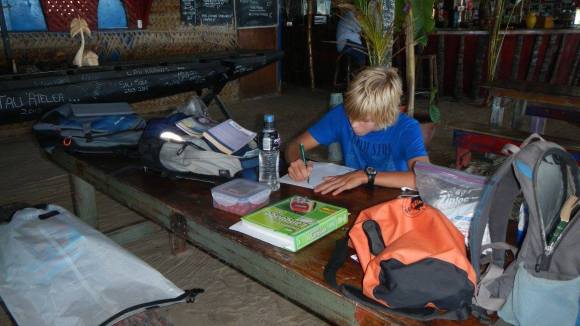
Our homeschool program is a “curriculum in a box” and it’s great for staying organized and making sure the boys are getting what they need in order to eventually reintegrate into a mainstream public school. But it’s definitely NOT good for giving them content that is relevant to where we are in the world, and also since it’s a jam-packed curriculum, it’s hard to be flexible enough to augment with other types of learning we think are important. It’s been two years, and we still don’t have a perfect system, but these are a few ways we are overcoming the downside of our curriculum choice and trying to find the right balance for us. Some of these are recent changes, within the past few months, so the jury’s still out on their effectiveness, but I thought I’d share where we are now with the understanding that this is always a work in progress.
1) We don’t do everything. We can’t. We left home to see the world, not to have our noses in books all day. If we did EVERYTHING that was in our “curriculum in a box” we would be doing schoolwork 6-8 hours per day. So, first I used my knowledge of the boys’ strengths to pair things down. Both boys are very strong in math so I have basically cut in half the daily assignments as long as I can tell they’ve mastered the concept. Second, I evaluated and prioritized what I thought was important from all of the other subjects to see what else could be cut out. I decided not to touch reading and writing. Of all of the skills to have for a successful life, these are the ones to have. So, I turned my attention to history and geography. It seemed that other than being exposed to the content matter itself, the real value of the coursework for these subjects were reading comprehension, inferring and drawing conclusions, writing clearly and concisely, and memorizing. Since these skills are also thoroughly covered between reading, composition, and science, I felt OK with skipping a lot of the history and geography coursework. We still do the lessons, just not much of the work to go along with it.
2) We make changes to specific assignments. This is especially so in composition. I really like their composition curriculum, because they are writing about an essay per week and they are learning to be proficient at all kinds of writing from free writing to research papers. So, rather than tweak the curriculum, I just give them different topic choices or let them choose their own. So, instead of comparing and contrasting dogs versus cats they are writing about pole spears versus spear guns. Or homeschool versus regular school. Or whatever seems most relevant at the time. Brenden recently wrote a very mature autobiographical piece about his emotional struggle when he kills a fish. So, instead of having a bunch of meaningless essays that check the box, they will have a stack of work that documents some of their most memorable experiences out here. Another example of altering coursework is in geography. You use geography skills constantly when you live on a sailboat and must navigate from here to there, so whenever possible I try to make their lessons in this area directly relevant to our current situation.
3) We try to take advantage of everyday activities as learning opportunities. I have to be sneaky about this, because the boys are averse to all things that are overtly “learning.” When we saw a glacier the other day (how casual did that sound) Brenden detected that I had worked a few of his science vocabulary words into the conversation, and he was immediately turned off. I think younger kids are easier in this respect, because they are still easily awed. My teen and pre-teen are just too cool to be awed. They still love learning, but not if they know their learning, and especially not if their mom is the one teaching them. So, we just try to take advantage of the fact that they are exposed to something new almost daily, and let them take the lead. When they express the slightest interest in something, we try to just push it along, ever so delicately.
4) We periodically (once every 1-2 weeks) designate a full day as “Science Experiment Day.” This is working really, really well. The boys love doing the experiments (at least as an alternative to their normal schoolwork) and there is the added benefit of Dad getting involved. See my previous post Saving Science for more details.
5) We periodically (once every 1-2 weeks) designate a full day as “Local Project Day.” This isn’t working quite as well as Science Experiment Day, but I think it’s because it challenges them a little bit more, so they want to retreat back to the safety of their normal schoolwork rather than branch out and do new and different things. But the concept is sound, so I am going to stick with it. Basically, I make up a couple project ideas for them to choose from and they have to choose together and work on it together. The projects aren’t too complex as they need to be completed in a single day, but they are projects that are directly applicable to where we are at the time and the environment around us. Like I said, the boys aren’t embracing this quite yet, but we will press on.
6) We’ve added a laid back foreign language program. I gave them the choice of French or Spanish, and luckily for me they chose Spanish. We are using a free podcast and I write out the vocabulary for them from each lesson. This isn’t going as well as I would like, but that’s mostly because we aren’t doing it often enough and because we aren’t in a Spanish speaking country, so the benefits of learning aren’t immediately obvious. I so wish I started this when we were in Mexico.
7) We’ve added smart phone app development. This is Dad’s project with them, and one of the boys is loving it and one of them really isn’t. This just highlights the difference in their personalities and aptitudes. A memorable quote from Brenden was, “I don’t like programming. I just want to think of what the program should do and Alex can program it.” So, Dad has used their relative strengths to come up with a team project they are all working on. Stay tuned for a future blog post about that.
In a nutshell, this is our current approach to managing the boys’ education. Some homeschool parents are pretty passionate about their approach while others lack confidence and are always second guessing themselves. I guess I fall somewhere in the middle, and I’m always open to improvements and new ideas. So, any other homeschoolers out there? How do you homeschool?
P.S. Our neighbors at our current holiday park include a homeschooling grandma, and she is very passionate that when they are traveling the girls must keep a journal every night. “The diary is more important than schoolwork!” I’m not sure I’d go that far, but I do see the immense value in having the boys keep journals. But I don’t make them do it. Why not? I reflected on that question and could come up with no other answer than it must be laziness on my part, or misplaced priorities. I had the boys keep journals in the very beginning of our cruising journey, but they resisted, and I relented. It was a busy time and there were so many things to focus on, so maybe I can’t be faulted too much for letting that slide, but now there is no excuse. We are two years into this thing, and I’m finding the time to run, write, and learn Spanish, so I should be able to muster the energy to commit to enforcing daily journal entries. We shall see.
 Gresham Family Exodus