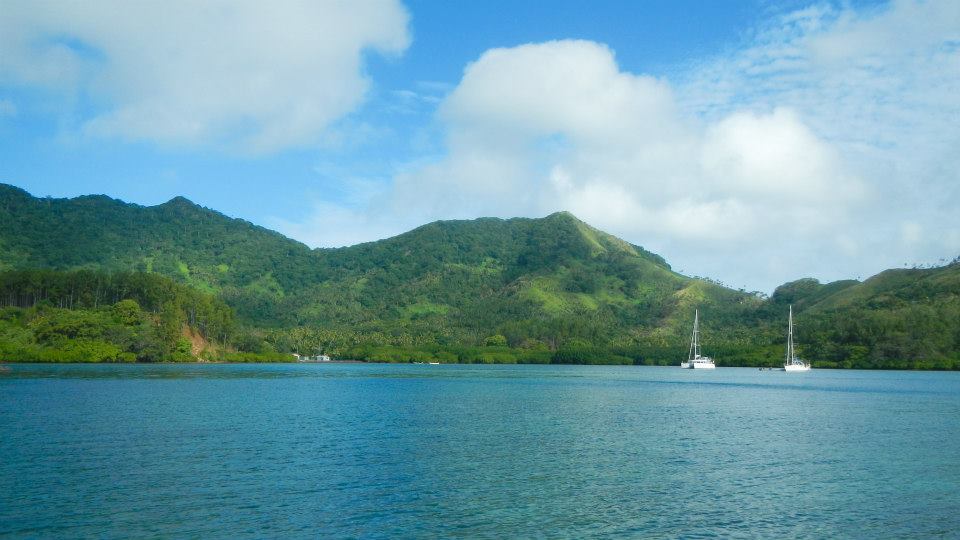
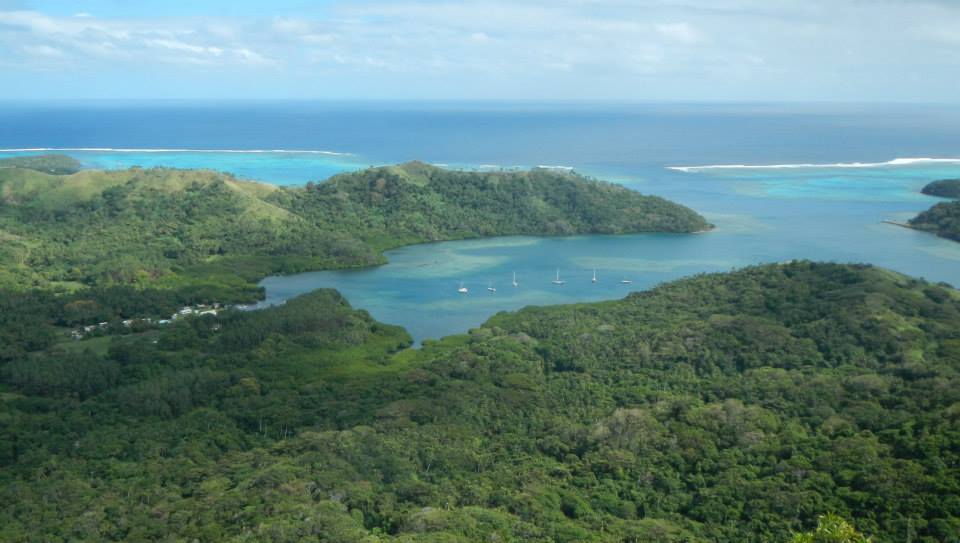
In contrast to the atoll of Fulanga, Matuku had the steep, dramatic geography reminiscent of The Marquesas in French Polynesia. It is a bit older in its life cycle than the Marquesas, though, since it has a fringing reef, but still younger than The Society Islands like Tahiti and Bora Bora since there isn’t much of a lagoon. The bay where we were anchored was tucked into the middle of the island, in fact it is the remains of the volcanic crater. It was an amazing place to be because we were basically surrounded by this steep, beautiful, lush green island.
Our first morning in the bay we were all visited by a man in a fishing boat who introduced himself as the chief. He invited us to all come in together for our sevusevu the next day, and he told us a little about the village, which is small, with only 9 families. The chief was very welcoming and friendly. He told us they have plenty of water so we can fill jerry cans any time we want, and we are welcome to do our washing on shore. He also told us we were free to swim and fish and generally enjoy the bay, even though we hadn’t done our sevusevu yet. However, in stark contrast to how we were treated in Fulaga, I, the woman, was basically invisible. They came aboard our boat, but they didn’t introduce themselves to me and didn’t shake my hand. After I served them drinks, they thanked Tim and when they were leaving, they said good-bye to Tim. There may have been a slight nod in my direction when they mentioned doing laundry on shore, but that was it. I really only noticed it because that most certainly WASN’t the way in Fulaga. Simon, the husband in our host family, was the son of the chief, and he always addressed me, looked me in the eye, and shook my hand.
The people in the village later told us he wasn’t the chief, that their chief was in Suva. We didn’t ask for any further information, not wanting to get too deep into the island politics.
Wow, as much as I had raved about Fulaga, Matuku was pretty nice too. We went ashore as one big group to do our sevusevu, and we were met at shore by a couple of local young men and one of them went to get the “old people.” I’m sure he meant “elders” but “old people” had it’s charm, too. We went to the community hall where there were women weaving mats and cutting fruit, and they were all very welcoming. As usual, they loved my chumba, but not nearly as much as they loved 1.5 year old Benjamin in his little sulu. Can you blame them? We did the sevusevu, and then they invited us to stay and drink some kava right then and there, so of course we couldn’t refuse. We stayed for a couple of hours and they gave us many different local fruits to sample. Matuku is a very lush and fertile island and they can grow many things. It poured down rain but we were all nice and cozy in the community hall chugging kava and getting to know one another. It is a very small village there called Lomati, and all of their school age children go to a boarding school at another village on the island during the week, so our big group gave them the sound of playing children that they don’t hear everyday. There was a young girl there, maybe 4 years old, and she was all smiles when Fien (girl from Nautilus) went over and took her hand and asked her to join all the boat kids in their circle.
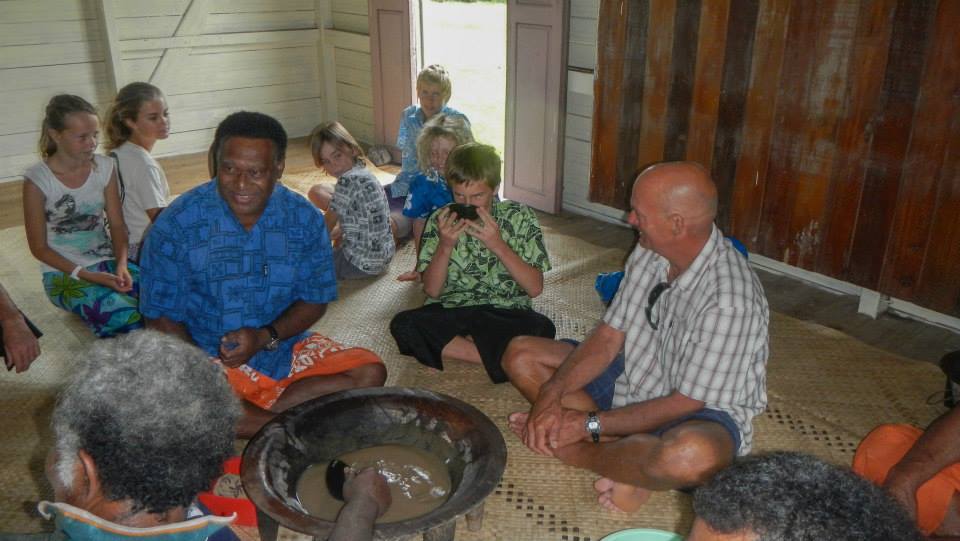
We had been warned that at low tide the water dries near the village and all that’s left is mud. But not to worry, as the rain kept coming down and the kava kept flowing, periodically we’d send the kids out to move the dinghys further out so they would be left sitting in the mud.
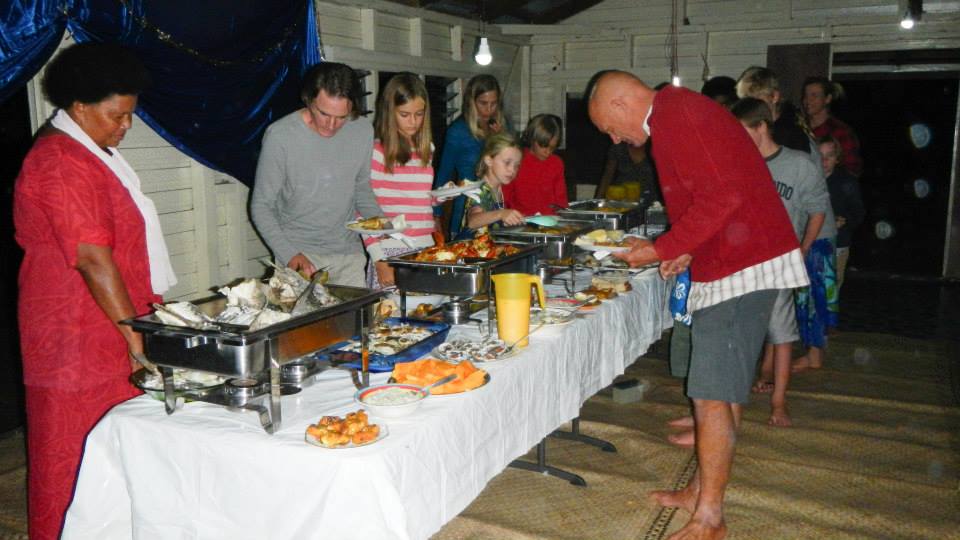
While we were there, the people of the village invited us to their church fundraiser. It came across as if it were something they were planning independent of our presence, but since we were there we were welcome to join them. So, then they had very good luck with their timing, because the church probably raised quite a bit more money than it would have. The feast and the fun evening were more than worth the donations we all contributed. They had a full spread of food, but a noticeable difference between this meal and the meals we had in Fulaga was that this one had a decidedly much more western feel to the presentation. First of all, it was all set up on folding tables with table cloths, and second, they used burners to keep the food warm as it sat there, similar to what they used to use at catered work lunches. But not to take the western theme too far, the food was very much Fijian and we still all sat on mats on the floor, so that was a relief. Most of the evening the kids all ran around outside playing games and having fun. After the meal, the men all stayed well into the night to drink some kava while the moms and kids retreated back to the boats. In contrast to Fulaga, here it was really only the men drinking kava rather than it being a mixed gender activity.
One of the young men of the community really seemed to befriend our group. He is married and has a young family (two kids, if I remember correctly) and Tim and Hans especially seemed to take to him. When we met him, he introduced himself as James or JJ, but pretty soon they guys were calling him Jesse, Jesse James. I always thought that was a nickname they gave him, but I just asked Tim about it, and he told me that his name really was Jesse James. Anyway, Jesse told Tim that he doesn’t drink Kava anymore. He said that now he has a family, and his family is more important. If he drinks Kava then his family doesn’t eat, and so he doesn’t drink kava. We took that to mean that Kava saps your productivity, so if he’s drinking Kava all night then he’s not providing for his family during the day. He seemed educated and genuinely inquisitive about our travels and the places we’ve been.
We went on two hikes while in Matuku. The first was more like a walk up and down a hill to the beach on the east side of the island, while the second was more like a climb up a mountain to a high peak where we saw amazing views of the anchorage, the reef, and the ocean beyond.
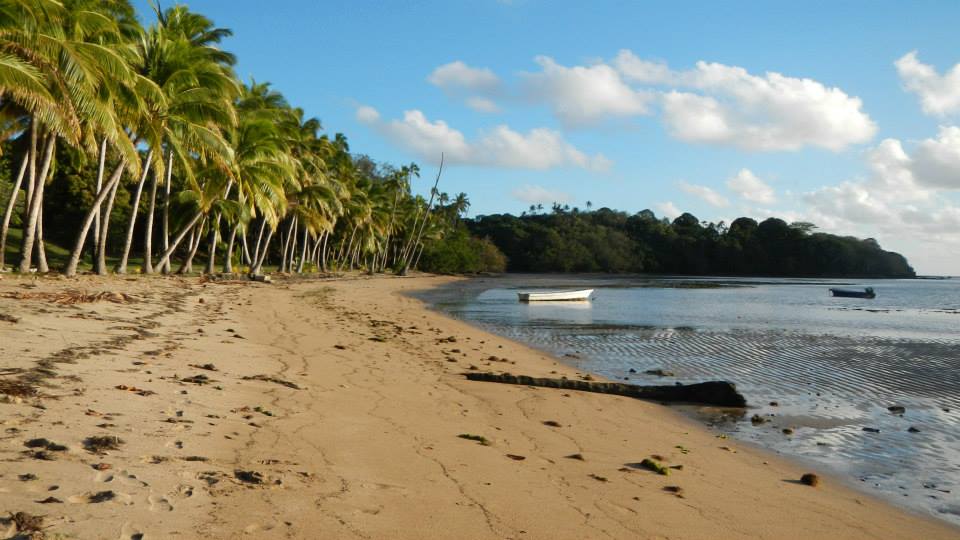
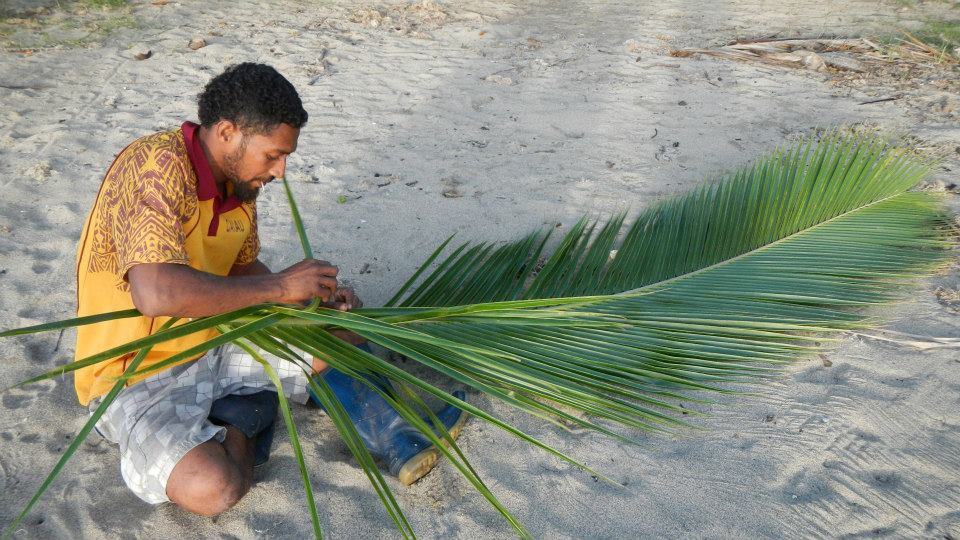
Jesse James was our guide on both hikes, and on the first one just a subset of our little fleet went. It was a nice walk through the lush island, and we passed a papaya “plantation” as well as a huge mandarin (tangerine) tree. We were all a little short of fresh fruit and veggies on board, so it wouldn’t be too much of an exageration to say that we were all drooling over the mandarins. Jesse said if we wanted some, no problem, we could pick some on the way back. So, we made our way over the hill down to the beach on the other side, enjoying pleasant conversation along the way. When we reached the beach, Jesse started to make some baskets out of palm fronds so that we would have something to carry the mandarins in. This is the side of the island where the school is, and since it was just about the time school was getting out, several kids came over to hang around us. There was one young teen girl who spoke a small amount of English, but most of the smaller ones didn’t. So, they just hung around close by and smiled huge smiles like only Fijian children smile. It was relatively low tide, to Axel and Sepe, two boys from other boats, played and explored around the reef, while I enjoyed a solitary walk along the beach. When I got back I found that Gary had decided to learn to make a basket and Jesse was patiently helping him. The rest of us were somewhat ready to go, so we got a head start. Back at the village, Jesse showed up with our mandarins as well as a few papaya. These were all given to us in generosity, without expectation of anything in return. Of course, to show our own gratitude, each family gave something to Jesse as well.
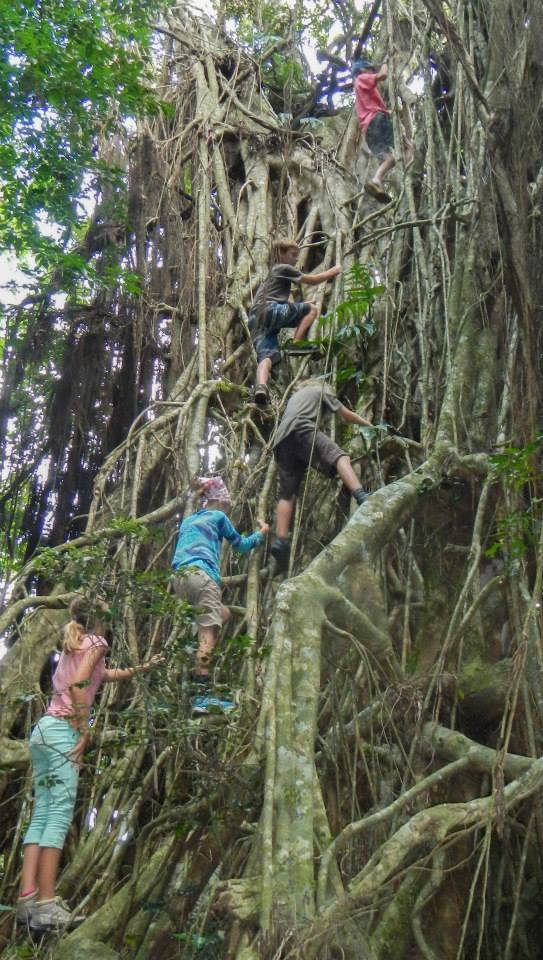
The second hike was a bit longer and a lot more challenging. This time the whole anchorage was there, including Liz with Benjamin in a carrier on her back. I must admit that she was my inspiration many times that day when I found myself struggling for a handhold or slipping on rocks. I just kept thinking to myself, “Suck it up. Liz is doing this with a baby on her back.” We made a few rest stops on the way up, and one was a particularly interesting stop because it was at the base of a huge banyan tree. The kids loved it, because it was hollow up the middle, and they could climb a fair way up to the top of the tree. It was also here that Gary was taken out by a rock. When the climbers ahead of you dislodge a rock such that it starts rolling down, they yell, “rock!” This all came together about a split second too fast, and Gary heard the call, saw the rock, and jumped up over it, but like I said, just a split second too late. Truth be told, we are lucky no one got seriously hurt that day from falling rocks, because falling rocks were plentiful.
The last bit of the climb was the worst as you were basically going straight up grabbing roots and trees to hold on and desperately looking for footholds among grass, dirt, and loose rocks. For me, it wouldn’t have been nearly so bad if I wasn’t obsessed with thinking about how hard it was going to be to get down! Anyway, making it to the top was worth it as the views were breathtaking. You could see the boats in the anchorage below and all the way out to the reef and the ocean beyond. It rained a bit while we were up there, but no one really seemed to care. We were satisfied that we had made it and satisfied that we were eating lunch. After lunch at the top and the kids moving here and there along the steep ledge, we were perched on that I was beyond nervous, we started our descent. I was advised that I should descend facing the ground, like going down a ladder, but I opted instead going down seated on my butt, and it was much easier than I thought it would be, why did I worry so much? Of course, the seat of my shorts took a bit of abuse getting down. When we were back at the banyan tree the group was much more spread out than on the way up as there was a wide range of paces coming down. A good part of the descent I found myself following Katrien but then I lost her too and it was just Victoria and I. Victoria was nervous we were lost, and I was too, but I put on a confident face and insisted that if we are going down, we are going the right way. Eventually we caught up with some of the others and we were told that Tim went that way, but someone else thinks we should go this way. I responded as honestly as I could, that Tim has a way about these sorts of things, and if I had to, I’d trust him with my life picking the right way to go. So, we followed the way Tim went and soon found ourselves back in the village. I wonder if I ever told Tim about that.
 Gresham Family Exodus