As things were winding down at the beach picnic, discussion turned to the kava party (aka grog) they would have that evening. They insisted we were all invited, so, not wanting to miss a party, we raised anchor and moved over to the village for easier access.
A grog is basically a social gathering for drinking kava, which is a drink that is made from a powder of dried, ground pepper tree root (called yaqona, the same stuff we present to the chief for sevusevu). Kava is very important in Fijian culture, not just because of the physical effects it has on you, but because of its central role in the social aspect of society. We’ve been told that they drink kava every night. Not always in huge gatherings or big parties, but often, even usually, with a small group of friends or family.
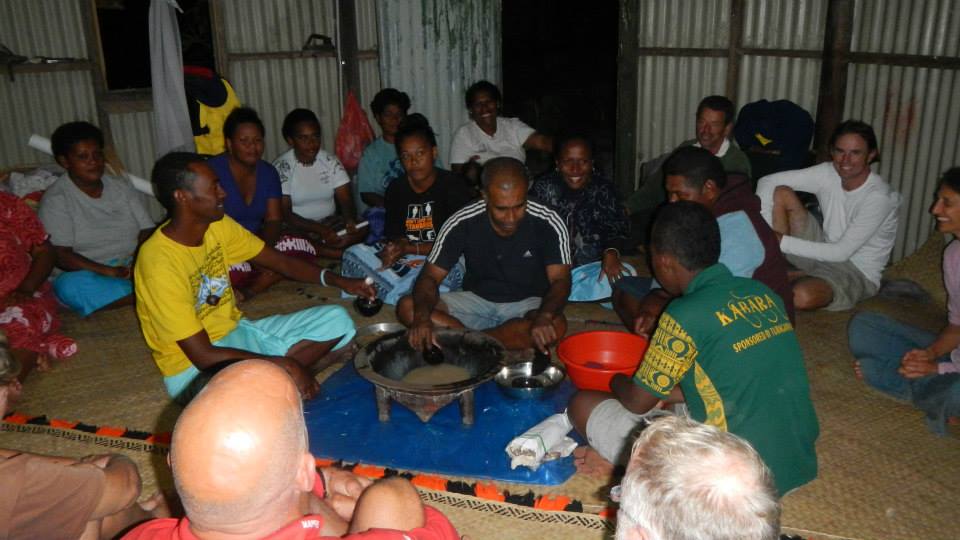
When we first arrived at the grog, it was mostly yachties and only a few locals, and somehow our friend Hans (s/v Nautilus) was whisked off to another, apparently more exclusive, grog with only locals and for a while we were wondering where he was. When he turned up a little later, he hung out for a while, then said his party was better (smiling the whole time) and went off again. Feeling not a little bit jealous to be at the grog with more white people than locals, I was happy as that changed as the night progressed and we drank round after round of kava.
They make the kava right there by putting the ground uproot in a mesh bag and swishing and squeezing it in the water. They serve it out of a large hand carved kava bowl with small coconut bowls and when it’s your turn to drink you can request, “low tide, medium tide, high tide, or tsunami.” When they offer you the bowl to drink, you clap your hands once and say, “Bula!” then it’s down the hatch all at once. When you are done you say, “Maca” meaning empty, and everyone claps three times. Then it’s the next person’s turn. (Although later I learned that you are only supposed to say “Bula” and “Maca” for your first bowl and then after that you don’t say it. But it has also been made clear a few times that the specifics aren’t so important in these social grogs, just have fun and enjoy the company.)
After each round the server waits for the caller to yell, “Taki” meaning something like “let’s drink” before the next round can begin.
The Kava here in Fiji seems to be much better than what we drank in Tonga, and it also seemed to get much better as the night progressed. Eventually, there was singing and dancing, including a conga line that somehow, I ended up leading. During the evening Tim made a friend, Tai, whom he chatted with for a while, and when the dancing started, Tai leaned over and told him, “If we act like we are having a very important conversation then we will not have to dance.” Needless to say, Tim was grateful for that! The next day, Tim repaid him with a couple of barracuda.
I have no idea how many rounds of kava we drank, but I think it was more than 10 and less than 20. It’s difficult to describe what its effect feels like. There is a definite numbness to the lips and tongue that you feel right after each drink and seemed to intensify as the rounds racked up. Towards the end I was feeling the numbness all the way down in my throat. When I was feeling like it was time to go, I was at a loss of how to politely extract ourselves, but then the locals took care of that for us. At some point, they basically told us it was time to go.
Now, they say the kava doesn’t make you drunk and that it’s not a narcotic. But when we got up to leave, I felt seriously bad. It was a lot like being drunk, I felt weak and nauseous, and I stumbled about a bit, but it was distinctly different as well. I finally nailed it this morning: it was like being physically drunk while still having a clear head. And luckily, no hangover! On the walk back my friend Gennie distracted me from how bad I felt by talking to me and by the time we got back to the boat I just collapsed in bed.
 Gresham Family Exodus