Our Host Family in Fulaga was Simon and Senna. Their house was right next to the Chief’s house, and we quickly learned that this was because Simon is the Chief’s son. Our first evening after Sevusevu, Senna invited us to visit with her, and she was apologetic, because her husband was not home yet from the beach cleanup. She served us tea and some corn muffins, and to her delight, Brenden loved the muffins, so she kept offering him more, and it tickled her each time he would take one. I’m pretty sure he ate a total of 8 of them, and he was sick to his stomach when we got back to the boat. When Simon came home, he was friendly, yet quite formal, and he was happy to discuss some of the details of the island with us.
The next day we were planning to move anchorages over to the sand spit, so I went ashore with Alex to visit Simon and Senna and take them some cookies. They seemed disappointed that we were leaving and also that Tim did not come in with us. I wondered if this was somehow some kind of an insult, being visited only by the woman and children, but then I realized that they had prepared lunch for us. If they had told us the night before about lunch then I must have missed it, or perhaps from their perspective it was simply a given that we would have lunch together. So, Senna put a bunch of food into the container I brought the cookies in and sent us on our way.
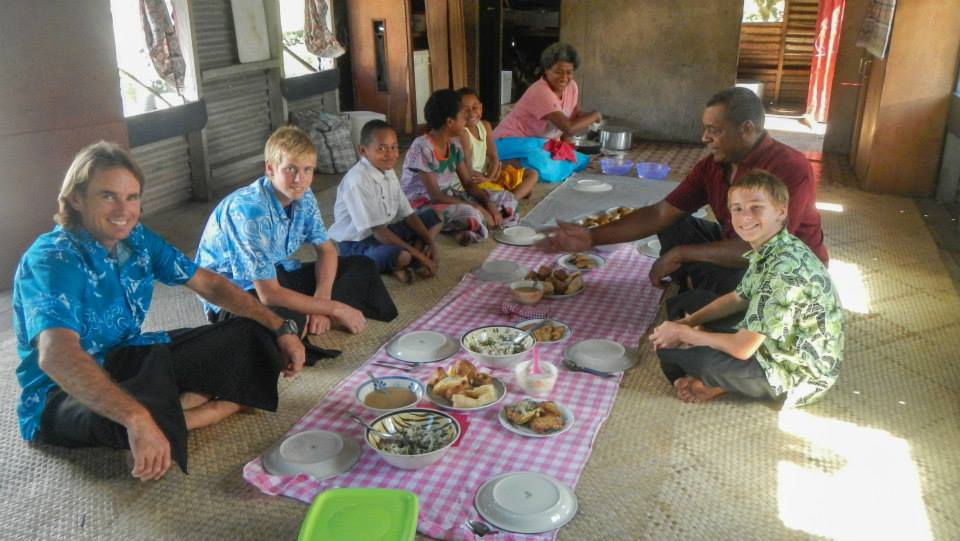
Simon and Senna didn’t come to the beach picnic, and we didn’t see them the night we went for the grog, so the next time we saw them was Sunday for church. We stopped by before church to give them some spice cake that we made, and they insisted that we join them for lunch after church. We had a nice, even if a bit awkward visit, and it was here that we learned of the the Fijian custom that guests eat before the hosts. They were waiting for us to eat and we were waiting or us all to start eating, and we didn’t know they were waiting for us. But once we talked about it out in the open, it was all quite relaxed. When it came up that we had come to the village for a grog, it seemed to us that there was some negativity around the fact that we didn’t come to see them. They said more than once that they didn’t know we were in the village, and that they would have liked us to stop by and say hi and drink some kava with them. We realized we had made a serious mistake and had possibly even insulted and embarrassed our host family that their guests were in the village without them. We never talked about this one out in the open, and still today I wonder how serious this mistake of ours was or if possibly I’m blowing it out of proportion in my own head.
Over our stay in Fulaga, we did have a few interesting conversations with Simon. He told us about how the village is organized in clans, along familial lines, and that each clan has a responsibility to the community. His clan is the chief’s clan, so they are the leaders responsible for order and organization, and there are other clans, for example, one is responsible for fishing, one for gardening (growing vegetables), and one for managing resources (like water). He didn’t say this outright, but it seems like you are pretty much stuck in the clan you’re in. For example, the man that Tim met at the kava party is in the clan to grow vegetables, but what he really likes to do is fish, so he tries to fish whenever he can get the chance.
Simon also told us about obligations to family. He explained that family members can take anything from you and you are obligated to give it without complaint. It seems like a nice thing, sharing with your family, but it seems it becomes an issue when some family members are motivated and successful, and others are not.
We also had a conversation with Simon about cruisers who came before us, and specifically, Tim asked if any cruisers ever did anything that was bad, that made the people of the village unhappy, and Simon’s response somewhat surprised me and made me reflect a little over our own behavior. He said, well, there was this one couple from Turkey, and they had their hosts out to their boat, and they served them cold coffee, and the hosts were really upset and complaining about that. I almost laughed out loud. That hardly seems like a horrible offense, I mean iced coffee on a hot day isn’t a strange thing to drink, perhaps they thought they were giving their host family a treat. It gave me a little bit of a glimpse into the fact that first of all, these people have a certain level of expectation of what they are to get in return for being the hosts, and second, that they may not all be as opened minded about accepting our foreign customs as we are to accepting theirs. I understand that we are the visitors in their country so we are the ones with the responsibility to respect their culture, but I have to admit that I was a bit disappointed that being served cold coffee was the first thing he thought of regarding bad things cruisers have done. The other thing he mentioned was a boat that came and did a sevusevu and then stayed in the lagoon for over a month without ever returning to the village. He said the host family was very disappointed and upset about that one. And this is where I started to reflect on our own behavior, since we had spent so much time away from the village. Had we disappointed our hosts too? Perhaps even insulted them? I truly hope not.
I mentioned before that they charge a $50 per boat anchoring fee in Fulaga, and we had a bit of a conversation with Simon about that. He said the reaction from the boats is a mixture: some people complain about it while some people give more, and most people just pay it without any sort of reaction. He told us that he’s been given some advice that they should raise the fee, that it’s worth a lot more and he could get a lot more. But he says he doesn’t want to raise it because it provides enough money for what they need. They don’t need more, so why charge more? He gave us a warning that we remembered much later when we were in the Yasawas. He told us that some people when they see us will not see us as visitors or friends but only as a source of money and free stuff. He doesn’t want to be that way, and he doesn’t want his village to be that way.
When it came time to leave Fulaga we went into the village to say our good-byes the afternoon prior to departure. Simon insisted on drinking kava together, but he needed just a few minutes to prepare so he suggested that perhaps we would like go down and look at some of the carvings that the village has for sale. Later we returned and had a few rounds of Kava with Simon and some other men, who as far as I could tell, were never introduced to us. We exchanged farewell gifts, and then Senna fed us dinner, although they did not sit down and eat with us. That was extremely awkward for us, but I couldn’t tell about how it was for them.
In the end, I have somewhat mixed feelings about the whole host family thing. At first I thought it was a good idea because it immediately makes the visitors feel welcome and they have someone right away to connect with and someone who they can ask questions. If you are only going to be somewhere a short time then this is a strong advantage. However, if you are going to be somewhere for somewhat longer, then having a host family means, well, to be frank, that you are stuck with your host family and it cuts off the development of natural friendships with people you might be more drawn to if given time.
Another thing is that we did learn that they used to have just a single point of contact with the yachties, but then people in the village complained because that one person was the only one who would get all the gifts and stuff, so then they implemented host families to spread it around. So, even though Simon spoke about not just seeing us as sources of free stuff, that mentality is there in Fulaga after all. Cruisers are generous and cruisers typically have things that villagers want, but I think as a cruising community we have taken it too far and we’ve created this attitude among them. On Exodus we started to take this very seriously and we no longer just lightly give things away, especially when someone we’ve just met or barely know asks us for something. Instead, we are trying to forge friendships if possible, or at least acquaintances, before giving gifts, and in general we prefer donations or gifts that benefit the community, like for schools for examples. Cruisers go around giving personal handouts to strangers and then wonder why they constantly get asked for things.
 Gresham Family Exodus