Originally posted on cruisingrunner
Our time so far in Fiji has been very special. We have had the opportunity to be in some wildly remote places where people still lead somewhat traditional lives, and the friendliness and hospitality of the Fijians never ceases to amaze me. It seems to me that their lives are at the proper pace, where neighbors are people, not blurs you barely notice as you rush around assuming your busy, self-important life. One Fijian tradition is that a visitor to any village offers “sevusevu,” and the ritual itself is quite simple. You offer to the village chief (or his spokesman if he’s not available) a bundle of Yaqona, which is dried pepper tree root. A short solemn ceremony in Fijian ensues, and after that it’s all smiles. You are now one of them. Part of their village. They welcome you into their community and into their homes, and if you’re lucky and your timing was right they will invite you immediately for a grog, that is the drinking of the kava, which is made from grinding up the yaqona. Each village we visited was different, but in each you still had that genuine sense of warmth and welcoming.
However, now we find ourselves in Bizarro Fiji where modest villages and friendly people have been replaced by mega resorts and parasailing. We are now in the islands west of the main island of Viti Levu, which is the dry, sunny side of Fiji. And where the sun always shines, you can bet that’s where the resorts will be. Our first stop was Musket Cove, a cruiser friendly resort that even has a small marina. For a small fee, cruisers can join their yacht club and then have full access to all resort amenities. Our first afternoon ashore while we were going about the business of joining the yacht club, I was observing all of the Fijian resort employees. They were all business and few smiles. The lady who runs the yacht club handed me some forms to fill out and then turned her back on me and went back to her business. I was reeling. I wanted everything to slow down, and I wanted to go back to Fiji. It was clear to me that this side of Fiji had been infected and I felt myself mourning that fact. But it was as if Tim read my thoughts, and he did the obvious thing, that is, he struck up a conversation with her. He gave her a big smile, asked how her day was going, and asked where she’s originally from in Fiji. It was as if everything came to a grinding halt and a switch was flipped, and she gave him a big smile back. Turns out she’s from Kadavu, one of the islands we’ve visited, so it gave us a little connection, and she was immensely friendlier to me after that moment. So, now I’m thinking that it’s not necessarily that the Fijians have been totally adopted our impersonal western ways, maybe it’s just that most of their western patrons are too busy to notice or care that there’s any other way. That there’s a Fijian way, and that it might be better.
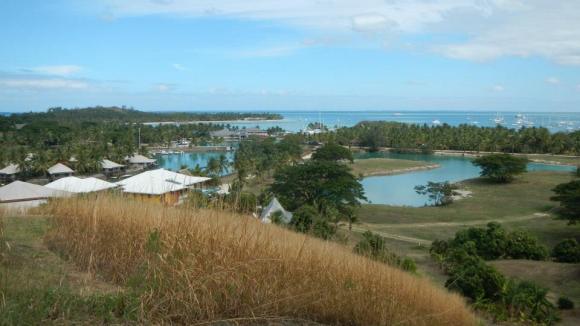
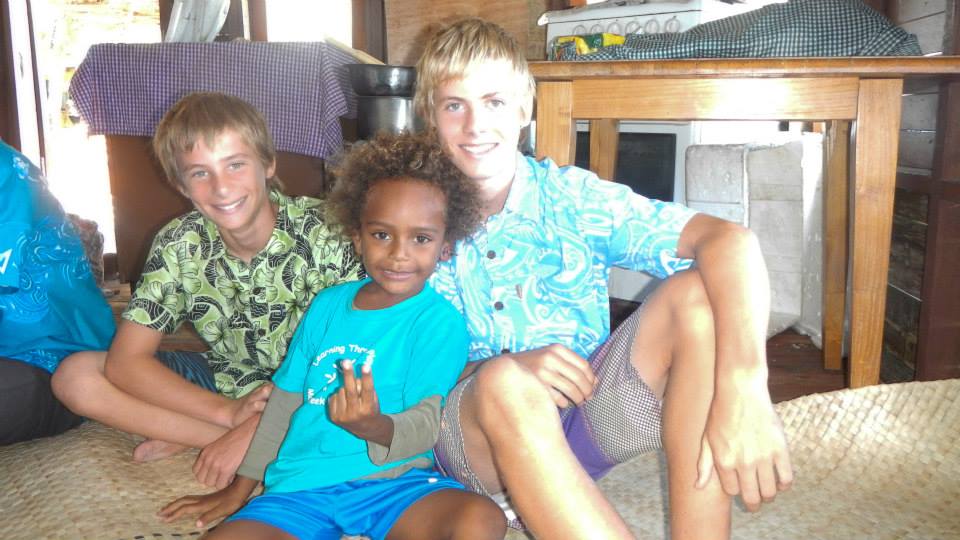
In our current anchorage, it’s gotten even more bizarre. We are anchored in the small lagoon of the small island of Mana, just north of Musket Cove. I had read that there are two backpacker’s hostels, a luxury resort, and a village here but today is the first day we went ashore. We had arrived on Saturday late afternoon so without doing a sevusevu, we basically stayed on the boat until this morning. Sundays are important days to Fijians, and we think that it’s somewhat disrespectful to show up in their village for the first time on a Sunday. Anyway, we figured that the village was the spot on the beach where all the fishing boats were, but Tim got out the binoculars and was surprised to notice that the two backpacker hostels are basically on the beach right at the village. Basically, part of the village. And there were people in bikinis — on the beach — right there at the village. Shocking. We usually wear our traditional Fijian outfits when we go ashore for sevusevu, but Tim was questioning the need to do that here. Clearly, it won’t be expected or even appreciated is what he was thinking. For some reason I clung to it, though. For some reason I felt that here, more than anywhere else, it was important to demonstrate that we appreciate and respect their traditions. I wore my full chumba and proudly walked down the beach in it amongst all the other scantily clad tourists. I’m pretty sure that no fewer than four different Fijian women said to me, “Nice chumba!” We asked a woman just off the beach who was selling handicrafts where we could find the Toraga ni Koro of the village, who is like the appointed village headman. In some villages you do the sevusevu with him if the chief is unavailable and, in some villages, he will take you to the chief and be your spokesman. Today, the woman we asked was with a little boy of about 4 years old and she said, “This is the Toraga ni Koro’s son, so he’ll take you to him.” So, the little boy took us further down the beach to his house where we were warmly greeted by his father, Dan. We said our polite hellos and he thanked us for stopping by and told us we were welcome anywhere on the island. That’s when I pulled out the yaqona and told him we would like to present sevusevu. He was slightly surprised but didn’t hesitate. There was a little tidying up to be done inside and then we were welcomed in for a seat on the woven mat. During the short ceremony his son played with the yaqona bundle like it was a big truck, and you could tell he’s been through these before because he clapped at just the right moment. Afterwards we had a short chat, and Dan explained that the chief was in another village and that he himself is quite young to be a village headman. He is one of the younger generation, but he appreciates that we came and respected their traditions. I wish I could remember all of his exact words because it was quite heartfelt, and I was happy to hear all of it.
I told him in response that we have continually been touched by the warmth of the Fijians and therefore we have grown to appreciate these traditions for ourselves too. But the truth is that because we were here in the middle of all this tourism, we WERE tempted to skip the sevusevu altogether, and then we WERE tempted to just go ashore in shorts and t-shirts. We had already been numbed by the resort scene and had forgotten about the value of making personal connections. Today was a very nice wake-up call.
I don’t know how long we will stay on the Bizarro side of Fiji, but while we are here, we are going to try to make a point of seeking out the villages among all the resorts.
 Gresham Family Exodus