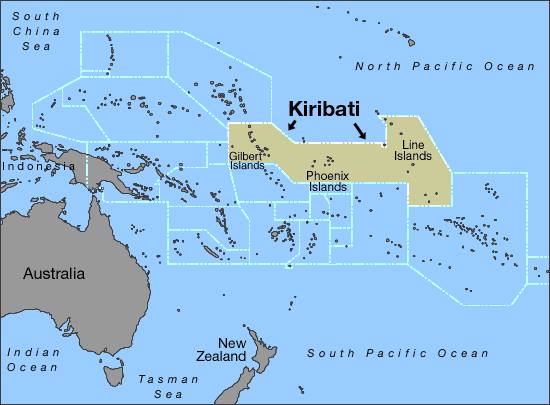
Kiribati is an island nation that covers a huge geographic area of the Pacific Ocean. There are three island groups, which are: The Line Islands (furthest east), The Phoenix Islands (in the middle), and the Gilbert Islands (furthest west). It was the Gilbert Island chain that we visited as it lies in between Tuvalu and The Marshall Islands.
The total population of Kiribati of over 105,000 with most of the people living in The Gilbert Islands, and most of those people living in the capital of Tarawa. Continuing on, most of those people live on the island of Betio which has a population density of 10,000 people per square km. (Spoiler alert: I thought this was dense until we got to Ebeye in The Marshalls). For reference, the city of Los Angeles has a populatoin density of just over 3,000 per square km. The map below shows the layout of The Gilbert Island chain and the location of Tarawa within it. It also highlights the other islands we visited: Abemama, Aranuka, and Marakei. (Spoiler alter: we would also visit the island of Onotoa on our eventual way south.)
Before I go any further I’d like to point out the correct pronunciation of “Kiribati” and “Betio.” The Gilbertese language does not have the letter “s.” Instead, the letter combination of “ti” makes the sound of the letter “s.” So, Kiribati is pronounced “Kiribass” and Betio is pronounced, “Besso.” Also, the letter “r” is pronounced more like it is in Spanish (or Scottish English), so Kiribati is prounouced with a little flick of the tongue on the letter “r.
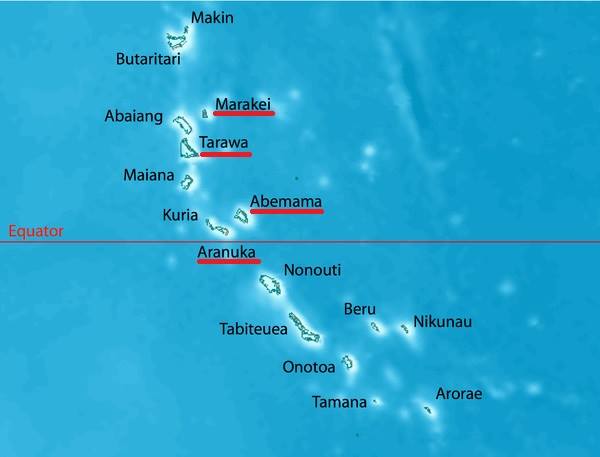
The Gilbert Island chain highlighting the islands that we visited
Everything we had read about Tarawa and Betio were negative. In fact, there’s a book out there called Sex Lives of Cannibals about a guy from the U.S. who went to live in Tarawa for awhile, and from everything I’ve heard, it’s a pretty negative account of the place (although also quite humorous). Even though everyone asks me if I’ve read the book, at this point I have not. I made a conscious decision not to read it before we went there because after reading some Amazon reviews, I decided I didn’t want to be tainted by someone else’s negative views of the place first. (Spoiler alert: I still haven’t read the book. Too many blog posts to make…)
There is only one pass at Tarawa, located on the west side. On our first entry, we were happy to arrive before the sun went down, but we had previous intel from our friends on Ariel IV that it is a reasonable pass to navigate at night. It is wide, well lit, and current is negligible. We did not follow the shipping line on the navionics chart to the Betio anchorage, rather we cut a more direct route to the west of the shipping line.
The main anchorage in Tarawa is off the densely populated island of Betio in the southwest corner of the atoll. This is where the main commercial wharf is located and also where the customs office is located. Unfortunately, the anchorage is totally exposed to the north and northwest, so it would get rather lively at times. There are other places to anchor within the lagoon, but we were never in Tarawa long enough to bother moving from Betio.
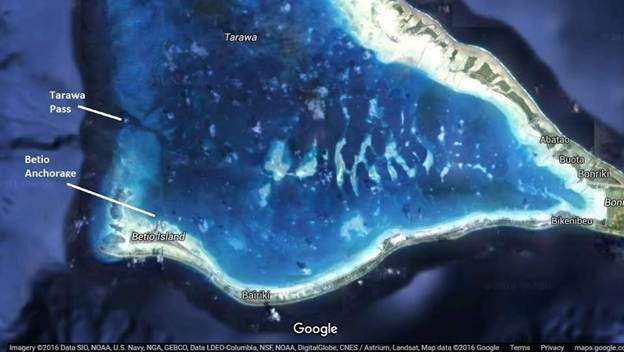
Satellite image of the southern end of Tarawa
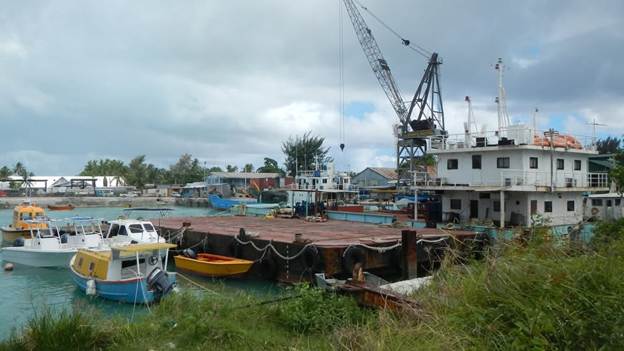
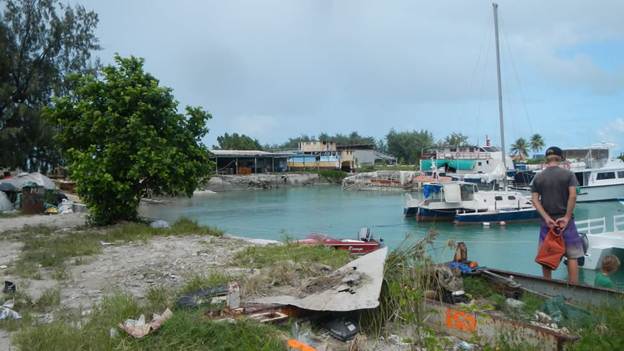
Overall, I am sad to say that Tarawa, and specifically Betio, was the most depressing place we have visited in the Pacific. It’s smelly, dirty, and way too crowded. The infrastructure is completely run down and the roads are mostly dirt which means they alternate between being a dry dusty mess and being a sticky muddy mess. Our first time there, there wasn’t a fresh vegetable to be found, only some moldy onions and cabbage. And it was the very first place we’ve been in the South Pacific where I have felt a little uncomfortable walking around at night. Nothing specific happened, so perhaps it was in my head. Or perhaps it’s just because of how crowded it was. One of the first things Dr. Eric (Ariel IV) told us when we got there was don’t even think about swimming in the harbor, and certainly don’t think about running your watermaker. Luckily, it rained enough while we were there that we could catch enough to fill our water tank plus do about 50 loads of laundry. And last but not least, it seems that the beaches are considered to be the public toilets. This approach may work when you are in a village with a few hundred people but think about what this means where there are 50,000 people on a small island. Pretty gross.
All that being said, I did find things to enjoy about Tarawa, and I am probably the least negative on of the place of all the cruisers we went through there with. Even though the streets were either dusty or muddy, I enjoyed walking around, checking out every little shop and interacting with people. There’s also the egg farm that was a huge highlight for me, but I’ll get to that a little bit later. I find you can make the most of any place you are, and dwelling on the negative can have somewhat of a snowball effect. Obviously, I found a lot of negative things about this place, but I didn’t dwell on them, and I think that’s why I didn’t hate this place as much as everyone else.
 Gresham Family Exodus