This wasn’t a long passage, but it was a particularly trying one. It was the kind of passage that makes you question what the hell you are doing out here anyway! The map below shows our inReach track that covered just over 400 nmi. You’ll notice that upon departing from Marakei we immediately started heading in the wrong direction. That’s the thing when you are dependent on the wind, sometimes you have to go in the wrong direction in order to later go in the right direction. Let me explain. Marakei is at about 2 deg N latitude, which puts it within the light, variable, squally weather of the equatorial region. We knew that once we got just a little further north that the Tradewinds would kick in, and since in the northern hemisphere they blow from the NE and we wanted to go NNW, and since Exodus is a big fat pig who doesn’t like sailing to weather, we knew we needed to get in a little easting early on while we could. (Yes, “easting” is a real word if you’re a cruiser.) So, we took advantage of the light wind in the vicinity north of Marakei and motored ENE for almost a day before making a hard left and heading in the direction of Majuro. We knew it was a good strategy, and we knew it had worked for True Blue V and others only recently, but it is still hard to be out at sea watching the VMG on your instrument display read near zero or even negative for hours on end. (VMG = Velocity Made Good = the portion of your velocity vector in the direction of your destination.) I was asleep when Tim made the left turn and by the time I was up for my watch we were bashing and bouncing into those NE trades, which would quickly, yet ever so uncomfortably, get us to Majuro.
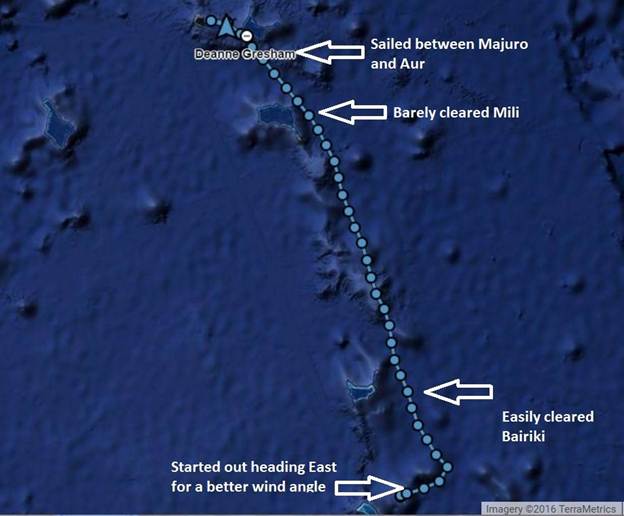
Exodus track from Marakai (Kiribati) to Majuro (Marshall Islands)
By 6am the next morning we had 20+ knots on the nose and we pointed as high into the wind as we could with the goal of clearing the west side of Butaritari and then Mili (shown on the map above). It was a horrible, bouncy, upwind ride the whole way. There aren’t a lot of notes in the logbook for this passage, which is a clear sign that I wasn’t feeling well most of the time. When we were finishing day 2 of the passage things calmed down enough so that I could sit at the computer and write, and this is from an email I sent out:
“I think the time since we left Aranuka until now has been one of my lowest points while cruising. There’s just no way to describe the way the discomfort of a severely rocking boat gets deep in your psyche and makes you want to scream or throw someone overboard, or both.”
The passage wasn’t all bad, though. We were on our way to Majuro, a place where there would be American style supermarkets with American products, so we started eating all the of the little things I had been rationing since we left Fiji: oreos, ritz crackers, pringles, canned fruit, olives, juice, etc. The boys went through lockers and bilges looking for treats I may have forgotten about (or was hiding) but sadly, the chocolate we were all hoping for was long gone.
Our entire sailing focus was trying to point high enough to be able to clear the island of Mili to the east. If we missed it and had to go around the west side that meant a lot more direct headwind (i.e., motoring) later on, which we really didn’t want to do, as much to preserve our sanity as our diesel supply. So, once we cleared Mili it lifted a mental pressure and made the boat a little bit more comfortable as we were able to fall off the wind just a tad.
Overall, this passage could have been a lot worse. The most sustained wind we had was is the low 20s and a lot of the time it was in the high teens. Most of our fleet of friend boats who had trickled into Majuro over the previous couple of weeks had experienced much higher wind speeds and bigger seas. But that’s little consolation, really.
On the last morning when I was checking into the SSB radio nets I really thought there was no chance we would make it into Majuro by the end of the day, but stronger afternoon winds kicked up and helped us speed along. By mid morning we passed by the eastern side of the atoll, which is where the actual city of Majuro is located and where all of our friends were moored. We had VHF traffic with True Blue V and it was so nice to be welcomed by them yet again. Craig was organizing a mooring for us, but we still weren’t convinced we would get there by dark because we had to go all the way to the pass and then, once inside the lagoon, all the way back down to the city of Majuro. But we took a shortcut mini-pass into the lagoon and then flew across the flat lagoon water in order to be tying up to our mooring ball as the last hints of dusk were leaving the sky.
Passage summary:
- Duration: 3 days, 7 hrs, 31 minutes
- Route miles: 359 nmi (this is the distance of the passage route we planned in the chartplotter.)
- Track miles: 398 nmi (this is the actual distance over the ground that we traveled.)
- Log miles: 461 nmi (this is the distance derived from the log paddle wheel, so it is influenced by the current. The fact that this is so much greater than our track miles implies we had a prevailing head current.)
- Average SOG: 5 kt (Speed over ground)
- Average VMG: 4.5 kt (Velocity made good)
- Engine summary: Port only 0:47, Starboard only 8:49, Both 3:30
 Gresham Family Exodus