When Lahnee found out that Tim and I are aerospace engineers (aka “rocket scientists”), she was floored and amused herself by calling us that over the radio. Soon, she added “pioneering” to the nickname, and here’s pretty much why:
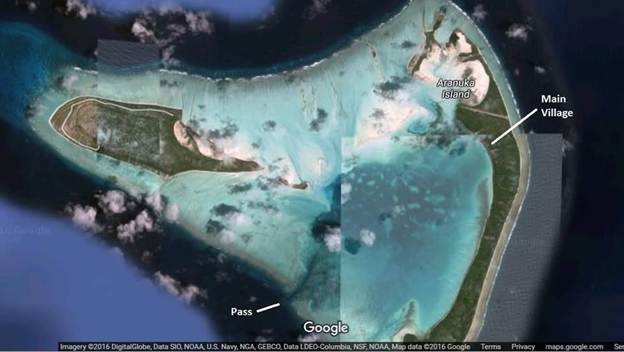
A first for us…we went to Anranuka and entered the lagoon without ANY prior cruiser intel… no tracks, no waypoints, no depth/current information… nothing. We didn’t even have nautical charts… the island of Aranuka, must not have been important during WWII because unlike Tarawa and Abemama it’s completely uncharted. All we had was a somewhat cloudy satellite image and the fact the someone once heard from someone in Majuro that you could get a boat in there. From the Soggy Paws Compendium about Aranuka: “We didn’t stop here, but I was told in Majuro that you could get inside the Arunka Lagoon. Google Earth seems to support this. If you try this, you’ll be a pioneer!”
When we arrived in the afternoon, it was about low slack water, and before going through with Exodus, we dropped the dinghy and Tim and Alex scouted the pass to check for depth and current. All of the depth readings they took were deep enough for Exodus, but it was still very shallow, and the pass is full of little bombies, so it’s difficult to know if they sounded the shallowest parts. In the end we made the difficult decision to anchor for the night on the outside of the lagoon and enter in the morning at high slack water in order to give us a few more feet of depth.
We entered the pass the next morning about 10 minutes before the listed high tide (+4.5 ft), and coming in the pass, and all the way across the lagoon for that matter, we navigated by eyeball. Tim was at the helm, I was on the top deck, and Alex and Brenden were each on one of the bows and everyone’s job was to look for shallow coral heads. This was harder than you might think because 1) there was about 15 kts of wind on the nose and the small wind chop made it hard to see into the water, and 2) we were basically going over a sea of coral heads at 10-15 ft deep and we were trying to spot any tiny pinnacles that might stick up shallower than our draft, which is 4 feet. Tim says it was a piece of cake, but I found it quite stressful… no surprise given our personalities. The shallowest depth we measured was 8.5 feet and that was at the very inside of the pass.
 Gresham Family Exodus