Kwajalein is one of the largest atolls in the world, and as part of the Compact of Association that was established in 1986 between the U.S. and RMI, the U.S. Military has permission to use the lagoon and several islands of the atoll as a missile test range facility. Eleven of the 97 islands are leased by the U.S. I can’t find a corroborating source for this now, but when we were there, we were told that local residents of those islands were pretty much forcibly relocated to the island of Ebeye without any say in the matter.
The main island used by U.S. personnel is the island of Kwajalein, which of course shares its name with the atoll itself. Something like 1800 people live and work there, including civilians and military personnel. Cruisers can’t just sail up to the U.S. installations without permission, and you have to have a sponsor on the base in order to be able to visit. This is not the case for the rest of the atoll, like Ebeye for example. The rules for visiting Kwajalein atoll are just the same as visiting any other atoll as long as you avoid the U.S. leased islands.
Checking in was pretty straightforward. Upon approach to the Bigej Pass we hailed “Kwajalein Harbor Control” on VHF channel 12 (they monitor channel 16 and channel 12). We requested permission to enter the atoll (not really needed since the U.S. is not the entry/exit authority for the atoll) and we also requested permission to enter the harbor at Kwajalein (this is definitely needed, since the U.S. is indeed the authority for the base on the island of Kwajalein). The radio operator notified base security of our ETA and gave us instructions on where to tie up in the harbor. You can see the relative locations of Bigej pass and Kwajalein on the satellite image below. (As we passed the island of Ebeye on our way down we noticed a boat called “Cloud 9” at anchor there. Stay tuned for more on that…)
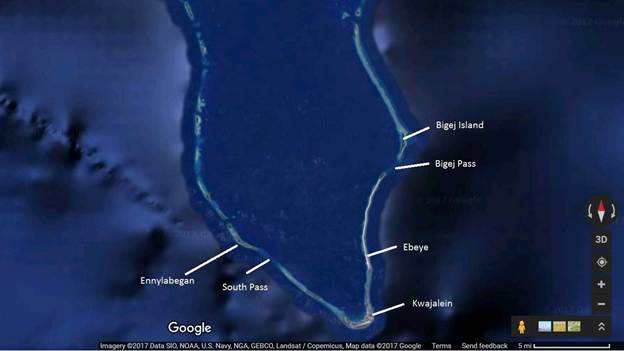
Southern End of Kwajalein
As instructed, we tied up at one of the docks at the small boat marina inside the harbor, and we were greeted by a guy from base security and our sponsors, Todd and Megan Ropella. Once we were securely tied up and ready to go, the security officer escorted us to officially check in. The only thing we needed for this was our passports, and they gave us guest ID cards to carry around with us on the base. We did not need to be escorted all the time, and we were never once asked for these IDs while we were there (although we did carry them with us.) After we checked in, they brought a security boarding party, including a dog, onto Exodus, presumably looking for things like contraband or drugs. Luckily, we passed the inspection and they let us stay.
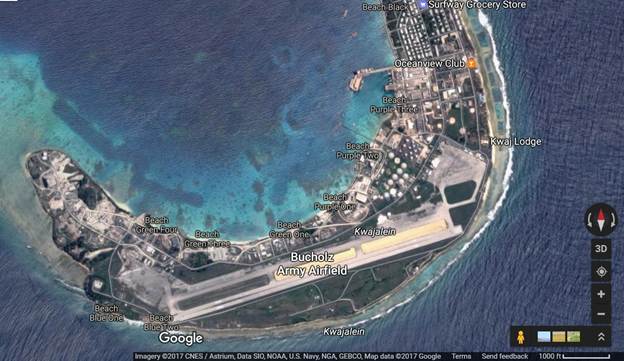
Island of Kwajalein
 Gresham Family Exodus