Majuro is the name of the atoll but it’s also the name of the main city located on the far eastern side of the atoll. There is a large pass, suitable for large shipping and fishing vessels, on the northern side of the atoll, but once you are inside the lagoon it’s still a 10-mile haul to the mooring fields which are located at the city of Majuro. You can see our arrival track on the image below.
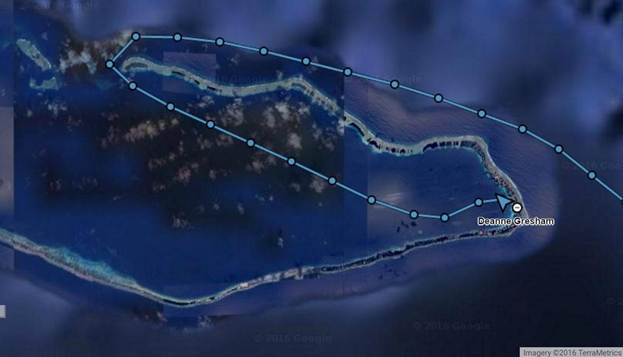
The Atoll of Majuro (Exodus arrival track shown)
As mentioned above, we were racing the clock, or more accurately the sun, so as we approached the pass we decided not to enter through the main shipping channel, but instead we picked a shortcut that looked deep enough based on satellite imagery. We were cautious and had the boys posted as lookouts on the bows, and although the Navionics charts weren’t quite accurate, visibility was good and we had plenty of depth the whole way in. We were feeling really good about once again using our exceptional pioneering skills to our advantage, only later to notice that the short-cut, mini-pass we had used was already extensively documented in one of our cruiser guides (Soggy Paws Compendium) as a totally viable pass. Oh well.
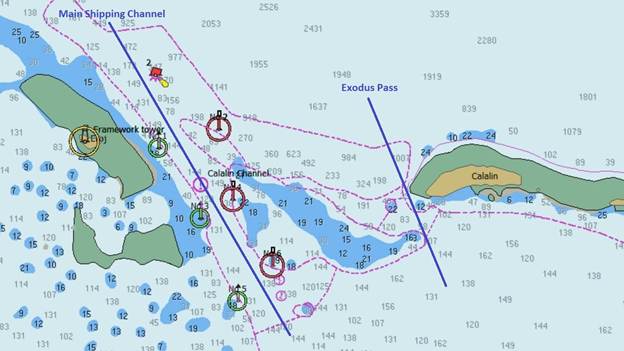
Majuro Passes
Once inside the lagoon the sail to the anchorage was almost pleasant, since the water was relatively flat and we were able to zip along. We couldn’t quite point at the mooring field, so we just pointed as high as we could until we almost reached the other side of the atoll and then we engined up for the last little bit. There was *no way* we were going to tack back in order to make it the whole way under sail because 1) as I mentioned, it was almost dark, 2) we were so ready to be there it wasn’t even funny, and 3) There were literally hundreds of fishing boats in the lagoon creating a slalom course out of any straight line you might want to take. Seriously, we had never seen so many fishing boats in one place. The word on the street was that there was some sort of conflict going on with regards to fishing rights and the fleet was “grounded” for awhile.
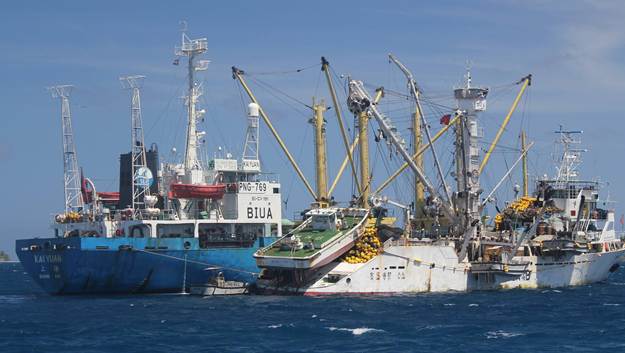
Fishing Boats in Majuro
We were so thankful to our friends on True Blue V who found a suitable mooring for us that day, and as we were pulling up they met us in their dinghy and gave us a quick lay of the land. This arrival in Majuro is a borderline candidate to qualify for “Arrival Euphoria” and it was oh so appropriate that it also included being reunited once again with True Blue V.
(If you’re interested, here’s a link to a cruisingrunner blog post where I describe the phenomenon of “Arrival Euphoria”: https://cruisingrunner.wordpress.com/2015/10/15/arrival-euphoria/)
There are two mooring fields in Majuro: 1) the north mooring field is owned and operated by RRE (a large company that owns a lot in and around Majuro, including the big hotel near the mooring field and the Tide Table restaurant.) 2) the south mooring field is owned and operated by Matt Holly. In our case, we were one of the last boats arriving for the season, and when Craig (True Blue V) checked for a mooring for us he found out that RRE was full and the ones that Matt Holly had left were not suitable for our size boat. So, they asked around and were able to arrange for us to use a private mooring owned by Chuck on S/V Deviant. It was separated from the rest of the mooring field a little bit further south, and it was more expensive, but it worked out OK for us. We kind of liked being out of the high traffic area, but on the downside it was a longer dinghy ride to the dinghy dock.
Majuro itself was very American, in fact it reminded me a lot of Mexico. The funny thing is that when we were in Mexico everything seemed pretty foreign since at that time we were so fresh and home was still so much in the forefront of our memories. At this point after being so many different places whose western influence did not come from the US, arriving in Majuro seemed so familiar, so much like home. But in reality, it was just the same as Mexico, it’s just that my perspective had totally changed changed. And it’s all the little details that made it feel American… USD as the currency, 110V electrical power, 8×10 paper (not that crazy A4 size), driving on the right side, pizza, good beer, coin operated laundromats, butter sold in 1/2 cup sticks, all of the American products in the supermarkets, the fact that there even were supermarkets.
The best internet among the Pacific islands is in Fiji by a long shot, but it turns out that Majuro is a surprising distant second. However, it’s only a wifi service rather than 3G digital data. So, when we were in range of a wifi hotspot we had a blazing fast connection, but we weren’t able to reach the hotspot from the boat. This means we tended to spend our afternoons in the Tide Table bar/restaurant getting our daily internet fix, while of course throwing down the cheeseburgers and beer. And as a bonus, it was air conditioned!
Provisioning in Majuro was good and bad, and here’s what I mean by that:
The good:
- Several large, air-conditioned, western style supermarkets. The first time I waked into the K&K Store I almost wept.
- Familiar American products
- Good beer, like Sierra Nevada and Stone Brewing (although very expensive)
The bad:
- Very little locally grown produce, only sad looking imported stuff
- I bought one bottle of California wine (Kendall Jackson Chardonnay) and it had gone bad and tasted like vinegar
- Lots of bugs in the dry products, especially cereal. The grocery store would refund or exchange if I brought it back, but after a few times, I just stopped buying cereal.
- No automatic doors at the supermarket. This isn’t really that much of negative, but it is kind of funny that the first time we were in K&K I must have felt very much at home after doing my shopping, because I stood by the doors waiting for them to automatically open!
Overall, provisioning in Fiji, especially Suva, was much, much better, but Majuro was a sight for sore eyes after months in Tuvalu and Kiribati.
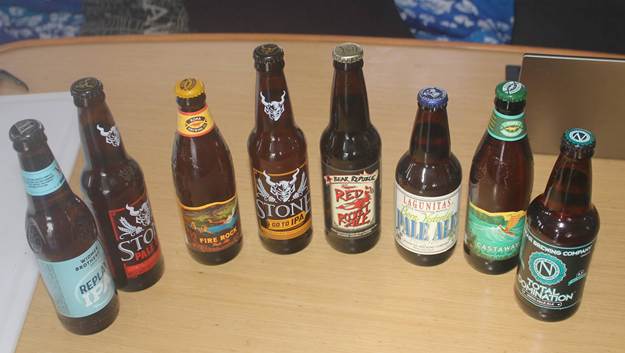
We hadn’t seen a beer selection this good since leaving California!
The majority of our time in Majuro was dedicated to boat chores and getting Exodus listed on the market for sale. Although we were busy, I had originally had big plans to do some touristy stuff while we were somewhat settled in one place for a little while. Yeah, this never really happened. The best I can say is that one day we took the day off from school to visit the Alele museum, and it was well worth the visit, but probably not worth credit for a *whole* day of school. It’s very small, with just a couple rooms, but that meant we could look at every exhibit in much depth. Two featured bits of interesting information is the construction of the traditional sailing canoes and the aspects of traditional Marshallese navigation.
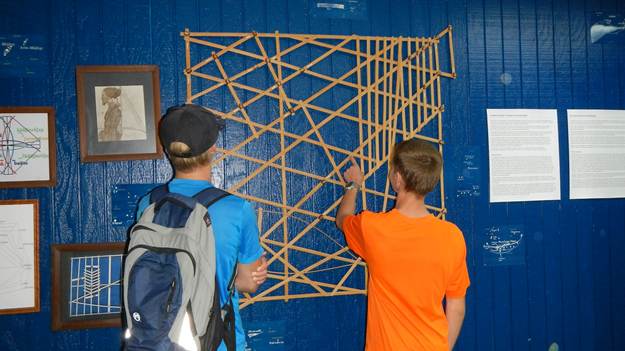
Discussing a stick navigation exhibit at the Alele Museum (Why yes, I *did* make them pose for this photo)
We ended up spending an entire month in Majuro, which was *way* too long. I wasn’t really crazy about the place, but I suppose there are worse places to be stuck for a month (like Tarawa!)
During our time there, our “northbound” fleet of boats, the group we traveled with from Tuvalu to Marshalls slowly scattered as Ariel IV headed to Micronesia and many others went off to various outer islands within The Marshalls. This represented another end of an era for us, and we forged ahead as we always do.
The hardest part was saying good-bye to True Blue V yet again, but we’ve said good-bye to them so many times by now and we always seem to end up back together, so I tried to take this in stride as well. (Spoiler alert: Of course we will see them again in Fiji in a couple months!)
 Gresham Family Exodus