Although The Marshalls is generally considered an alternative for cyclone season, it’s not like cyclones don’t go there. Yes, it’s rare, certainly more rare than somewhere like Fiji, but they still happen. In fact, the analysis presented at this website (http://thegiddyupplan.blogspot.com/2014/10/typhoons-el-nino-and-republic-of.html) concluded that it’s more risky to go to The Marshalls than to French Polynesia or The Cook Islands and only slightly less risky than Samoa. So, what the hell were we doing?
Well, the fallacy in the conclusion from the website is that it doesn’t consider the fact that you don’t have to go straight to RMI from Fiji (or wherever) in October or November as you bail in advance of cyclone season in the southern hemisphere. (I submitted a comment on their website pointing this out, but they didn’t post it. Go figure.)
You see, the worst months for cyclones (they call them typhoons up there) in RMI are Nov-Jan. So, if you went straight there in October or November, then yes, your risk of encountering a cyclone might be on par with Samoa. However, what most people do is leisurely cruise Tuvalu and Kiribati and then arrive in Majuro at the right time for them based on their own risk tolerance. For us that meant late January/Early February. We were a little more conservative than some, but the data also showed that the risk of a cyclone in RMI during an El Nino event was MUCH higher, and since we were smack dab in the middle of an El Nino event, we played it safe. And it should be noted that our departure from Kiribati was actually delayed by a cyclone that formed near the equator (cyclone Pali) and was at one point forecast to go right over Majuro (though, in the end it didn’t).
So, as long as we timed our departure from Fiji and our arrival in Majuro appropriately, we would have a much lower risk than staying anywhere in the South Pacific (especially since in an El Nino year the Eastern region, such as French Polynesia, has higher cyclone risk than normal.)
OK, with that resolved, what about the dreaded westerlies I kept hearing about? For some reason it took me a little while to figure out that the “westerlies” were just long-range effects of cyclones. Both Tuvalu and RMI, and to a lesser extent Kiribati, are subject to strong westerlies when there is a cyclone present to the south or north, respectively. In the southern hemisphere cyclones spin clockwise, so the wind direction north of the eye comes from the west. In fact, we experienced a bit of this phenomenon when we were in Tuvalu as a result of one of the first low pressures of the season. We were in Nanumea and had great protection, but some of our friends in Funafuti had a rougher ride. Likewise, in the northern hemisphere cyclones spin counterclockwise, so the wind direction south of the eye comes from the west.
RMI had a pretty rough season with regards to westerlies, and we could see the evidence of it when we arrived. There were boats washed up on shore as well as trash piled up. People who had been there during the entire season told stories of 50 knot winds, which means getting pummeled by miles of fetch from across the lagoon, and The Shoreline dinghy dock had been destroyed. It wasn’t much fun at all. But based on the timing of our arrival to RMI, we didn’t have to worry about any of this. We pretty much had 18-25 knot tradewinds from the ENE the *entire* time we were there. Seriously, passage planning all of a sudden became easy again as there were no fronts or troughs to watch out for and no periods of light wind. But while passage *planning* was easy, the actual *passage* to Ailuk wasn’t exactly a walk in the park, because once again we found ourselves bashing to weather.
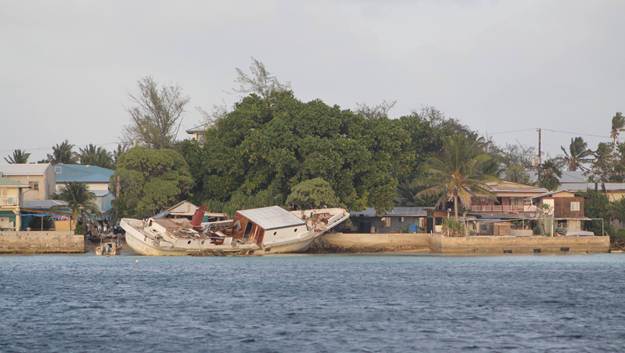
Evidence of previous strong Westerlies in Majuro
 Gresham Family Exodus