Categories
Uncategorized

Fun in Makemo

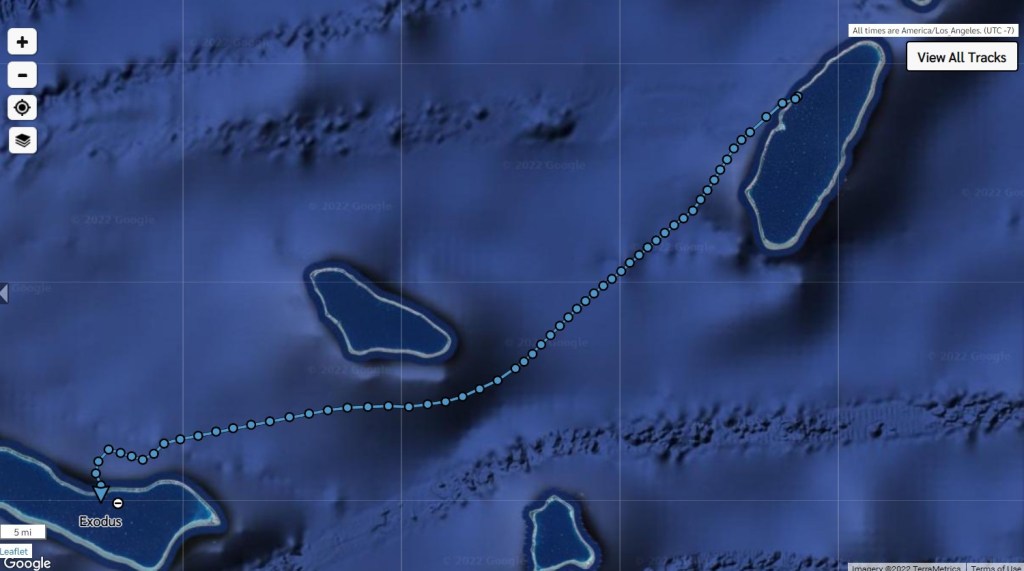
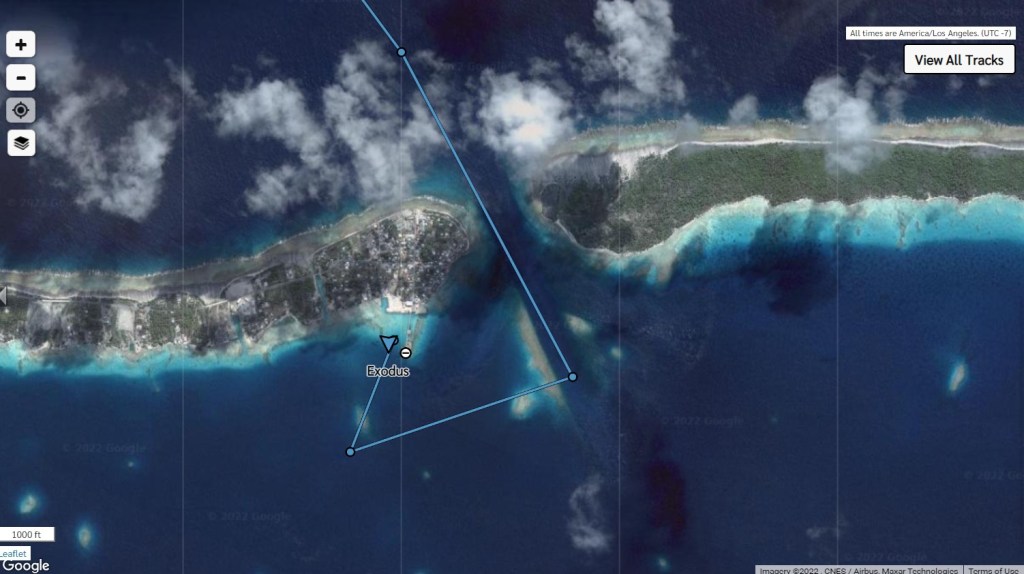
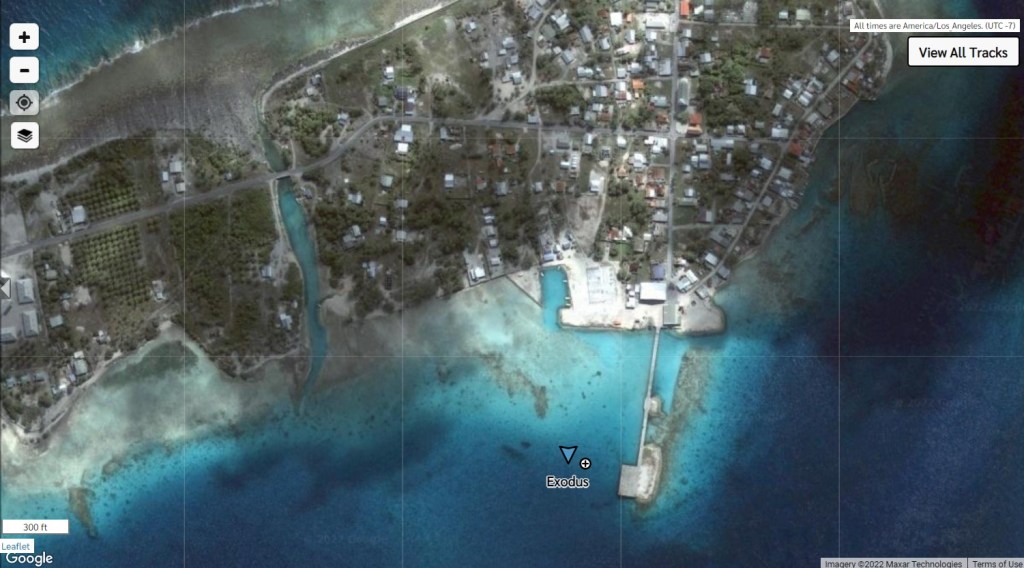
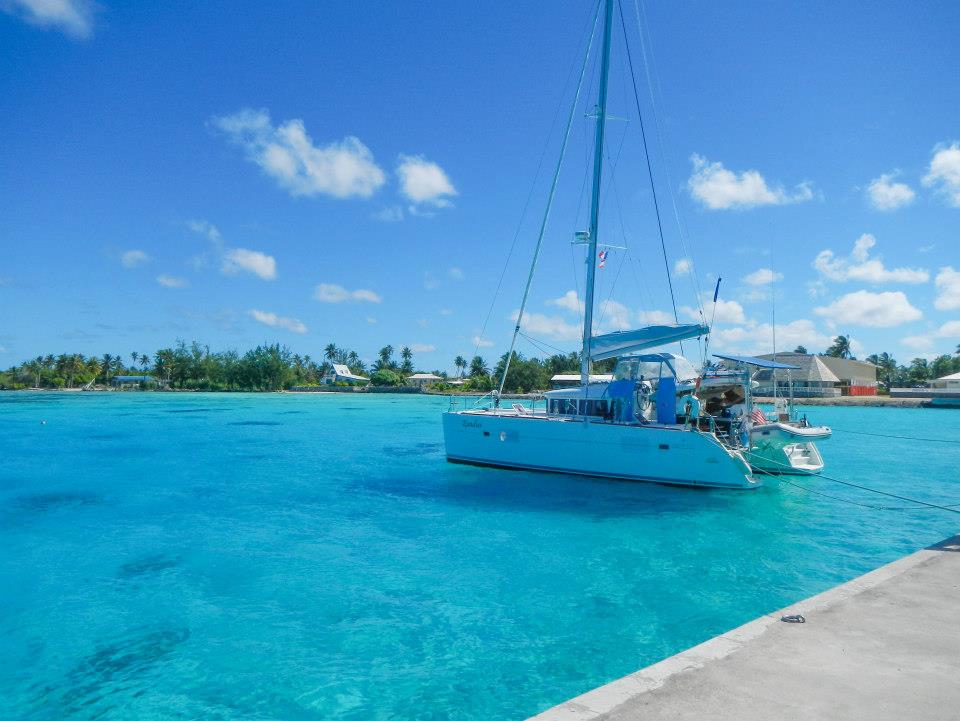
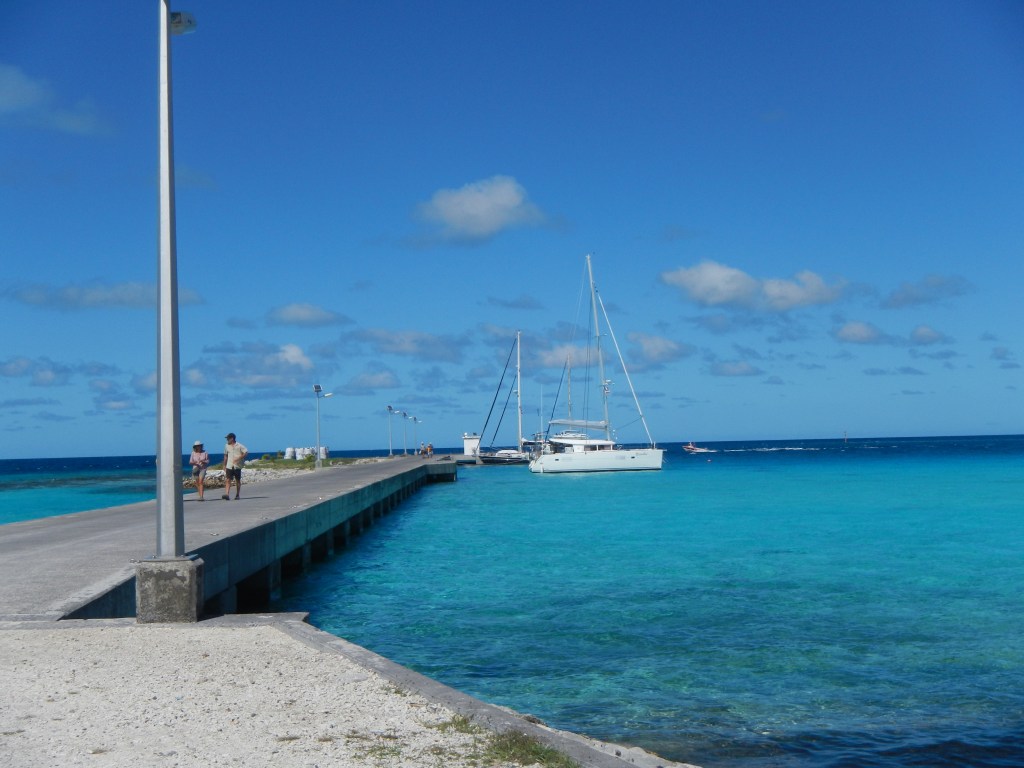
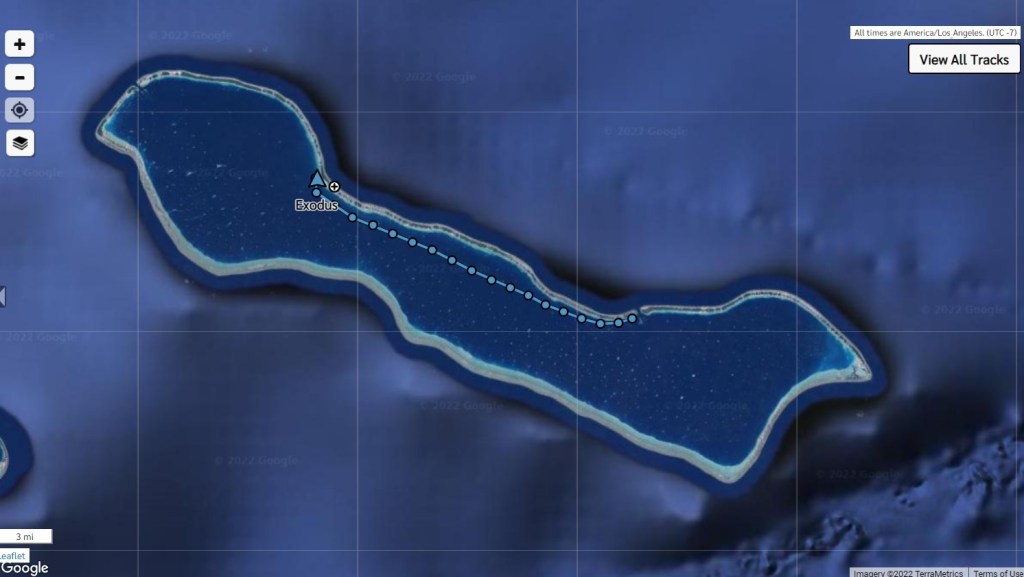
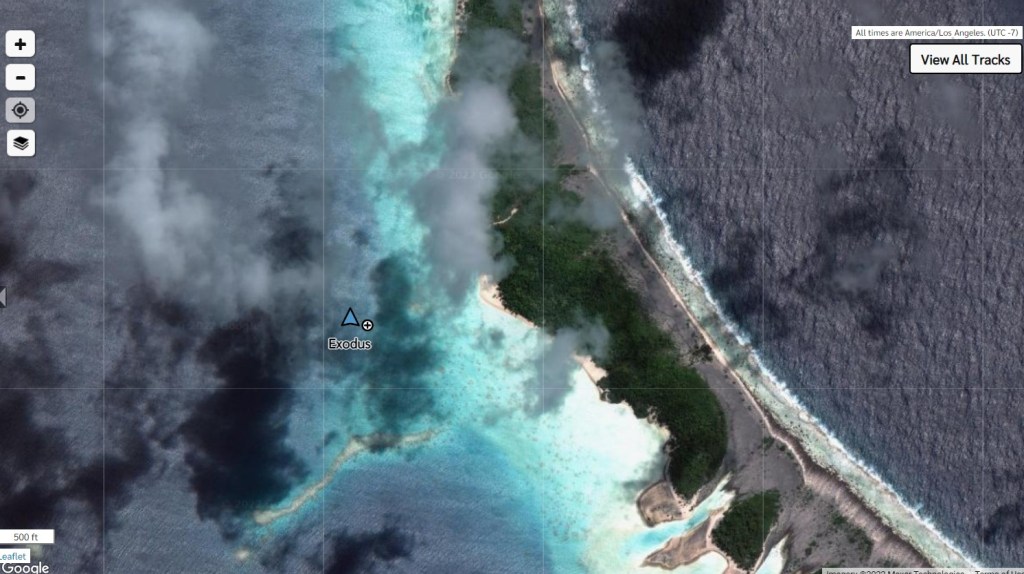
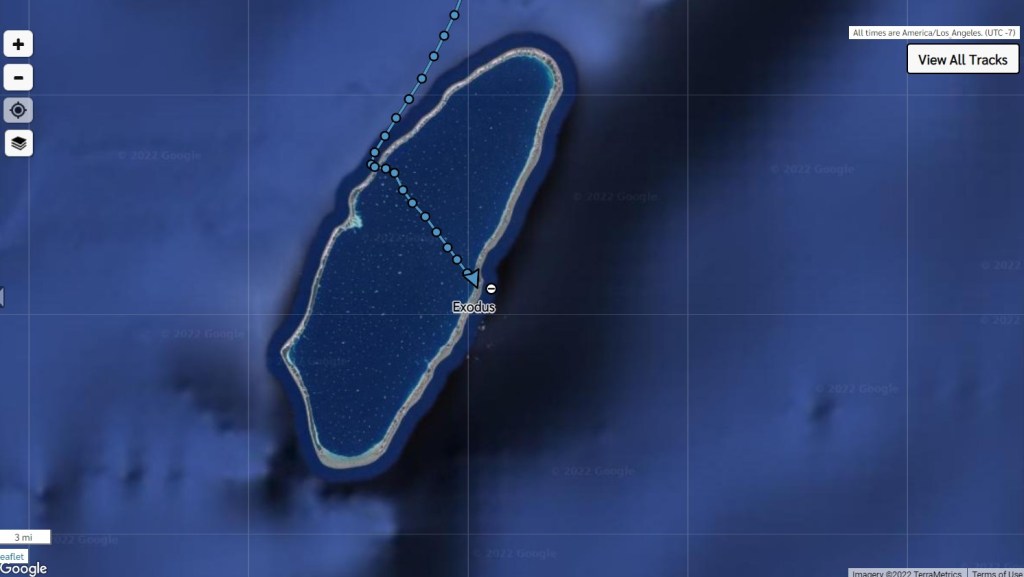
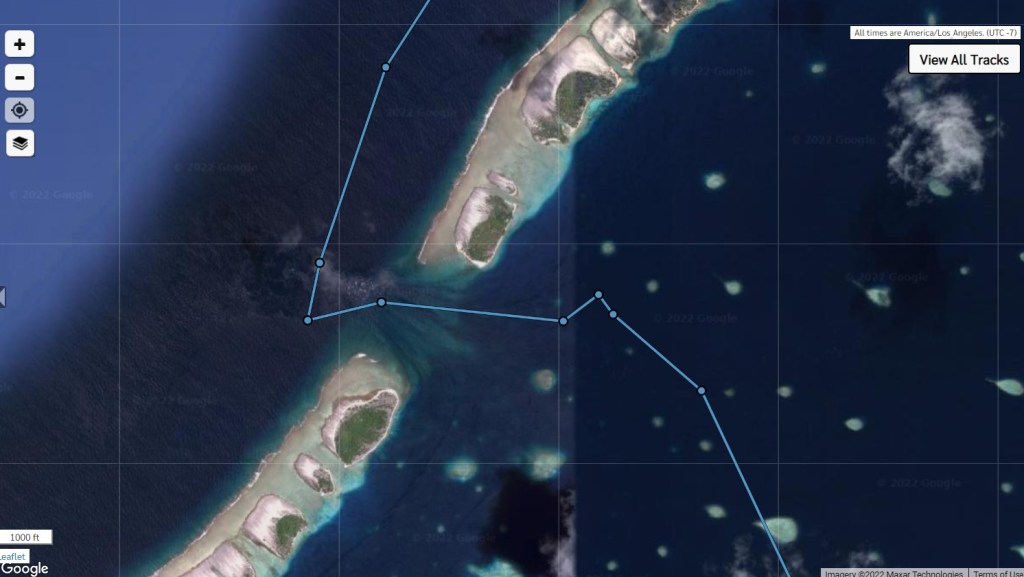
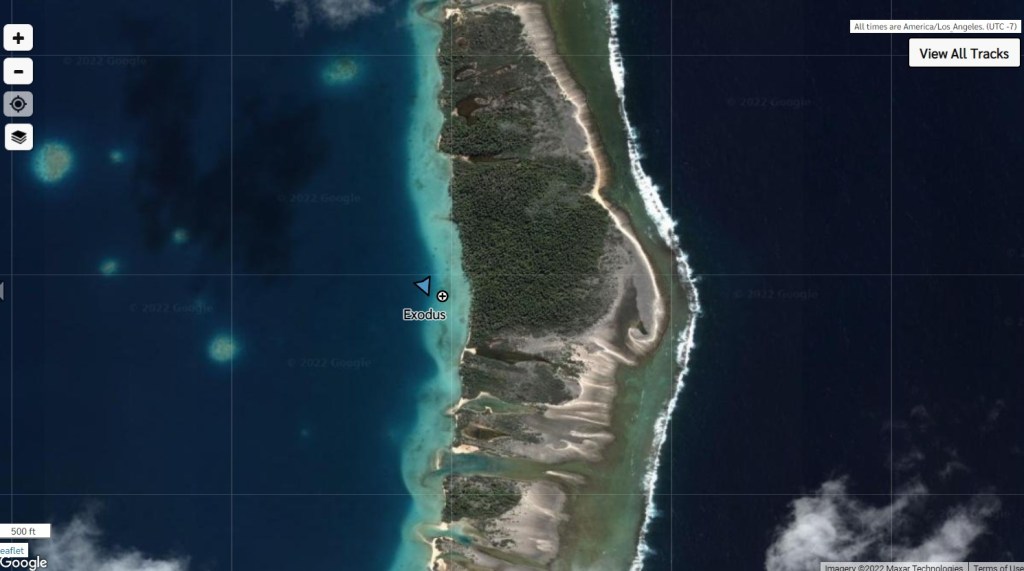
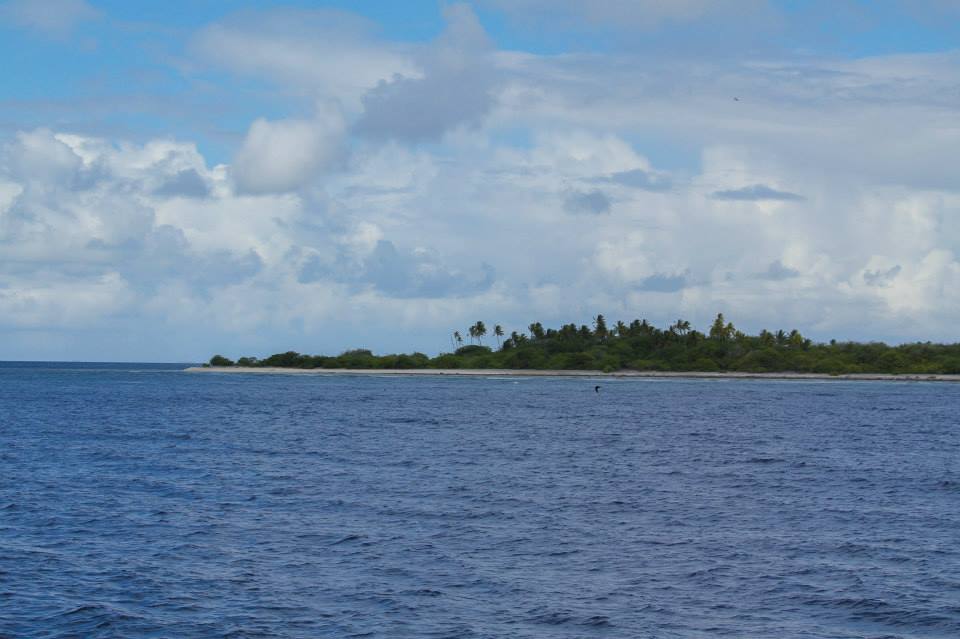
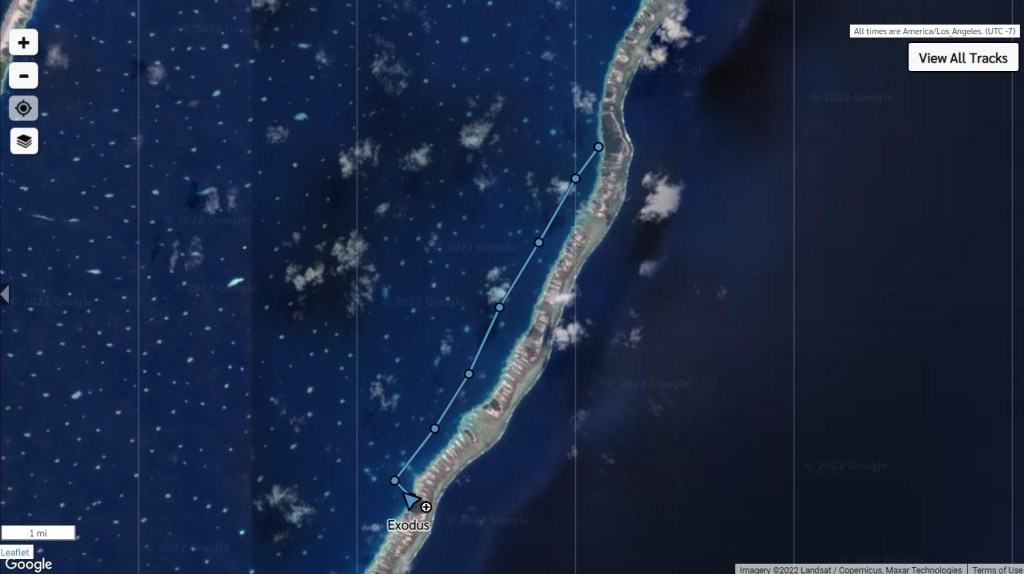
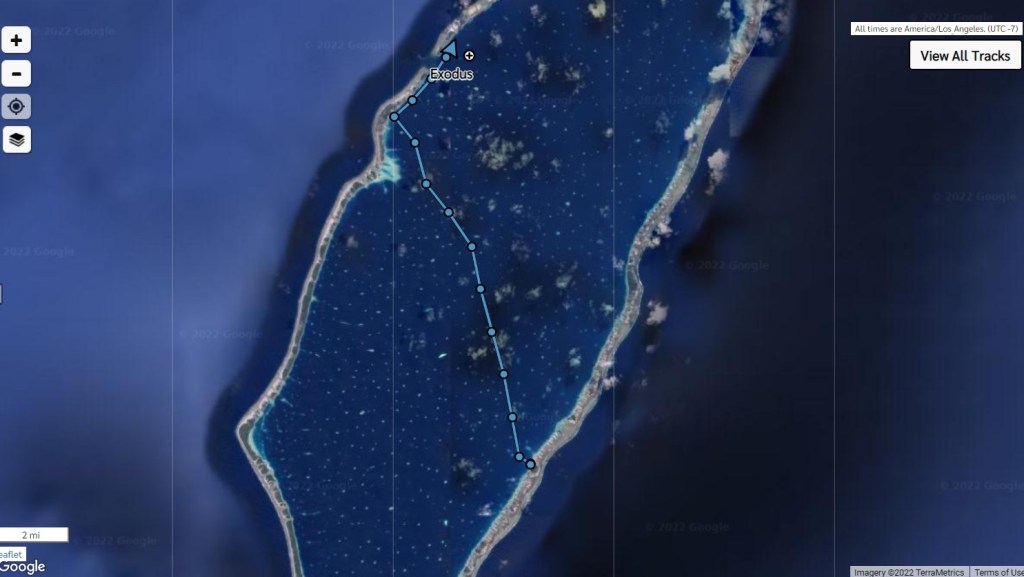
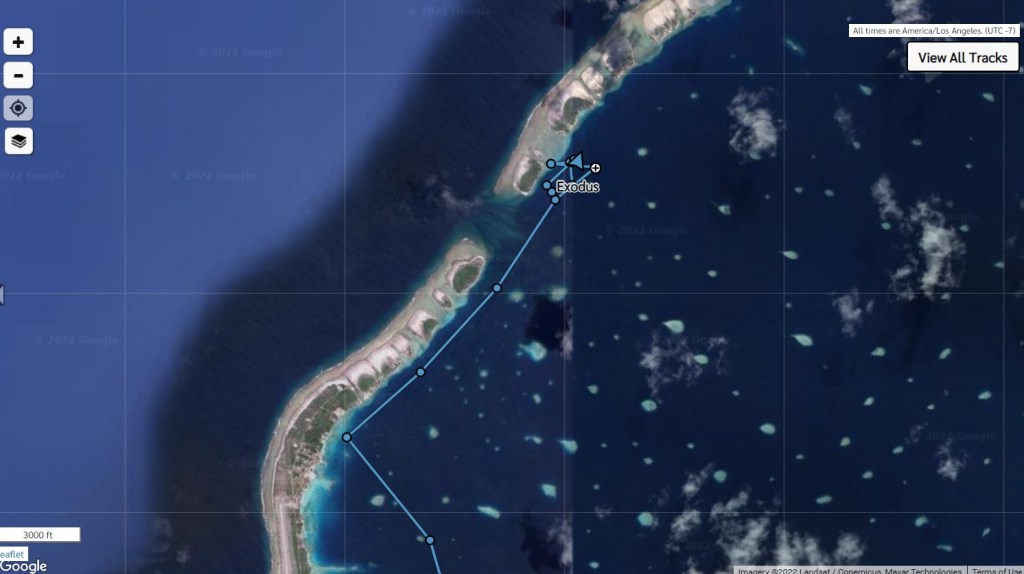
Makemo is southwest of Raroia, and it was an easy overnight passage to get there.  It is an elongated atoll, it is oriented WNW to ESE, and it is shaped somewhat like a dumbbell (narrower in the middle than on the ends.)  Somewhat larger, it is about 40 miles long and 10 miles across.  There are two passes, and we entered the lagoon through the more southern one, which is actually on the north side of the lagoon, just about 1/4 way up from the southern tip.  The pass is called Passe Arikitamiro, and the village of Pouheva is just on the motu on the western side of the pass.  Entering the pass was pretty straightforward as we rode the incoming tide again and had a maximum of about 3 kt of current.  We elected to stern tie to the wharf at the village, and that turned out to be the most challenging aspect of our transit.  This was our first time with this maneuver.  We dropped the bow anchor and then backed into the wharf and tossed the dock lines ashore to some guys who came to help us.  The problem is that Exodus is so big and fat and has so much windage that we were getting pushed sideways pretty good, since the wind was blowing about 20 kt.  With Alex’s help, we were able to get everything secure.
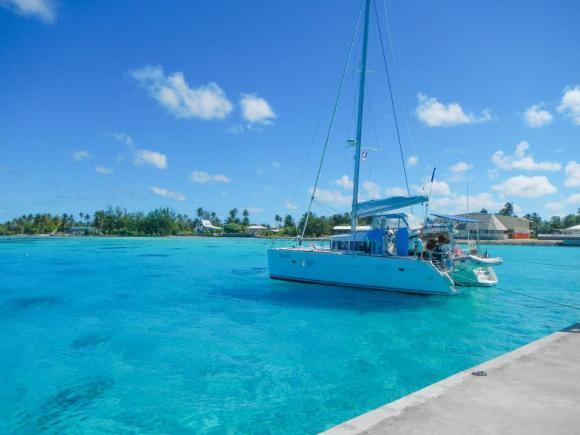
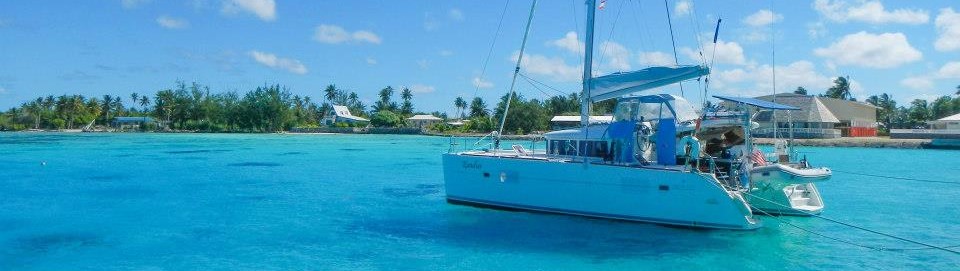
Exodus stern tied to the wharf

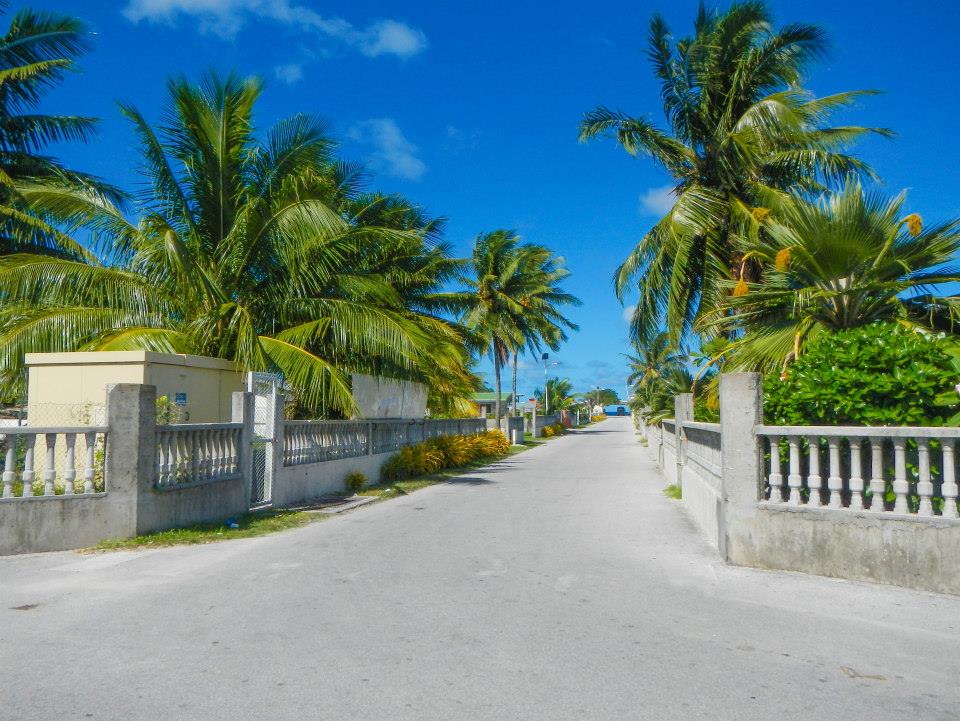
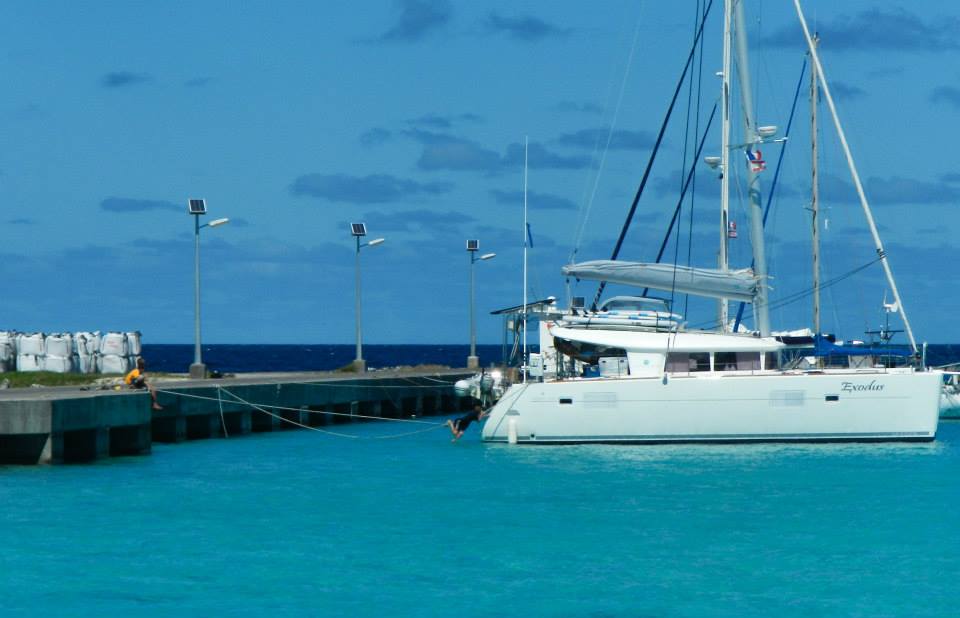
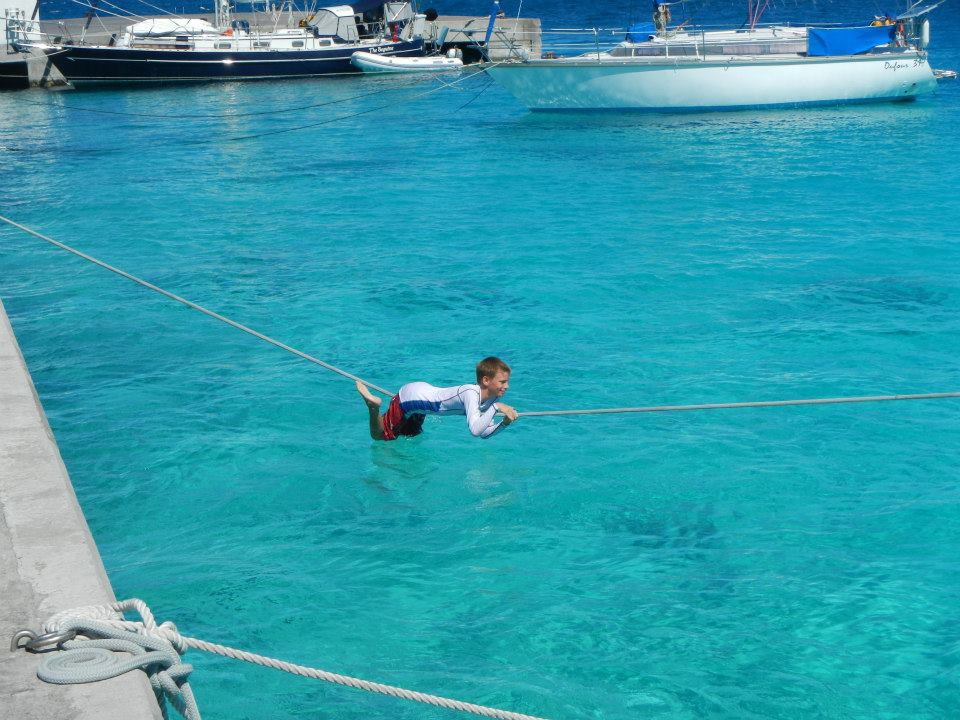
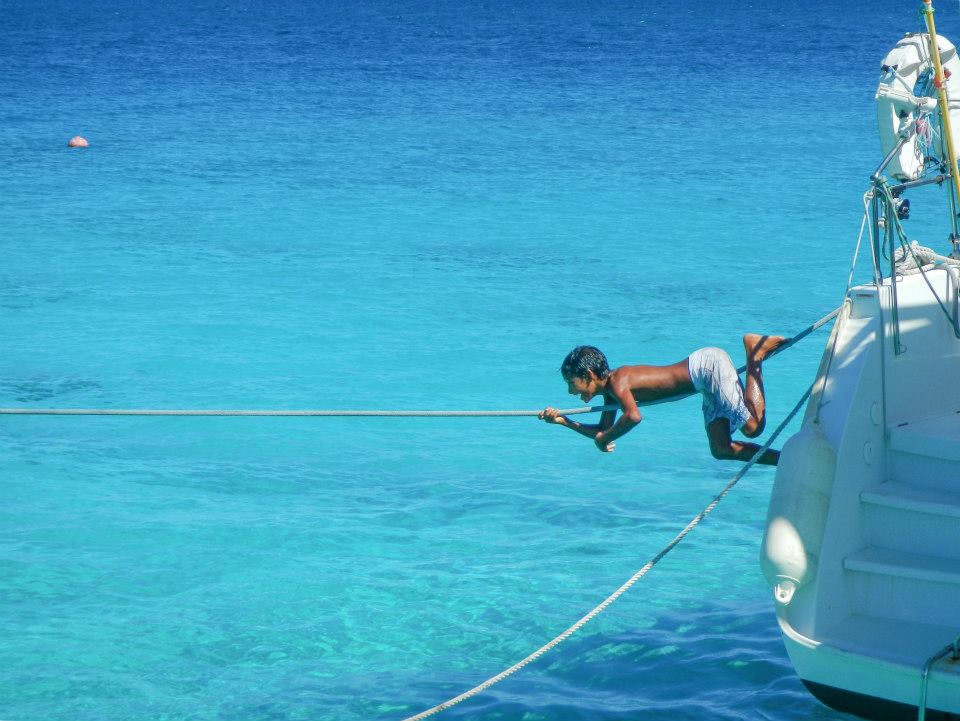
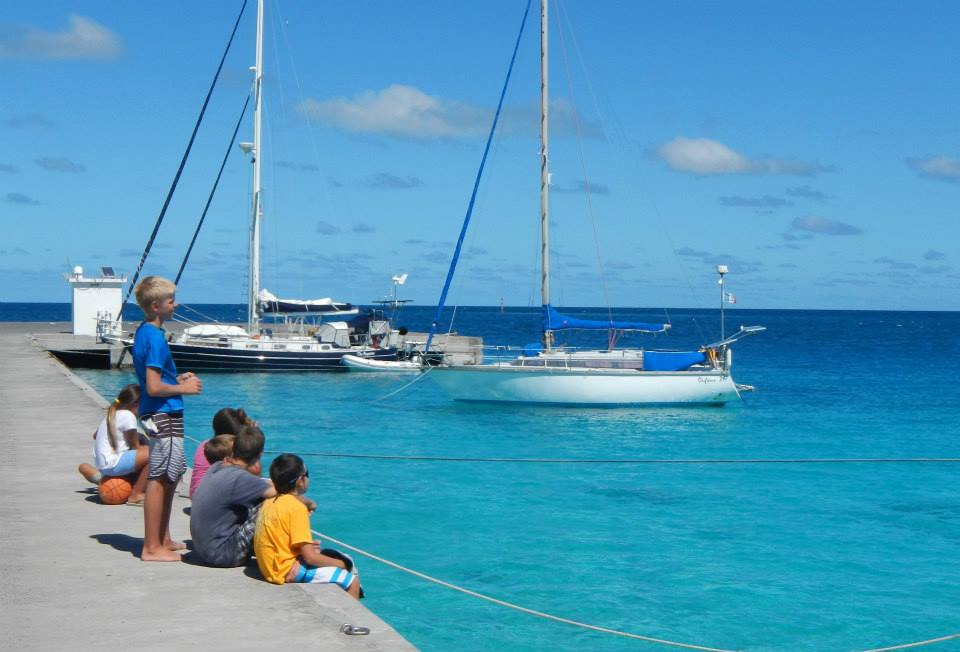
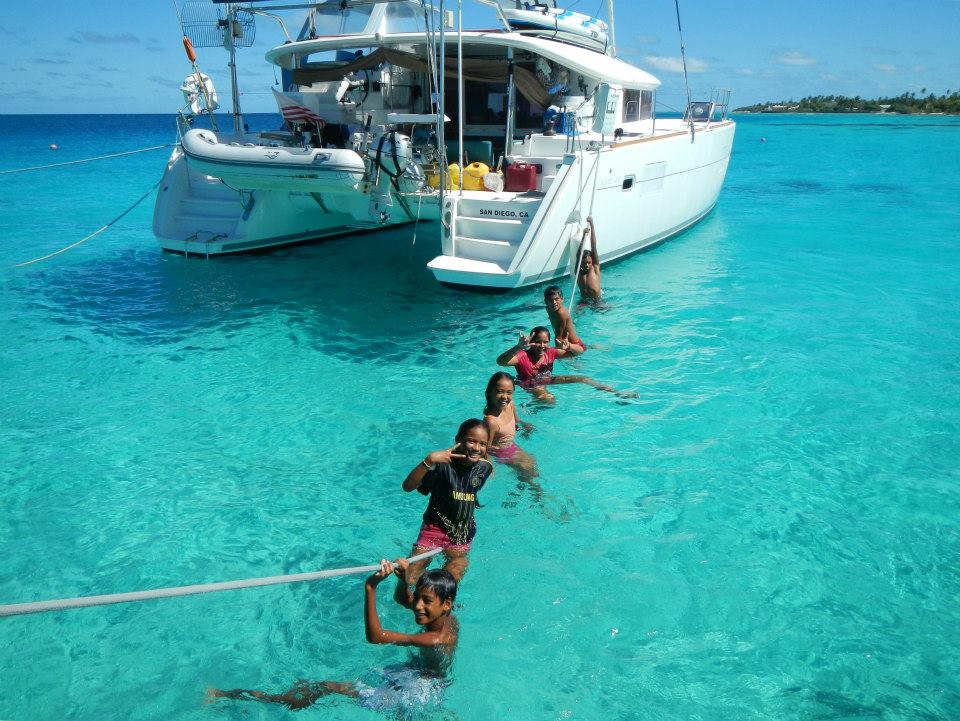
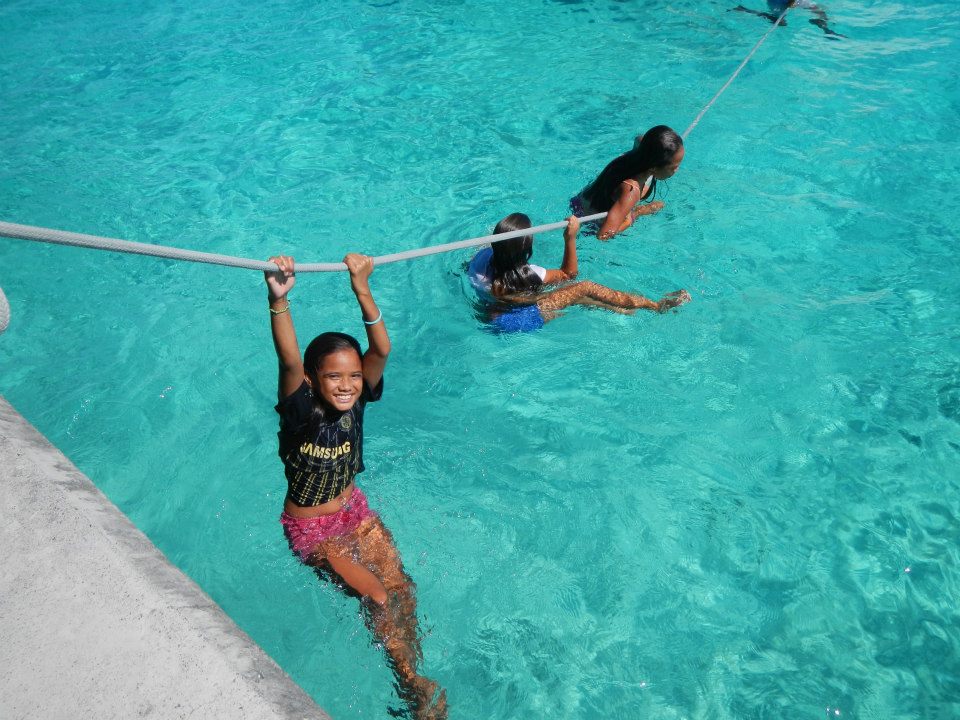
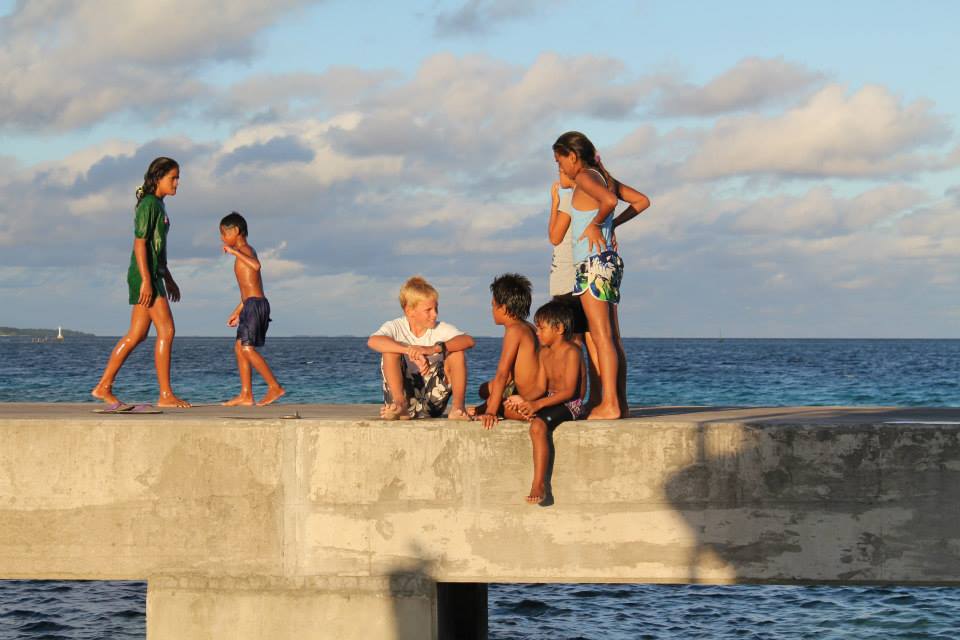
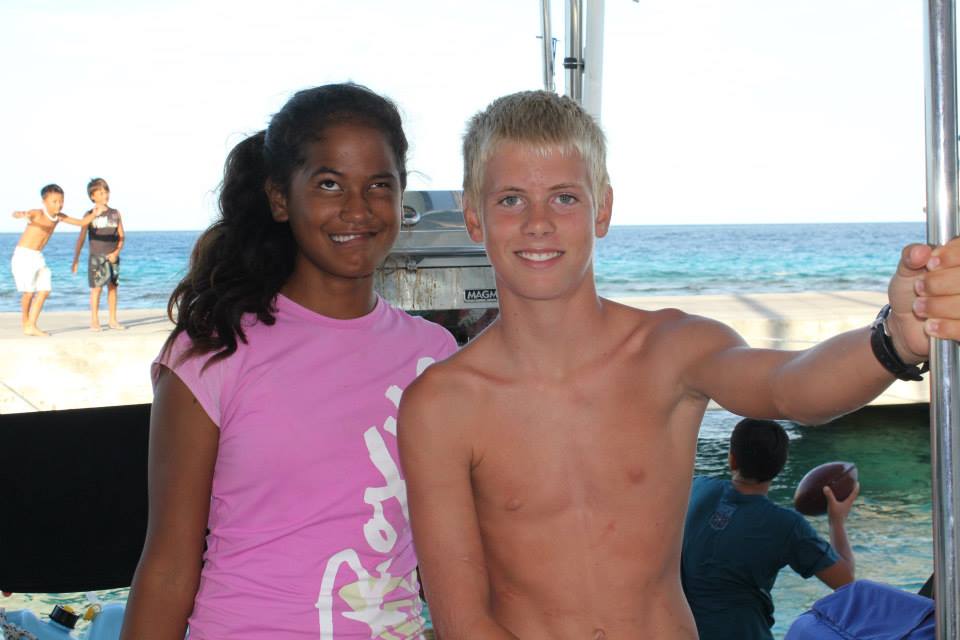
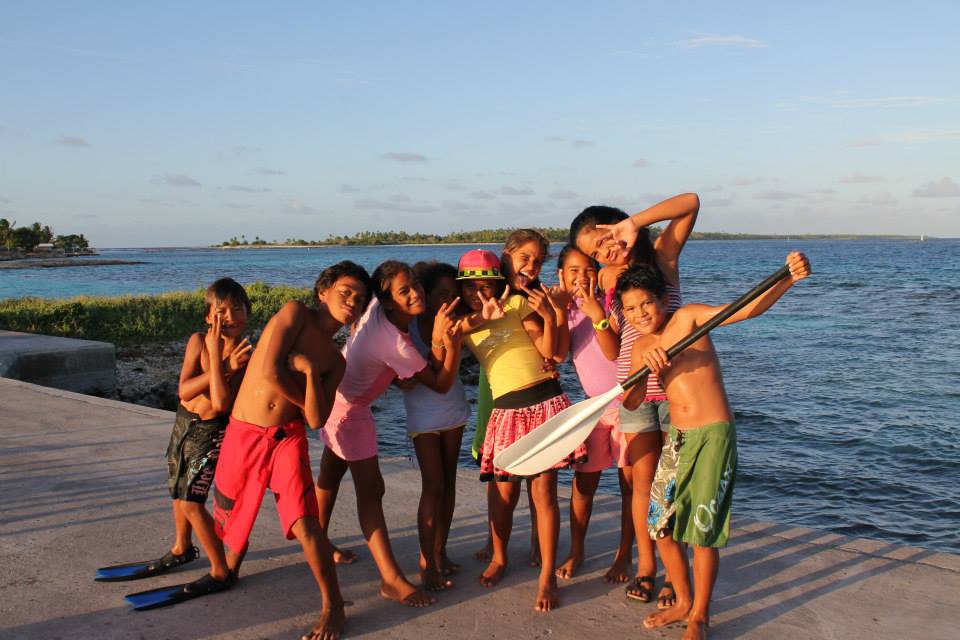
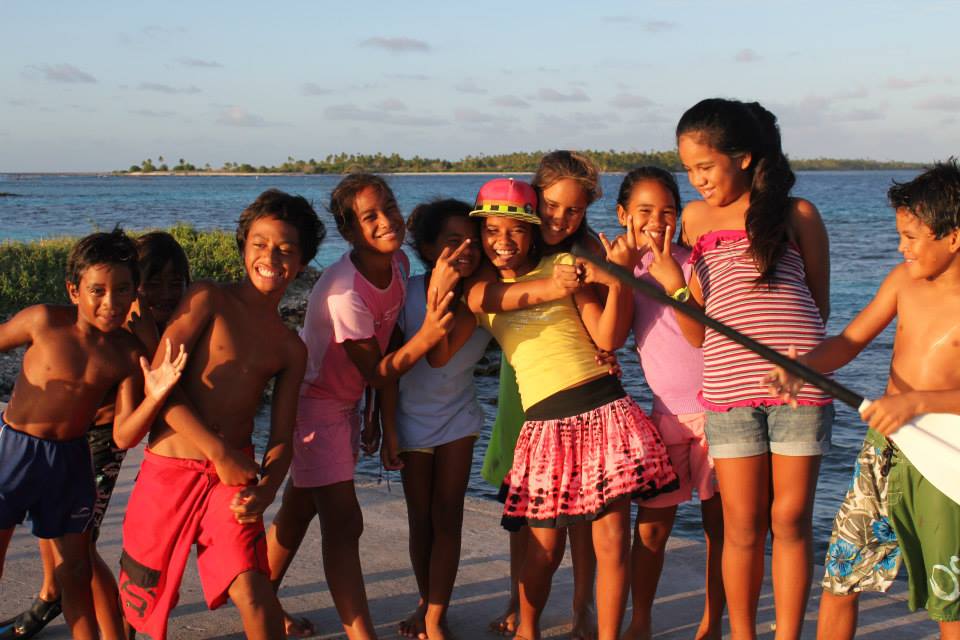
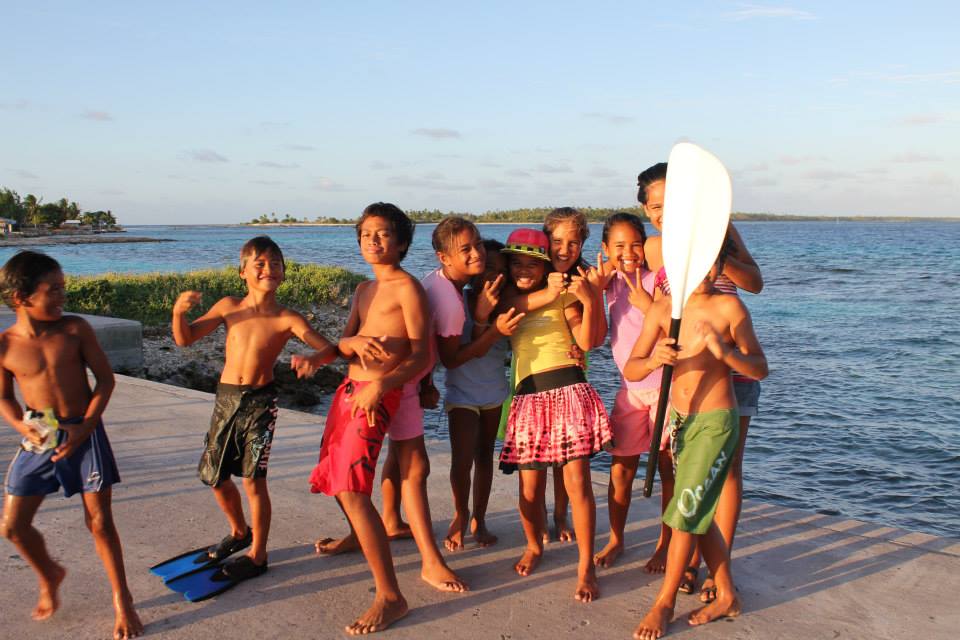
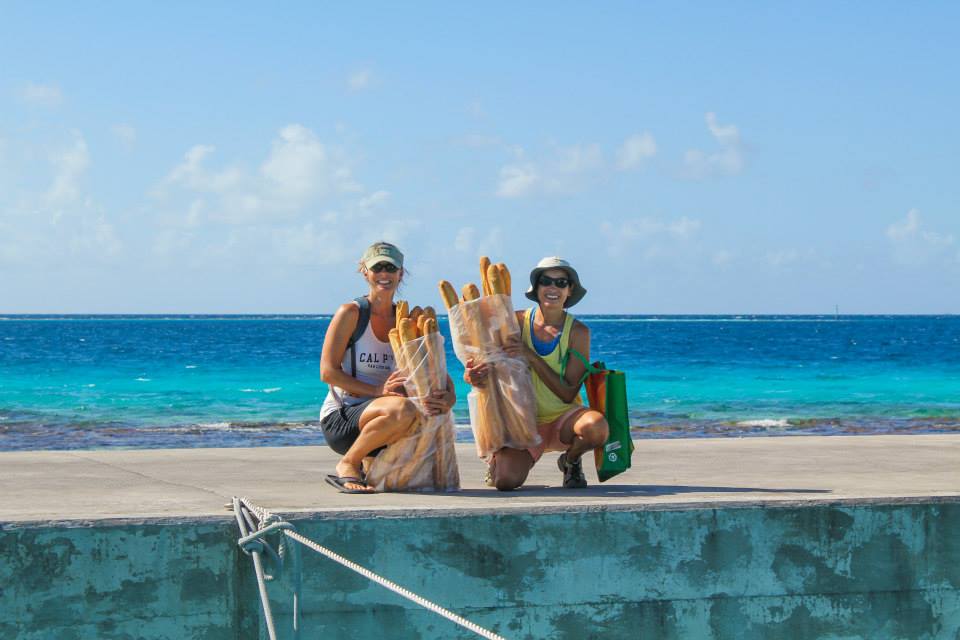
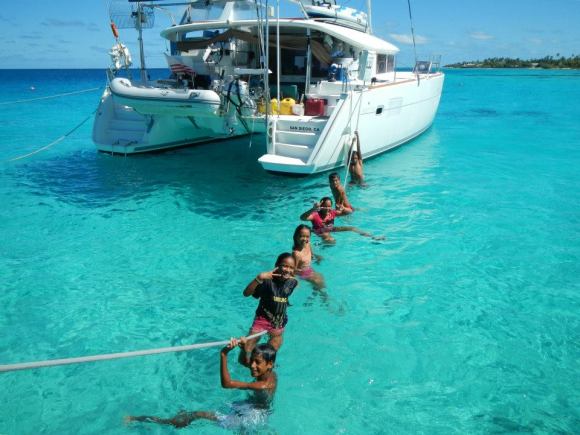
We explored the town almost immediately, and we found it clean and the people friendly.  We found the stores pretty easily, including a bakery.  Baguettes, again!  Although they weren’t as tasty as what we had grown accustomed to in The Marquesas.  Right near the wharf was a covered recreation area for the kids including basketball hoops, and there were several kids playing as we wandered past.  Tim encouraged the boys to go play, and when they wouldn’t he gave them a little more incentive.  He told them if they didn’t go play with the local kids, they couldn’t eat anything we bought in town, including and especially the baguettes.  They were stubborn and went and sat on the wharf near the boat.  After a little more exploring of the town, we saw the kids again, and Tim talked to them and told them about the boys, and they are welcome to come play down by the boat.  The kids quickly accepted this offer and found the boys near the boat.  Brenden was going back and forth between the wharf and Exodus by shimming along the dock lines, getting dipped in the water along the way.  Of course, this looked fun, so some of the other boys wanted to try it as well.  Before long, they were all swimming, jumping off of Exodus, playing catch with our “futbol americain” and generally having a really good time.  Tim would throw the football and they would try to catch the football as they jumped off the dock.  Eventually, they all went to play soccer, including the Exodus and Lady Carolina boys.  When they got back, Brenden commented on how good at soccer they all were. 
That evening we were invited to watch the dance practice at a covered area right near the wharf, and so we all went down to watch.  The women of the town were practicing their dancing for the upcoming Heiva celebration, and we got to see the instruction and practicing and listen to the fantastic drum playing.  It wasn’t a professional dance troop, to be sure, but we had fun watching and talking to people.   The only downside was that after the overnight passage I was so tired I could barely keep my eyes open after sitting there for a while.  Luckily, that wasn’t our only opportunity to watch them practice. 

The next morning when we got up there was a group of younger children on the dock with flowers, and they wanted to “change” them for chocolate.  After school, all the kids were back for more playing on Exodus.

After bypassing the opportunities in the Marquesas, Tim decided he wanted to get a tattoo.  I was skeptical about finding someone here in Makemo, after all, the Marquesans are very well known for their tattoos, and I had no idea what we could find in The Tuamotus.  After asking a few people and getting the same answer from all of them, the guys went to see Beko, and it turns out he’s a real artist.  In addition to tattoos, he engraves black pearls with intricate designs.  Tim saw his work, and thought, yeah, this is the guy I want to do my tattoo.  Would you believe his tattoo “machine” was broken?  No tattoo for you.  Tim and Steve suggested maybe they could fix it, but Beko had already thrown it out, so he’s no longer in the tattoo business. 

Not to be discouraged, the guys then turned their attention to the carved pearls and made some complex trading deals for him to carve some pearls for us.  Ok, not too complex, just some alcohol and a few boat items and they had their deals.  As a bonus, they got to meet Beko’s brother Victor.  Just like when you asked anyone in town about tattoos, they steered you to Beko, if you asked anyone in town about fishing, the only name you heard was Victor.  Since that is right up Tim and Steve’s alley, they joined him for spear fishing one day, but the “piece de resistance” was going out fishing with him on his boat.  If you haven’t seen it, go check out our youtube video called “Fishing with Victor,” and so not to spoil it too much I’ll just say it involves a harpoon rather than rods and reels.  OK, since I spoiled it, I’ll tell just a little more.  His boat is a hard bottom skiff, but unlike the Mexican Pangas which are driven by outboard from the back of the boat, just like our dinghy, Victor’s boat is driven from the front.  What he does is follow the birds until he finds a Mahi Mahi (Dorado) and then he chases it until it gets tired.  Then when he’s close enough he throws a harpoon at it.  His success rate was amazing, and they came back with 4 huge Mahi Mahi.   The only time he missed occurred because when he went to cock his arm to throw the harpoon the first time, he was interfered with by one of the fishing poles the guys had brought.  They had a great time, and when they got back, we invited Victor back to Exodus that evening and he had dinner with us, but I had seasoned up some Wahoo and baked it, and I’m not sure it was his sort of meal.  But he drank beer with us, and we all practiced our French, and overall had a very pleasant evening.

The only bad thing about being stern tied to the wharf was the weather.  On the one hand, it was comforting to be tied securely as squall after squall passed over.  But on the other hand, our orientation was such that the wind would blow dead astern, which means when it rained, the rained blew straight into the cockpit.  So, with the cockpit continually wet it put a damper on our pot lucking activities on Exodus.  One evening we ventured to the “restaurant” which wasn’t a restaurant the way we tend to think of them, but rather a place they will cook for you, if you make arrangements in advance.  Similar to some of the smaller villages we visited in Baja California. 

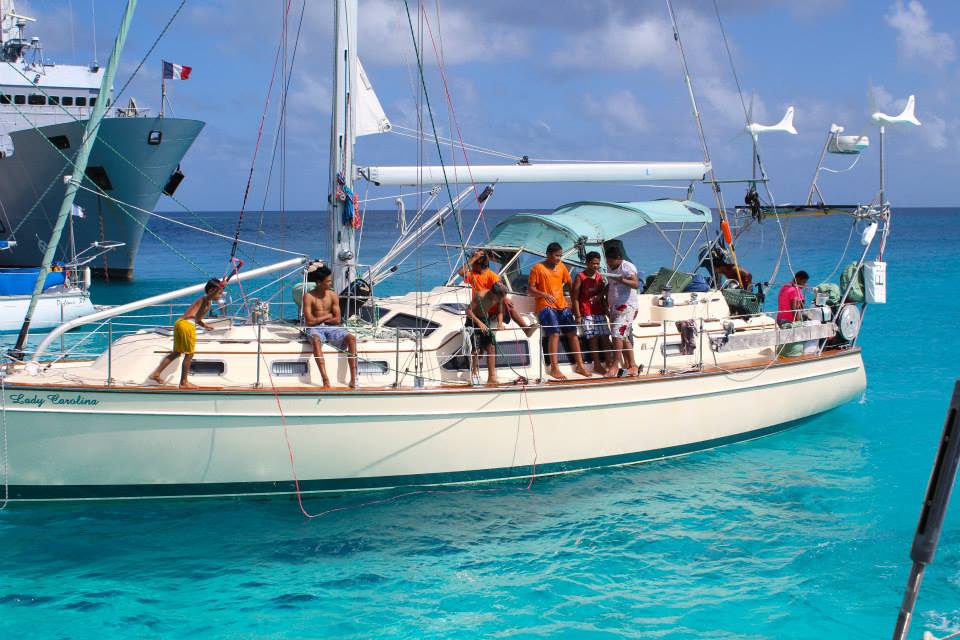
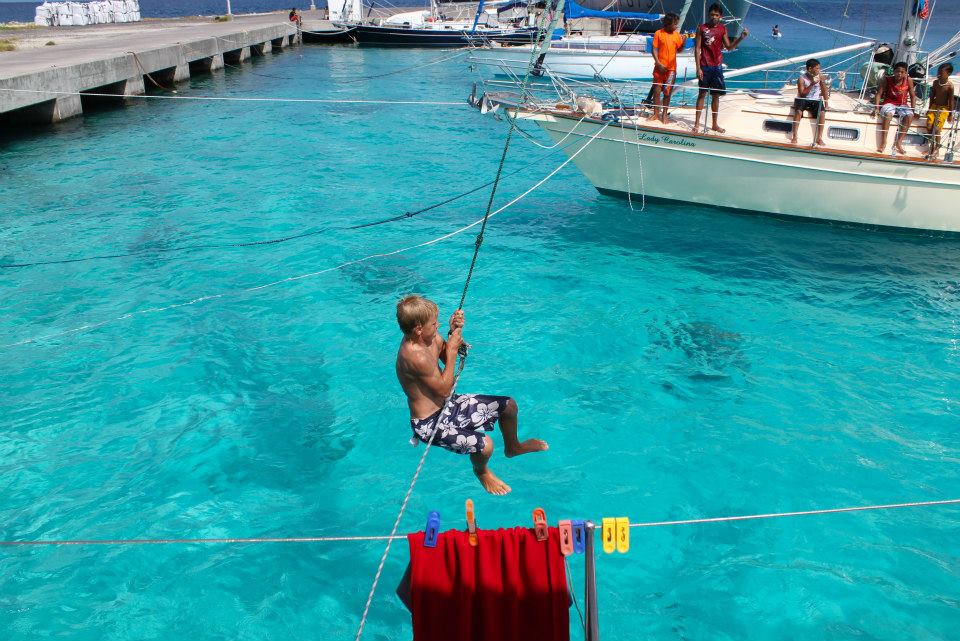
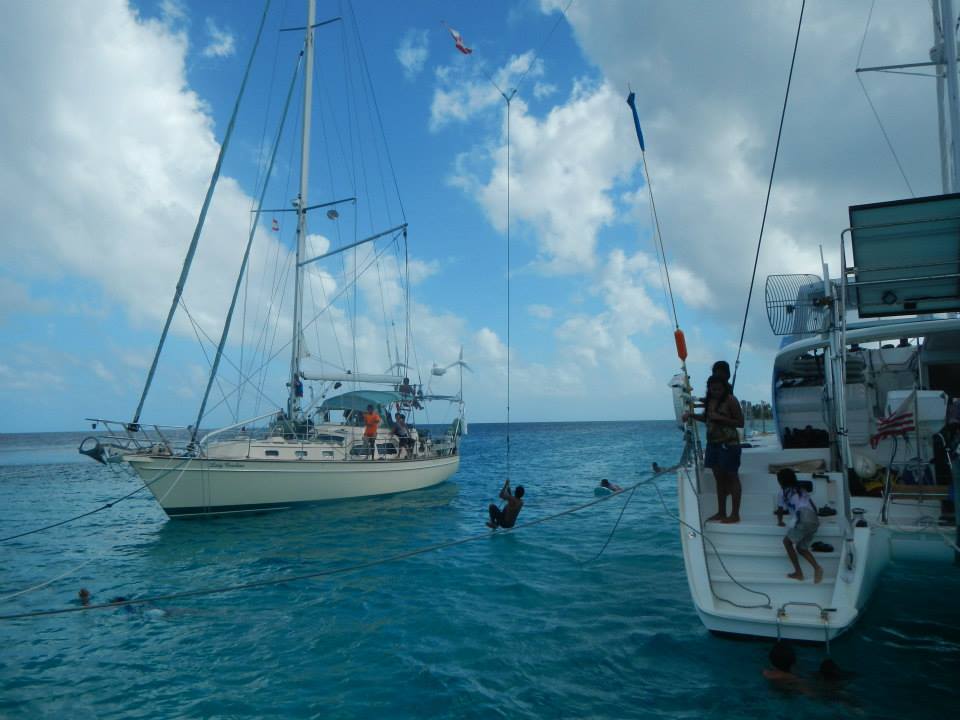
The first few days Lady Carolina was anchored rather than tied to the wharf as we were, but then they came in and parked right beside us.  At this point, I guess Tim and Steve decided they needed to up the ante for the kid fun, and they rigged a rope swing on Lady Carolina.  This was a huge hit, and even got the attention of the group of teenagers who had been hanging out on the dock but were too cool to come and play.  In addition to enjoying the rope swing and eating all of Carolina’s SAO crackers, they also enjoyed Steve’s weight set, and they were pumping iron to our amusement.  Well, I guess one rope swing on Lady Carolina just wasn’t good enough, so Tim and Steve attached a Lady Carolina halyard to an Exodus halyard, and then attached a third line to that, and created the rope swing of all rope swings that could be launched from the port stern of Exodus.  By late afternoon, we must have had 50 kids on or around our two boats.  It was a bit crazy and got away from us a bit, but amazingly nothing got broken or lost, well, except for Lady Carolina’s pulpit, which got a bit bent when a large kid used it as a springboard.  A couple times we had to remind them to not stand on the lifelines and not jump on the net, but overall, they are a good group of kids.  I spent some time with some of the older ones reading the French for Cruisers book together.  They would pick a phrase and ask me something in English and I would try to answer in French.  They seem to speak French more often here than in the Marquesas, even when interacting with each other.  In the Marquesas, we heard a lot of Marquesan.  I’m not exactly sure what the native language here is called.  They seem to speak Tahitian, but a couple words they taught us they would say, “in Makemo” indicating it’s a local language, but I’m really not sure.

Rope swing

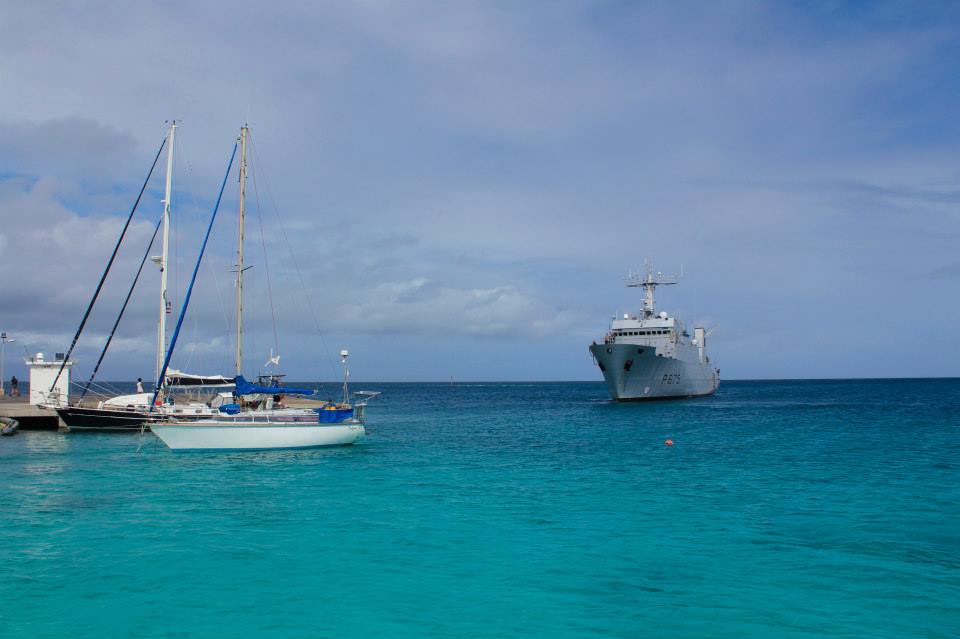
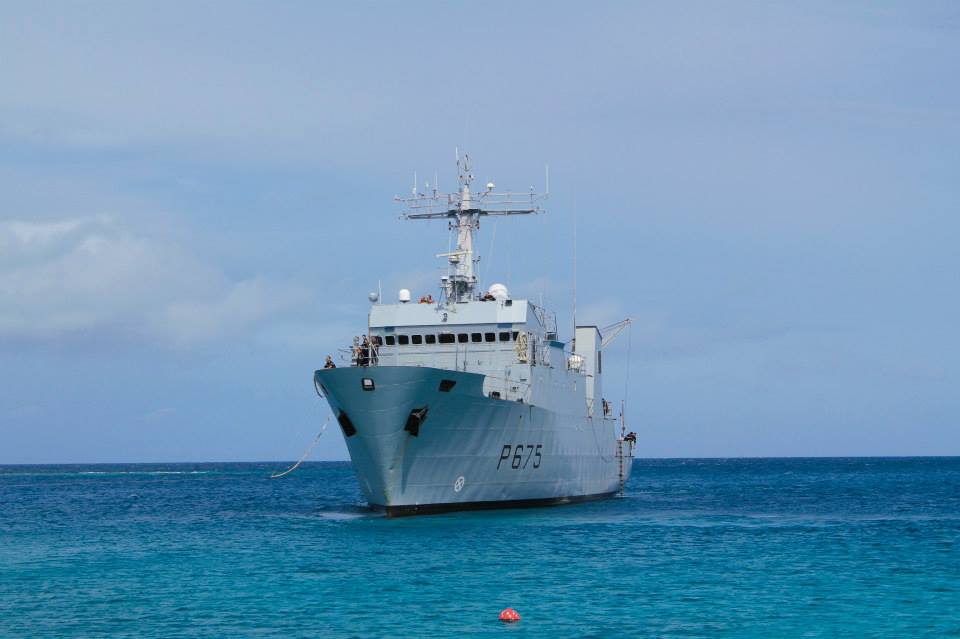
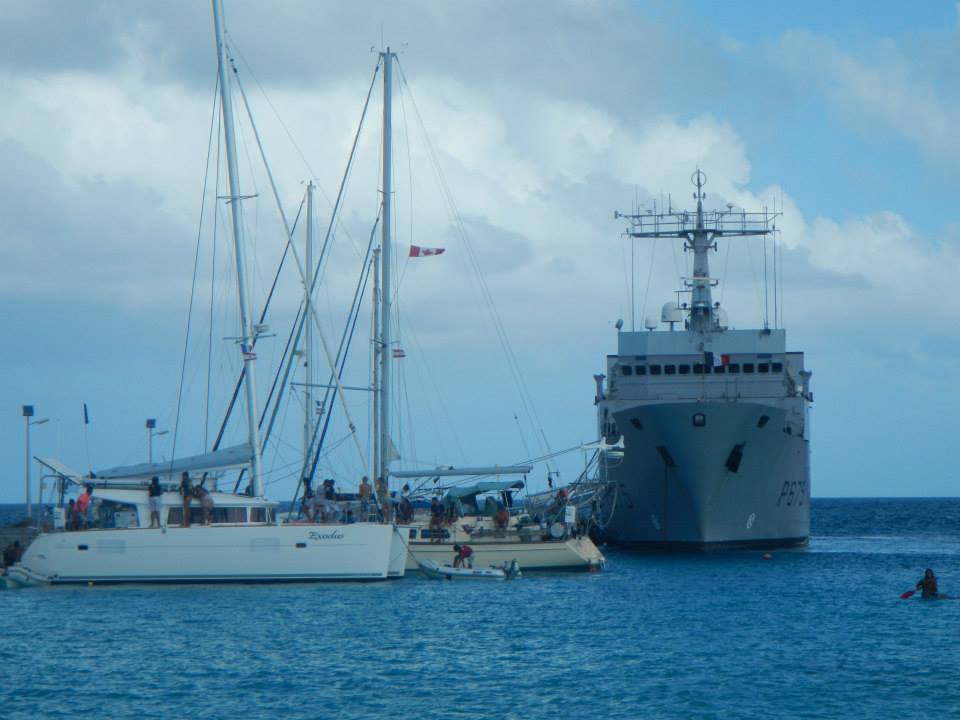
A military boat pulled up to the dock while we were there, and at first, we were wondering if we would get boarded and searched, but that was not to be.  This was a French Navy boat with nothing to do with customs, and while they were there it was if the men all had a day’s leave as they explored the town dressed in shorts with their cameras.  They were all so young, and surprisingly spoke very little English, but they seemed to get at least a small kick out of all the local kids playing on our boats.

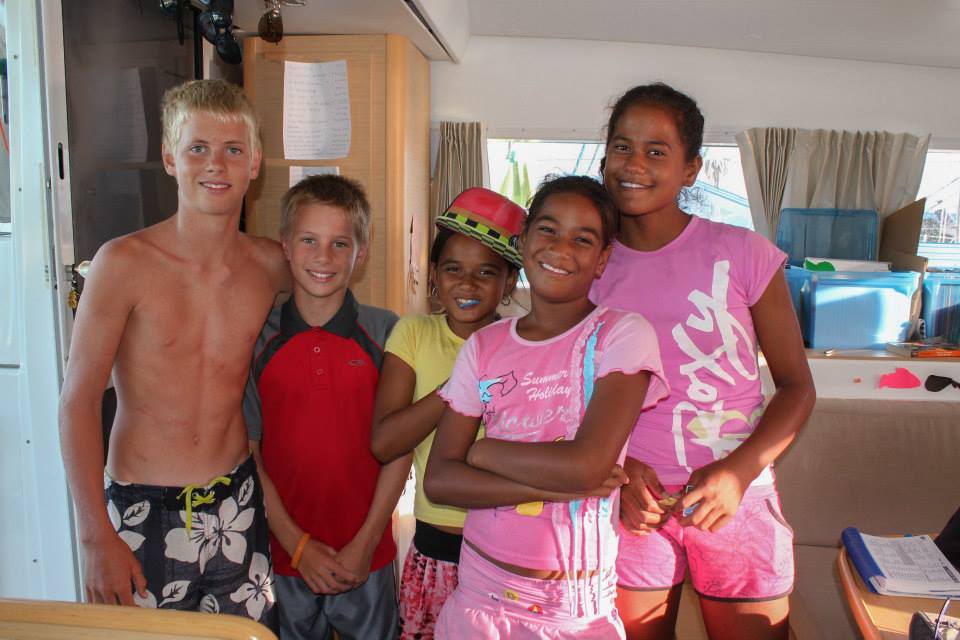
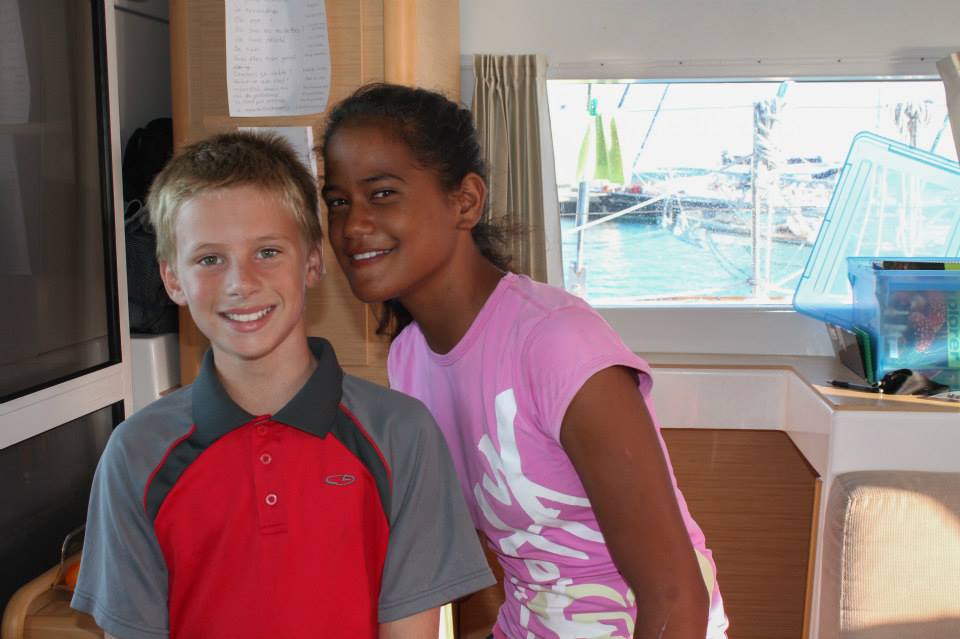
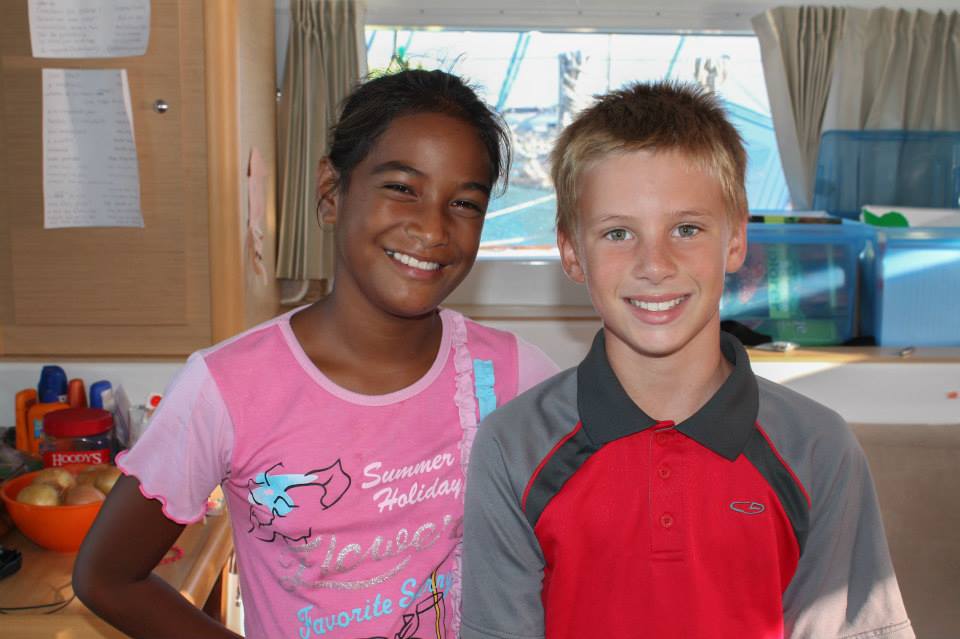
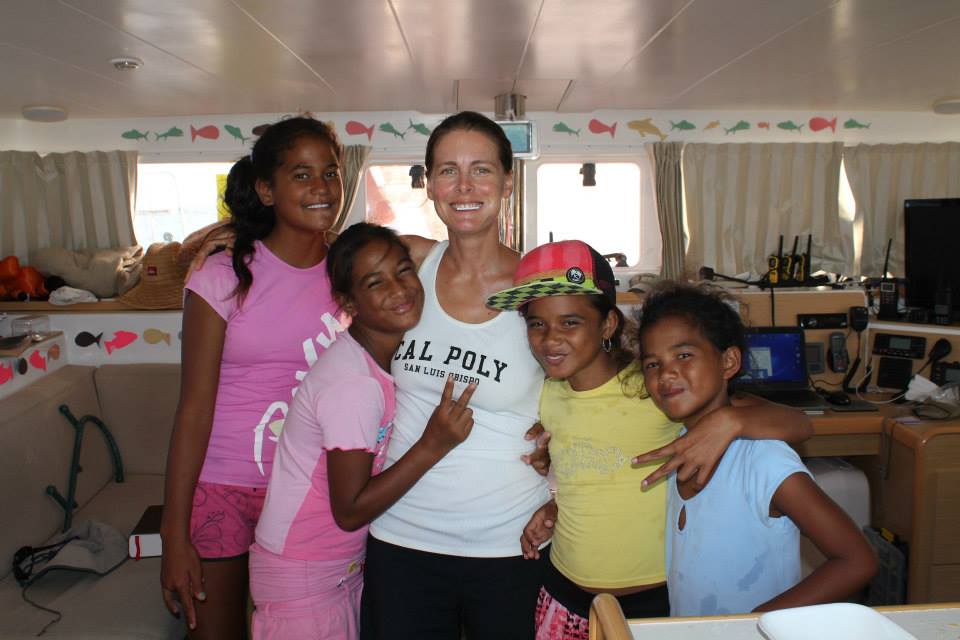
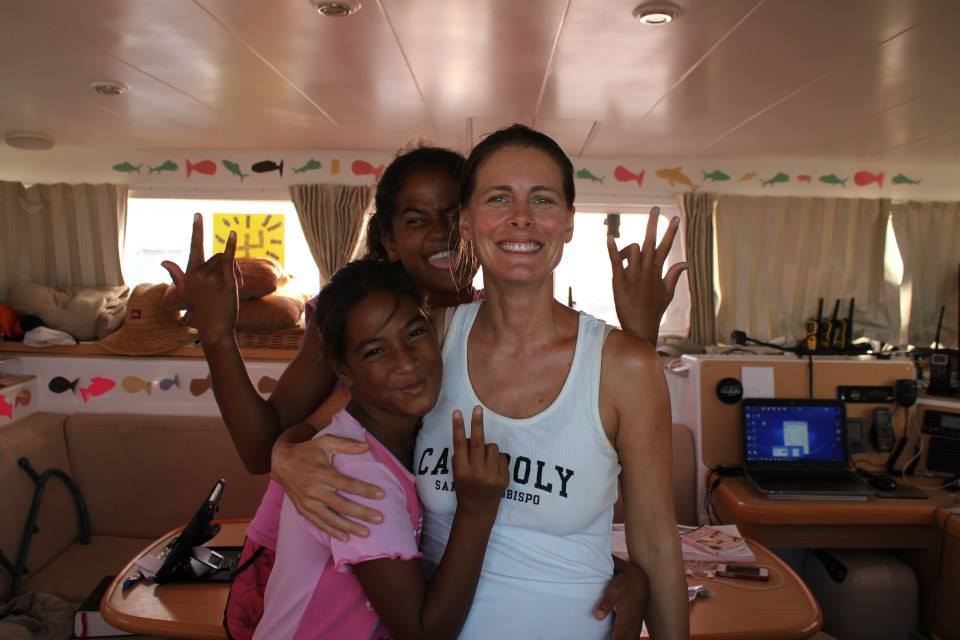
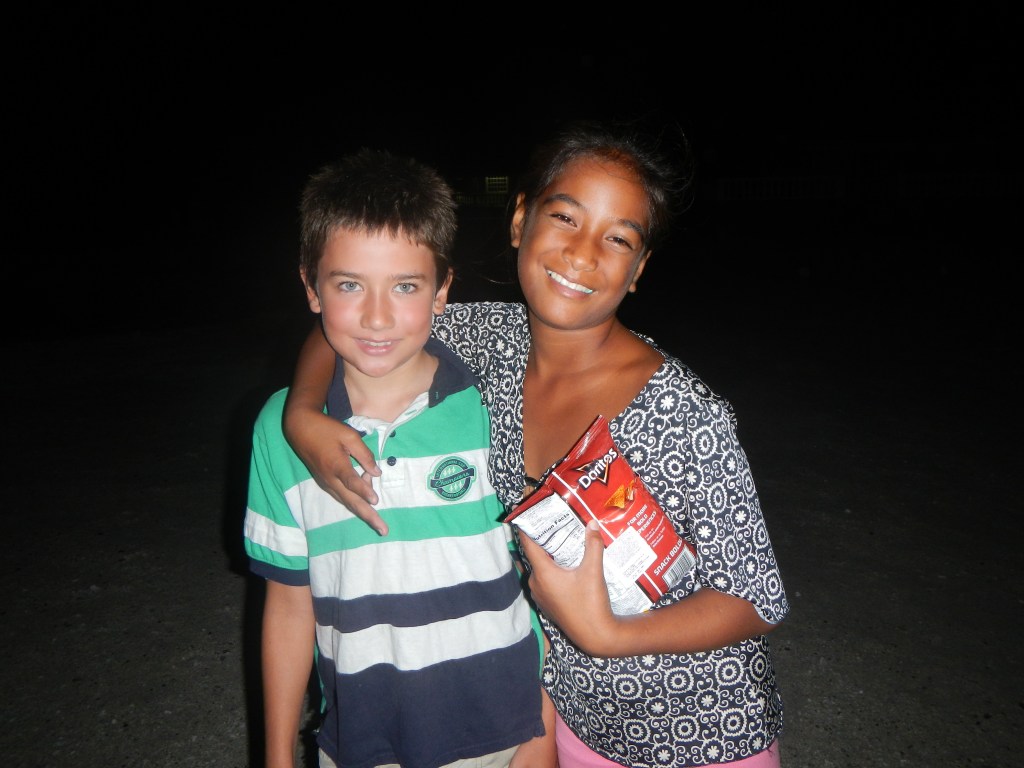
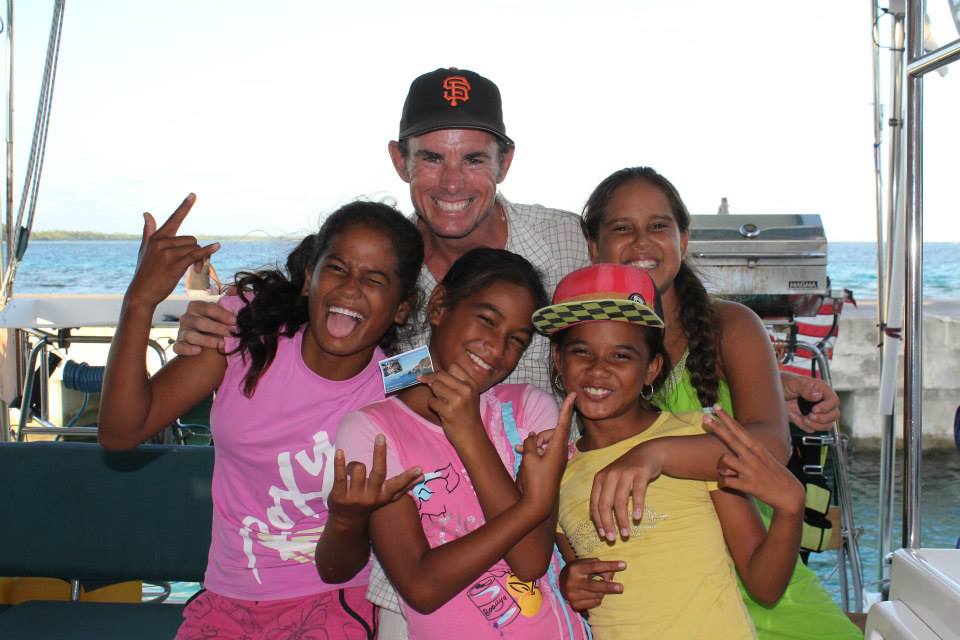
Once we had planned to leave the village and we had told the children, we ended up staying one more day at the last minute, and I’m so glad we did.  When I told the kids we were staying “a demain” (until tomorrow) they were so excited they hugged me, especially the girls who are “in love” with Alex, Brenden, Kyle, and Joel.  It’s funny, they communicate this by making a heart shape with their hands.  They wrote notes with lots of hearts on them and gave the boys silly band bracelets.  They spent the day with me on Exodus helping me chop vegetables and teaching me French.  One of the girls would say a phrase in French and then tell me, “repetez.”  They told me, in French, that they wanted souvenirs from us because they don’t want to forget us.  I told them, “OK I understand,” thinking I would think of some things and give them later.  Apparently, what I actually did was give them permission to go to Alex and Brenden’s rooms and pick out what they want.  They each came out with two shirts, dirty and smelly I might add, but they didn’t seem to care.  I felt so bad I had to stop them because since they’ve been growing the boys don’t actually have that many clothes to spare, especially Alex.  Oh, they pleaded with me to let them have shirts, so I dug around in Brenden’s cubby and found some (clean) older, smaller shirts and gave them each one.  Another funny thing is when Brenden came back, he asked if I cleaned his room.  I guess the girls thought the Legos needed to be tidied up a bit!  The next day Carolina was able to dig out a shirt of Kyle’s and gave that to one of the girls too, they were so ecstatic. 

Our last morning in town the girls were on the dock bright and early with more love notes for the boys.  But even more exciting, Beko brought us our pearls, and they were exquisite.  Tim “ordered” one with each of our names on them in addition to several others, and Brenden’s has a tuna on it, so he was happy.  Beko also brought Tim and Steve bone carved necklaces, “for the captains.”  I admired Tim’s because I had been wanting one like it, but I’m pretty sure that was not in front of Beko, so I’m not exactly sure what motivated his next visit, but he came back with necklaces for me and Carolina.  He said with a smile, “for two captains.”  The necklaces were gifts, thrown in with the pearls, which was very generous of him. 

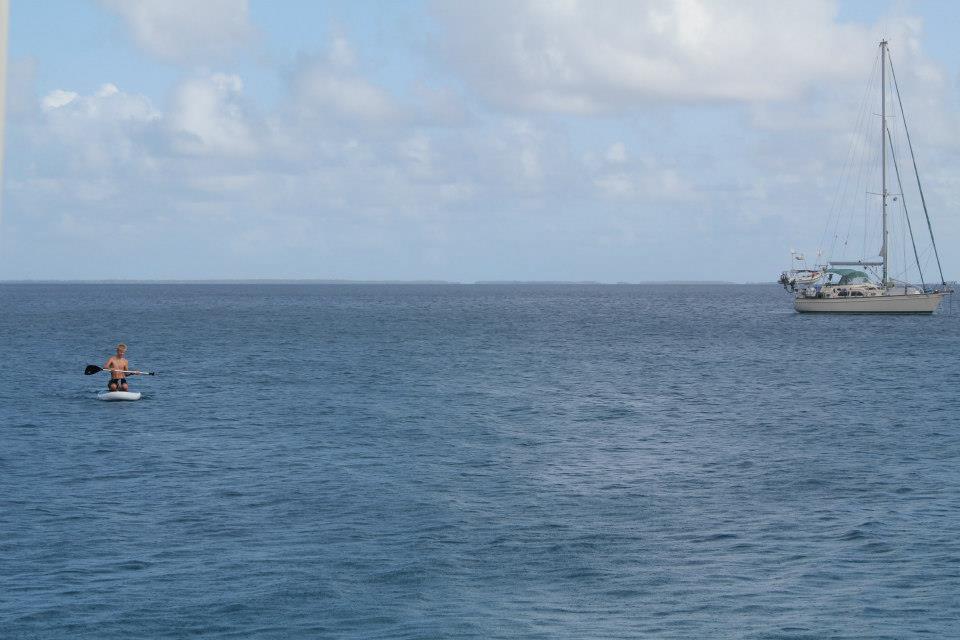
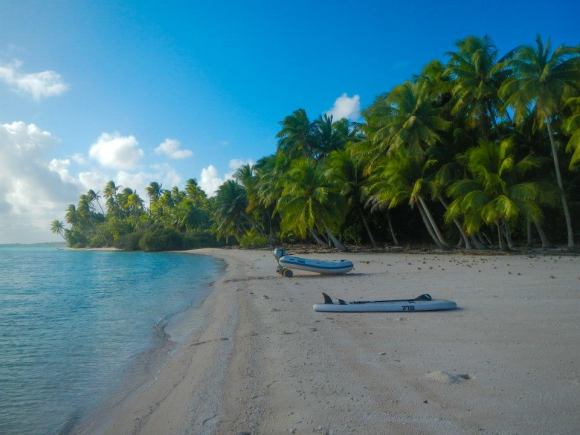
When we finally pushed away from the dock, after the drama of the anchor windlass, we made our way just a little bit northeast to a secluded anchorage, which was the perfect place to decompress.  Brenden was feeling sick with a sore throat, so he was confined to the boat, but the rest of us went to shore in the afternoon to explore a bit.  It was pretty windy, and Alex and I had a hell of a paddle to get to the beach, and unfortunately for Alex, he forgot his shoes, so he had to go back and beat upwind a second time. 
After a day or two we made our way to the vicinity of the northwest pass.  It took four hours in squally weather to get there, and Tim and Steve both spent the entire passage hoisted up in bosun’s chairs near the first spreaders.  This was so they could have a higher vantage point to be able to see the coral heads that much better.  And of course, they each had a VHF radio in hand, so the bantering never ceased.  We had a difficult time finding a spot to anchor, and when we arrived, we actually had to wait for a pretty big squall to pass over us.  So, after getting windblown and dumped on, we made our way into a tiny, protected lagoon, and here we stayed just for a couple hours while all the boys, except Brenden, did a pass dive.  Brenden was still a little sick, so he remained in quarantine.  When they got back from their dive, we all decided to stay the night, so we moved Exodus out of the lagoon and out near where Lady Carolina was anchored, so we would have a bit more swing room. 

The next morning Alex woke up sick, and it turned out to be something like strep throat and he even had to take anti-biotics.  I teased him that it was mono and kept asking him which of the girls in Makemo he was smooching on.  When we raised anchor that afternoon, it was wrapped on a coral head, and Tim had to dive in to clear it.  So, with Alex out of commission, Brenden had to step it up and work the anchor windlass, since I was at the helm and Tim was in the water.  Brenden did a phenomenal job, and we were unstuck in no time.  We took a “shortcut” out of the anchorage, because Tim had dove there and he was confident Exodus could get through, and our pass exit was just as uneventful as all of our other passes.  Lady Carolina declined the shortcut route and took the safe, long way around, and their story afterwards was that they had a serious “oh shit!” moment where they only had a foot of water under the keel.  But when all was said and done, we were both out safely by 5 pm and on our way to Tahanea.
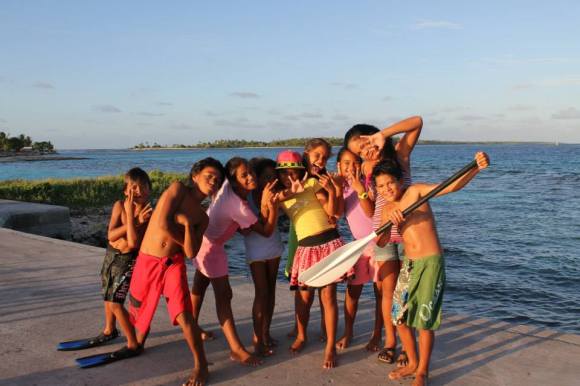
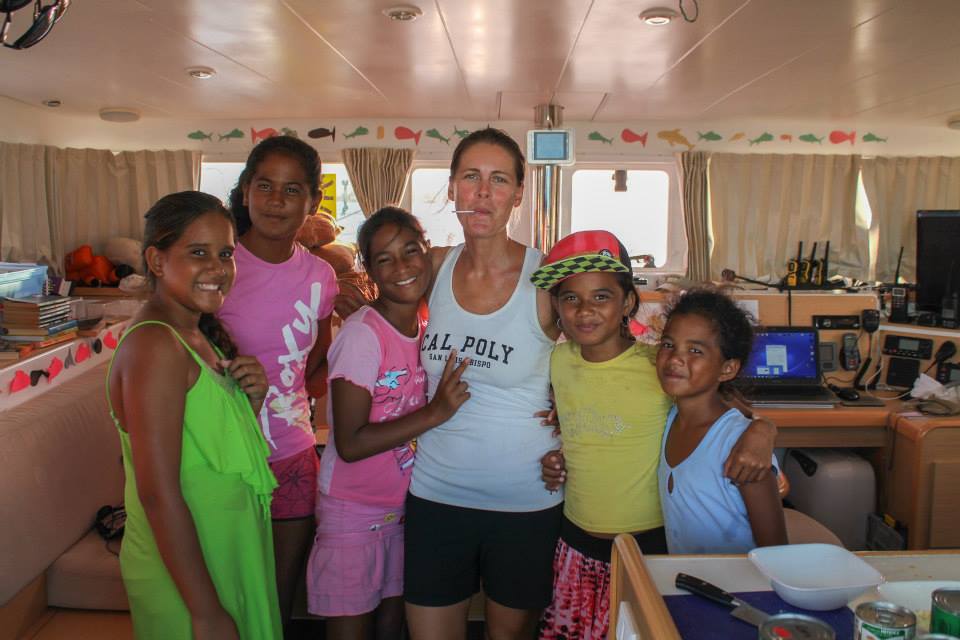
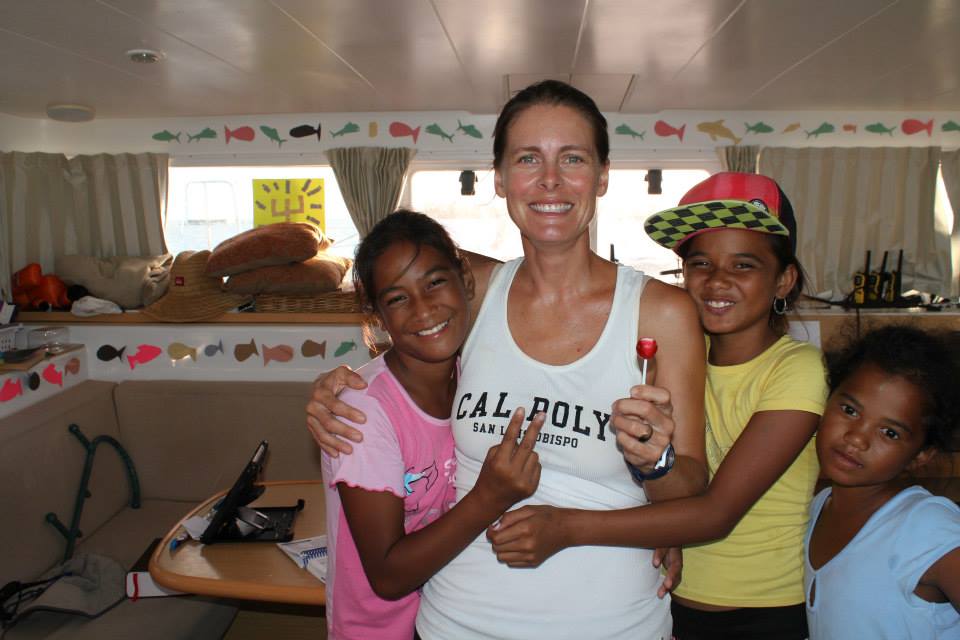
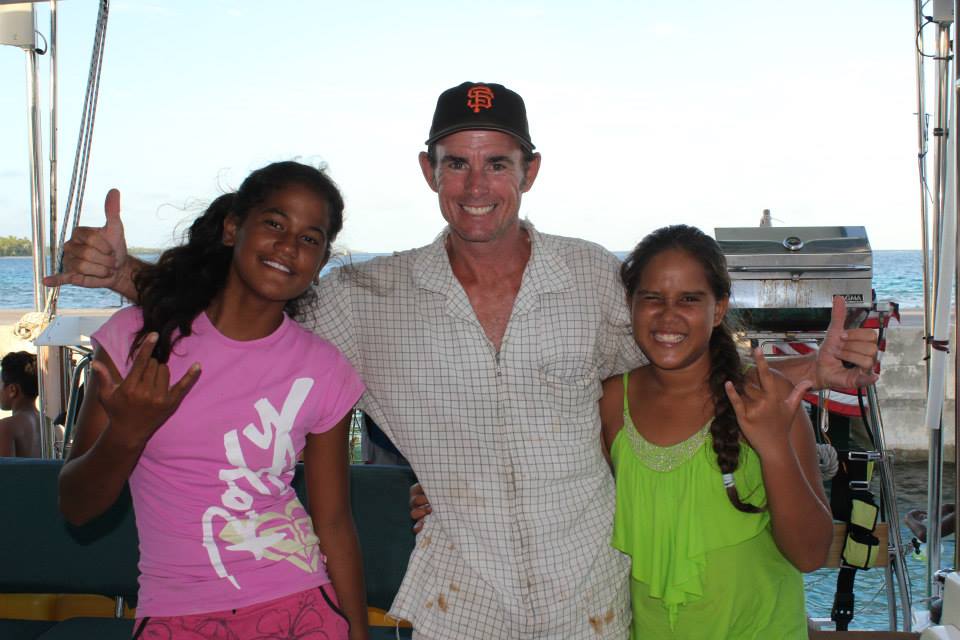
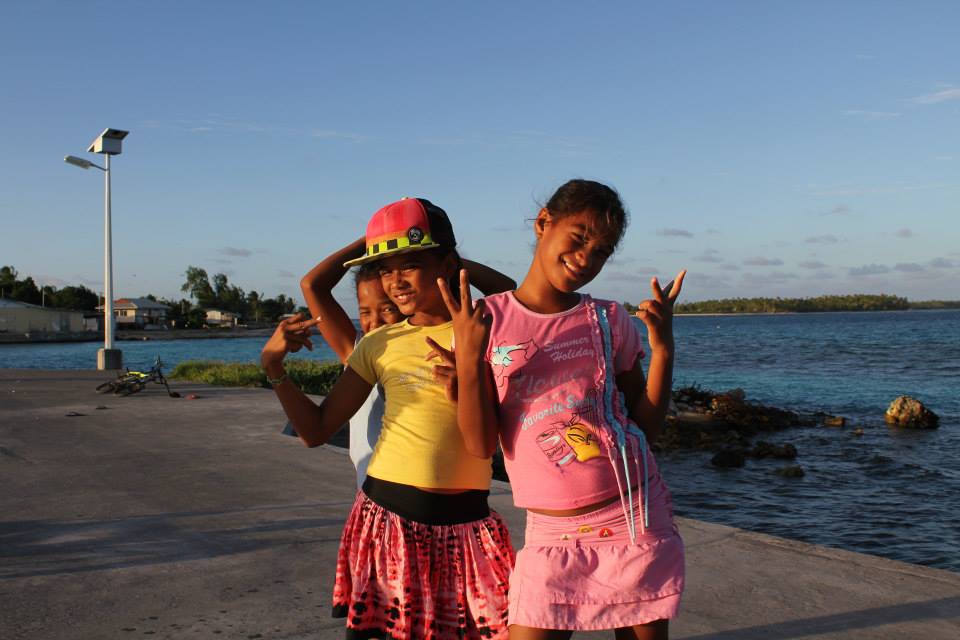
The kids of Makemo


Categories
Photo Log

Makemo Photo Log

May 20-29, 2014

Makemo was a true highlight of our journey. Not for the beauty, not for the diving, but for the interaction we had with some of the people who live there. We don’t speak French, and I’ve never regretted it more, but we still had a rich experience. I hope to go back there some day.


Logbook – May 20, 2014 (Raroia to Makemo)

Passage Log Highlights

  • 1539 Engines on
  • 1554 Depart
  • 1622 Engines off main (1 reef) + genoa – TWS 10.3 kts SE

Logbook – May 21, 2014 (Raroia to Makemo)

Passage Log Highlights

  • 0618 Main (1 reef) + genoa (2 reefs)
  • 0636 Engines on
  • 0802 Arrival – tied to wharf

Daily Notes

  • Pass – easy. Incoming tide – 3 kt of current. Tying to wharf challenging, Exodus has so much windage!
  • Walk to town – 8 baguettes! Met lots of children – invited them to dock. Lots of playing, swimming, football, paddle boards. Kids all go play soccer
  • B – sea urchin sting on finger
  • Invited to go watch dancing – practice for festival (I think)
Depart Raroia May 20 at 1554 – Arrive Makemo May 21 at 0802
Entering the pass at Makemo
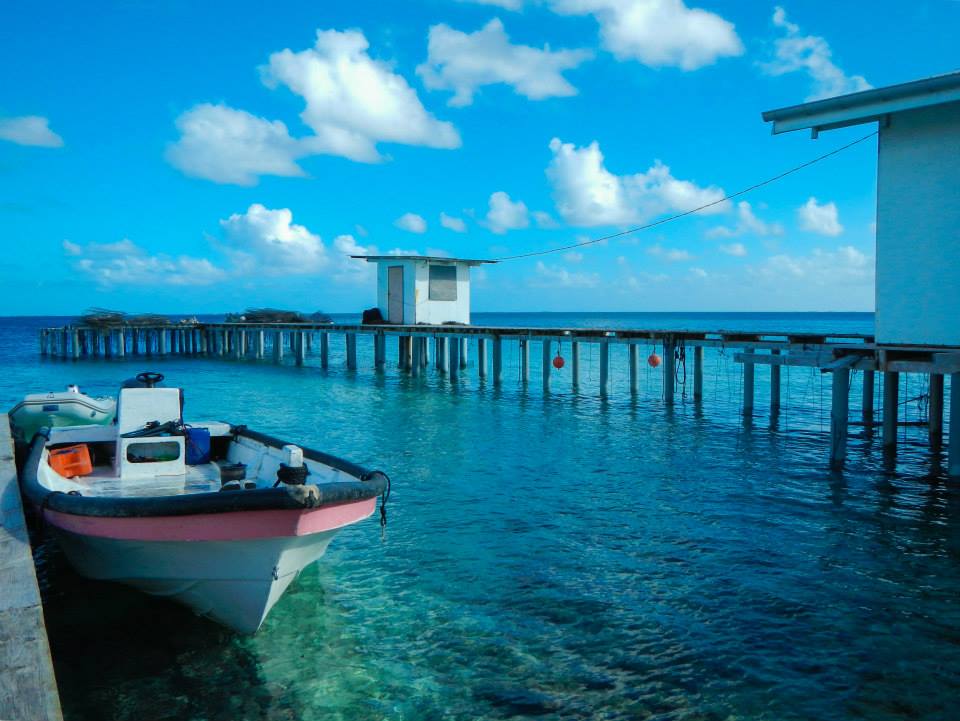
The wharf at Makemo
Exodus stern tied to the wharf
The village here has approximately 600 people (Thanks mom, for sending that Wikipedia factoid
If you look closely, you can see that Brenden didn’t feel like waiting for the dinghy to get between Exodus and the wharf. He just shimmied along a dockline…
Here’s a close up
Then all the kids had to try it!
They don’t speak the same language, but they try

Email to family and friends dated May 21, 2014

Subject: Makemo Arrival

We just arrived at our second atoll in The Tuamotus, Makemo. It is larger and has a more substantial village than Raroia, so we are looking forward to getting ashore and doing some exploring. Exiting the pass at Raroia was easy, the overnight passage was easy, entering the pass here at Makemo was easy (incoming tide, max 3 kt current), but tying up at the wharf was a bit challenging. This was our first time with this maneuver… we dropped the bow anchor and then backed into the wharf and tossed dock lines ashore to some guys who came to help us. The problem is that Exodus is so big and fat and has so much windage we were getting pushed sideways pretty good. With Alex’s help, we got everything secure and now I’m going to download weather to see if we want to stay here tonight or move to a protected anchorage. We are going to try to get some school work done before going in search of baguettes.
Love and miss you all,

-D.

At 5/21/2014 6:14 PM (utc) our position was 16°37.59’S 143°34.15’W


Logbook – May 22, 2014 (Makemo Wharf)

Daily Notes

  • Kid on the dock w/ flowers when we got up. Wanted to “change” for chocolate. Boys finished school early and played w/ kids all day
  • T – visit to the pearl artist
  • Dinner at the restaurant with s/v The Beguine and LC

Email to family and friends dated May 22, 2014

Subject: Local Kids

We had a great first day here in Makemo, but the highlight had to be that Exodus and the dock around Exodus have become the hangout for all the local kids. They swam, played with our American football (Tim would throw it and they would try to catch it as they jumped off the dock), played with our surf boards and paddle boards, and we all tried our very best to communicate with what very little French we know. They even took the boys to play a game of soccer, and when they got back Brenden commented on how good they all were. Alex and Kyle are getting a lot of attention from the girls, of course, but they act like they don’t even notice. When we got up this morning there were a group of younger kids on the dock with flowers wanting to “change” them for chocolate. We will probably stay tied up here a couple more days so we can enjoy the baguettes and the kids, and then we will go explore more of the atoll.
Love and miss you all,

-D.

At 5/21/2014 6:14 PM (utc) our position was 16°37.59’S 143°34.15’W


Logbook – May 23, 2014 (Makemo Wharf)

Daily Notes

  • Squall after squall after squall. Tons of rain. Max 35 kts.
  • T – bartered for engraved pearls.
  • Boys – more soccer w/ local kids
  • French Navy boat arrived
  • T – spearfished off pier (No fish) w/ Victor and Jack (Mayor)
A French Military boat joined us at the dock in Makemo
A bit of a squall blew through…

Logbook – May 24, 2014 (Makemo Wharf)

Daily Notes

  • No bread. Twice.
  • T/boys – Wedding
  • Rope swing day!
One Lady Carolina Halyard + one Exodus Halyard = a pretty cool rope swing
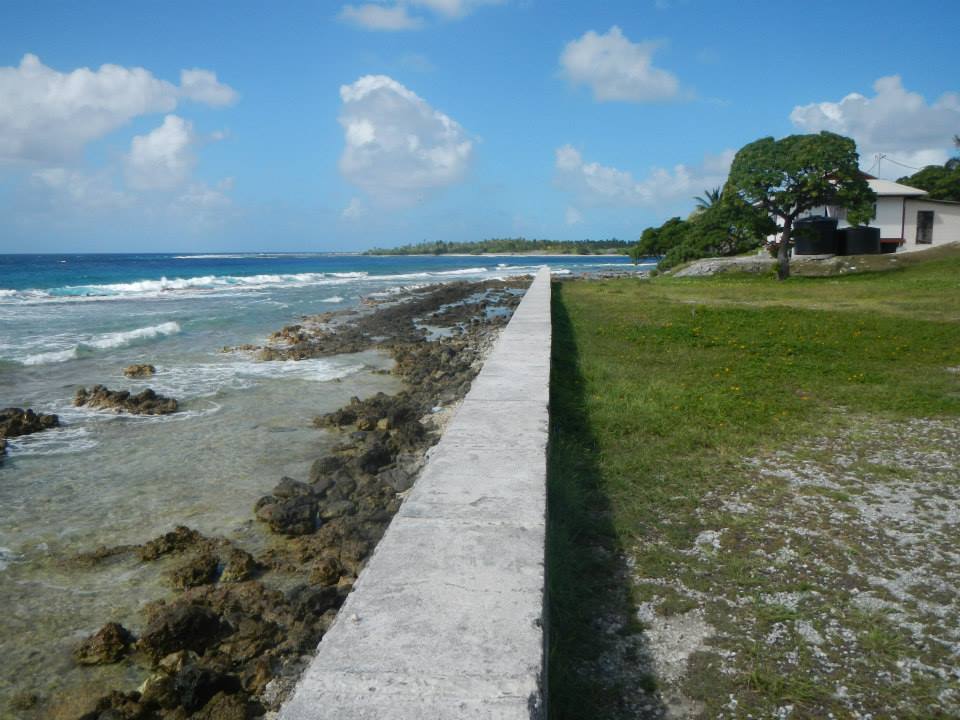
It’s but a short walk across town to the outer edge of the atoll. On the left side, the Pacific Ocean. To the right side, Makemo.
Quite a crowd on Exodus and Lady Carolina

Logbook – May 25, 2014 (Makemo Wharf)

Daily Notes

  • D – first run since La Cruz. Found the cemetery. Lots of tiny graves.
  • More rope swinging
  • 3 hours of internet & lots of wine
  • T/Steve/Paul – Dorado harpooning with Victor. AMAZING. Go Pro Videos
  • Potluck on Exodus

Logbook – May 26, 2014 (Makemo Wharf)

Daily Notes

  • Last day in Makemo Village
  • Girls take the boys’ shirts and clean Brenden’s room
  • Watched the dancing in the evening again
In case you are wondering, that’s a “bon bon” in my mouth (aka sucker or lollipop, en englaise)

Email to friends and family dated May 26, 2014

Subject: Time to move on

Our stay tied to the wharf here at the village in Makemo is coming to an end. This has been our favorite village that we have visited, by far. We spent another day yesterday with all the local kids playing on Exodus and Lady Carolina, and amazingly nothing got broken or lost. Well, except for Lady Carolina’s pulpit, which got a bit bent when a large kid used it as a spring board. A couple times we had to remind them to not stand on the lifelines and not jump on the net, but overall they are a good group of kids, and I spent some time yesterday with some of the older ones reading the French for Cruisers book together. They would pick a phrase and ask me something in English and I would try to answer in French. They seem to speak French more often here than in the Marquesas, even when interacting with each other. In the Marquesas, we heard a lot of Marquesan. I’m not exactly sure what the native language here is called. They speak Tahitian, and a couple words they taught us they would say, “in Makemo” indicating it’s a local language, but I’m really not sure. Tim, Steve (Lady Carolina), and Paul (The Beguine) got a treat yesterday and went fishing with a local guy named Victor. They went spear fishing with him the other day, but yesterday they went out in his boat, which unlike the Mexican Pangas, is driven from the front of the boat. He didn’t bother with any rods and reels. What he does is follow the birds until he finds a Mahi Mahi (Dorado) and then he chases it until it gets tired. Then when he’s close enough he throws a harpoon at it. His success rate was amazing, and they came back with 4 huge Dorado. We have a few errands to run before casting off today including picking up some engraved pearls that the guys traded a bunch of stuff for, and of course stocking up on baguettes. I paid for about 5 hours of internet yesterday and got some photos and a couple movies uploaded, hopefully you’ve had a chance to see them.
Love and miss you all,

-D.

At 5/21/2014 6:14 PM (utc) our position was 16°37.59’S 143°34.15’W


Logbook – May 27, 2014 (Makemo Wharf to Makemo Anchorage)

Passage Log Highlights

  • 1040 Engines on
  • Depart wharf
  • 1125 P engine off
  • 1405 P engine on
  • 1428 Arrive Makemo anchorage

Daily Notes

I’m not sure we bought enough bread
We left the village and anchored in a more remote location. Depart Makemo Wharf at 1040 – Arrive Makemo Anchorage at 1428

Logbook – May 28, 2014 (Makemo Anchorage)

Daily Notes

  • B – cough & sore throat
  • T/D/A – explore the beach
  • Quiet night – French bread pizza & a movie
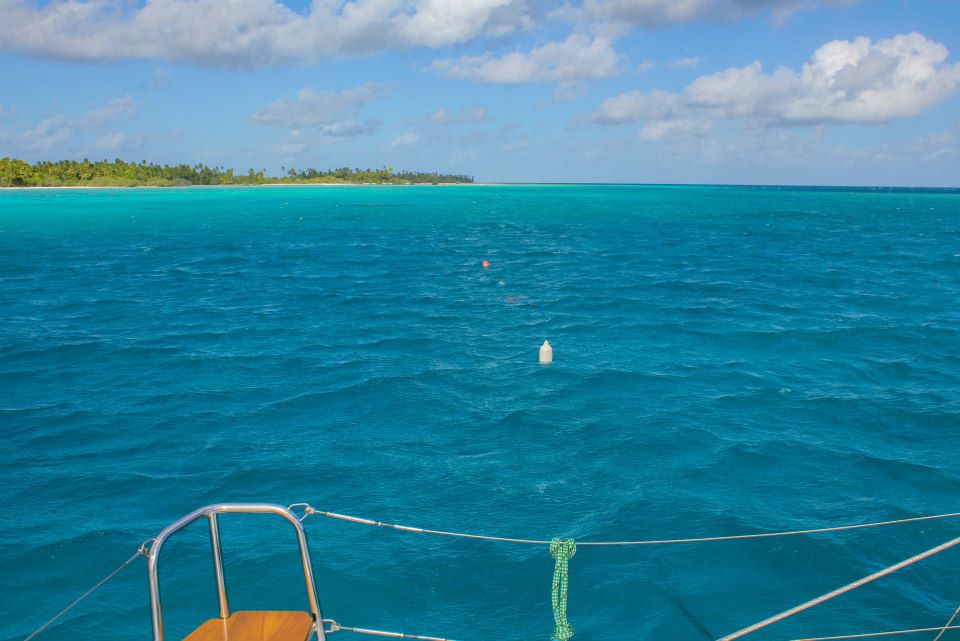
When anchoring in the Tuamotus we float our anchor chain to keep it off the bottom and away from the coral
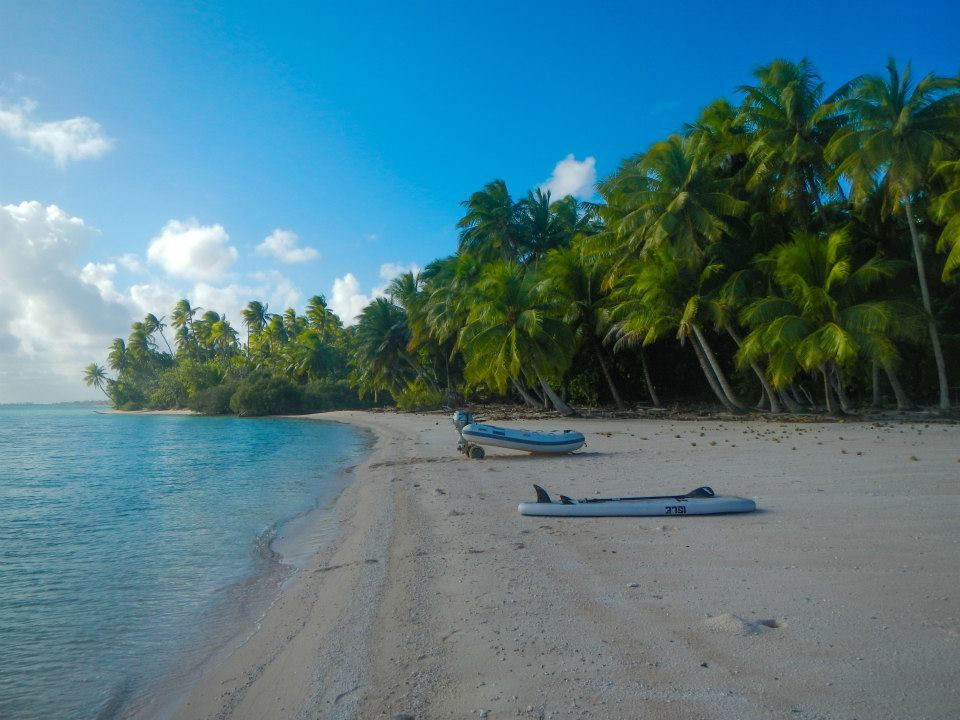
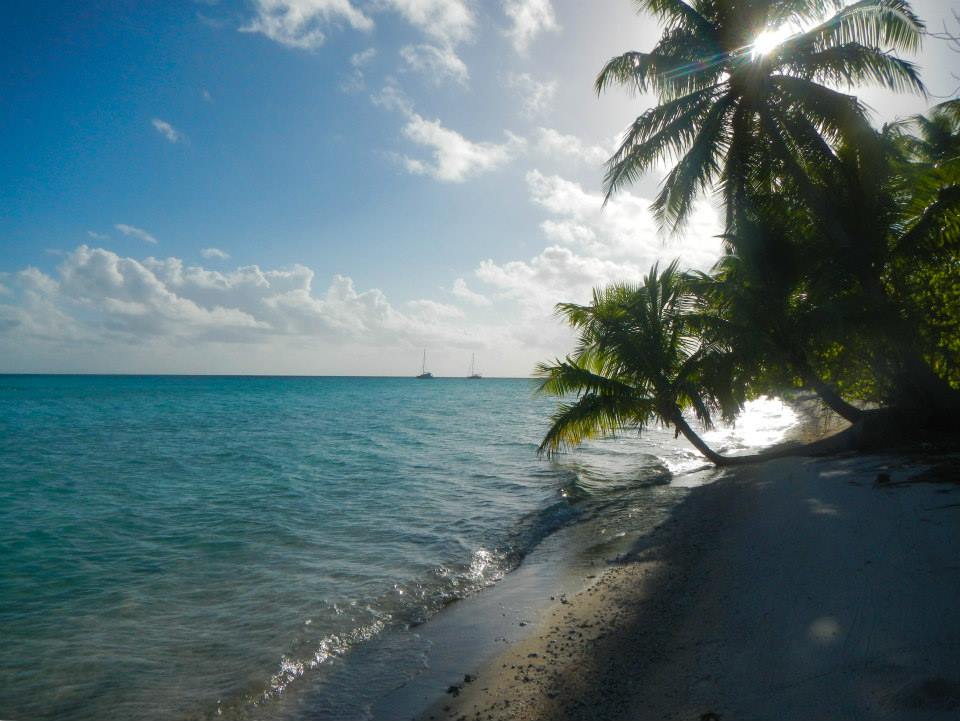
After we left the village, we anchored off this beautiful beach
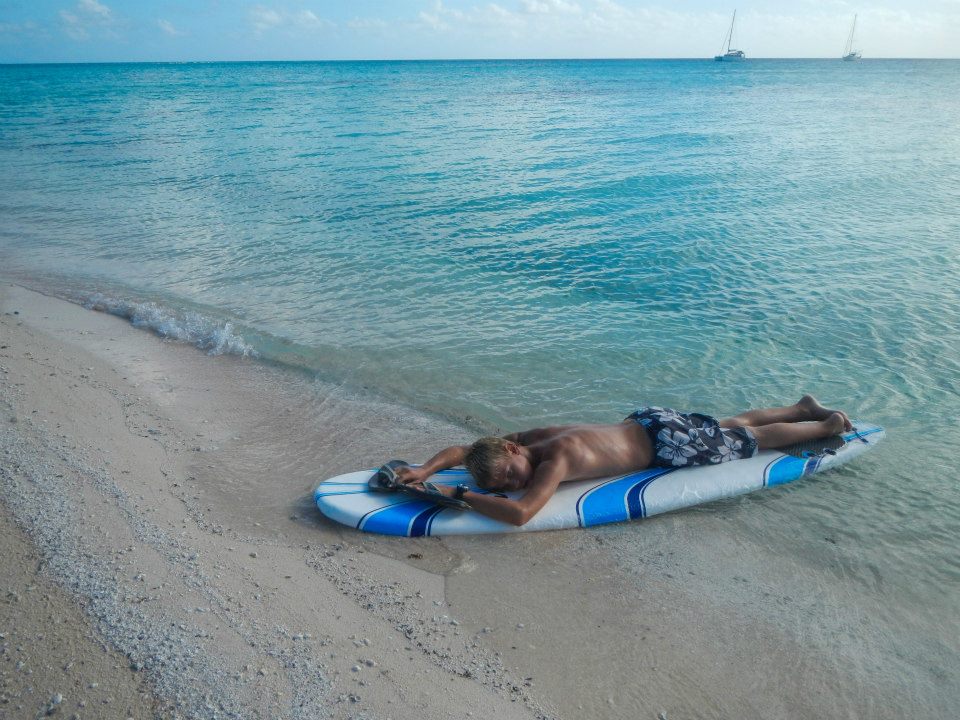
Alex and I had a grueling paddle to the beach
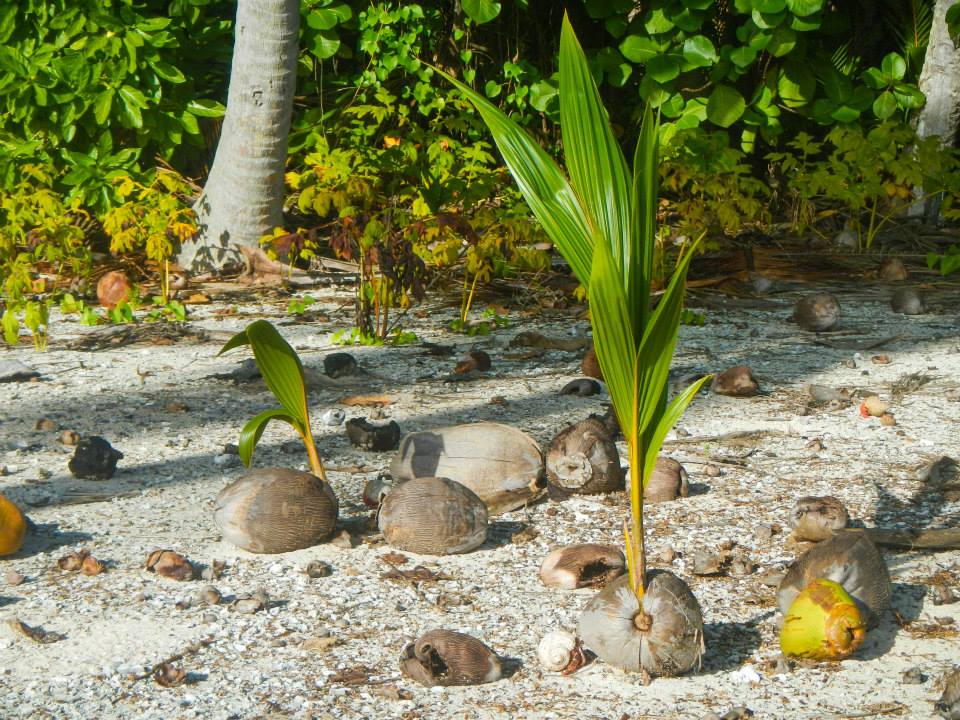
Some young palm trees

Logbook – May 29, 2014 (Makemo Anchorage to Makemo NW Pass)

Passage Log Highlights

  • 0842 Engines on
  • 0853 Depart
  • 0903 P engine off
  • 1208 P engine on
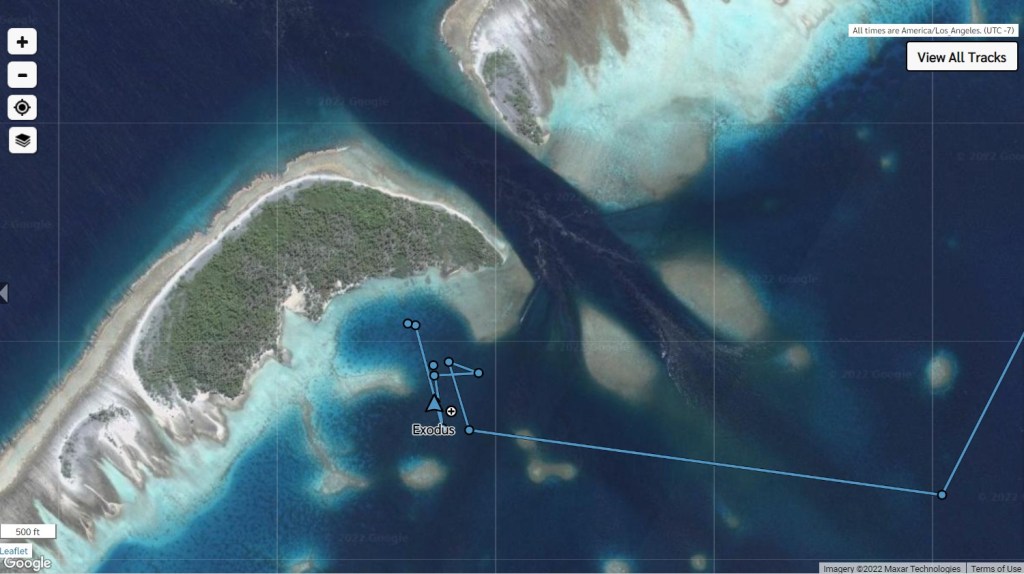
  • 1253 Arrive anchor near NW pass
  • 1600 Engines on
  • 1620 Re-anchor complete

Daily Notes

  • Waited for a squall to pass before anchoring
  • First anchored in the small lagoon
  • T/A/Steve/Kyle – snorkel in the pass. B still sick.
  • Decided to stay the night, moved anchor locations
Depart Makemo Anchorage at 0853 – Arrive near NW pass at 1253 – Reanchored at 1620
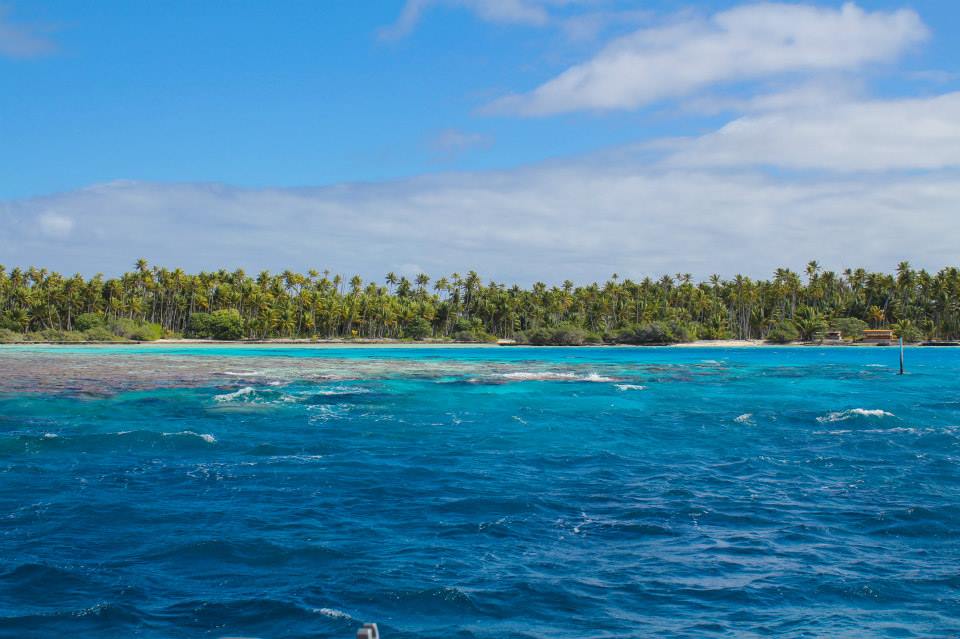
The NW pass at Makemo
The coral head behind us at anchor

Email to friends and family dated May 29, 2014

Subject: Still at Makemo

So, we ended up staying one more day tied to the wharf at the village, and I’m so glad we did. When I told the local kids we were staying “a demain” (until tomorrow) they were so excited they hugged me, especially the girls who are “in love” with Alex, Brenden, Kyle, and Joel. It’s funny, they communicate this by making a heart shape with their hands. They wrote notes with lots of hearts on them and gave the boys silly band bracelets. They spent the day with me on Exodus helping me chop vegetables and teaching me French. One of the girls would say a phrase in French and then tell me, “repetez.” They told me, in French, that they wanted souvenirs from us because they don’t want to forget us. I told them OK I understood thinking I would think of some things and give them later. Apparently what I actually did was give them permission to go to Alex and Brenden’s rooms and pick out what they want. They each came out with two shirts, dirty and smelly I might add, but they didn’t seem to care. I felt so bad I had to stop them because since they’ve been growing the boys don’t actually have that many clothes, especially Alex. Oh, they pleaded with me to let them have shirts, so I dug around in Brenden’s cubby and found some (clean) older, smaller shirts and gave them each one. Another funny thing is when Brenden came back he asked if I cleaned his room. I guess the girls thought the legos needed to be tidied up a bit! The next day Carolina was able to dig out a shirt of Kyle’s and gave that to one of the girls too, they were so ecstatic.

When leaving the dock we had a little bit of drama… we had bow anchor down and were stern tied to the wharf and good fortune had it such that the wind was blowing dead astern, so theoretically it would be an easy departure. Throw off the dock lines (we had help on the dock for that) and then just get pushed by the wind over the anchor as we raise it. No problem, right? Well, Alex wasn’t being quite as careful as he should have been and he jammed the anchor bridal hook up against the bow roller and the windlass fuse blew. I’m at the helm, and Tim tells me we have to raise the anchor manually, so “just hold us right here.” Well, some might think that with two engines holding Exodus in precisely one spot would be easy. And it is, in very light wind conditions. But with huge windage and very little keel, once the wind is over about 8 kts we get pushed around pretty good. And this day it was blowing 15-20. So, I try my best but we do end up getting blown sideways a bit, so my great idea is to just turn, drive back to line we were on, and then face the anchor again. In the process of doing that, I wrapped the chain around a coral head. What a fiasco, Tim had to jump in the water to free the chain, and at this point I just turned us around to face the wind so once free of the coral head we just floated back bow to the wind and raised the anchor manually (with help from Steve who had jumped in the water and boarded Exodus) in a more normal wind orientation for anchor raising. So, I was ready for my rum right there, but we still had 3 hours of navigating through the coral heads to the next anchorage. I dipped into the Zaya for that safe arrival cocktail! It’s a nice spot, but not as nice as where we anchored in Raroia as we are much further from the beach without as much wind protection.

We are heading to the NW pass later this morning to dive the pass and may even leave for Tahanea as early as this afternoon.

Love and miss you all,
-D.

Categories
Uncategorized

Skabenga Rolls in at Dusk

Most cruisers are cautious.  They scrupulously check weather, and when it came to these passes in The Tuamotus I’ve already written about how we all agonized over what time to arrive for slack tide, making sure we had proper sunlight to navigate the coral heads, etc., etc.  But there are always exceptions.

While Lady Carolina and Exodus were anchored on coral heads near the pass at raroia, we got a radio call from an approaching vessel at dusk.  It was someone we knew, s/v Skabenga, and they said they didn’t want to spend the night outside, so they were coming in, and did we have any advice.  Holy Crap.  Coming through the pass now?  Where are we in the tides?  Is there enough light to see?  Where the hell will they anchor?  Where we were wasn’t exactly an anchorage, maybe they could follow the lighted channel to the town?  If it had been either Carolina or I who had picked up the radio, our responses would have been the same.  Our advice to you is to stay outside for the night and come through the pass in the morning when you can, you know, see.  But it was Tim who was first responder, and to be honest I don’t even really remember what he told them, because I was floored that it wasn’t advice to stay outside.  All I remember are his words at the end, “good luck.” 

So, in they come.  No drama.  They come just inside the pass and drop hook just off the coral shelf inside in I don’t know what depth, but probably pretty deep, since we had circled the area for an hour the day before looking for places to anchor.  In the morning their back end looked like it was situated right on top of the coral.  And after talking to Bruce later, it actually was.  They had a foot or two under their stern.  If it had been us, our saildrives would have been bashing but luckily their configuration is different and their saildrives are actually further forward up their hulls.
When it was light enough, they made their way across the lagoon and were no worse for the wear.  So, what are we all stressing about?

Categories
Uncategorized

Raroia Pearl Farm Tour

Raroia Pearl Farm Tour (mostly by Steve from S/V Lady Carolina)

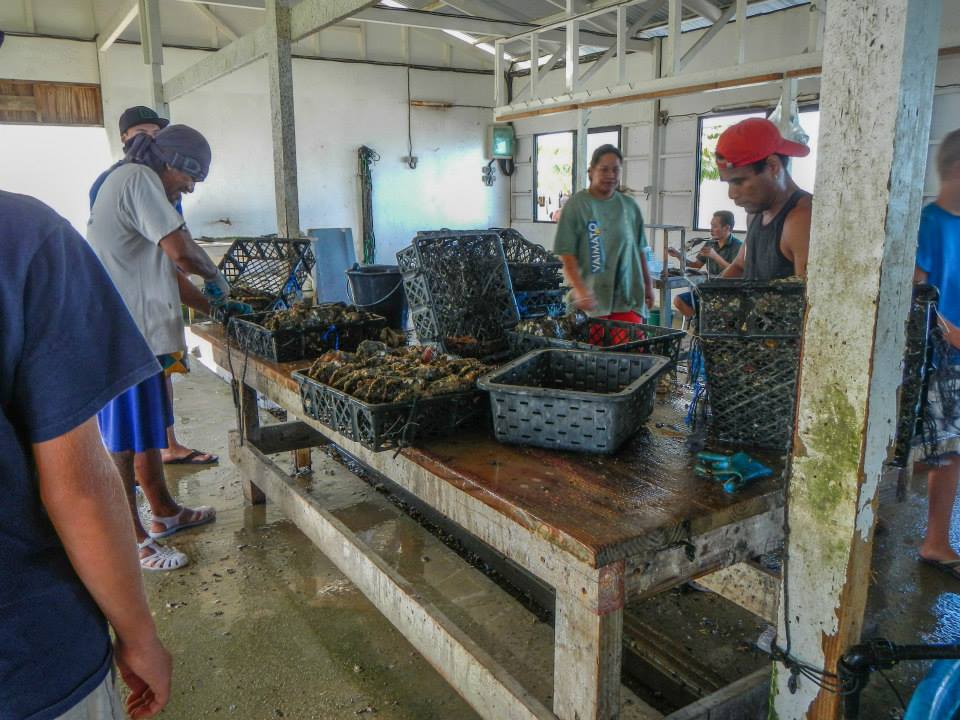
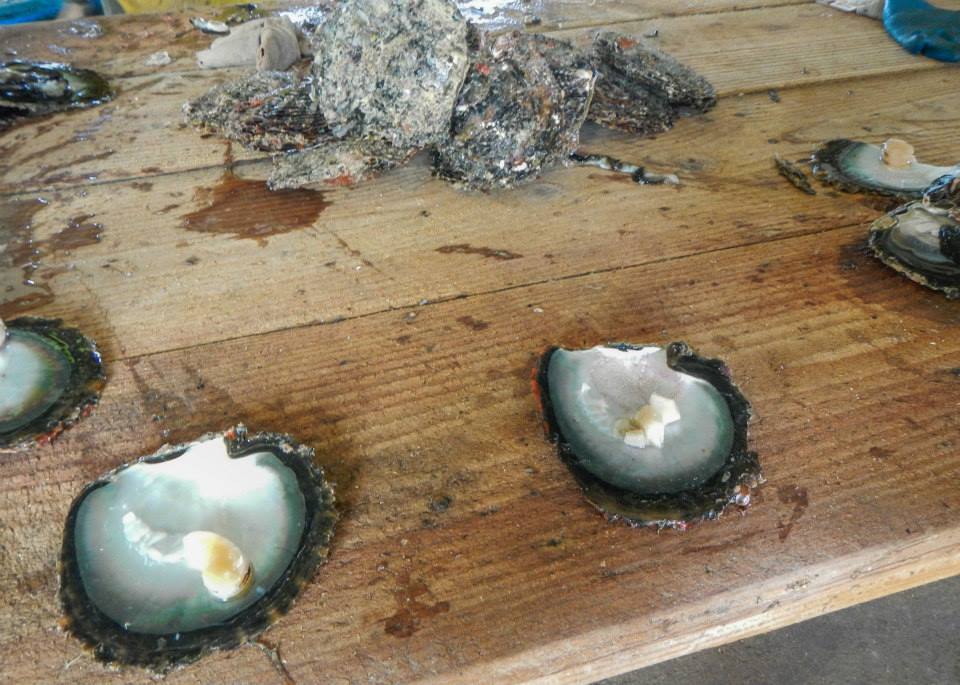
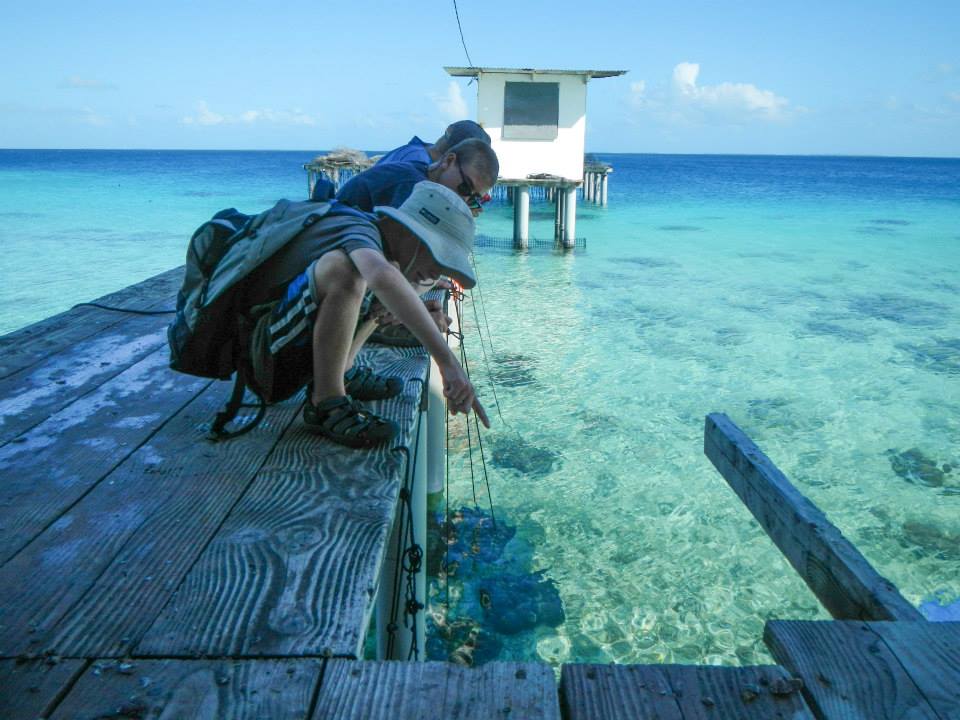
We had heard and read a lot about the black pearl industry in The Tuamotus before we got there and about how cruisers before us were able to buy pearls directly from the farms for very cheap, so we were excited when our friends on S/V The Beguine organized a tour of the pearl farm in Raroia for all of us.  Paul and Celeste had been there the day before and spoken with the owner, so it was all arranged.  There was a shanty dock that we all tied our dinghies to and some loud construction going on near the water.  On the dock, two guys were pulling strings of scallops out of the water and putting them in wheelbarrows.  Once full, they’d push the wheelbarrow into a large open warehouse type building, where most of the activity was going on.  So, one of the first things we learned was that the black pearls come from scallops, not oysters.

We didn’t meet the owner that day, because he was away in Tahiti, but we spoke to the forewoman, and met several of the workers.  They have quite an assembly line operation going on, even if on a small scale. 

Steve, from Lady Carolina, did a really good write up on the operation, so I’m just going to use that here instead of recreating my own:

There were about 12-16 people processing the shells in total and another 5 or so people working on the surrounding structures.
Some point form notes:

–    I thought that pearls come from oysters however the shells certainly looked like scallops, so I am not sure what they were
–    The black pearls that they extract are about 12-14mm in diameter.
–    When they seed the oyster, they use a (guess) 10-12mm white ?pearl? (actually, some other shell from the Mississippi). This means that the black pearl is not ALL black pearl ?it’?s a thin coating on top. I never would have guessed that. Kind of like learning about Santa Claus
–    It takes the oyster/scallop 1 year from seeding to retrieving pearl
–    They do not harm the shellfish when removing the pearl in fact it is quite an operation as follows:

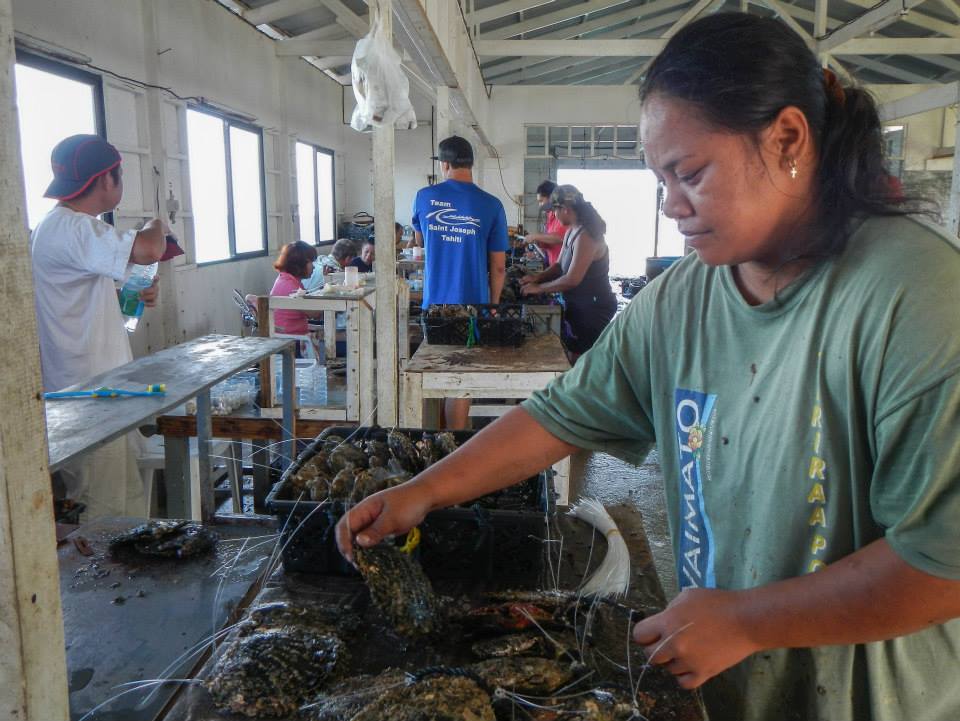
a)    Divers retrieve large strings of oysters on a line. (15 or so on a ½? polypropylene line) that are submerged off on one of the many (argh!) buoys/lines that crisscross the atoll
b)    Oysters are brought to a temporary holding pen on the end of the dock of the processing plant. (In the water)
c)    Workers, as required, bring up strings of oysters, put them in a wheelbarrow and move them 75m to inside stage 1
d)    Stage 1: Workers cut off the monofilament lines that attach oysters to ½? line with machetes and then use machetes to clean off numerous other smaller shells that are attached to the outside of the oyster.
e)    These cleaned shells are put in a crate and the crate put in a large blue (4m? diameter, 1m depth) ?pool? that is cycling salt water.
f)    Another worker drills/redrills the holes in the shells for the monofilament line.
g)    Oysters back in the holding tub
h)    Another set of workers remove the oysters from the tub and use a special wedge tool to just open the shell a little bit and then a small plastic wedge is placed in the shell to keep it open.
i)    The shells are placed upright, wedges up, in the same orientation in a single layer in another plastic crate and put back in the water
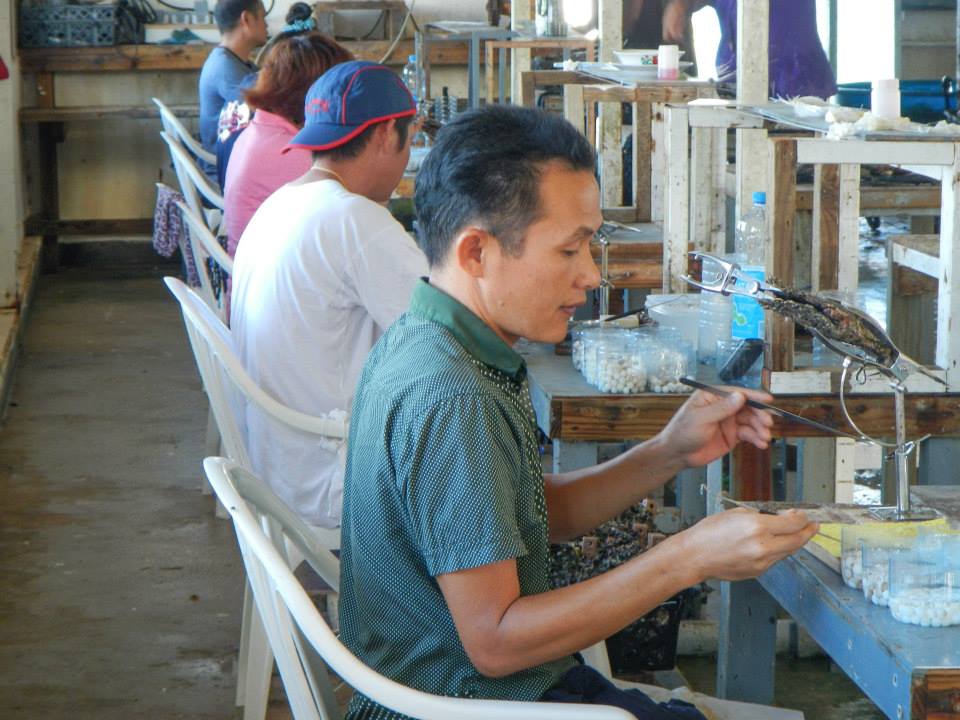
j)    The pearl extractor (we were told they make 100kUSD/year) takes an oyster shell and puts a set of handheld spreaders into the shell where the wedge was and opens up the oyster a bit more. Jiggles the oyster around to the correct orientation and then places the shell in a holder.
k)    When in the holder he uses to long tools similar to dental probes to cut a small incision inside of one of the organs to retrieve the pearl. Examines the pearl. Good paerl in one bucket, bad pearl in another bucket. If a good pearl the oyster is reused and another seed pearl is put in, if the pearl was bad, the oyster is put into the discard bucket.
l)    The whole operation that the pearl ?surgeon? does takes about 30-45 seconds
m)    The good oysters get new monofilament put through them and they are tied to strings
n)    The strings are taken to the temporary holding pen at the end of the dock and eventually put back out in the bay.

Everyone is happy that is working there (or so it seems but it is really repetitive assembly line work) but what is totally staggering is the VOLUME of oysters that are moving through the line coupled with the knowledge that it takes a year to culture a pearl?there has to be 100,000?s of oysters strung up just in this atoll!!! (That is assuming that the operation runs year round?.not sure if that is the case, either way it is a lot of oysters all over the place)

It is actually nice to see that they have a 100% sustainable business that is managed quite well. There are many pearl farms in each atoll and many atolls that have pearl farms.

On a sad note, we were not allowed to purchase any of the pearls as the ?boss? was not there. There apparently is a HUGE tax on the pearls and it is monitored closely. We hope to find someone that will sell us a bag of them under the table in the next atoll.

Pulling scallops from the water at the Raroia pearl farm


Categories
Uncategorized

Coconut Crab Hunting

Coconut Crab Hunting (By Steve from S/V Lady Carolina)

Yesterday afternoon Tim, Craig, Louis and I braved the flies and went into shore to set up traps for coconut crabs. Apparently, whoever introduced flies to the Tuamotu’s did not want them to be alone, so he also introduced mosquitoes. I am not all that sure what the flies and the mosquitoes eat however they both have an impressively massive population. Perhaps they get together and potluck during the evenings. (I have not seen mosquitoes like this since being back in Calgary….they were pretty bad and we had to retreat for bug spray……well, and more beer of course.)

Given that we are not seasoned coconut crab hunters my only information was to split coconuts and stake them down to the ground with spikes so that the crabs do not drag them away. We spent about 1-1.5 hours finding crab holes, splitting coconuts and spiking them to the ground. There is no shortage of coconuts on this island. I bet that 99% of the vegetation is coconuts. We actually had a rough time finding trees suitable to make into spikes. After the traps were set, we returned to Exodus for our evening potluck.

A few hours later when it was dark, we ventured back on shore and quickly determined that flies cannot see well at night whereas the mosquitoes have excellent vision during any time of day.

After we bug doped up and started our trek with a 2.5-gallon plastic bucket, we walked towards the first trap. Perhaps the rum was the cause of the difficult walking, but I am going to suggest that walking on 1000’s of large ball bearings at night on uneven, rocky terrain was to blame. There are literally 1000’s of coconuts and associated palm leaves blanketing the forest(?) floor.

As we arrived at our first trap, we learned a couple of things.

1) Hermit crabs LOVE split coconuts.
2) There are as many hermit crabs on the island as coconuts.

Essentially, we spent 1-1.5 hours setting up hermit crab feeding stations. Well, just for good measure we threw a couple of the big ones into the bucket. You never know how good they taste until you try one.

After a little while we saw other crabs that were not hermit crabs. We have arrived!!! We found the crabs and they were relatively easy to spot and catch. There was some confusion and question as to whether or not these were coconut crabs however when we caught a couple they were running away with coconut in their mouths. Well, it was definitely a crab, and it was eating coconut soooooooo it makes sense that these are in fact coconut crabs. Off we go to catch more.

Soon the bucket was filling up with crabs that certainly did not want to be in the bucket. A 2.5-gallon bucket is not all that big, and the job of the bucket carrier was to shake, spin, beat down, chase and recapture the ones that got out. This was almost a full-time job and, in the end, if you could get the crabs mad at each other they would tangle up in a ball of pincers and hold each other down. How do you get a crab mad you ask? Personally, I found that shaking, spinning, beating them down and recapturing them did that plenty well. Every now and again one would spring free and had to be recaptured.

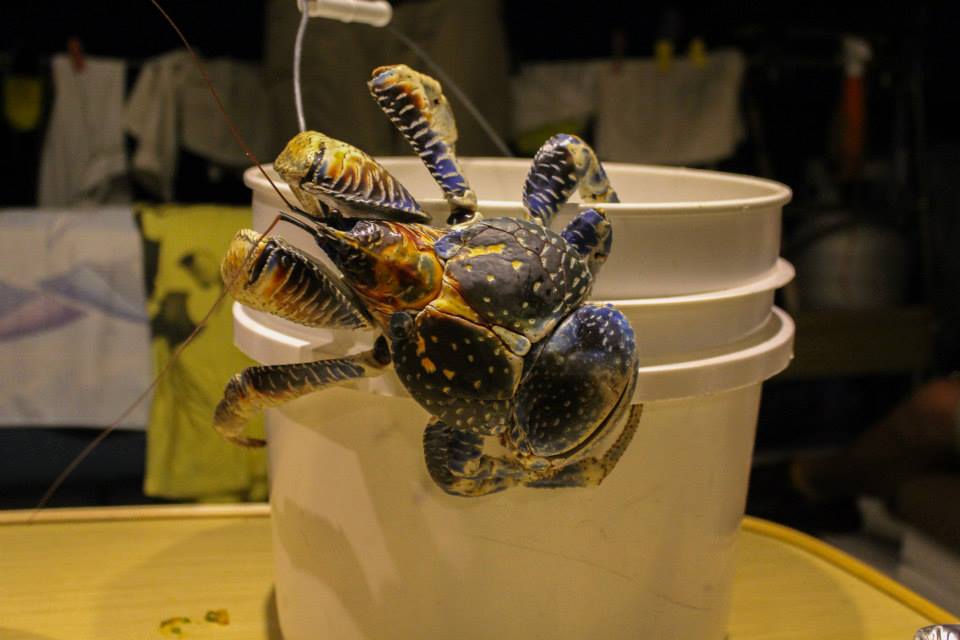
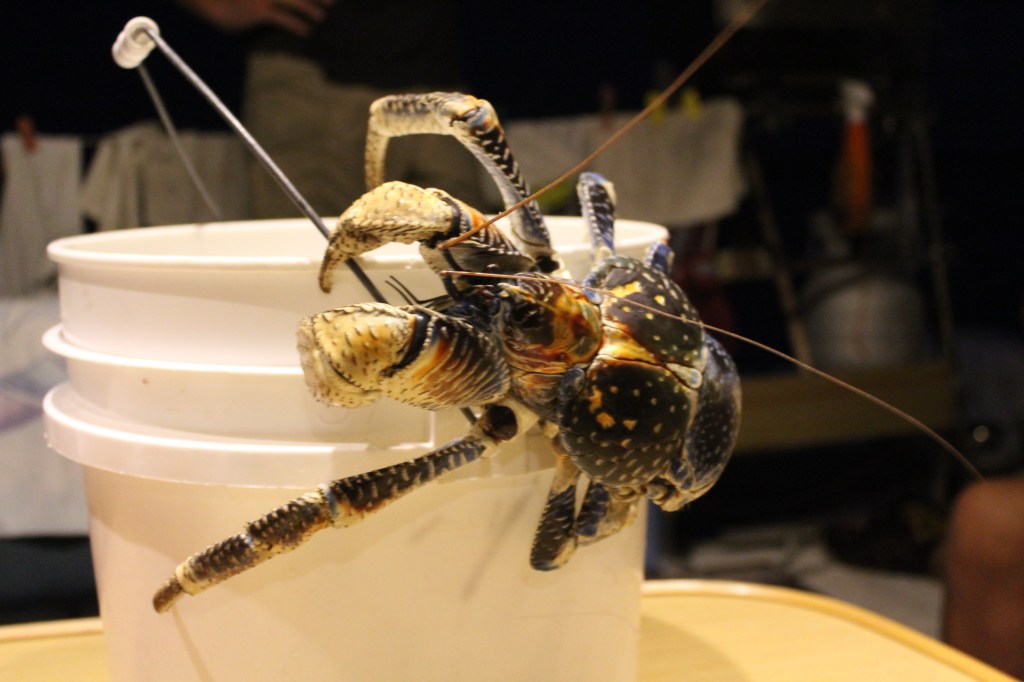
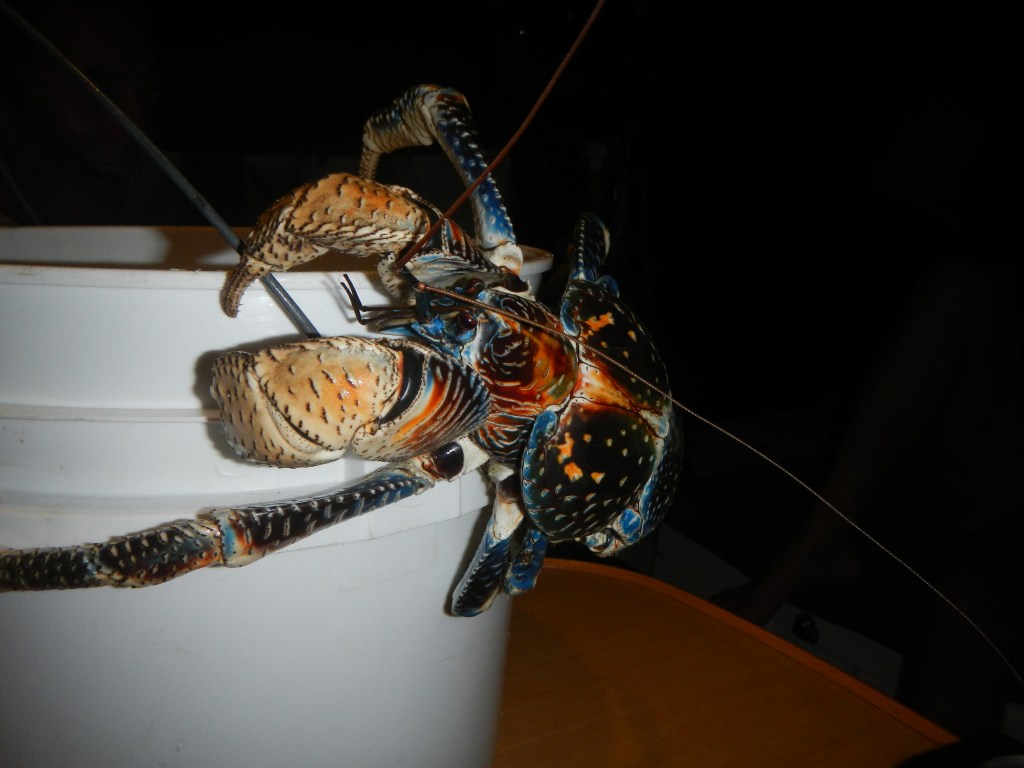
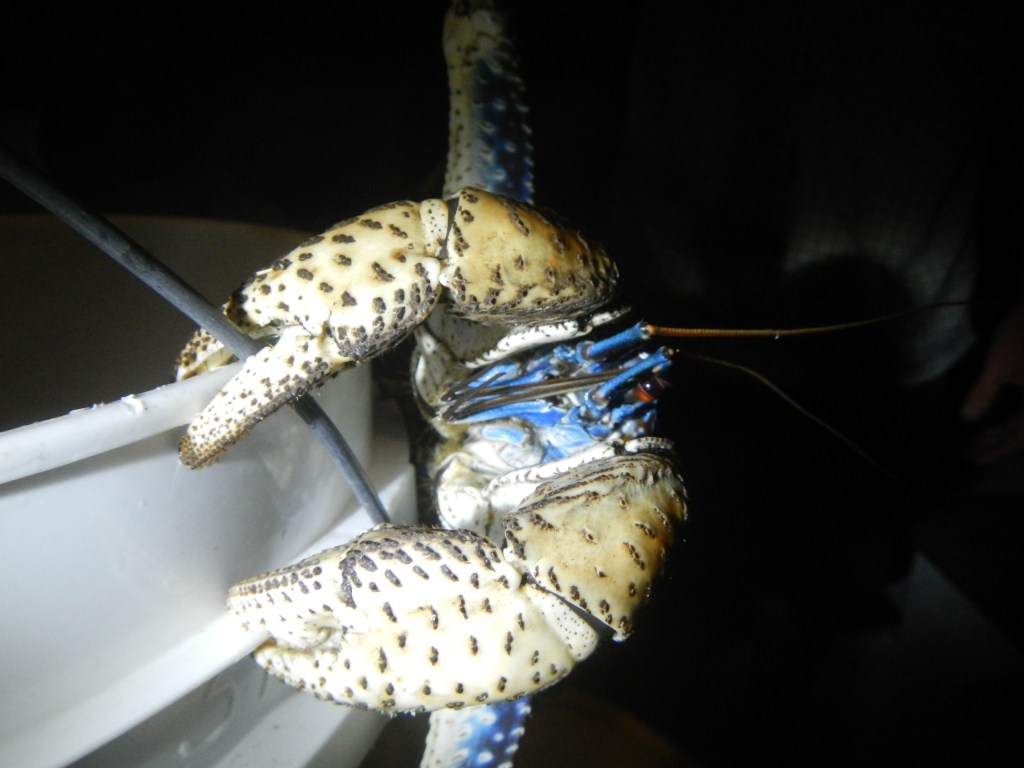
At about time that I figured out how to control the crab-mass Tim yelled out. “Holy crap, what is that?” At that point we all came over and he had his light shining on a fairly large 10-12″ long, 4″ wide vibrantly blue crab-lobster like thing! Aha!!!!! THIS MUST BE A COCONUT CRAB!!!!!

We all concurred that this WAS the coconut crab that we have been looking for. The only problem is that we did not have any bucket room. The solution? All of our work getting the other crabs was lost and we dumped the crab-mass. They did sit there in a pile for a few seconds until they realized that they were not in the bucket and then they scrambled for cover. A neat sight to see. They all put their opened claws up in the air and ran sideways while saying “aye, aye, aye!”

We then put the coconut crab in the bucket and proceeded to look for more. We looked for a while with no luck and then decided to cross the island to the windward shore to look for lobsters at low(ish) tide.

As we moved towards the windward shore the vegetation turned from 99% coconut trees to 99% brush. More like a wall. While traveling through the brush-wall we discovered another interesting thing. Whoever introduced flies and mosquitoes apparently knew that this was a mistake. I am not sure if he tried little mosquito traps or fly paper and got poor results or not but the end solution to the original mosquito and fly problem was to introduce spiders. Many spiders. 1000’s of spiders.

These are special spiders with HUGE abdomens full of silk. Or they used to be at least until they made their numerous webs. The webs were no match for our might, and we easily smashed through web after web after web with our faces.

On the other side we found the remnants of a (40-100′?) steel boat that was washed up really high (inches deep water). Pretty sobering to see such old thick plates of steel broken and twisted and laying in pieces on the reef that we were walking on. Mother nature sure is tough at times. Perhaps the guy that introduced the flies, mosquitoes and spiders was on that boat and this was his punishment? I certainly hope so.

On the other side we did not see lobsters but lots of eels, small fish and something big that splashed a lot and swam away. I did not see it, so I am not sure what it was. In any case, tromping through a shallow reef at night with a flashlight and seeing something big splash in the water and only seeing a shadow leave was an entertaining adventure. After that experience the files now have something to eat.

During this walk through the trees, brush, reef our brightly color crab hung happily on the bucket, right at the top just sort of hanging out.

We decided to make our way back to the boat. Instead of returning the way that we came we decided to try a different route. Great success, it took us 10 min to get through the brush and onto the leeward side back to the dingy. The island is shaped like a teardrop.

We took the crab back to the boat to let everybody see it. (Not exactly our original plan, arriving back at the boat with 1 crab for 12 people after 16-man hours) We took pictures of the crab (which is a really gorgeous animal….well, for a crab). Poked it for a while, played with it and since it was the only one we caught we decided that there are clearly not an abundance of them, so we returned it back to the jungle to let it do its thing. I am sure that he is at the fly/mosquito/spider potluck telling all of his friends “You are not going to believe what happened to me last night!”

The lone coconut crab
Categories
Uncategorized

Floating the Anchor Chain

We read about this in the Soggy Paws Compendium, and it became standard part of our anchoring process while in the Tuamotus.  Basically, the bottoms of most anchorages are littered with coral heads of various sizes.  So, even if you find a nice sandy patch to drop the anchor on top of, since the anchor chain lays along the bottom it can get wrapped around a piece of coral if the wind shifts a bit or even as you swing about on your anchor.  So, in an effort to minimize the chances of this happening, Tim would attach anywhere from 1 to 4 floats along the chain to keep it elevated up off the bottom.  The first few times he did it from the water after anchoring, and this could be quite a chore since you had to get the anchor chain and the float close enough to attach, and the anchor chain is heavy and the float is of course buoyant, so it would take some strength and a lot of kicking while breath holding to make this happen.  Eventually, he figured out to just attach the floats from the bow as we are paying out the chain when anchoring.  Much easier.

Categories
Uncategorized

The Soggy Paws Compendium

The “Soggy Paws Compendium” became our primary source of information and waypoints for the Tuamotus.  Basically, this is an informal guidebook put together by a cruiser (s/v Soggy Paws).  They have gathered input from various cruisers and blogs over the years and have organized it into a document for other cruisers to use.  They have a compendium for most island groups in The South Pacific, but I had an abundance of guidebooks for The Marquesas, so I really didn’t delve into the compendium too much.  That changed for The Tuamotus.  All I had was Charlie’s Charts for Polynesia, which in general hasn’t been that helpful for anywhere because the chartlets are hand drawn and hard to read, the information is usually outdated, and the information on the passes are usually just worst-case stuff.  Also, the French Polynesia guidebook I bought in Hiva Oa only covered the most heavily visited motus and didn’t even include the ones we wanted to visit. 

So, the compendium provided us with a lot of firsthand accounts of the atolls, and in many cases even included anchor waypoints.  We are grateful to the cruisers who came before us who took the time to write up their experiences and even more grateful to Soggy Paws who collected the information and made it available to everyone else.

Categories
Uncategorized

Our First Atoll – Raroia

Raroia was our reward for the awful bash down from Nuku Hiva.  It is a large atoll, but not really one of the largest, which will give you a sense of just how big these things can be.  It’s oval shaped and about 21 nmi long and 6 nmi across oriented in a SSW to NNE direction.  It has a single pass for yacht transit called Passe Garue, which is situated on the NW side.  This is good, because since the trade winds blow from the E or ESE the pass entrance is in the lee of the atoll, so the sea conditions were calm as we waited to go through.  It is a deep pass with just a few exceptions, and according to Charlie’s Charts, “Tidal streams and currents can reach 8 knots and slack water is usually of short duration.”  Eight knots would be tough for Exodus, but luckily, we were there in much more benign conditions. 
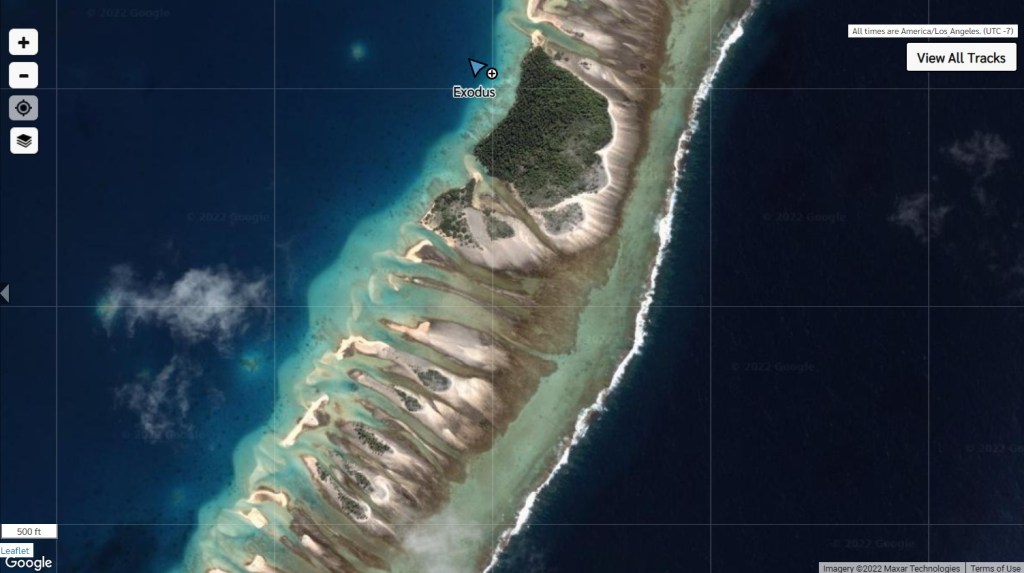
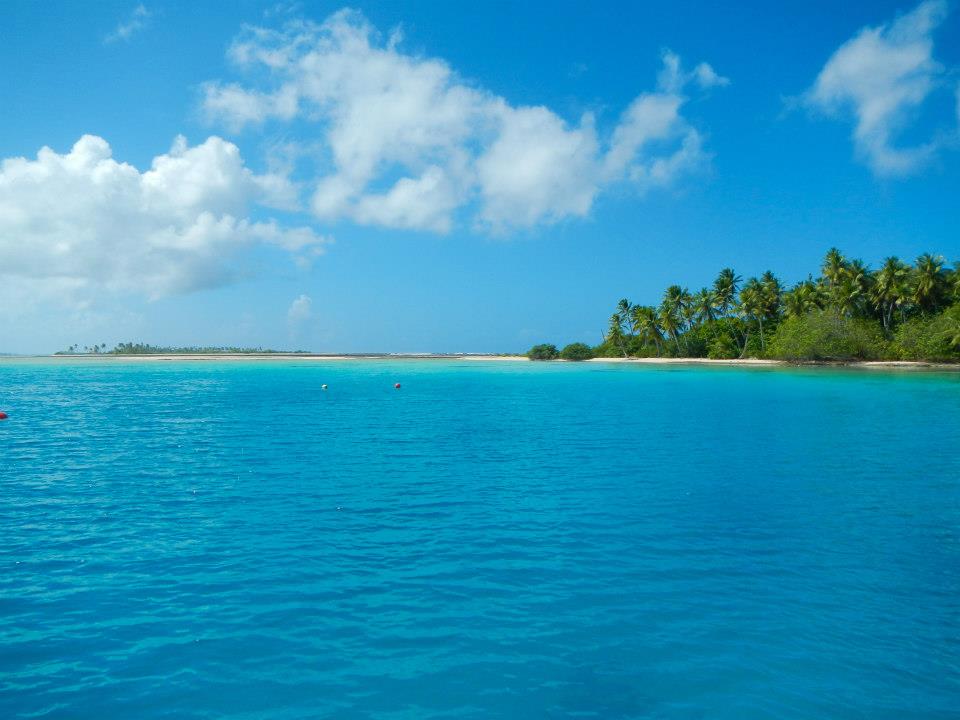
There is a single village called Garumaoa, which again, according to Charlie’s Charts has a population of about 50.  I’m guessing since the publication is slightly dated that the population estimate is on the low side.  The village is located on the West side, down a well-marked channel about 1.8 nmi south of the pass.  This is also the atoll where Thor Heyedrdahl’s Kon-Tiki (google it) grounded on the eastern side of this island, and supposedly there is a little “monument” and even though we had GPS waypoints for it, we never went to see it.

I don’t have great notes on all of this, but my recollection is that we arrived at the pass entrance just about when we anticipated slack tide to be, but a quick look with the binoculars showed that it was still an incoming tide.  Since winds were blowing from the East we had the situation of current opposite wind, which every guidebook said you should avoid.  So, we slowed down and pondered what to do.  First, we radioed for “any station inside the Raroia lagoon” because we were told that when you pull up to a pass you can always reach another cruiser inside who can give you any necessary tips and intel about slack tide.  All we heard were crickets. Well, after that we didn’t ponder too much longer, because Tim’s assessment based on the visual with the binoculars of the standing waves on the inside of the pass (they were on the inside since the current was flowing in) was that it was something Exodus could easily handle.  Neither the wind nor current appeared very strong, so even with the opposing condition, it really didn’t look that bad.  Me, I probably would have waited around for slack tide before going in, if for no other reason than we’ve never done this before, and even though it doesn’t look that bad, what standards are we really judging this by?

So, we went for it.  Tim was at the helm, and I was drinking rum.  No, not really, I was on the bow, and I’m not kidding, we were through the pass in about 2 seconds.  We had about a 2-3 knot current with us, so we just zipped right through.  Piece of cake.  Tim was right.  (He doesn’t read these essays, so don’t tell him I said that.)  Our drama didn’t start until we were inside the pass, and we saw black clouds looming and we checked the radar and could see a huge squall approaching us from across the lagoon.  I was seriously worried about lack of sunlight and our ability to see the coral heads as we tried to cross the lagoon, but we would deal with that after the giant squall passed over us.  So, we held position just inside the pass, in amongst about 3 coral heads, charted luckily, for about 20 minutes as we sustained pouring rain and 20+ knot winds.  It seemed like it would never end, but when it did, it did so rather abruptly, and the winds died and the sky cleared up and we suddenly had fantastic overhead sunshine, and the bombies were lighting up with the sun’s reflection.  Before arriving, I was actually more nervous about navigating the coral heads once inside the lagoon than I was about the pass entrance.  For some reason I was picturing us having to go like a half a knot with one of us on the bow giving quick directions to go this way then that way through a narrow winding lane of clear water surrounded by millions of coral heads.  I laughed at myself when we got there.  The coral heads were large and easily visible with lots of room, in fact Tim even used the autopilot and just changed 10 deg this or that way well in advance of a bombie that would be visible a half mile away.  So, Tim made a joke that we had mastered the first two dangers of the fire swamp (Princess Bride reference for any losers who didn’t get it), and we all wondered what the third might be.  We found it soon enough.  It was the underwater lines and bouys of the pearl farm, and our route across the lagoon had us going right through it and we didn’t notice until it was too late.  The boys and I had to be even more diligent on the bow and yell if we thought a line was going to be too shallow so Tim could put the engines in neutral as we skidded over it.  We never wrapped a prop or anything, but it seemed to take forever to get through it all.

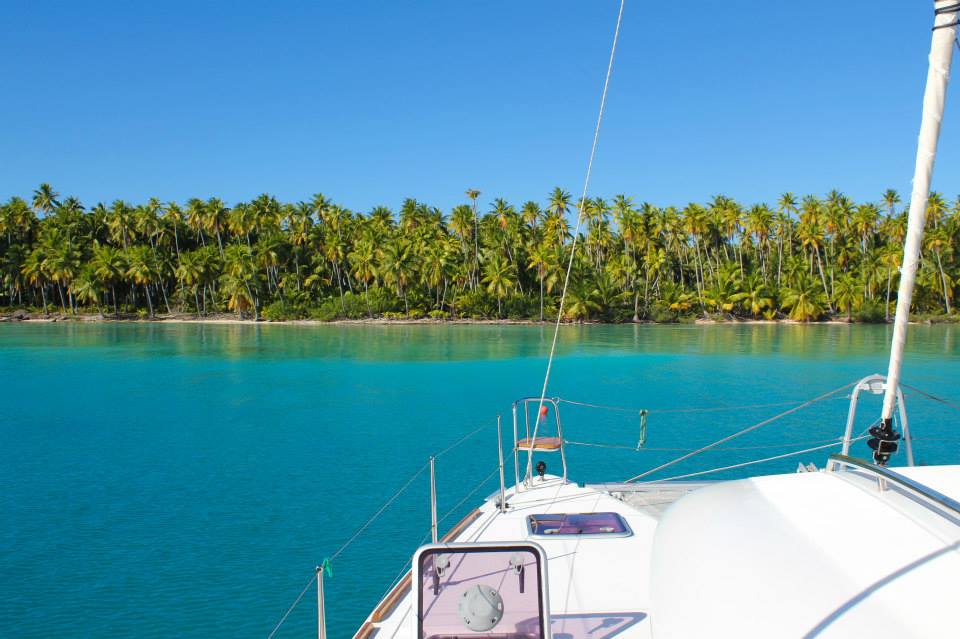
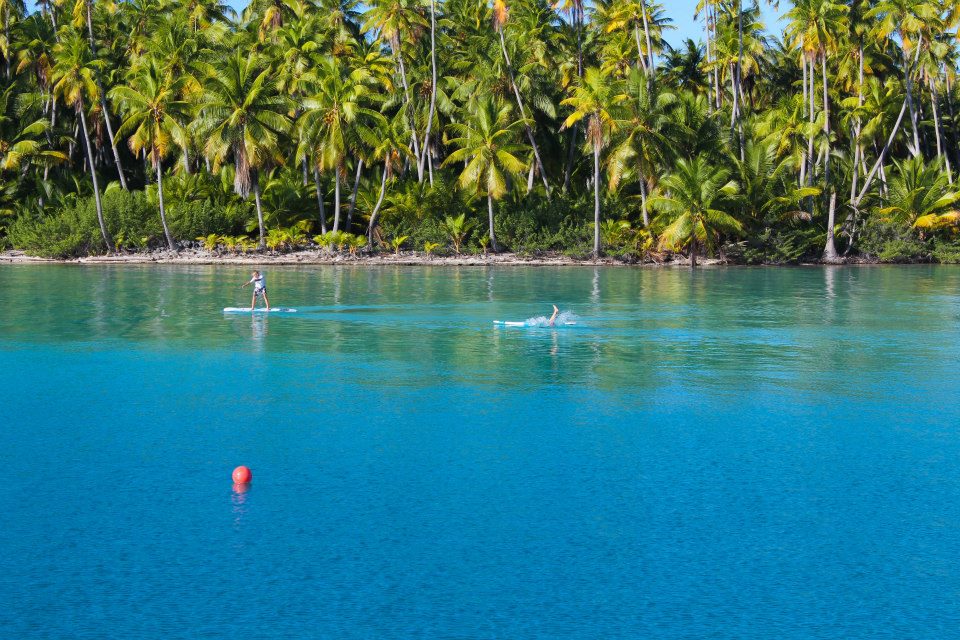
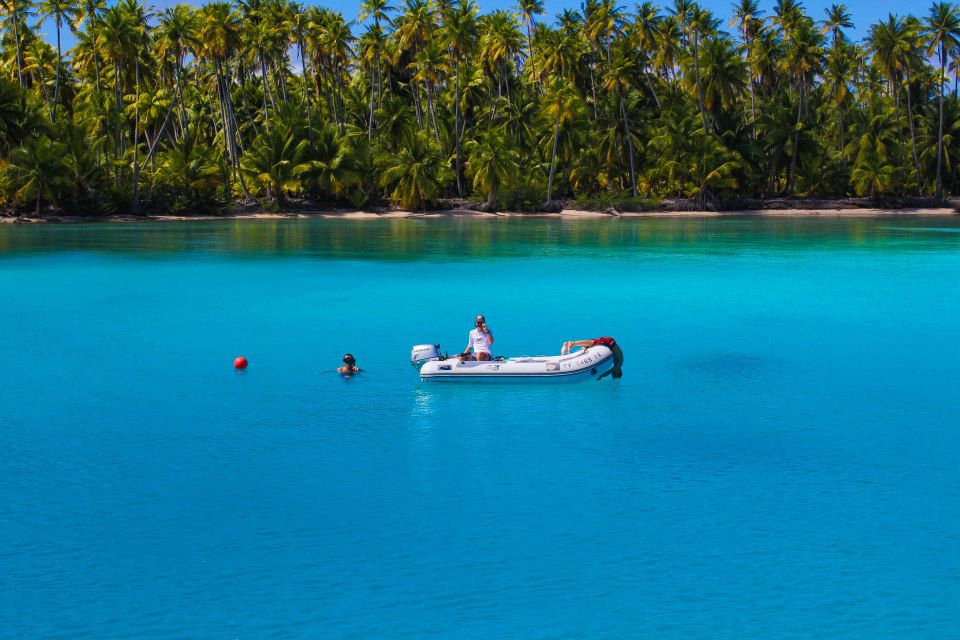
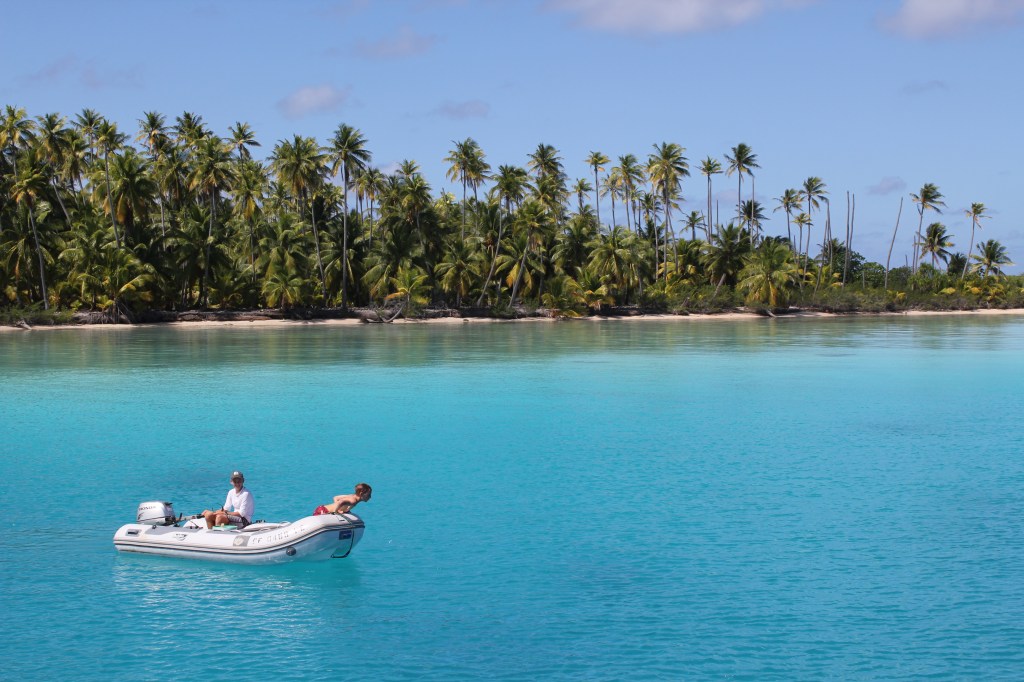
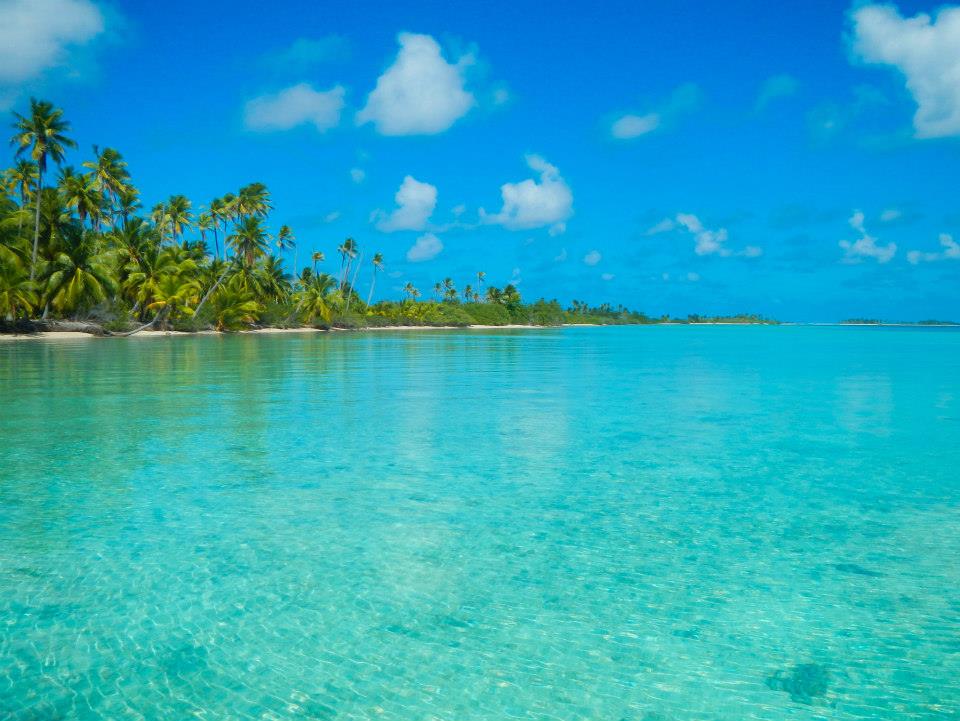
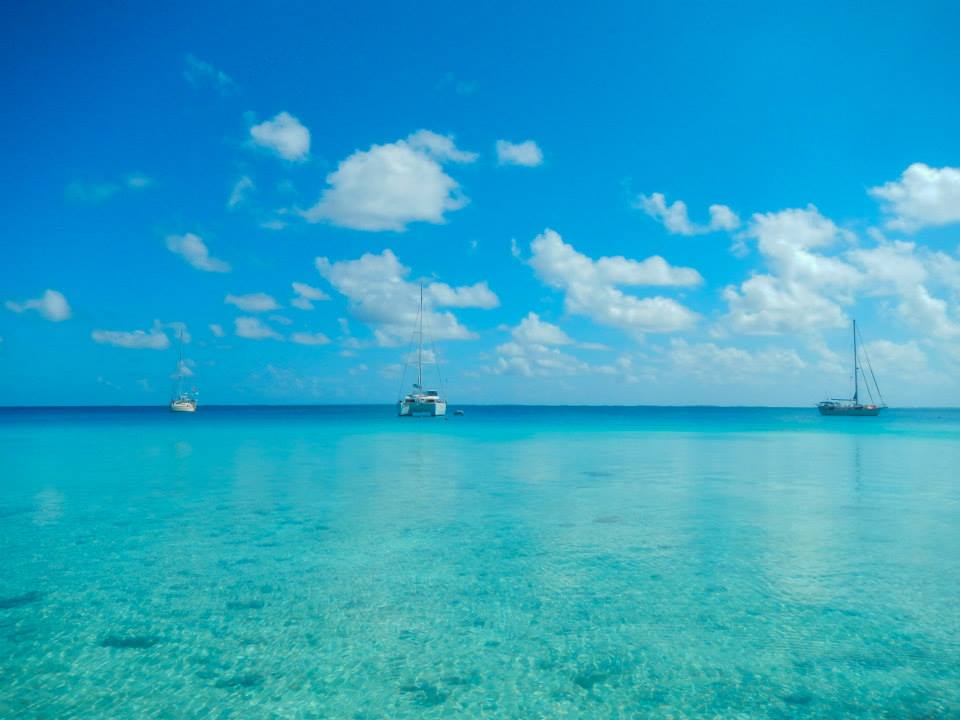
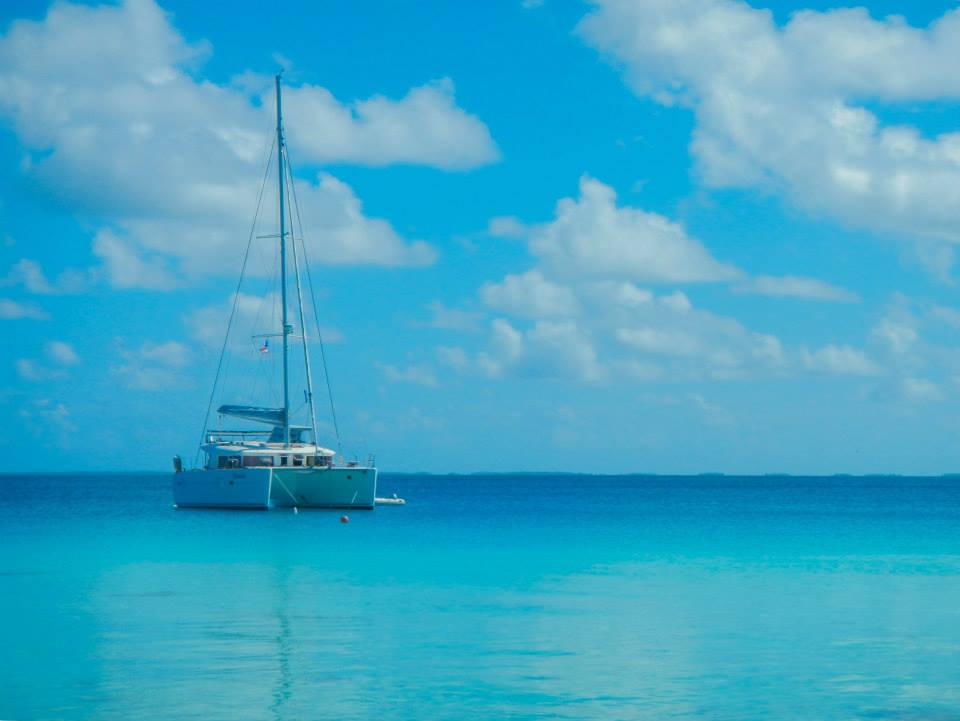
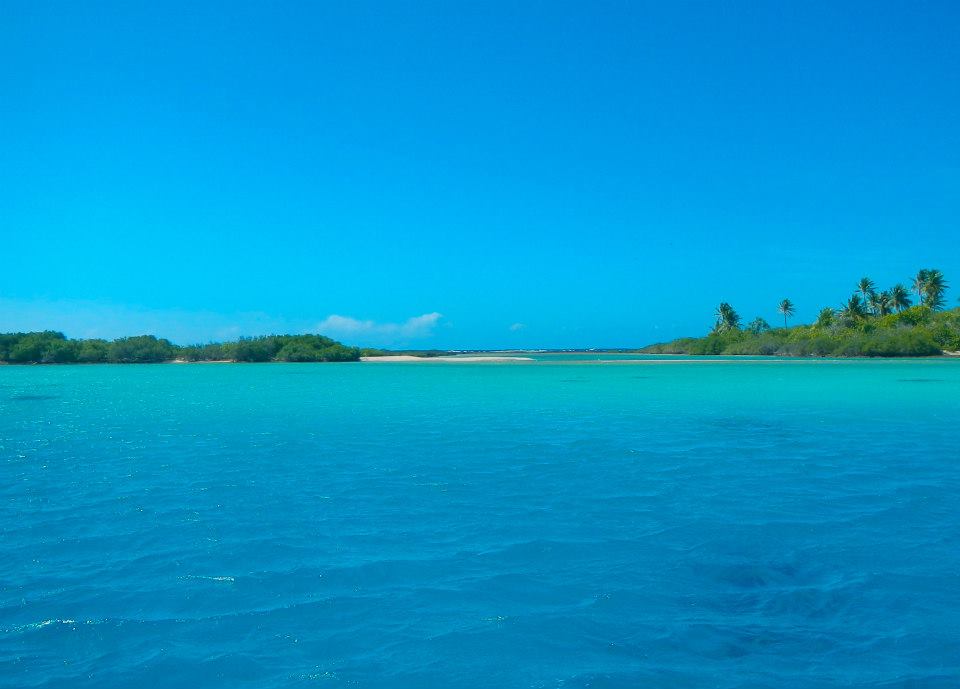
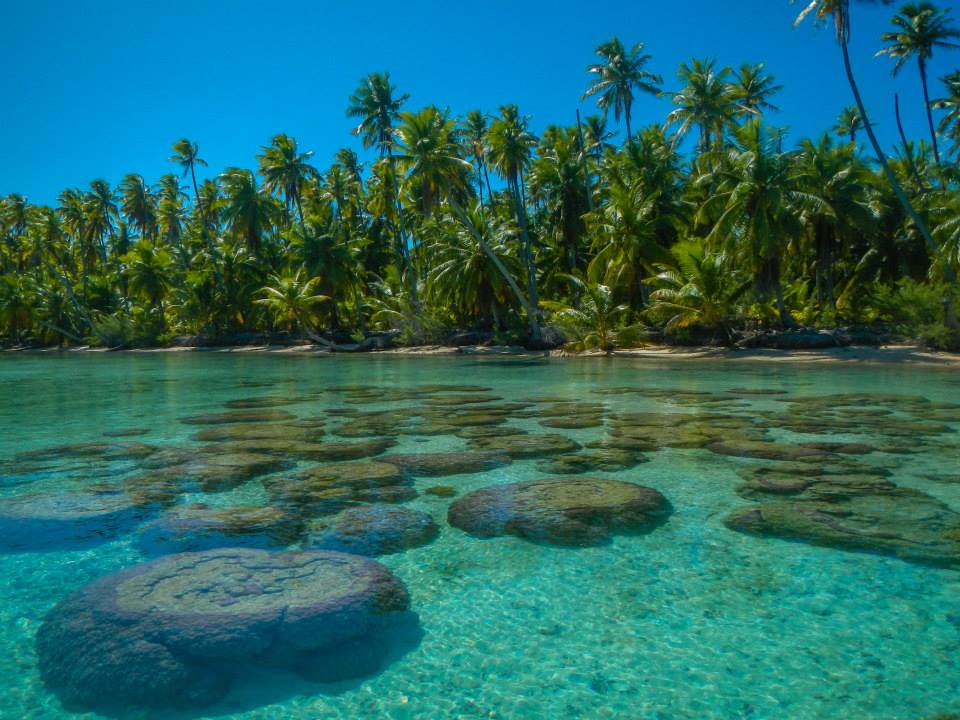
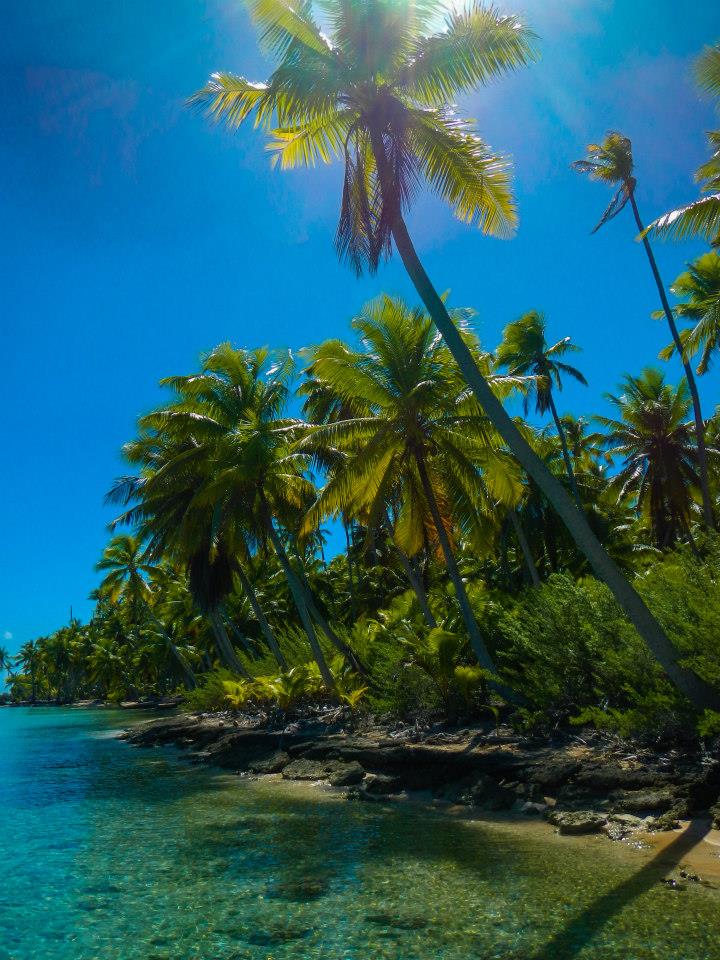
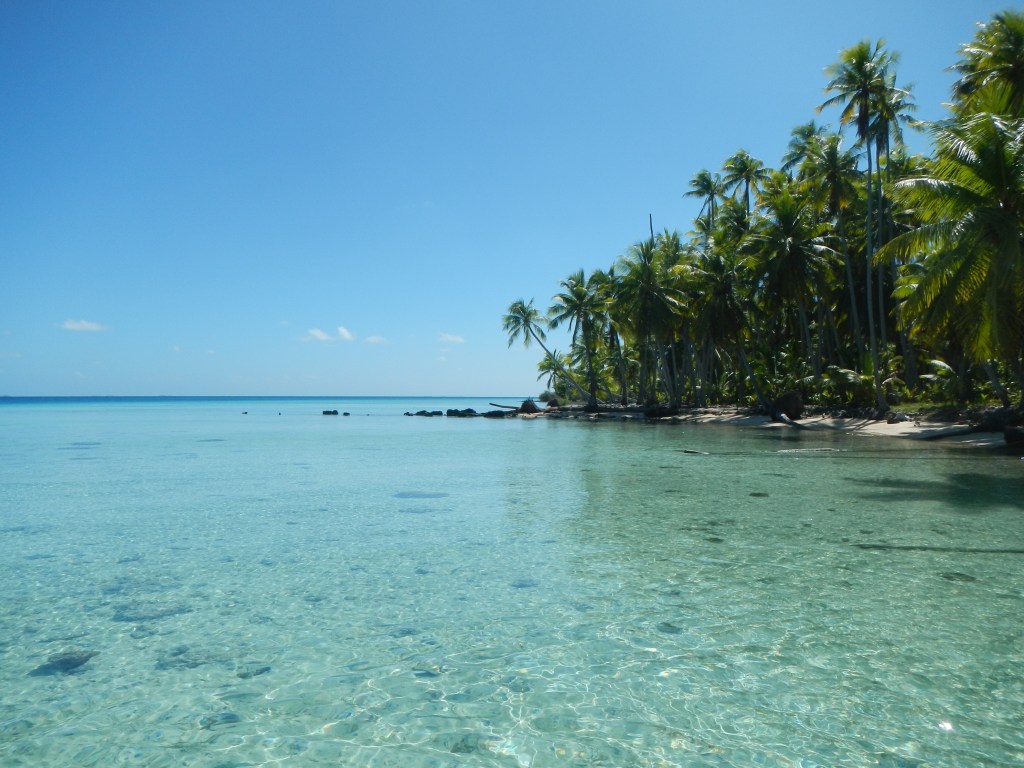
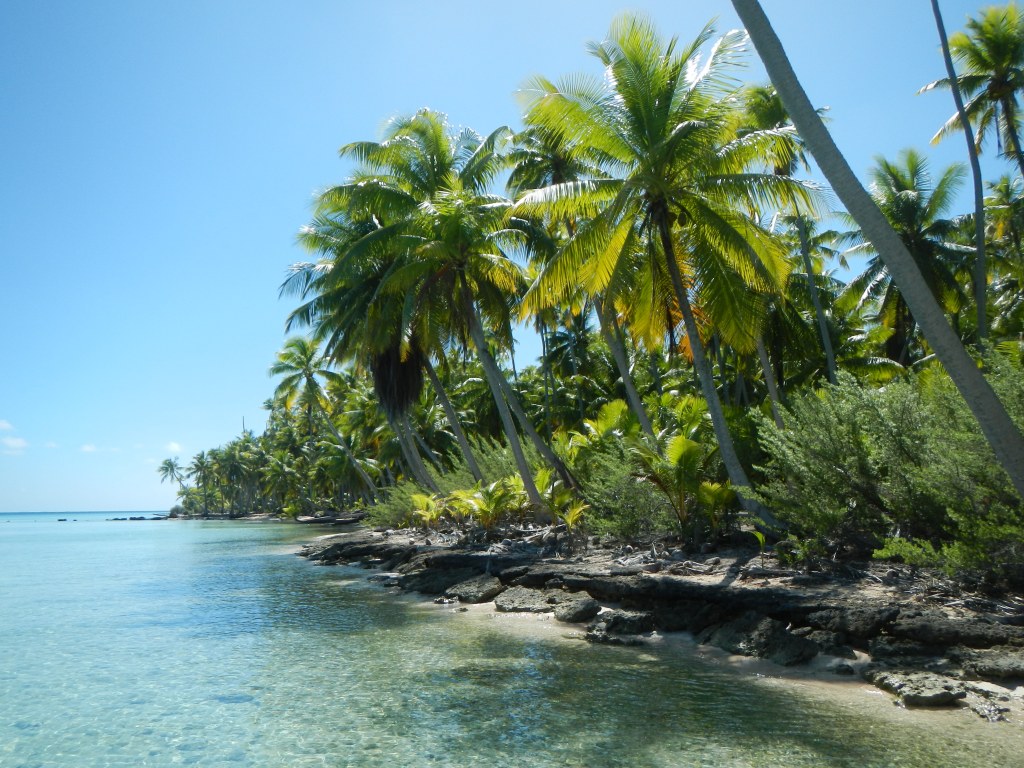
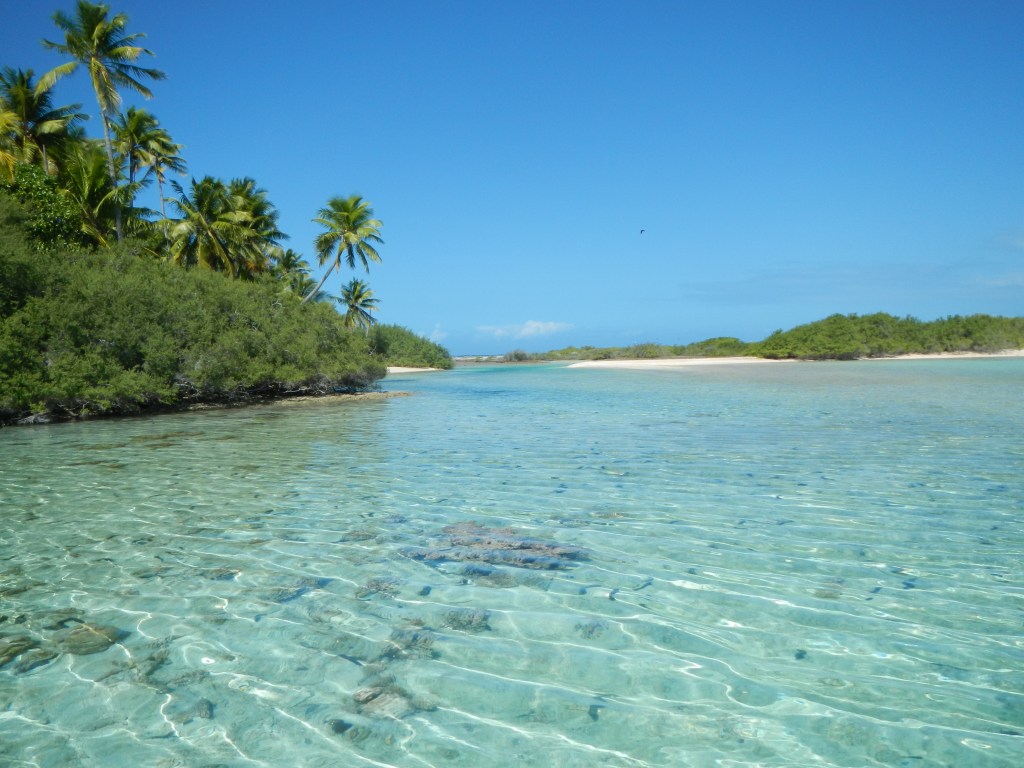
We had picked out an anchorage from the Soggy Paws Compendium, and when we arrived, it was jaw droppingly brilliant.  It was out of a postcard or a professional photograph, not a place that you actually get to visit in real life.  There was a white sandy beach, palm trees swaying, and crystal-clear turquoise water that beckoned you for a swim.  We were totally protected from the ocean swell bashing against the other side of the reef, and the low lying motu and palms also provided protection from the wind, so the closer you got to shore, the glassier and clearer the water was.  And there was absolutely no one else there.  Certainly not in this anchorage, and since no one was on AIS and no one answered our VHF call, it’s possible we were the only cruising boat in the entire lagoon.  It was amazing.  We were sitting in a stereotypical remote tropical paradise with a slight breeze and water lapping on the swim step. The weather was a bit cooler than The Marquesas, having dropped so many degrees in latitude.  Tim and I spent the evening on the net (Exodus foredeck) after sundown, and I was actually a bit chilled, a sensation I hadn’t experience since way back in San Felipe in October.  The solitude lasted only one night, but that’s OK, we were joined by the rest of our “clan” Lady Carolina, True Blue V, and Eleutheria.  We had a potluck on Exodus the first night after everyone arrived, and all the guys went stumbling around the motu hunting coconut crabs.  Steve from Lady Carolina did a write up on this, which a must read and follows down below.

Speaking of Lady Carolina, having arrived the following day, earlier in the morning, than we did, their experience coming through the pass was, well, a bit different than ours.  They arrived in the morning, near a slack tide, with the current flowing out of the lagoon.  So, they went for it, and it was like treading water.  Carolina said at one point she was pretty sure they were going backwards.  The boat didn’t point where they wanted, and it was a pretty stressful operation.  Then those showoffs on True Blue V passed them on the left.  Damn Aussies.  Now, Lady Carolina was following the path down the middle of the pass, just as we had done, and it had worked pretty well for us.  But since we were going in on an incoming current, our experience was like riding the rapids in, while since they had an outgoing current, they had those rapids against them.  True Blue V stayed further to the outside, where they ran the risk of being in shallower water, but where they also enjoyed less current flowing against them.  Anyway, obviously Lady Carolina made it through the pass and across the lagoon in order for Steve to go hunting for coconut crabs. 

One of my favorite activities in this anchorage was paddle boarding, as long as I stayed between Exodus and the motu in front of us.  The wind protection was excellent, and the water was glassy and there were tons of coral teeming with fish life scattered around in shallow water, so that paddling around wasn’t that different from snorkeling around.  It was serene to the point of almost being meditative.  Then one morning I ventured a little too far south out of the wind shade of the coconut palms and towards a little gap in the atoll, a “mini-pass,” if you will.  The current must have been flowing in that mini pass, because within single digit seconds I was blown well into the lagoon, well behind Lady Carolina, who, as usual, was anchored well behind us.  The paddle back to the anchorage was the most difficult paddle I’ve ever had.  More difficult than paddling upwind in a squall at Las Rocas (Mexico, northern Sea of Cortez) to be sure.  I had to get down on my knees to decrease my windage and increase my paddling moment arm.  Once back in the anchorage it was glassy and serene again, so I could go back to my meditation pretending I didn’t really know how ugly it was out there.

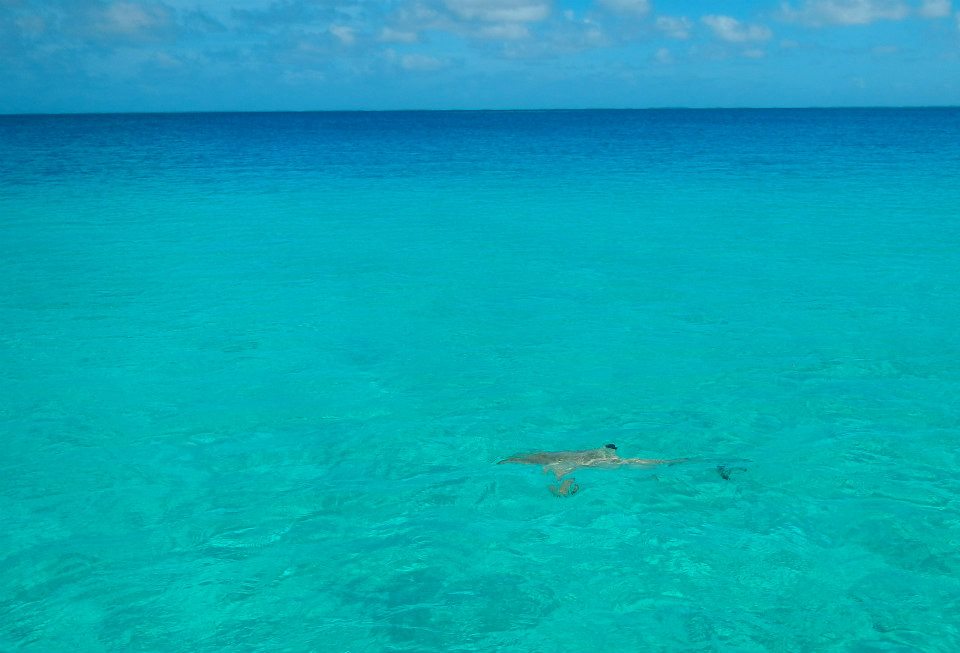
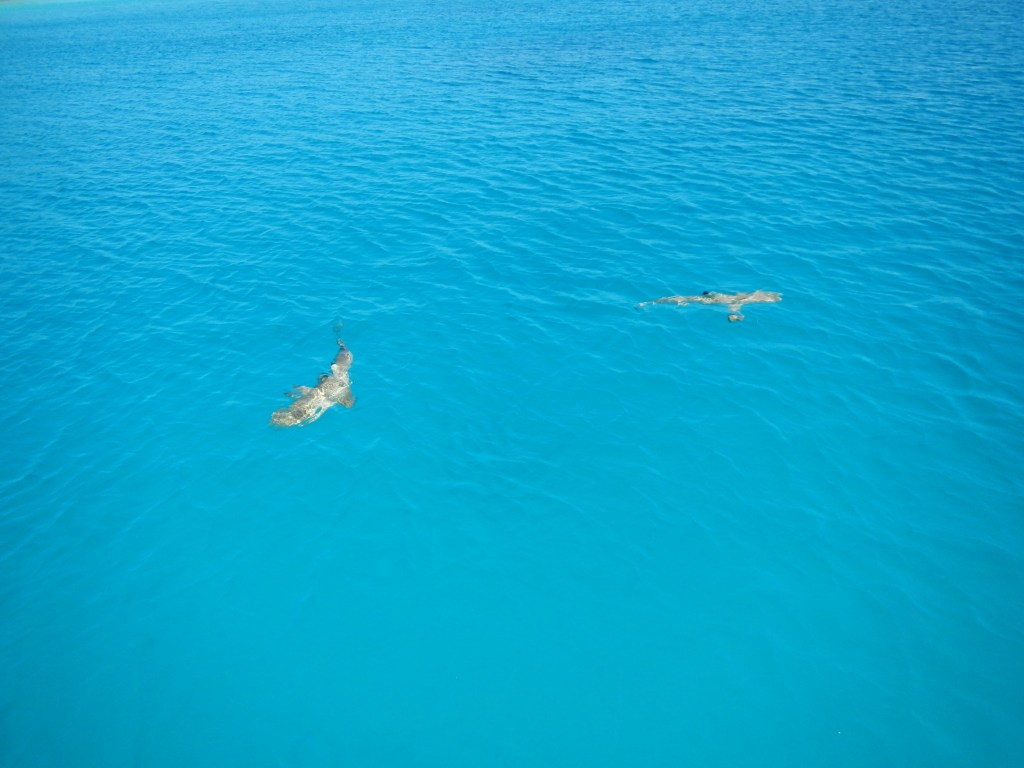
The snorkeling in Raroia was most excellent.  Especially after spending so much time in the black sand and murky water of The Marquesas.  Tim and Steve (Lady Carolina) did some advanced scouting to find the best snorkeling spots for the rest of us, and they did not disappoint.  They found a little mini pass, further south than the one that almost swept me out in the middle of the lagoon on my paddle board, and it made for really fun snorkeling.  You could ride the little rapids down the middle and jet past all kinds of fish and coral, and then swim around and do it all over again.  Here is where I swam with sharks for the first time.  It’s starts out a bit unnerving, but you learn right away that these reef sharks are more afraid of you than you are of them.  As long as you don’t have a bleeding, gaping wound, and as long as you don’t have a wounded, struggling fish, they will totally leave you alone.  They swim around simply ignoring you.  On this dive, there were only about 3-4 at a time and they were the black-tipped reef variety, only about 3 feet long, so it didn’t take long for us to ignore them just like they were ignoring us. 

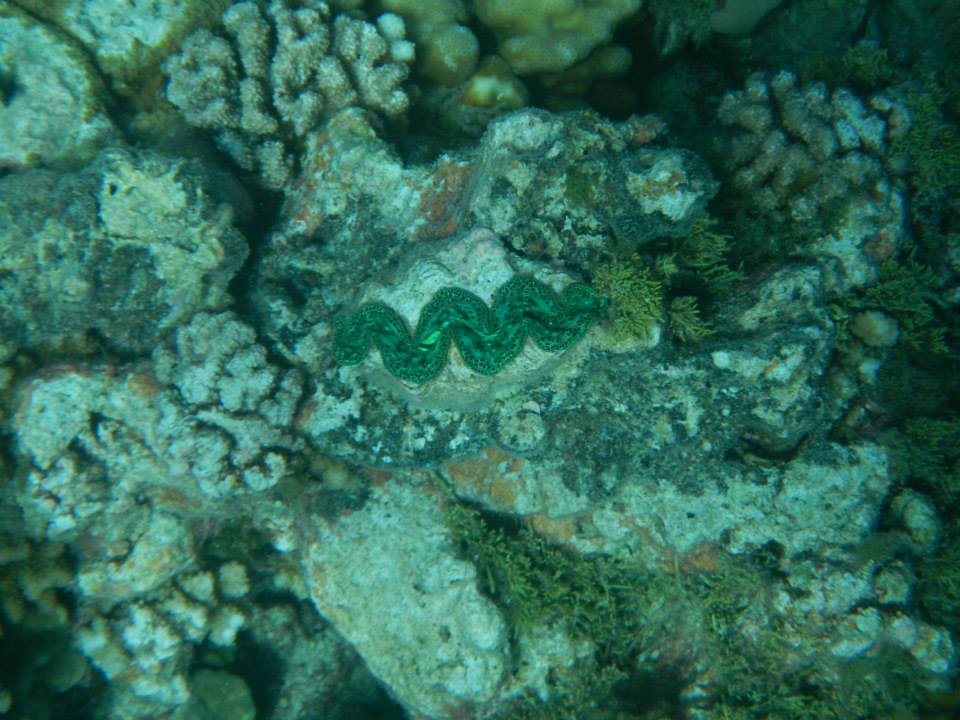
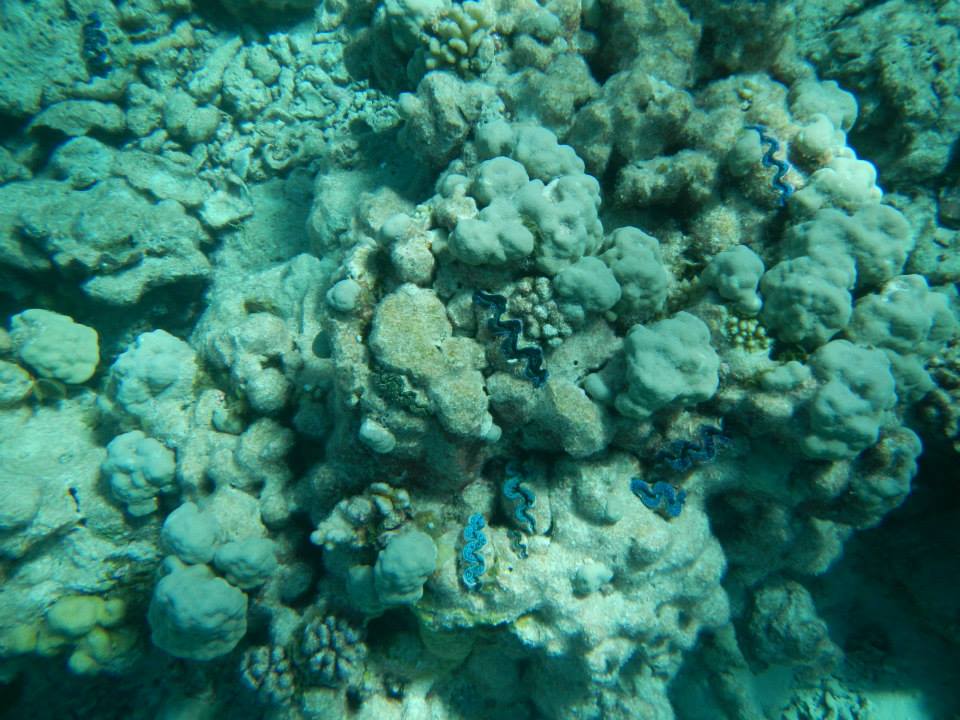
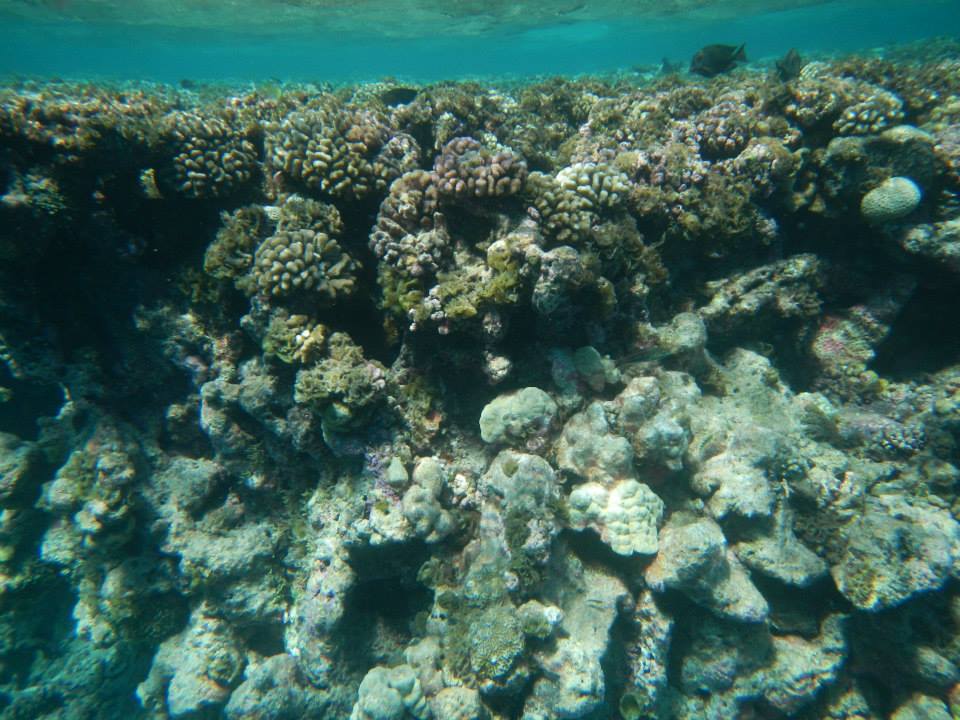
Next up on the snorkeling docket, we officially achieved snorkeling bliss.  We snorkeled on and around one of the bombies and it was the most amazing snorkeling I had ever done.  Water clarity was infinity. (OK, I’m exaggerating, but in a relative sense compared to Mexico, it may as well have been infinity.)  There was both soft and hard coral and thousands of aquarium type fish.  My favorite part were the giant clams with colorful wavy “lips” kind of like in a cartoon.  I just kept swimming laps around the coral head, and I was actually the last one out of the water and back in the dinghy, and that just never happens.  I’m usually the first to get cold or bored or both.

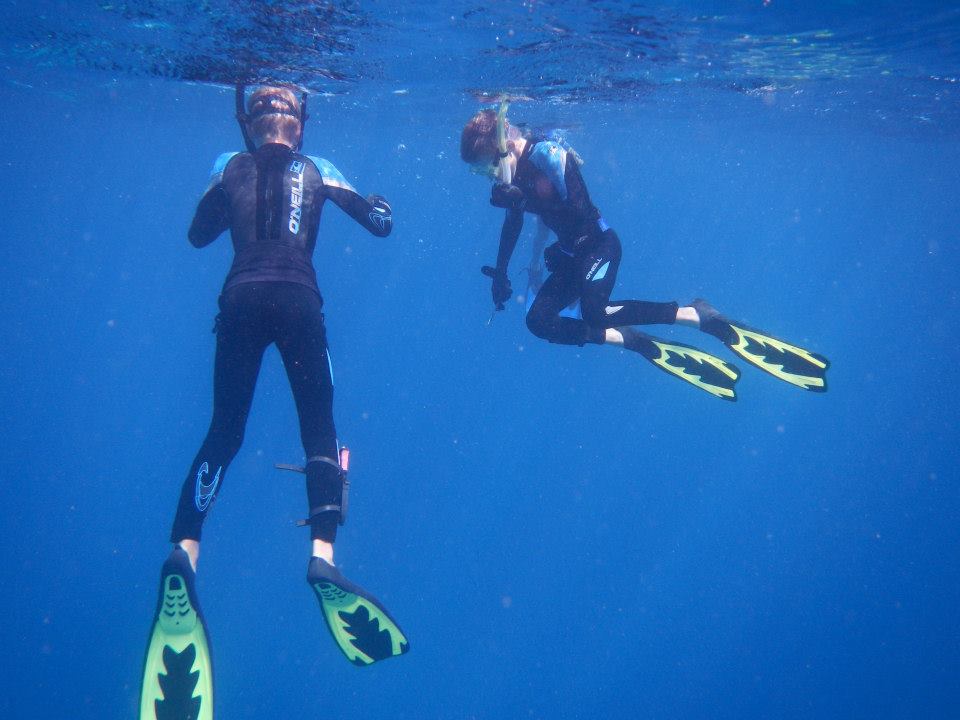
And last but not least, the winds died down just a hair and we were able to move back over to the other side of the atoll in order to do some pass diving.  The skies were a bit clouded over for our passage across, which made it a little nerve racking.  The sun would be out, and you could see every bombie clearly in your path, and then the sun would hide and the bombies would simply disappear.  We also had more pearl farm buoys to contend with, but somehow, we made it all the way across with very little drama.  We thought we would anchor near the town, but when we got there, we found the anchorage pretty deep and close to shore, so we were just a bit concerned about swing radius and being on a lee shore.  Also, it would still be a bit of dinghy ride to the pass, so we opted to go see if there were any better anchor spots closer to the pass.  There weren’t.  We ended up anchored on small coral pinnacles (Lady Carolina on one, Exodus on another.)  Tim dove in and inspected before we dropped anchor, and then he got back in the water when we anchored so he could place the anchor exactly where he wanted it.  This is a good example of how Alex and Brenden make us *not* a shorthanded crew, because we never could have done such a precision anchoring job without them.  The wind blew about 15 knots steady the whole time we were anchored there, and since we had no protection from wind or fetch from across atoll, so was a bit bouncy.  But the location was great for staging for the pass dives, of which there were numerous.  I only went on one of them, and wow, what an experience.   We arrived at the pass in the dinghies pretty much right at slack tide, and once the current started up again (flowing into the atoll) we drove outside the pass, jumped in the water (each having our own line tied to the dingy), and rode the incoming tide all the way in.  The visibility was amazing, and we saw all kinds of sea life.  I was especially captivated by all the sharks.  Not because I was afraid, but just because I’d never been so near so many at one time.  I saw my first white tipped ones and even a nurse shark.  We did this three times, and I have to say Tim and the boys enjoyed the dive WAY more than I did, since they dive deeper and can hold their breath longer.  But I had a lot of fun too, up until the end of each ride when we were in standing waves getting tossed around like a mixed salad.  Anyway, it’s definitely one of those not to be missed experiences, and the boys went several more times, once even with the hookah. 

Overall, Raroia was an excellent introduction to The Tuamotus.  There were so many options of where to go first, but I think we nailed the decision and ended up in a place that had the best of everything.  My only regret is that we didn’t visit the small village there, and the only downside of the whole place was the flies.  I’m not kidding, they were everywhere, and they were numerous.  It’s like nature’s cruel joke, and idyllic tropical paradise, but we can’t make it too nice, so let’s add flies.

Our pass exit was just as easy as the entrance.  We rode a dropping tide, so we had the current in our favor again, and we were out in seconds.  I even drove Exodus this time.

Arriving in paradise


Categories
Uncategorized

Passage from The Marquesas to The Tuamotus

Sitting in Anaho Bay in The Marquesas we were making final preps for the four-night passage down to Raroia.  We were delayed a bit because we had a leak in our dinghy, and it was taking longer than anticipated to locate it.  This little delay meant we were still in the bay when a French Customs boat rolled in to do some inspections.  They stopped at Lady Carolina first, and after boarding and being there about 15-20 minutes, they started heading our way.  A brief VHF chat with Steve included the advice to declare all the alcohol we had on board up front, even if it’s more than you claimed on your check in papers.  OK, no problem.  They came aboard, declined any sort of drink or snack, brought out a copy of our clear in paperwork and asked if this is what we had on board.  I said, “well, we may have a few more bottles of rum and vodka, and maybe some more wine too.”  I really had no idea exactly how much we had on board, so I was just playing it safe.  They started searching, but I quickly realized that they were only looking in the bilge compartments that have little finger holes to open them, and it just so happens we have only one of the three stashes of alcohol in a compartment with a finger hole (totally coincidental), so what they found matched pretty much with what was on our paperwork, and they were happy, and I was relieved.  Additionally, when they were searching the salon, the boys were in the middle of a chess game, and they had to move, and their game didn’t survive the moving process.  When they moved, they went down into Brenden’s cabin to play, so when the Customs Agents went to search that side of the boat, they just peaked in Brenden’s room, saw the boys playing, and moved on without searching so much as behind the door.  Maybe they felt bad about the earlier chess game, who knows.  Since our entire beer supply is in Brenden’s head, that meant we didn’t have to explain why we had more Pacifico than we declared either.  They left happy that we had declared everything and moved on to the next boat.  Afterwards, we learned that they found undeclared rum on Lady Carolina, but all they got was a lecture.  So, it ended up being a net positive since the rum had been missing for a while.  The silly thing, in hindsight, is that there was absolutely no reason not to declare everything we had on board when we arrived in Hiva Oa.  No one boarded the boat and there were no duties to pay, so going forward, that will definitely be my approach.  Declare everything.

Anaho is on the west end of the north side of Nuku Hiva.  The wind was blowing pretty much due east, so we had the options of leaving the bay and heading west downwind and the get into the shadow of the island as we headed south, or we could head east upwind and motor just a short while and then have a beam reach as we turned south.  I suggested the latter, it was agreed to, and, yeah, big mistake.  The winds came more southeast as we turned the corner so we either had to motor longer or make a big, long tack.  Plus, the seas were a mess from the reflection off the island.  Anyway, once we cleared Nuku Hiva it was much better, but then we had to pass the lee of Ua Pou, so we were in an island shadow anyway, so there turned out to be exactly no redeeming aspects of turning right.  So, from now on when asked which way we should go, the answer is always, “left, definitely left.”

The entire passage was a lumpy bumpy one.  Our first night we had winds in the 25-30 kt range and we were hard into it on the port side.  We weren’t really prepared for all the boat motion and things were rattling around and falling over.  I hadn’t put the fiddles on the stove, and we really needed them in order to get dinner going, and I got myself a little seasick digging those out and putting them on.  We were taking waves over the side, so we were appreciating our soft bimini around the helm as it kept that area nice and dry.  The cockpit took a few waves all the way up onto the table, though, and the worst part of all was Alex’s cabin hatch started leaking.  He came up while I was on watch, and he was clearly distressed, and he said water was pouring into his bed.  I went down to take a look, but immediately realized there wasn’t much I could do without getting immensely seasick, so since Alex swore the hatch was actually closed, I asked him to wake his dad for help.  Tim got up, took a brief look, came up and told me he thought the hatch wasn’t closed properly and that’s why water came in, and he promptly went back to bed.  Of course, with the next big wave water once again poured into Alex’s bed, and I wasn’t much help to him in figuring out why, so he just “put a band-aid on it” and put a rag near the leak to guide the water and a large plastic bin on his bed under the rag to catch it.  This worked OK for the rest of the passage.

The second day the wind moderated a bit down to 23-24 kts and then after that it was a pretty consistent 15-20.  The worst part (other than the boat motion, of course!) was that we had to keep hatches closed due to water splashing onto the deck, so it was bloody hot in the salon and cabins.  We encountered many squalls along the way along with a new phenomenon we hadn’t encountered before.  On the backside of a squall after it had passed by us the wind would totally die.  I mean dead calm.  It was like the eye of a hurricane or something, and we even had to fire up an engine a few times to get out into the wind again.  Even with all of these “squall shadows,” as we started calling them, we made really good time.  We had planned for a four-night passage, and since timing our arrival for a slack tide was important for entering the pass, our fast speed early on was a bit concerning, and the rest of our buddy boats slowed down almost immediately.  At that point, we decided to proceed without concern for our arrival time, just reef for safety as we normally would, and as we got closer if it became obvious, we couldn’t make it in three nights then we’d slow down.  Going into the third night we were liking that decision because it looked like we’d make it at just the right time the next day if we could keep up a reasonable speed, which we did. 

It was squally while we were waiting for a good time to go through the pass
Categories
Photo Log

Raroia Photo Log

May 10-19, 2014

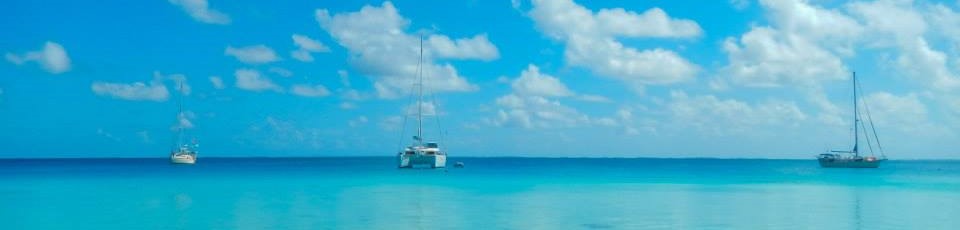
 We went just a bit off the beaten path in the Tuamotus, and we made landfall in Raroia. After the crowded anchorages in The Marquesas, it was a welcome change. It was amazing. The quintessential remote tropical anchorage. We arrived a day ahead of our buddy boats, so when we arrived, we were truly alone.


Logbook – May 10, 2014 (Anaho to Raroia)

Passage Log Highlights

  • 1255 Engines on
  • 1300 Depart
  • 1515 STBD engine off
  • Port engine off
  • 1928 Main (2 reefs) + genoa (1 reef)
  • 2105 P engine on – 2205 off
  • 2303 Main (2 reefs) + genoa (2 reefs)
  • Min TWS – 9.6 kts E
  • Max TWS – 20.2 kts E

Daily Notes

  • Killed a bee. Not many bees, plenty of wasps. Tim bit on foot by wasp on hike in Fatu Hiva – stung by a bee in bed on the upper thigh/hip?
  • Boarded by French Customs. Worried about alcohol quantities (didn’t declare everything in Atuona) OK. They only looked in bilges w/ finger holes
  • 2 ft tuna
  • Lots of squalls

Email to family and friends dated May 10, 2014

Subject: Adios Marquesas

We are planning to leave Anaho around noon today (Marquesan time) for the Tuamotos. Our planned first stop is the atoll of Raroia, and we expect it to take between 3 and 4 days. We want to arrive on the lee side of the atoll where the pass is by Wed morning in order to make it through the pass at slack tide around 12:30. We’ll have the inReach on so you can track our progress and I’ll send another email if any plans change. Right now Tim is trying to find a leak in our dinghy and I just finished preparing passage food and I’m doing all the other pre-passage activies (testing EPIRB, getting sails ready, etc.) The boys changed the water maker filters and cleaned the sea water strainer and are currently trying to talk me into having the day off from school. They took yesterday off to go on a hike with Kyle and Joel to collect mangoes, and would you believe they came back with 92 nice green ones? We are trying to take extra fruit to the Tuamotus, because unlike the Marquesas it is not very abundant and we want to share with the locals. Tim, Steve, Carolina, and I hiked over to an organic farm yesterday and picked our own green beans, lettuce, radishes, and eggplant, and we also got some tomatoes and peppers that were already picked. The part of the hike back that was along a trail just off the beach was amazing and I regret I didn’t have my camera with me. White sand, blue water contrasted with dramatic black volcanic boulders. No, it wasn’t a quick trip to the store for veggies, but it was a journey worth taking.
Love and miss you all,

-D.

At 5/9/2014 1:57 AM (utc) our position was 08°49.34’S 140°03.89’W


Logbook – May 11, 2014 (Anaho to Raroia)

Passage Log Highlights

  • 0204 D–> T Main (2 reefs) + genoa (2 reefs)
  • 1645 Main (2 reefs) + genoa (1 reef)
  • Min TWS – 19.6 kts E
  • Max TWS – 26.9 kts E

Daily Notes

  • Day 2

Logbook – May 12, 2014 (Anaho to Raroia)

Passage Log Highlights

  • 0851 Main (1 reef) + genoa (full)
  • Min TWS – 16.7 kts E
  • Max TWS – 16.7 kts E

Daily Notes

  • Day 3
  • Canadia/Australian terms I like and have adopted: bloody, fruit & veg, runners, swimmers
  • Dusk – caught pacific bonito – big – let it go – 2 ‘ – 15 lbs

Email to family and friends dated May 12, 2014

Subject: Passage

Our passage to the Tuamotus has been a lumpy bumpy one, but we’re all hanging in there. Our first night we had winds in the 25-30 kt range, and then the whole second day was about 23-24 kts. Since then it’s calmed down and been pretty consistent 15-20. We still have one reef in the main and we’re still going 7.5-8 kts! The worst part is we have to keep hatches closed due to water splashing onto the deck, so it is bloody hot in the salon and cabins. We have made really good time, and we are on track to arrive tomorrow, a day earlier than originally planned. Unfortunately the rest of our pack slowed down early on, so they will all still arrive on Wed, so we will definitely be the first ones through the pass.
Yesterday was mother’s day, and we didn’t even know it, so Happy Mother’s Day to all of you special moms.
Love and miss you all,

-D.

At 5/12/2014 6:23 PM (utc) our position was 13°06.10’S 141°30.75’W


Logbook – May 13, 2014 (Anaho to Raroia)

Passage Log Highlights

  • 0400 P engine on – zero wind
  • 0420 P engine off
  • 0712 P engine on – 0745 off
  • 1211 Engines on
  • 1451 Arrival Raroia – East side
  • Min TWS – 7.8 kts NE
  • Max TWS – 13.5 kts E

Daily Notes

  • Day 4
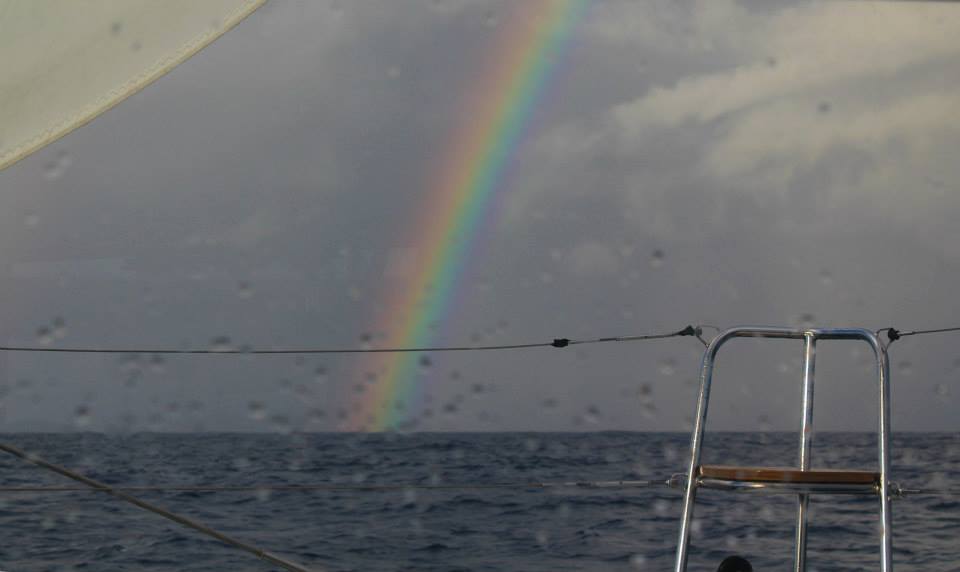
  • 7am – most beautiful rainbow, full color, full arc
  • Wind seems to die on the backside of a squall
  • Low – later – then incoming
  • High – earlier – then outgoing
Depart Anaho May 10 at 1300 – Arrive Raroia May 13 at 1451
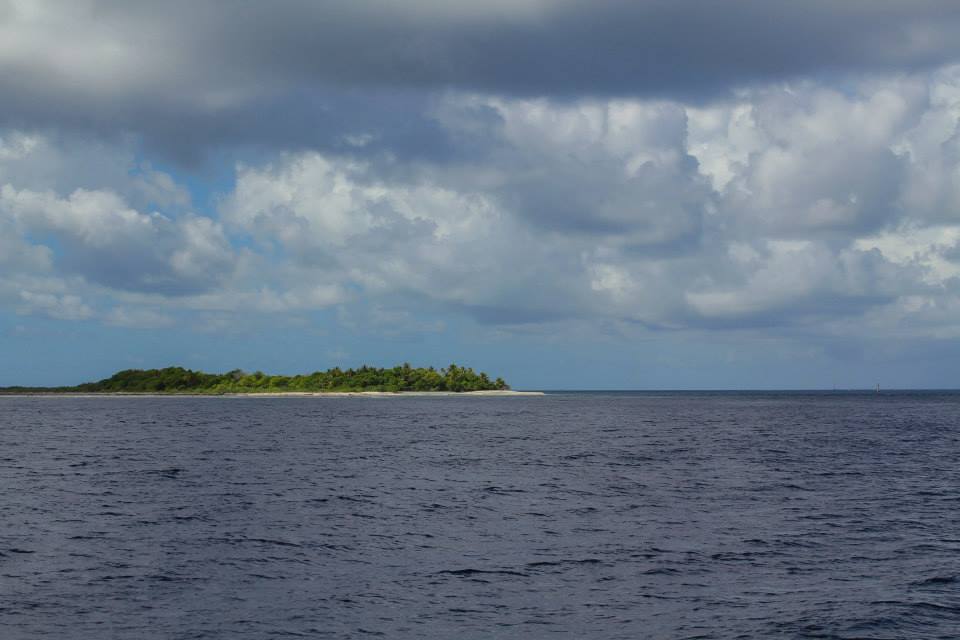
The Raroia Atoll
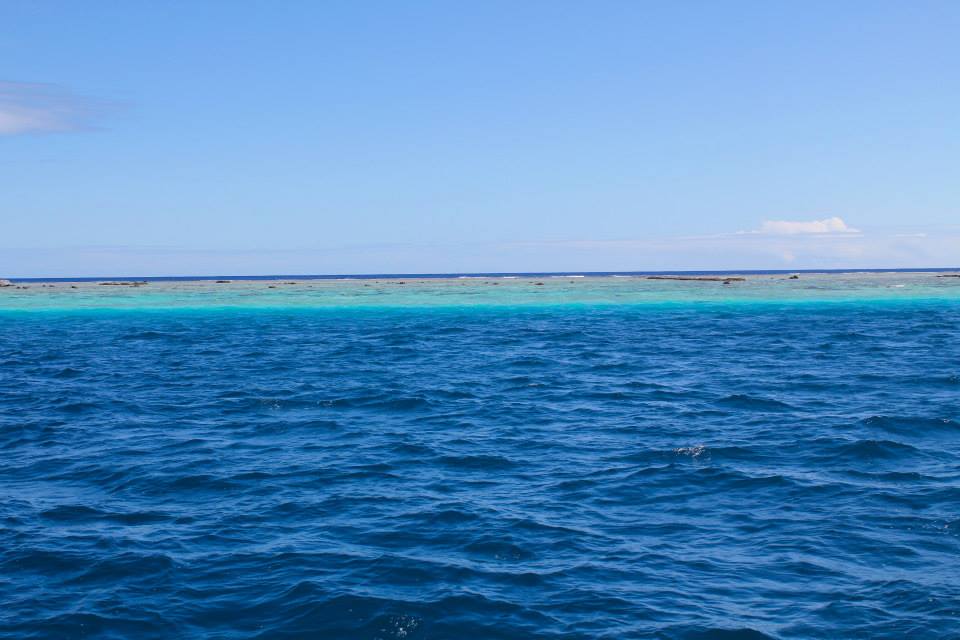
A look at the pass at Raroia
We anchored up against a motu on the Eastern side
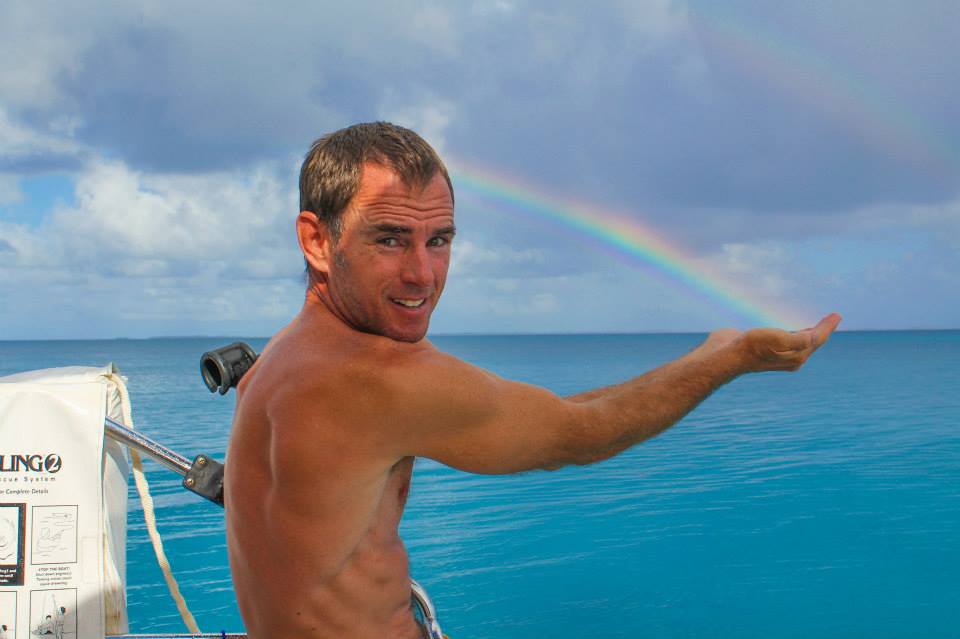
We had to wait out some squalls before entering the pass, but at least we got an awesome rainbow.
The right side of the pass. We truly aren’t in the Marquesas anymore!
The left side of the pass.
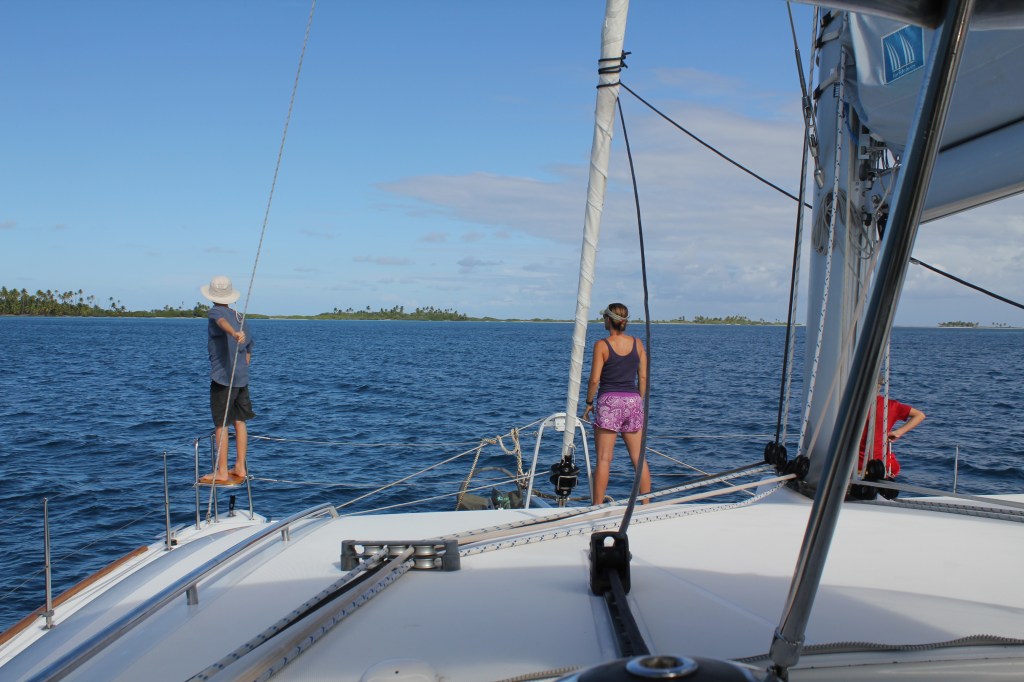
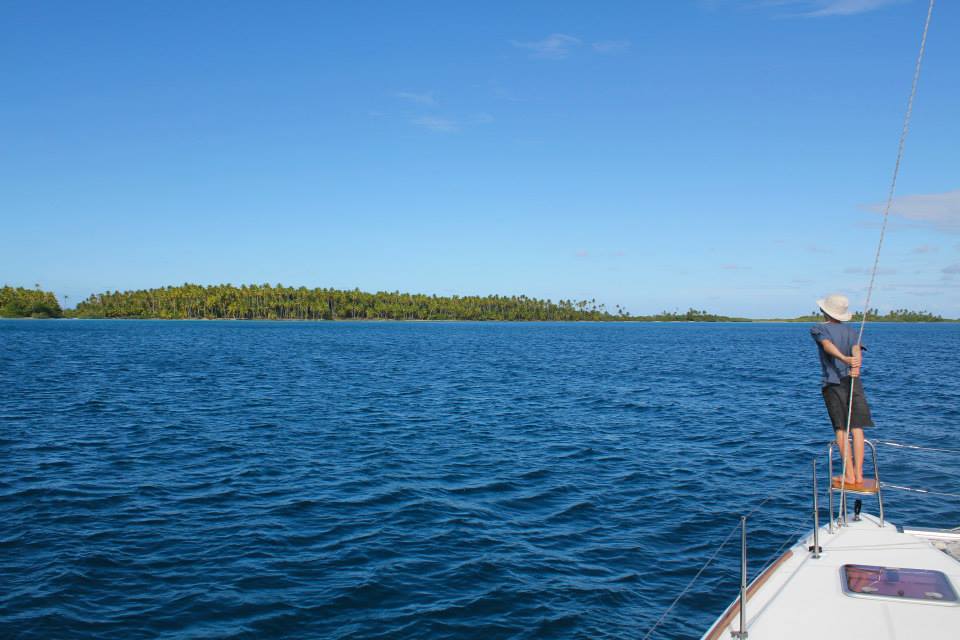
The crew on the bow looking for “bombies” (coral heads)
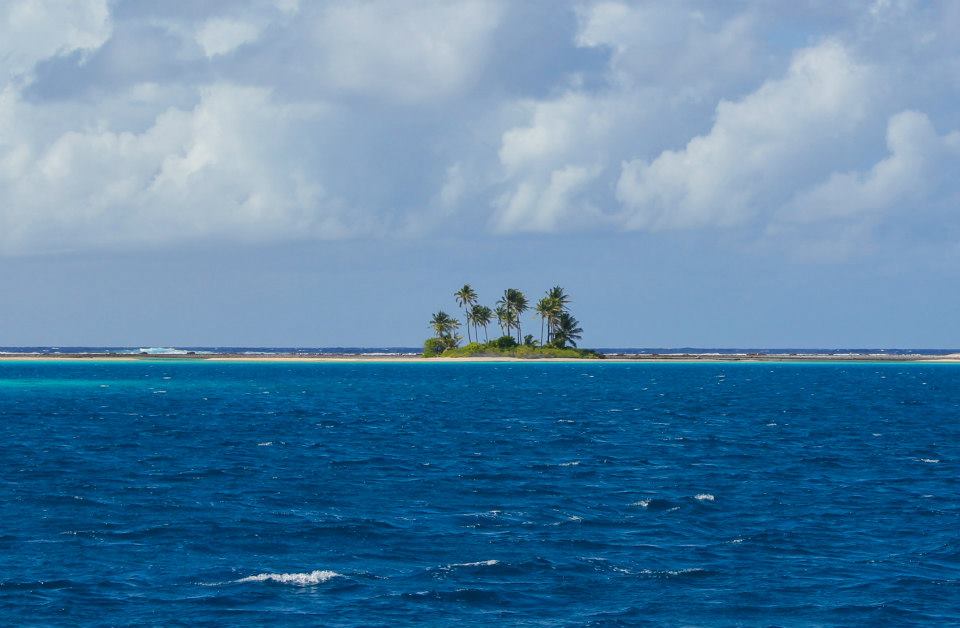
We found paradise
The “Exodus pose”
Down goes Brenden

Logbook – May 14, 2014 (Raroia East)

Daily Notes

Lady Carolina, Exodus, True Blue V
The guys went on a coconut crab expedition, but they only found one. So, the brought it back, we snapped a few photos, and then they released it back onto the island. We just couldn’t eat the last Coconut Crab.

Email to family and friends dated May 14, 2014

Subject: Raroia

We successfully made it to anchor yesterday afternoon. We sure aren’t in the Marquesas anymore… The Tuamotus are atolls, so gone are the dramatic tropical landscapes. Here it is basically a ring of low lying land and coral with a few palm trees. Gone are the black sand beaches and murky water. Here there is white sand and the water is crystal clear. We are the only ones here at the moment, and I don’t mean just out of our pack I mean out of anyone. When we were outside the pass we tried hailing anyone on VHF ch. 16 just to get the low down on the pass, and there was no one. We quickly mastered all three dangers of the fire swamp… getting through the pass, visually navigating across the 6 mile wide lagoon through the coral heads, and visually navigating through a pearl farm with strings of underwater buoys just dying to foul our props. Now we are sitting in a stereotypical remote tropical paradise with a slight breeze and water lapping on the swim step. It’s a bit cooler here having dropped so many degrees in latitude. Last night Tim and I hung out on the net (Exodus foredeck) after sundown and I was actually a bit chilled. The only downside are the flies, which are everywhere and are numerous. Jen, I wish you could be here, this is your turquoise water paradise. Well, except for the sharks.
Love and miss you all,

-D.

At 5/14/2014 5:00 PM (utc) our position was 16°06.24’S 142°22.67’W


Logbook – May 15, 2014 (Raroia East)

Daily Notes

  • Mini-pass dive – rapids, awesome snorkeling
My first shark sighting

Logbook – May 16, 2014 (Raroia East)

Daily Notes

  • Best snorkeling ever on a coral head (bombie)
  • Short school day. Boys rope swing on LC. B empties LC bilge for Worthers candies
  • Pleasant family dinner. B eats all the cous cous. Fat belly wars.

Email to family and friends dated May 16, 2014

Subject: Snorkeling Bliss

(I am writing this Friday night, but most likely won’t transmit it until sometime on Saturday)

We have officially achieved snorkeling bliss. Today we snorkeled on and around one of the coral heads near where we are anchored and it was the most amazing snorkeling I’ve ever done (Including Grand Cayman, Colin). Water clarity was infinity. (OK, I’m exaggerating, but in a relative sense compared to Mexico, it may as well have been infinity.) I have now officially swam with sharks, ~3 ft black tipped reef sharks that want to have nothing to do with you, pretty anti-climatic. My favorite part were the giant clams with colorful wavy “lips” kind of like in a cartoon. One of the other boats here with us (The Beguine) went over to the pearl farm today and arranged for us all to go on a tour tomorrow, so that will circumvent school tomorrow. Looking forward to it.

P.S. In the middle of typing this, Steve (Lady Carolina) got on VHF and sang his Wind Turbine song. Yes, we have a lot of fun out here.

Love and miss you all,

-D.

At 5/14/2014 5:00 PM (utc) our position was 16°06.24’S 142°22.67’W


Logbook – May 17, 2014 (Raroia East to Raroia SE)

Passage Log Highlights

  • 0957 Engines on
  • 1002 Depart
  • 1119 Arrive SE anchorage

Daily Notes

  • Caught a carron leure underway
  • Long line of coral extending from shore outward just N of the “anchorage. We went around it. Lots of coral heads, not very good holding – we dragged the anchor when we backed down.
  • Mini pass just to the N of the anchorage
  • Tour of pearl farm before we moved anchorages. Thanks to S/V The Beguine.
  • T/Steve – scouted for lobster while D/Carolina drank wine on Exodus
We went on a tour of a pearl farm
Paul and Celeste (s/v The Beguine) organized a tour of the pearl farm for us
1. They pull the scallops out of the water
2. scrape all the barnacles off
3. Insert wedges to make them easy to open
4. Take out the pearl to inspect and reseed
5. Tie new lines on the scallops
They gave us some to eat
We moved to an anchorage at the SE side of the atoll. Depart 1002 – Arrive 1119
New anchor location – you can see the “mini-passes” to the south
The mini-pass

Logbook – May 18, 2014 (Raroia SE to Raroia Near the Pass)

Passage Log Highlights

  • 0857 Engines on
  • 0901 Depart
  • 1250 Arrive near pass on a bombie

Daily Notes

  • Tim in the water as we dropped anchor on a bombie
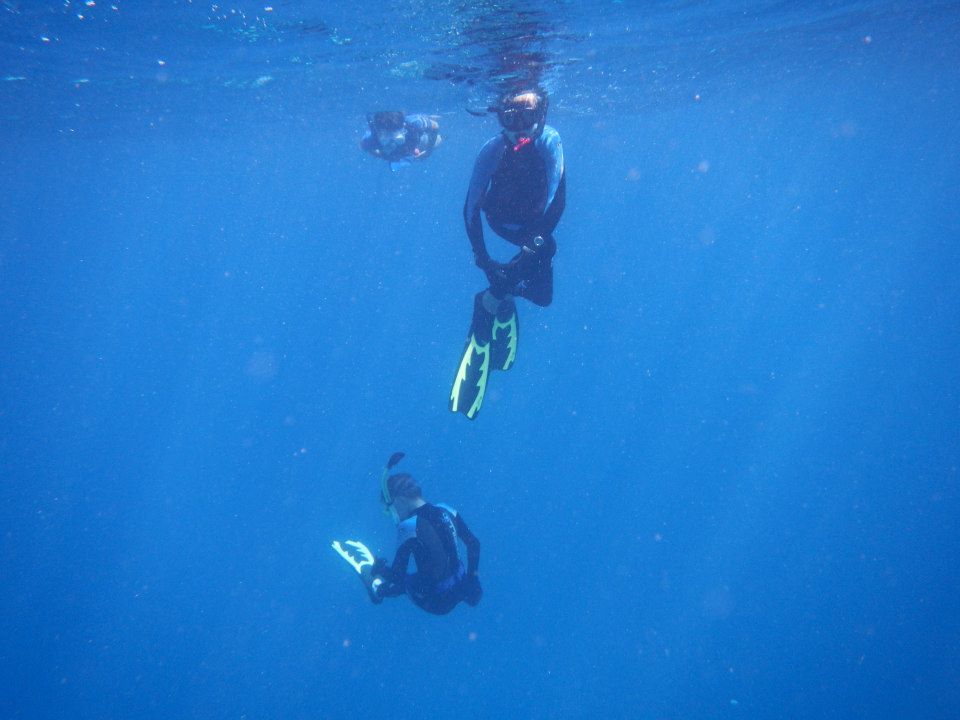
  • Pass dive x 3. Amazing visibility, fun riding the current. Tons of sharks, mostly black tip, some white tip, a few nurse sharks. Washing machine. Slack tide 1.5 hrs later than predicted.
We moved to anchor near the pass. Depart 0857 – Arrive 1250
It took a while to find a good spot to anchor
Alex, bringing back some pocket pancakes from Lady Carolina

Logbook – May 19, 2014 (Raroia Near the Pass)

Daily Notes

  • 0615 – hailed a vessel approaching the pass – s/v Good News
  • D/Carolina/Boys – dive on a bombie
  • T/Steve/Kyle/B – Hookah in the pass (B passed Steve’s hookah test, Alex’s tooth hurt)
  • s/v Skabenga rolled in at dusk
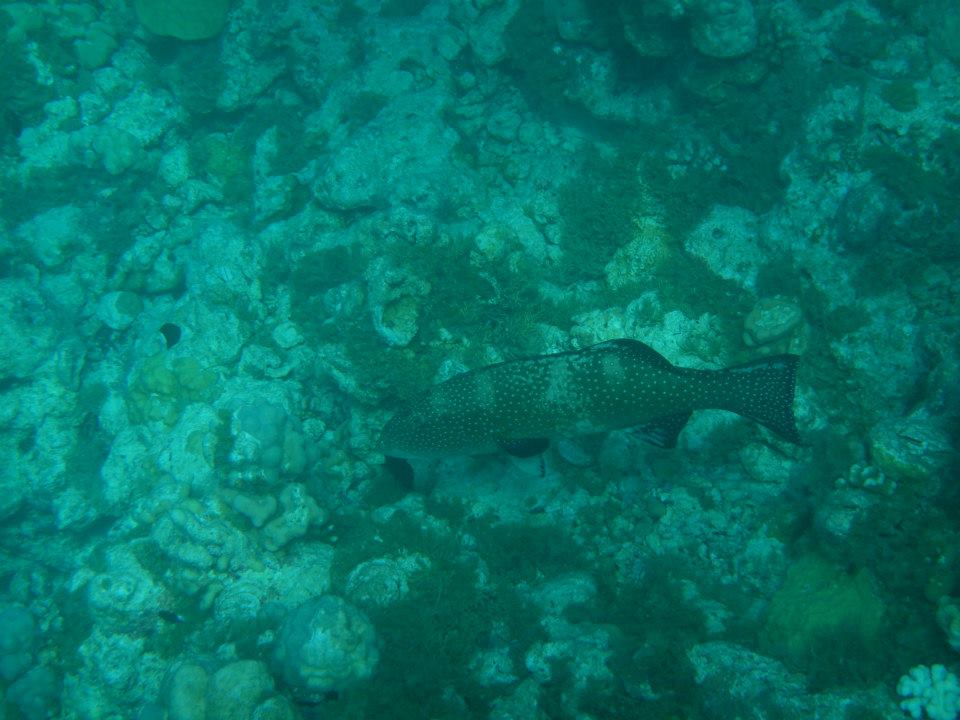
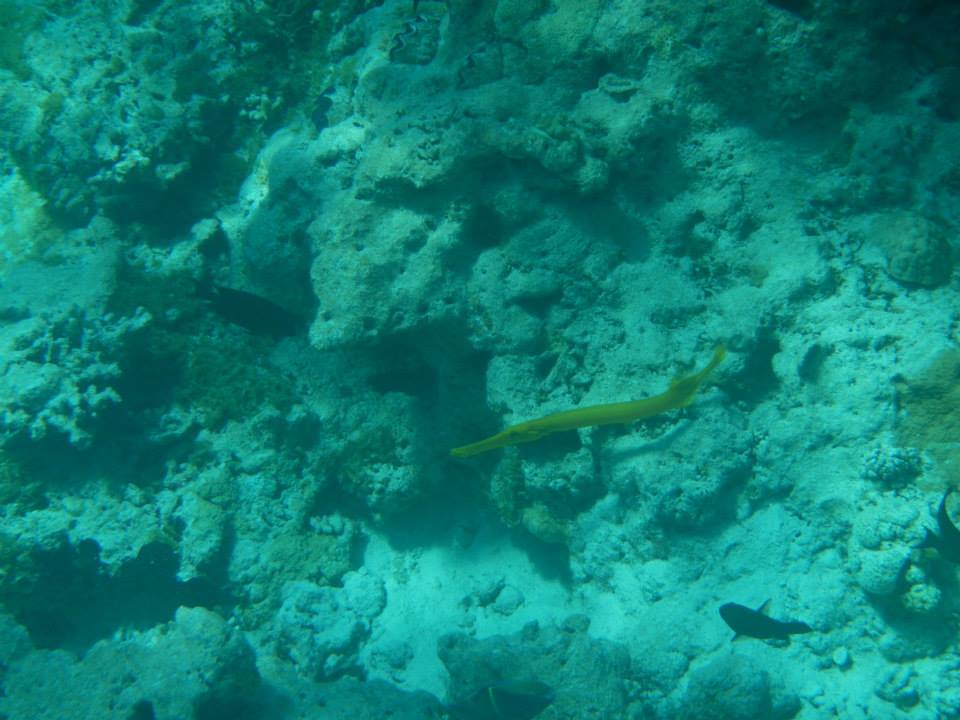
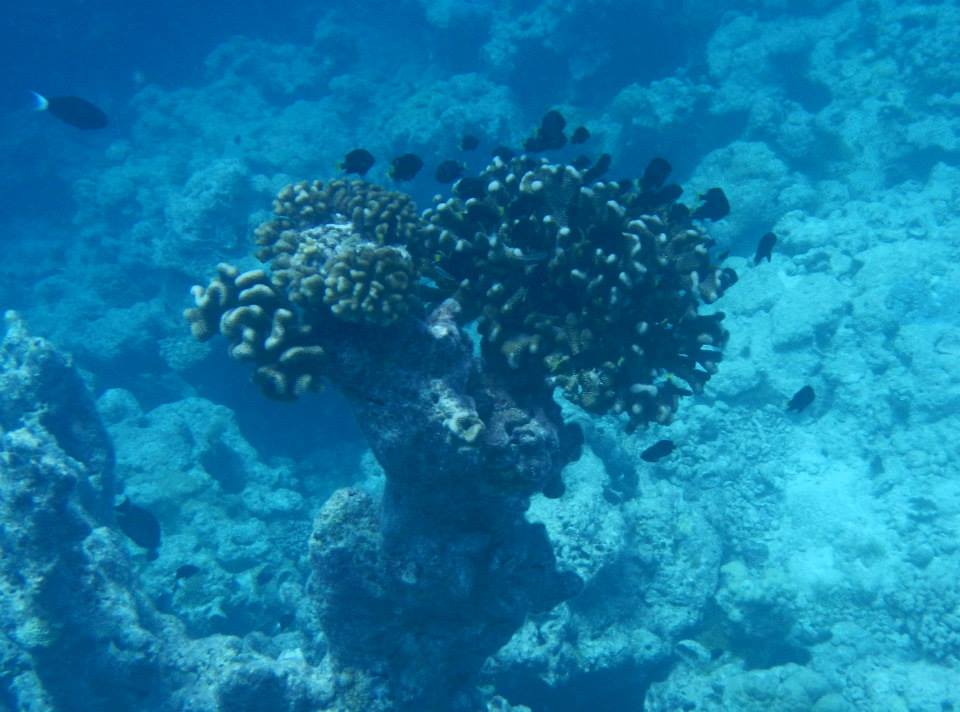
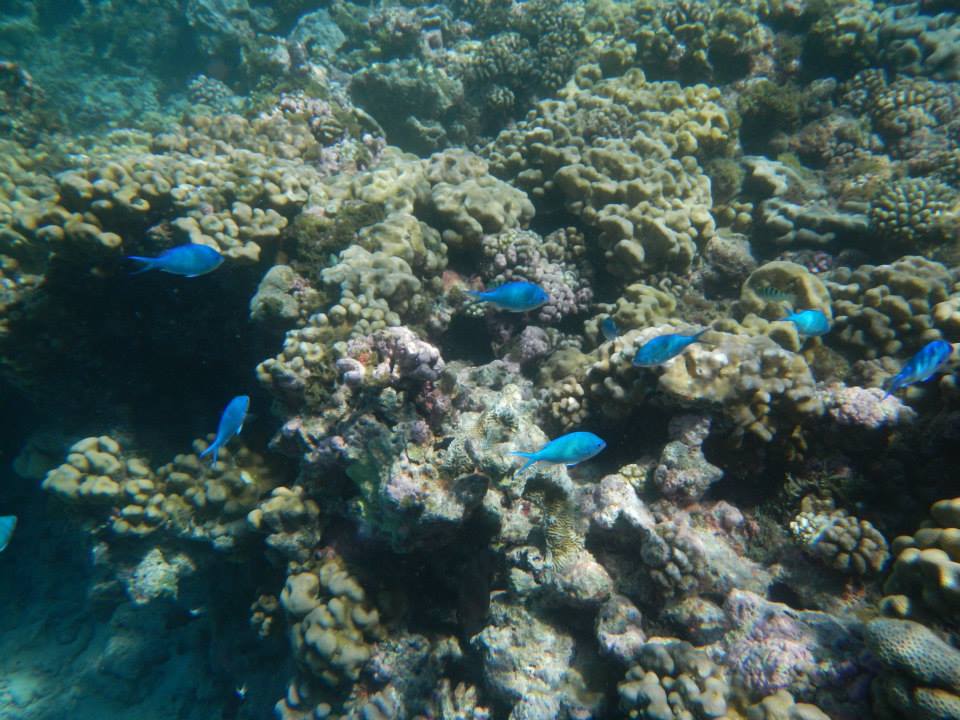
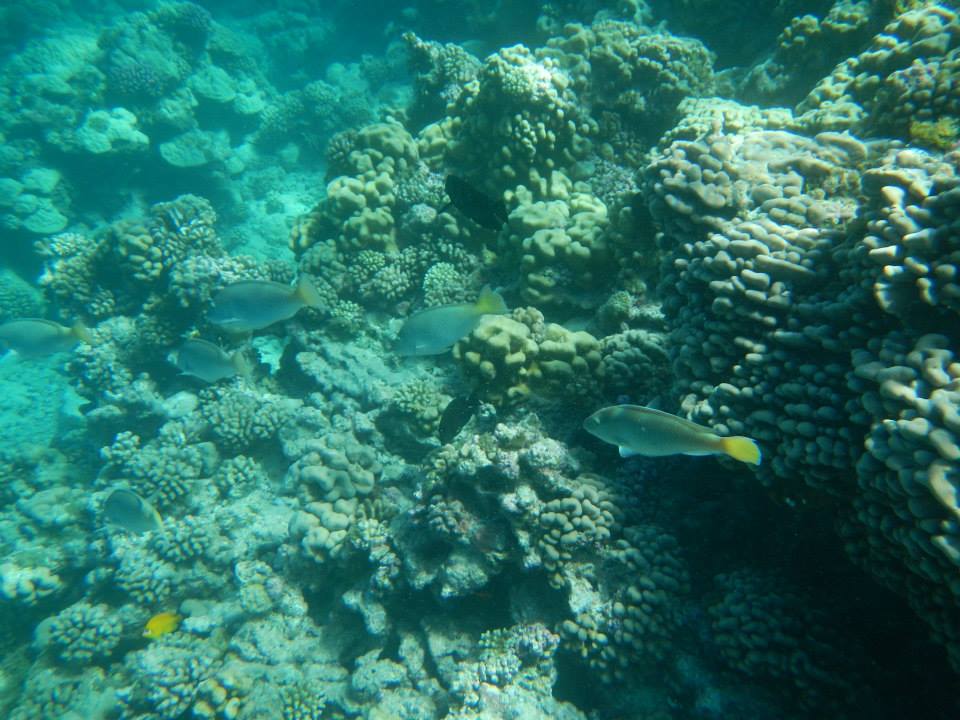
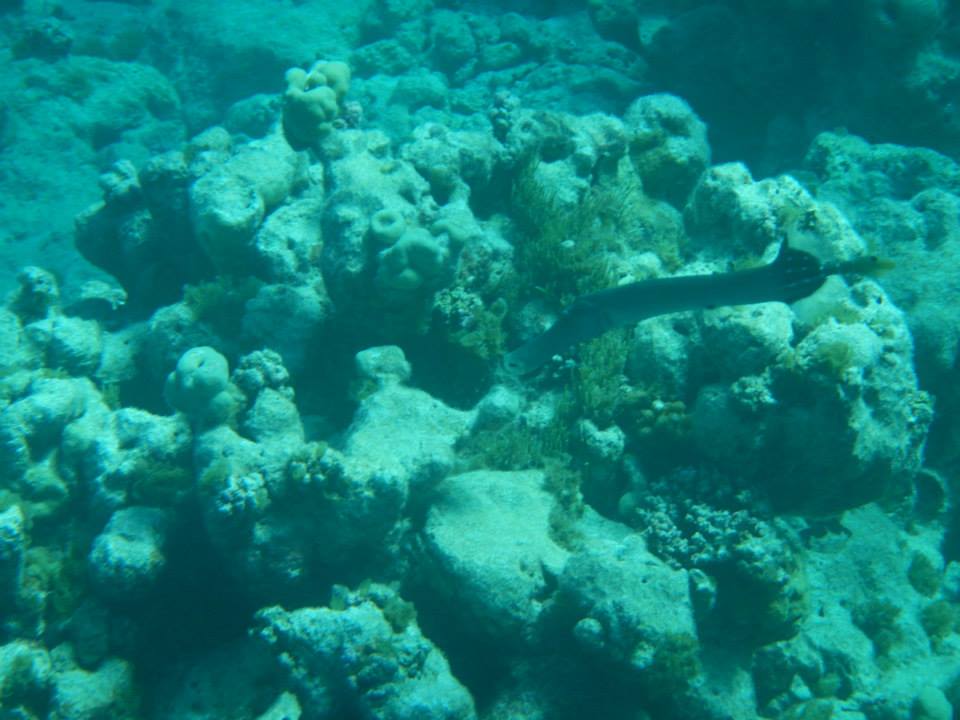
My first underwater pictures diving on a “bombie”
In order to do the pass dive we anchored with pretty much zero protection
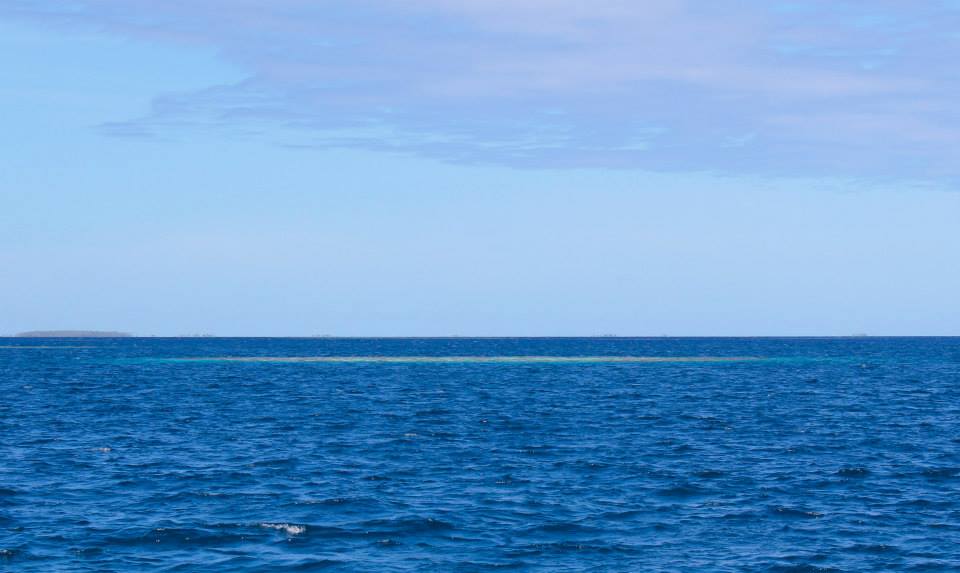
This is what a “bombie” looks like from the boat

Email to family and friends dated May 19, 2014

Subject: Pass Dive

We did our first pass dive yesterday, and wow, what an experience. But first we had to navigate our way back across the atoll in less than ideal visibility and then try and find a spot to anchor near the pass. We thought we’d anchor near the town, which is about 2 miles from the pass and listed as an anchorage in the guidebook. But it was pretty deep and near shore, so we thought we’d look for something better near the pass. We didn’t find much, so we are actually anchored on small pinnacles (Lady Carolina on one, Exodus on another.) Tim dove in and inspected before we dropped anchor, and then he got back in the water when we anchored so he could place the anchor exactly where he wanted it. This is another example of how Alex and Brenden make us not a short handed crew, because we never could have done such a precision anchoring job without them. The wind’s blowing 15 knots and we have no protection from wind or fetch from across the 5 mile wide atoll, so it’s a bit bouncy. OK, on to the pass dive… We arrived at the pass in the dinghies pretty much right at slack tide, and once the current started up again (flowing into the atoll) we drove outside the pass, jumped in the water (each having our own line tied to the dingy), and rode the incoming tide all the way in. The visibility was amazing, and we saw all kinds of sea life. I was especially captivated by all the sharks. Not because I was afraid, but just because I’d never been so near so many at one time. I saw my first white tipped ones and even a nurse shark. I have to say Tim and the boys enjoyed the dive WAY more than I did, since they dive deeper and can hold their breath longer. But I had a lot of fun too, up until the end of the ride when we were in standing waves getting tossed around like a mixed salad. Anyway, it’s definitely one of those not to be missed experiences, and we’ll probably do it again today too. (Not sure when school is going to get done these days…)
Love and miss you all

-D.

At 5/19/2014 4:15 PM (utc) our position was 16°00.71’S 142°26.86’W