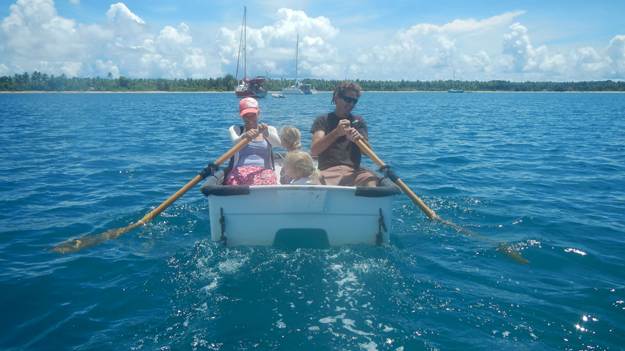
It’s about time I introduce The Mighty EOS II into our story. EOS II is the name of the boat, and they are a family of four from Australia with two young daughters: Kiani (4 yrs) and Ahia Kai (2 yrs). Now, those that know me know that I’m not a kid person; I mean I can barely stand my own kids (just kidding boys!) Anyway, these two girls really stole my heart. And Slade and Lahnee are pretty fun to hang out with too. Anyway, EOS II would become our most consistent companions all the way from Funafuti up to Majuro.
Since I didn’t go to the beach bonfire, my first introduction to Lahnee was a VHF radio call as we were leaving the anchorage.
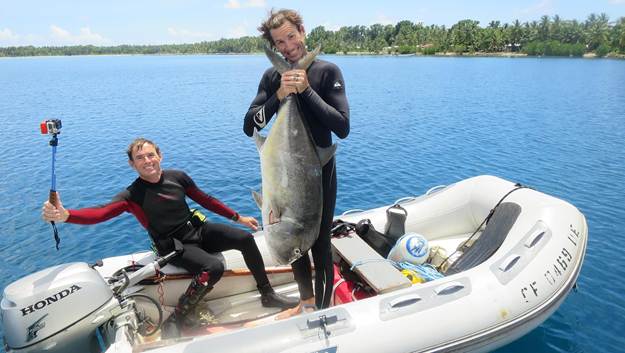
The background on this is that Tim and Slade went out spearfishing. Before they left, Tim and I had a conversation that went something like this:
D – “I need you to be back by 2:00 at the latest so we can get back to town to pick up our veggie order”
T – “You and Alex know how to raise anchor, what do you need me for?”
D – “You always say that, but this time I really do need to be back in town, so if you’re not back by 2 we’ll leave without you and you can catch us in the dinghy.”
T – “OK”
It’s still not clear to me if Tim thought I was joking, because he really, really, likes to give me a hard time about how I left him, but when 2:00 came and went the boys and I hauled up anchor and started heading back to town. And as we were leaving the anchorage I get a VHF call from Lahnee, and she said she was starting to get worried that the guys were gone so long, so she is kind of surprised to see Exodus leaving the anchorage. I told her the deal and that Tim would have to catch us in the dinghy. I was probably a little short with her only because I was driving Exodus out of the anchorage and focused on not hitting any coral.
She recently told me that she really got a wrong first impression of me that day, and I laughed and responded that it doesn’t seem very wrong to me, it seems pretty spot on.
So, Lahnee and I became an unlikely pair of fast friends. She’s a bit younger than me and is a former world-class gymnast, she has a refreshing candidness about her, and she’s got a sense of humor you can always count on. We had taken very different paths to arrive in Funafuti, but I’m so glad those paths had the opportunity to cross.
No, the title of this blog post isn’t some clever metaphor, because literally, I went running on an airport runway. We recently spent almost two weeks in Funafuti, the main atoll of the country of Tuvalu, where they have an airstrip that was originally built by the U.S. during World War II. Apparently, the Americans used Funafuti as a staging area for preparation for the Battle of Tarawa in the neighboring island nation of Kiribati (where we are headed next, by the way). The airstrip today is used as the only airport in Tuvalu, therefore by definition it’s an international airport, with twice weekly flights to/from Fiji. The island is not very big, and it’s long and narrow, so the airstrip runs right down the middle of town taking up much of the usable land.
But the airstrip is much more than a runway. In the early morning and early evening it’s a hub of community activity. There are walkers and joggers, rugby games and soccer games, kids riding bicycles and, of course, tons of motor bikes zipping along. During the heat of the day, mostly all that remains are the motor bikes and an occasional car or truck. There are no fences or security barriers, but one of the local women told me that all of this activity is technically “illegal” and that you aren’t actually allowed to be on the runway. Clearly this law isn’t enforced in any way.
Runway or playground?
When it’s time for a plane to land, there still isn’t much in the way of security. The fire engine comes out and gives three warning sirens spaced about 5-10 minutes apart, although I don’t remember the exact timing. After the first and second warning you still see a few motorbikes crossing the runway, but by the third siren, it’s mostly clear. We were able to stand basically right on the side of the runway as the plane touched down. Seriously, it would have been harder to get any closer without standing right on the runway itself. When it’s plane time, the entire airport vicinity becomes buzzing with activity. Women set up handicraft displays and there’s tons of people just milling about. Taxis are in the parking lot and the duty free truck shows up for last minute purchases by the departing passengers. After the plane takes off again, the activity gradually dissipates and everything goes back to normal.
Plane day!
So, after we were a few days there in Funafuti, I joined the evening crowd on the runway and went for a slow, hot run. Unfortunately, I went just a little too early, and the sun was still a bit too high in the sky, so I pretty much overheated after 10 minutes. But I was stubborn about it, and didn’t quit until I completed a full lap, up and back, of the runway.
Sometimes it’s hard, because consensus simply isn’t possible when partners have different risk tolerances. We discuss, persuade, argue, each of us convinced that we are correct in our position. Just to give you an idea of the kinds of things I’m talking about, here are a few examples: anchoring locations relative to land/reefs, entering an anchorage or port at night or in low visibility, and reefing the sails. I am more conservative with a tendency to follow the old salt rules of thumb, and my husband is, well, less conservative, with a tendency to make in the moment decisions. Don’t worry, this post isn’t going to be your typical cruising wife husband bashing diatribe, so stick with me.
Usually, when we have one of these “discussions” it’s my husband who gets his way, because he is supremely confident, and I generally back down first. But, of course, I don’t back down quietly. I make my dissension evident; sometimes loudly and sometimes passive aggressively. It’s easy to devolve into fluctuation between irritation with him and despair at my situation, having felt like I’ve lost my voice.
Obviously, we are still alive, and our boat hasn’t sunk, so my husband can’t be doing all that bad. But there *have* been times when non-ideal corrective action has had to be taken, like having to re-anchor in the middle of the night because we ended up too close to a shallow pinnacle or having to reef the sails in strong winds *after* a squall has engulfed us. When this happens, I always want to take the high road, I really do, but I usually cannot contain the smug little look and the occasional blatant verbal, “I told you so.”
The thing is that my attitude, my behavior, simply isn’t fair. First of all, it needs to be said that there’s nothing my husband has done that has been dangerous. He has never made a decision that has put our family at risk, rather it’s risk of damage to our boat that I sometimes question, not risk to any of our lives. But second of all, and the point I really want to make, is that at the end of the day, at the end of the discussions and the arguing and the I told you so’s, the buck doesn’t stop with me.
It stops with him.
And that’s a lot of responsibility, quite a burden, if you think about it. Even still, he carries it willingly and, yes, confidently, and I wouldn’t want it any other way. So, I judge from a very comfortable position, indeed. Would it kill me to be part of his team and support him every once in awhile instead of second guessing him all of the time? Maybe. But perhaps I can at least pick my battles for the *really* crazy stuff he comes up with.
According to a few sources, Tuvalu is one of the top 10 least visited countries in the world. (And it’s kind of funny that 2 others of the 10 are Kiribati and Marshalls, our next two destinations.) It is a Polynesian nation, being situated on the western side of the so-called Polynesian triangle. There is a total of 9 islands: six of them being atolls, with only 3 of those being suitable for a sailboat to enter.
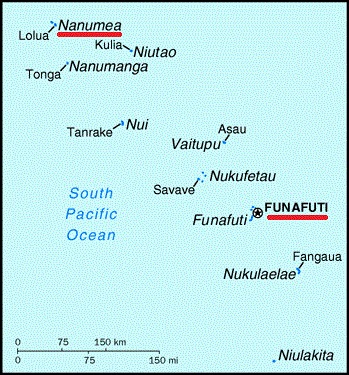
The total population of Tuvalu is about 11,000 with 60% of the people living in the capital of Funafuti. Funafuti is where we started our Tuvalu adventure, and the other atoll we visited is the northernmost island, which is called Nanumea. You can see both islands on the map of Tuvalu below:
The island nation of Tuvalu
We have been to many atolls, but Funafuti is a very old one, much further on in its life cycle than any of the others we have visited. The lagoon is very deep and there are very, very few coral heads in it. The motus, or islets that form the perimeter of the atoll, are very low lying, and overall, it was not exactly the most picturesque place we’ve been to. Apparently, the atolls of Tuvalu could be the first geographical victims of higher ocean levels due to climate change. (Recall the story of the people from Vaitupu, Tuvalu who migrated to Kioa, Fiji in the 1940s due to poor soil on their home island). What I have read with the boys has said that by the end of the century these islands could be under water.
Overall, Funafuti was a very pleasant surprise, though. All of the reading I had done regarding our path north didn’t have much nice to say about the various capital “cities.” But Funafuti is a real gem. The people are very nice, even if a bit reserved at first (not unlike other Polynesian countries we’ve been in.) Things were pretty cheap and most things were available, so I really didn’t need to do 4 months worth of provisioning in Fiji.
The infrastructure is quite good and the roads are well-maintained, but you won’t find many cars driving on them. Most people get around town on scooters, or “motor-bikes” as they call them. Even though it seems like there are more scooters than people in Funafuti, you will often see several people piled on a single scooter, and helmets? Not a chance. Babies on scooters? Of course!
The air and water temperatures have of course gotten warmer as we inch closer and closer to the equator. In Funafuti we had water temperatures of approximately 89 degrees F and air temperatures even higher, so needless to say we spent a lot of time in the water. We even busted out the water hammocks from Mexico!
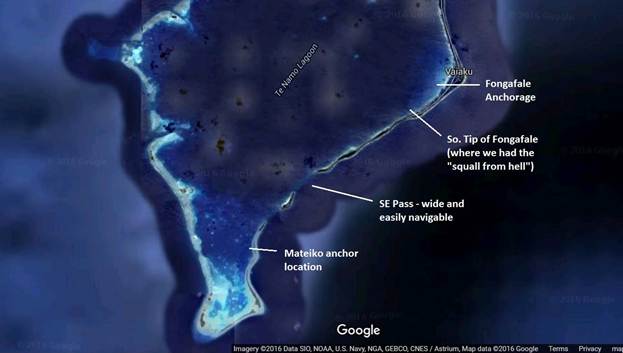
The main island in Funafuti, where most of the people live, is called Fongafale, and that is where we anchored most of the time. But we did venture to two other anchor locations, and you can see them all on the following satellite image.
Satellite image of Funafuti
On arrival we entered through the SE pass, and it was wide and easily navigable with minimal current and no obstructions. When we departed Funafuti, we left through the northern pass, not shown on the image above, but it was equally easy, and we actually went through it with minimal light at dusk.
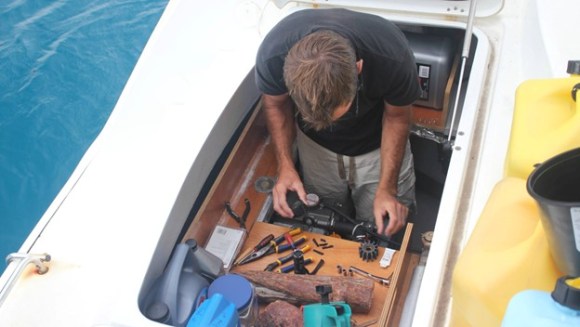
Our intention was to leave Rabi in the early evening for the two-day passage up to Rotuma. We got a bit of a late start due to an issue with the port engine. And now, since I am the one who writes these narratives, I get to be the one to tell my side of the story. I would like to take the opportunity now to say that I had been telling Tim since Savusavu that the port engine was exhibiting off-nominal behavior at start up. What I had noticed, and what I had communicated to him, was that it would take much longer than normal for water to start coming out, and that the first burst of water wasn’t a burst at all like it normally is, rather it was more of a trickle, and it would take some time for the bursting behavior to build up. Tim’s response to this was to lecture me about how the impeller and water-cooling system works, and the behavior I was observing was clearly consistent with the way it works. Well, that may be, but all I know is I have been starting the engines for almost three years, and what I observe now is different behavior than what has always been “normal.”
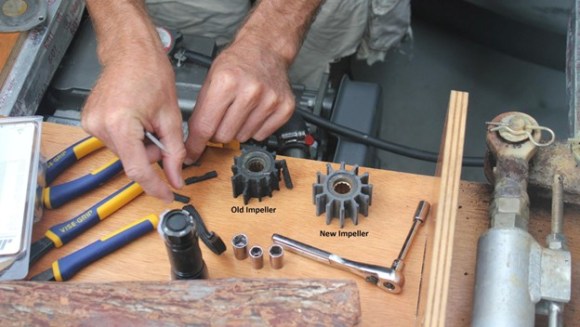
Anyway, this time, when we were ready to depart Rabi and I started the engine, no water at all came out of the Port side. When it became obvious to me that no water was going to come, I quickly shut down the engine. Tim had me restart it so that he could see for himself, and then he went into trouble shooting mode. Luckily, this wasn’t too hard to troubleshoot, since the intake impeller is the obvious first place to check. Sure enough, our impeller had pretty much shredded to pieces and had only one of its original 12 “blades” still fully in tact. We had a spare, Tim replaced it quickly, and off we went. And I didn’t even say “I told you so.” (Not then, anyway.)
Tim in the engine compartment changing the impellerOld and new impellers
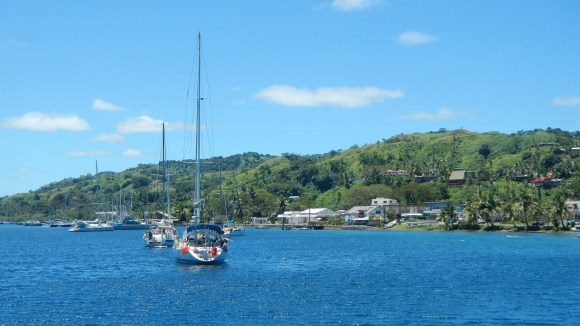
After being spoiled in Savusavu with easy running opportunities, we spent almost a week moored in Dere Bay on the northwest side of Koro Island. Koro is about 25 miles south of Savusavu and we had an easy day sail with light NE winds. When we arrived, we found Koro to be an enjoyable yet strange kind of place. It’s an intersection of traditional Fijian village life with western culture, but the western part does not dominate in such an offensive way as it does over on the dry side of Fiji in places like Port Denarau, Musket Cove, and even up into the Yasawa Islands. There are 14 villages on Koro, and our first afternoon we walked to the village closest to the anchorage, called Nabasovi, in order to present sevusevu to the chief. As we got to the village, the first people we encountered were a man, his wife, and their grown son, who were all sitting on a large woven mat in the shade. They motioned to us to come and sit with them, and we chatted a bit while the wife bounced their young grandson to sleep on her knee. They didn’t automatically assume we were from a boat, and they seemed just a bit surprised when we said we wanted present sevusevu. The son went to put on a sulu, and he acted as our spokesman with the chief, and after the brief sevusevu ceremony we had a nice visit with the chief and his wife.
It turns out that the likely reason they didn’t automatically assume we were from the yacht is that in addition to the two resorts at Dere Bay there is a small expat community who also live on the island. So, there are always white people about. And new white people are not always there to do sevusevu, as it is in some of the villages we’ve been to on other islands where the majority of their white visitors are from yachts. As an aside, the Fijians call white people “Palagi,” but we aren’t sure if it’s just a label or if it’s somewhat derogatory. Tim always refers to us a Palagis with them, and they always laugh, but I can’t tell if they are laughing because they think it’s funny just because he knows the word or because he’s actually saying it. I should have just asked by now, and if we come back to Fiji, I think I will.
Anyway, back to the expat community… there are western style houses, some quite luxurious in size, dotting all the hillsides around the bay. Tim and I took a walk, and the place is partitioned into at least a couple hundred lots, some with complete homes, some in various stages of construction, and some totally empty except for the wooden sign with the lot number. We met a few of the people who live there: A woman from Brazil, a man from British Columbia, and a family of 5 from Colorado. They were all very low key, down to earth people who enjoy the slow lifestyle and natural surroundings. And they seem to get on well with the locals. The Colorado family’s eldest son (9 years old, I’d guess) even attends the Fijian school and sometimes stays in the village. He has a “village family” that he stays with. As I mentioned, many of the lots are empty and a lot of the construction is halted, so it’s not like the expats have totally overrun the place. They seem to coexist there in more inconspicuous way than perhaps my cynical self was expecting.
I mentioned that there were two resorts in the bay but let me explain. I’m not sure what the business model is for these places, but they can’t be making much of a profit since we never saw any guests! Dere Bay Resort has a long wooden dock that extends all the way out over the coral and at the end is a floating dock where we could tie up the dinghy. Once you’ve made your way up the dock to the resort you see the small pool and the shady, welcoming restaurant/bar area. Except that there was never anyone there. Often not even any staff. It was $10/night for our mooring ball and in the end, I was having trouble finding someone to pay, because the staff was so scarce. Our last afternoon there, some of the expats were using the pool and they told us the resort does dinner on Saturdays, and since that day was Saturday, we tried to put in a reservation. It wasn’t until late in the afternoon that someone showed up, but they very graciously accommodated us. So, we had dinner at an almost completely empty restaurant, but the company was good, and the view was stunning. There was one other table of expats having dinner as well, and I think if it weren’t for their reservation the restaurant would have been dark that evening just like every other evening. Clearly, this resort does not exist strictly to make money.
If I were told about a beautiful coral lined bay with a lush green hillside that has two resorts and a resident expat community, I would naturally envision a bustling, thriving atmosphere, with happy hours at the bar and dive boats taking the tourists out to the reefs a few times a day. But that’s just it. This place was empty. Still. Quiet. Sometimes it was quiet the way an uninhabited island is quiet. So, in the end, we quite enjoyed Koro for its beauty and for the unique culture “clash” we observed. Unique because it didn’t seem much of a clash at all.
The opportunities for running on Koro weren’t great, but at least they existed. There’s a network of cement and dirt roads, but some of the hills are quite steep, so in the end I opted for running along the trail that we took to get to the village. The small muscles around my ankles were sore the next day from stepping carefully over roots and crab holes. I was also careful not to get too close to the village because I was wearing short running shorts and a tank top, not my usual village attire covered from my shoulders to my knees. It is getting hot now in Fiji, because summer is just about here, so I had to go somewhat early in the morning before the heat was too stifling. It was a Saturday morning, and I met two girls from the village walking down the beach to collect shells. They seemed curious about what I was doing and laughed because when I stopped to talk to them I was out of breath. I guess none of the expats are runners.
We’ve been in Savusavu going on three weeks now, and that’s by far the longest we’ve stayed put somewhere since… La Cruz, Mexico, maybe? We didn’t plan to stay here this long, but Exodus had her own idea this time. Thinking back though, we have seldom been stuck somewhere or had to change plans, I mean intentions, due to boat issues. In fact, the only other time I can think of is way back in La Paz, Mexico when we realized we needed a bigger anchor and had to order one. I smile when I think of this, though, because that delay in La Paz allowed us to be in the right place at the right time to meet our first pack of kid boats and then cruise with them around the southern Sea of Cortez. Coincidentally, two and a half years later, this current delay has allowed us the opportunity to spend some more time this season with one of those same kid boats, Fluenta.
This time the delay is due to the watermaker. We are getting consistently higher salinity readings than we used to, and sometimes the watermaker has to run for quite awhile before the salinity drops to safe levels and water starts going to our tank. We’ve ordered a new membrane, and it should be here soon, but in the meantime we’ve gotten to enjoy a little bit more of Savusavu, but in all honesty, not as much as you’d think.
First of all, the running. It has been absolutely amazing to be somewhere that I can dinghy ashore and run each morning. I haven’t been going far, and I don’t even wear my Garmin, because who wants to be brought down with the knowledge of exactly how slow you’re running, right?. It’s just nice to get out and move. I can usually get a run in before breakfast. I head west from the dinghy dock because that leads me out of town rather than right through it. It’s a flat road, asphalt for the first mile and a half and then dirt after that, which means that the first rainy week we were here it was muddy, but since then it’s been dry and dusty. It’s a beautiful stretch of road, though, right along the water. Nevermind that the locals look at you like your crazy running along, but they are still friendly as ever, belting out the hearfelt, “Bula!” as I go past. If I go before 8:00 then I get the added treat of running among all the kids walking to school or waiting for school buses. I think I get the strangest looks from them.
We are on a mooring at Waitui Marina, and the facilities are pretty run down. But they have the nicest staff I’ve ever met at a marina, so I’m OK with the fact that I’m scared to use their showers on shore. They have a spacious dinghy dock, laundry, a cheap restaurant, and did I mention the nicest staff ever? Not only nice, but highly competent too. Also, Fiji Meats is right there in the building, so stocking up the freezer has been easy.
Since we’ve been here almost three weeks you’re probably thinking we’ve gotten out and seen a lot, maybe even toured a bit more of Vanua Levu, the island on which Savusavu is located, right? Surprisingly, no. Since we are preparing to be well off the beaten path for awhile, Tim’s been focusing on boat projects, and I’ve been focused on research and provisioning. Research because we may not have very good internet, if at all, after we leave Fiji, so I want to have all the information we might need for our next few destinations all saved up on my hard drive. Also, this year is supposed to be like the worst El Nino year EVER! So, that presents a bit of a weather wild card, which has required it’s own research as well. Provisioning because I want to be stocked up for four months when we leave here. Think about it. Family of four with two teenagers. That’s A LOT of food. So, we haven’t done much here, but even still, here are a few interesting, or maybe not-so-interesting, tid-bits about Savusavu.
1. There are hot springs in town that drain into the harbor where you can see the steam. Apparently, there’s at least one hot spring that is really hot. The locals cook in it, and apparently someone has even fallen in and died. No, we haven’t been.
2. You can take a cheap 3 hour bus ride around the island to the larger city of Labasa. We haven’t been, and I don’t know why you’d want to.
3. There are several hardware stores in town, and they never have what Tim needs.
4. Surf and Turf restaurant went from serving excellent cheeseburgers to serving a pile of grisel on a bun in our four months between visits.
5. After a strong rain the water from the taps at Waitui will run brown and the laundry lady will close for the day.
6. You can get excellent, I mean excellent, cheap Indian food here. We are frequent diners at Hidden Taste of Paradise. The last time we went there the power was out in the dining room, and they were so apologetic that we had to dine by candlelight. But we really enjoyed it.
7. Savusavu reminds me a bit of Neiafu, Tonga but without all the simultaneously helpful and annoying expats. Except for Curly, the ex-cruiser savusavu resident from New Zealand who is simultaneously more helpful and more annoying than Neiafu’s entire expat community.
8. The fresh market here isn’t nearly as big as Suva or Nadi, but it has all the same stuff. Do you really need 100 tables selling bok choy or is 20 enough?
9. The grocery stores are small but there’s a few of them, and I can tell you exactly where to find what in each of them.
10. And last but not least, I think I could live here. Seriously. There aren’t many places along the way that I could say that about, but Savusavu is one of those places. It’s beautiful, the people are friendly, it’s a small town but big enough to have most of what you need, and I just love the vibe. Don’t worry mom, we’re still planning to come back to the U.S., but if we didn’t, this place is definitely on the short list.
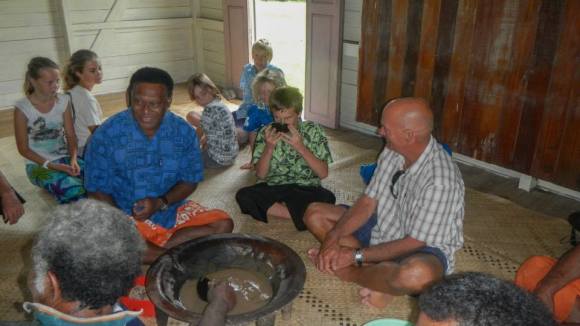
There are hundreds of blogs explaining sevusevu and the different experiences people have had, so I’m not inclined to dwell too much on the details and variations of it. Just know that sevusevu is a Fijian tradition where visitors to a village present a gift of yaqona (dried pepper tree root) and once the gift is accepted, the visitors are then fully accepted into the village. It’s generally good form to present sevusevu to the village before engaging in any other activities in the area, including swimming, fishing, diving, hiking, and playing on the beach.
If I have to be perfectly honest, sometimes it can initially feel like a bit of a burden. You pull into an anchorage, possibly quite tired after a passage, and the first thing you have to do is dress up in your chumbas and sulus and head to shore to present sevusevu. Sometimes getting to the village is simply an easy dinghy landing, but sometimes a bit of a hike may be required as well. However, even if I leave my boat a bit grouchy over this obligation, I never leave the sevusevu feeling that way. I usually leave feeling humbled and grateful that we were “forced” to make this personal connection with the people in whose back yard we have parked our boat. Even in the few villages where the people were a bit less friendly and obviously just wanted to milk us for money, I was still happy to have connected with them, to have had the face time, and to have gotten a glimpse into their lives and stories and given them a glimpse into ours. Some cruisers grow tired of presenting sevusevu and avoid it or even dislike it, but I have come to appreciate this tradition, which intentionally takes the anonymity out of our brief presence here in their islands and opens the way to richer experiences.
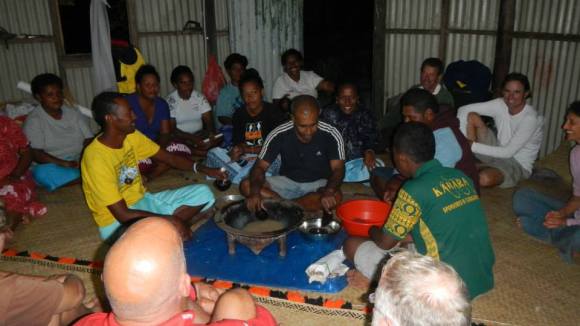
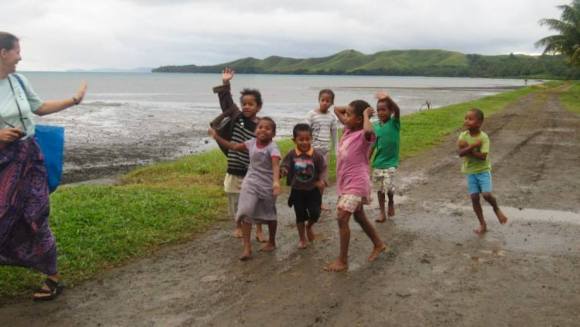
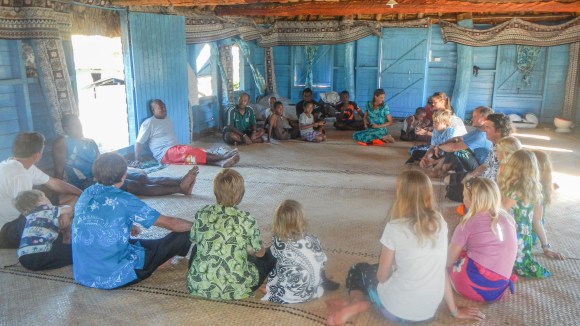
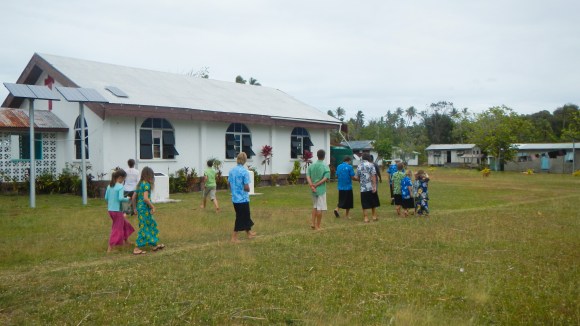
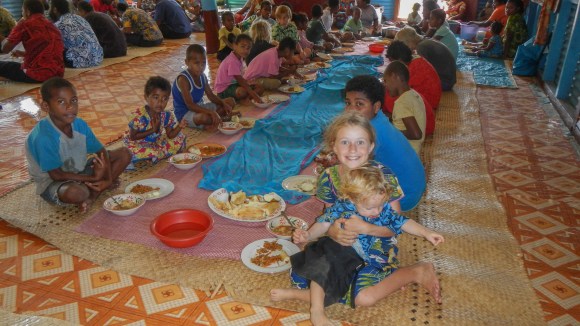
Here are some photos from just a few of places where we have presented sevusevu:
Drinking kava in FulagaEven Brenden got to try kava in MatukuSaying bye to the kids in GauPresenting sevusevu in ViwaTouring the village at Sese (Blue Lagoon)Father’s Day lunch after church at Yadua
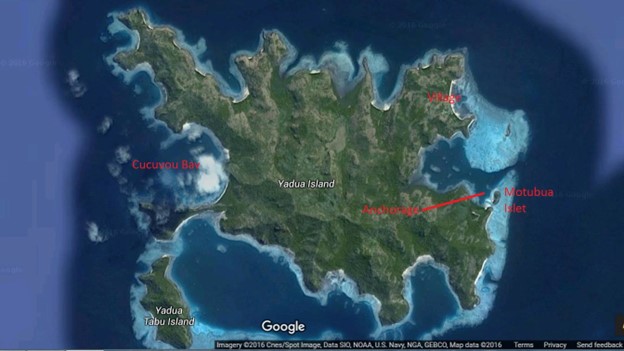
We thought you couldn’t visit Yadua. We had heard that there are protected iguanas there and that people are not allowed to go there, and boats aren’t allowed to anchor there. Curly in Savusavu, among other people, had told us that.
But thankfully, our friends on Lumbaz had gotten to the bottom of it. It turns out that Yadua isn’t off limits at all, rather it’s the small sister island of Yadua Tabu. And since Yadua Tabu is a totally separate island, it’s OK to go to Yadua, as long as you stay off of Yadua Tabu. So, when we met with people in the village of Yadua, they confirmed the situation, and that coming to Yadua, the bigger island, is OK, and that we should tell all our friends that too.
When we got back to Savusavu Max (Fluenta) went to talk to Curly and tell him the situation, but Curly was adamant about his position. The Fijian government had told him Yadua was off limits, so that’s what he was going to tell the cruisers. And when I reviewed our cruising permit that listed the islands we were allowed to go to, Yadua *was* conspicuously *not* mentioned. But then I took a careful look again and the Fiji 2015 cruising guide and it very clearly says that it’s Yadua Tabu, not Yadua, that’s off limits.
So, at this point I have no idea what the real deal is. But I’m glad we made the stop at Yadua, because it was pretty great.
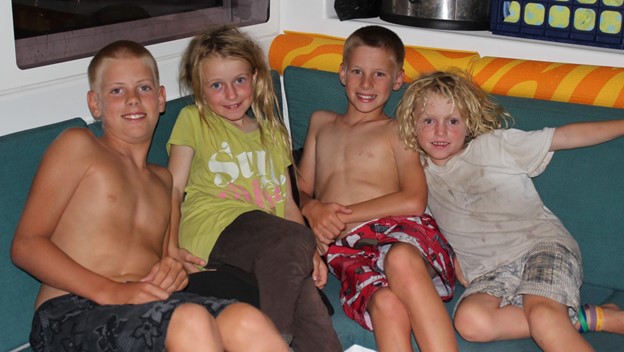
About a month earlier when we reconnected with our friends on Fluenta, they said they wanted to cruise up the Yasawas with us, but when we turn the corner to head east back to Savusavu they would go back down to the Port Denarau area to prepare for Max’s parents to visit. Luckily cruisers are flexible, and no plan is ever cast in stone, and we were so happy when they decided to come over to Yadua with us. And then to Vanua Levu. And then down to Namena. And then to Savusavu, with intention for a short stay and then head out. So, imagine how happy we were that they ended up staying in Savusavu with us the whole time and Max’s parents came there for the visit. We go way back with Fluenta…all the way back to La Paz, Mexico during the first couple months of our cruising voyage. How awesome to be with them after all this time and that our kids have gotten to grow up a little bit with each other. I was NOT looking forward to THAT sad good-bye, for sure.
Three years ago in the Sea of Cortez (Alex, Victoria, Brenden, and Jonathan)


 Gresham Family Exodus