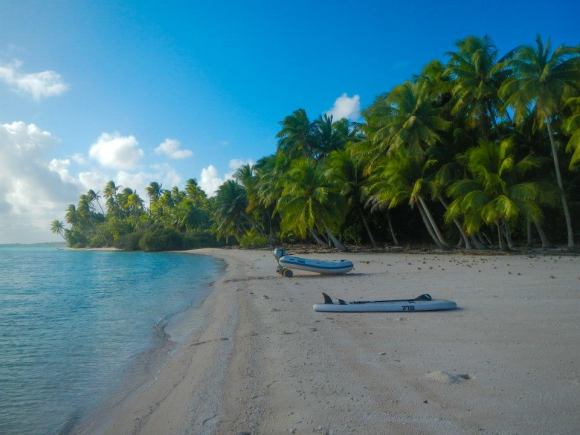
Way back when we made the drive in a rental van from Santa Rosalia to San Diego and back, Tim had purchased three paddle boards: two inflatable and one rigid. I was annoyed that he spent that much money on three, I mean why did we need three? It’s not like a paddle board is the kind of thing you need to carry a spare of, right? In fact, one of the inflatables never even made its way out of the locker it was stored in, that is, until we were in Tahanea.
Carolina and I had gone for a paddle, and I had used the rigid board, since it’s a little less stable than the inflatable one, and that night, for some reason, the boards were left in the water. We try to enforce the rule that the boards get brought up and secured at night, and along with raising the dinghy, that responsibility falls on Alex and Brenden. The next morning when I got up, the rigid board was gone. This was one of those rare circumstances where I wished we were anchored on a lee shore, but it was not to be. The wind was blowing along the long axis of the atoll, so the board could be 20 miles away by now, bashing against the coral on the other side, or even worse, out in open ocean. Tim and Alex took the dinghy to go look for it, but it was a fruitless dinghy ride from hell. The ride out was OK but coming back they were bashing into huge swells. I got chastised for not tying the paddle board up correctly, and I chastised right back that the boards need to be brought up each night.
Anyway, all hope wasn’t lost yet. On our way back to the anchorage near the pass, we saw some guys with a panga (hey, I thought this atoll was uninhabited!?), so we dropped the dinghy while underway and Tim dinghied over to talk to them while the boys and I proceeded to the anchorage in Exodus. Tim arranged to trade some gasoline for them to give him a ride to the other side of the atoll where the board might be. A deal was struck, and Alex, Steve, and Kyle went along too and made an adventure out of it. Although they made some new friends, they had no luck finding the paddle board.
I like to think that the board is now in the hands of some Polynesian kids who have so much fun with it that it makes it worth it that we gave it up. We have since blown up the other inflatable, so we have two ready to use again. And I added the item, “make sure paddle boards are up,” to my nightly checklist, and now they always come up.
Tahanea is an uninhabited atoll, and it is a national park to protect a type of rare bird, so we thought this would be the most remote of the atolls so far, but we were wrong. After the slow overnight sail to Tahanea, we still arrived too early, but we decided to enter the pass even before the light was ideal. This was our first time going through a pass with the current against us, and the max we saw was about 3 kts. We dropped anchor in a spot near the pass to wait for more direct sunlight before navigating across the lagoon, and while we were relaxing there, we noticed a boat on AIS called Field Trip. We were pretty sure they had kids, since if we were remembering correctly, we had heard of them from a boat called Tulu that we had met in Nuku Hiva. So, of course when Field Trip got a radio call from someone else inside the lagoon, Tim had to follow along and listen. We are once again stalking other kid boats on the radio. We gleaned that yes, Field Trip is a kid boat, and bonus, they were with two other kid boats across the lagoon. Tim came out of stalker mode and actually hailed them on the radio (or perhaps he just broke into the conversation on which we were eavesdropping) and talked to them and let them know there were going to be two more kid boats joining them.
The transit across the lagoon was pretty straightforward, and I think our charts were much more accurate for this atoll than the other two, as I was visually spotting each bombie that was indicated on the chart.
We had a bonfire on the beach that night, and we met Field Trip, Dafne, and Reme De. They were all on catamarans, and they had all cruised the Caribbean and came through the Panama Canal.
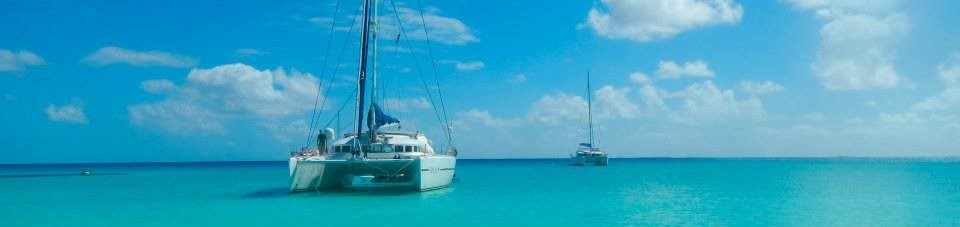
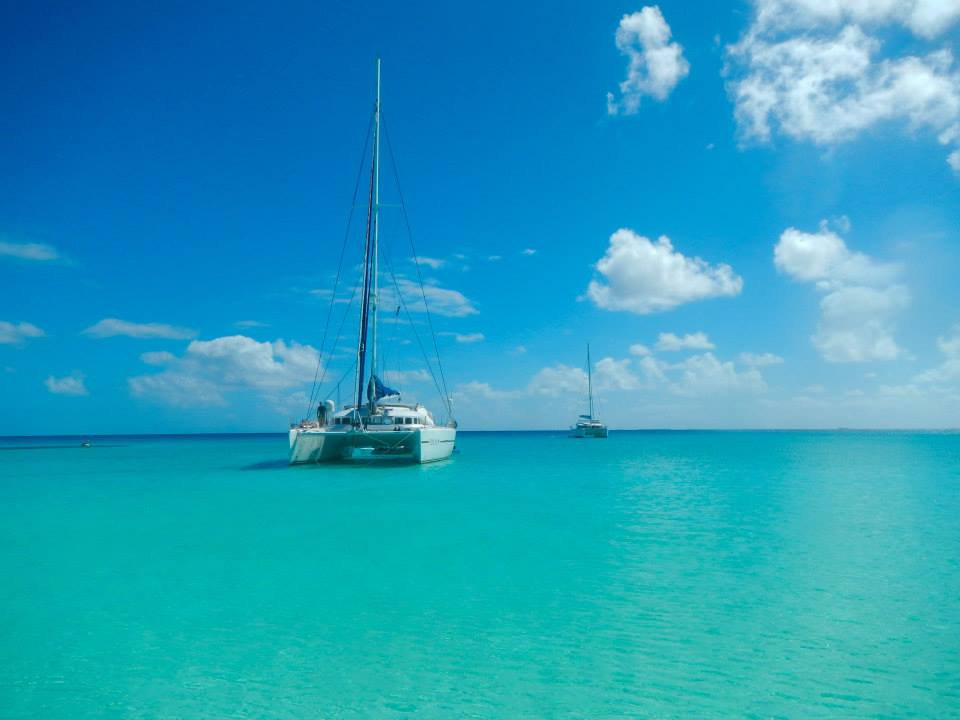
Exodus and Reme De (Exodus is the mini-me catamaran in the back)
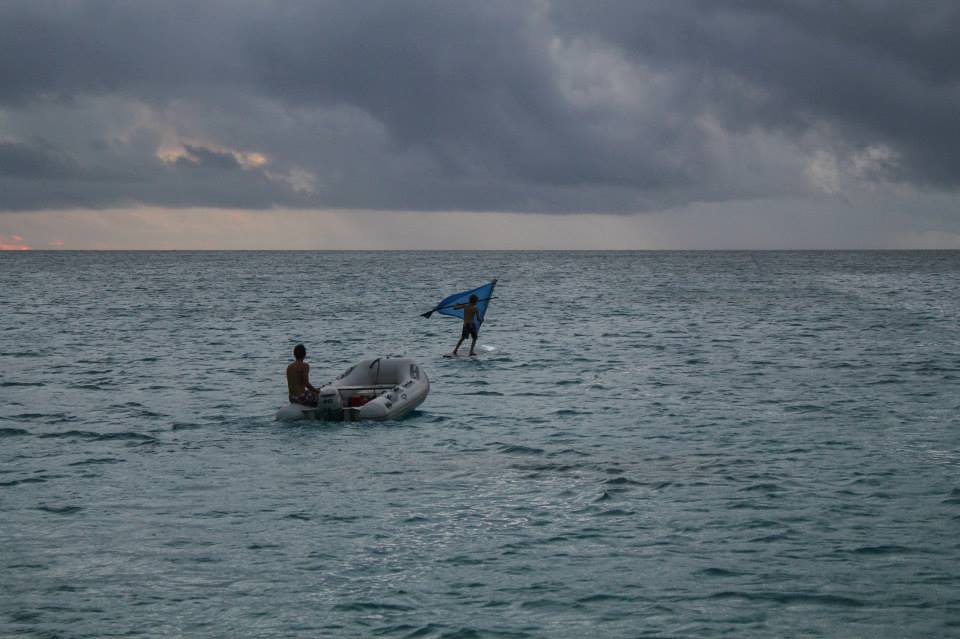
Among the three boats there were 5 girls and 1 boy, so our two crews instantly evened the boy/girl score. Our boys still, even after all this time and all the experience they have meeting new kids, even still want to just stay in their comfort zone and just play with each other (Exodus and Lady Carolina). So, the next day Tim and Steve hatched a plan to take ALL The kids to shore to build forts. Fortunately, all the kids were game for the adventure, and they were all on shore for a while, but it’s unclear who had the most fun, the kids or Tim and Steve. When they got back, they mused about how boys and girls really are different. “The girls wanted to make the fort all pretty.” Anyway, Kyle and Brenden quickly retreated into their own little world and hatched their own plan to build their own wind surfer. They were more or less successful, but they could only go downwind, so the other one would follow along in the dinghy so they wouldn’t get lost too far downwind of the anchored boats.
Brenden and Kyle and their wind surfer
We decided to invite everyone over to Exodus for a happy hour, and Lady Carolina volunteered their boat as the kid hangout. Tim and I disagreed on a start time, and Steve and Carolina stayed out of the argument saying they were good with whatever. Tim wanted 4pm, but I suggested 6pm, so we could feed the kids dinner beforehand. My experience with these happy “hours” is they tend to run much, much longer than an hour, and I wasn’t sure when we’d work dinner into the schedule. Tim won and we started at 4, well in reality more like 4:30 because these things tend to also run on cruiser time. Needless to say, at 8pm we were still going strong. Of course, we had plenty of appetizer goodies that we’d been munching on because everyone brought something, but dinner was nowhere in our sights. On Lady Carolina, Kyle made all the kids pasta since they were all getting hungry. I think we finally wound down about 10:30, and it was a great evening getting to know new friends. But after that, I always got to pick the times for our happy hours. And if we feel like starting early, we always make it a dinner potluck event.
We had a good time in Tahanea, but that mostly had nothing to do with the specifics of the atoll itself. Overall, it was a bit of a letdown. It was not nearly as pretty as Raroia, and it had no village to enjoy like Makemo. Admittedly, we never did a pass dive, so we can’t really judge that compared to the other two, but in hindsight I think Fakarava may have been a better choice. However, I wouldn’t really change anything, because up to that point we hadn’t met very many other kid boats, and it was fun to have a group to hang out with.
When leaving the dock at the village in Makemo, we had a little bit of drama… we had bow anchor down and were stern tied to the wharf and good fortune had it such that the wind was blowing dead astern, so theoretically it would be an easy departure. Throw off the dock lines (we had help on the dock for that) and then just get pushed by the wind over the anchor as we raise it. No problem, right? Well, Alex wasn’t being quite as careful as he should have been, and he jammed the anchor bridal hook up against the bow roller and the windlass fuse blew. I’m at the helm, and Tim tells me we have to raise the anchor manually, so “just hold us right here.” Well, some might think that with two engines holding Exodus in precisely one spot would be easy. And it is, in very light wind conditions. But with huge windage and very little keel, once the wind is over about 8 kts we get pushed around pretty good. And this day it was blowing 15-20. So, I try my best, but we do end up getting blown sideways a bit, so my great idea is to just turn, drive back to line we were on, and then face the anchor again. In the process of doing that, I wrapped the chain around a coral head. What a fiasco. Tim had to jump in the water to free the chain, and at this point I just turned us around to face the wind so once free of the coral head we just floated back bow to the wind and raised the anchor manually (with help from Steve from Lady Carolina who had jumped in the water and boarded Exodus) in a more normal wind orientation for anchor raising. So, I was ready for my rum right there, but we still had 3 hours of navigating through the coral heads to the next anchorage. I dipped into the Zaya for that safe arrival cocktail, to be sure!
There is actually a breaker switch for the anchor windlass, but if you recall, that failed on us while we were still in Mexico, and Steve and Tim rigged up a “fuse monster” so that we could operate the windlass while still having the protection not to overdrive the windlass. This incident in Makemo highlighted a problem with fuses. When they blow, they need to be replaced, but if we had a functioning breaker switch, we could have just thrown the switch and been back in business. It turns out we actually DID have a replacement breaker switch, and we had had it for quite a while, we just hadn’t gotten around to replacing it. Needless to say, that jumped up immediately to the top of Tim’s to do list.
While not quite as serious as when Alex had a run-in with a jellyfish in The Marquesas, Brenden’s encounter with a sea urchin in Makemo had every bit of the drama. He was playing on and around the wharf with several of the Makemo kids, when he showed up on Exodus’s back step crying and in distress. He showed me the tip of his forefinger, which had 5 dark, pinprick sized holes, and he told me he was attacked by a sea urchin.
I decided to hide my amusement for the moment, because he was clearly not in the mood to be teased about attacking sea urchins, so we put vinegar on it to try to neutralize the venom. One of the kids on the dock went to get someone and came back with a French woman who used to be the nurse. Her advice was that after the pain wears off you just leave it alone, and his body would expel the pieces of the urchin in time. Turns out this is pretty much what happened, although we kept a close watch on it for infection. When each one seemed close enough to the surface Brenden would pick it out with a needle and tweezers. I think it took over a month for all 5 of them to work their way out.
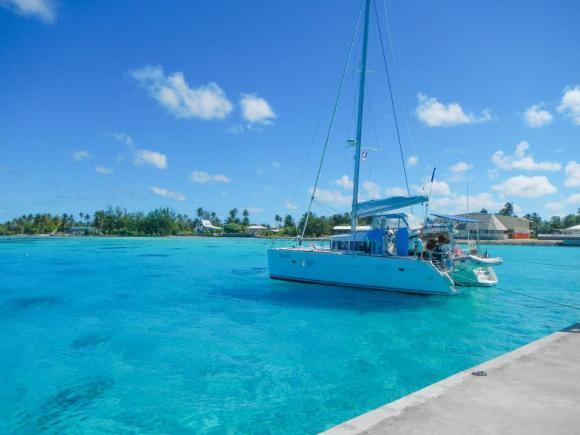
Makemo is southwest of Raroia, and it was an easy overnight passage to get there. It is an elongated atoll, it is oriented WNW to ESE, and it is shaped somewhat like a dumbbell (narrower in the middle than on the ends.) Somewhat larger, it is about 40 miles long and 10 miles across. There are two passes, and we entered the lagoon through the more southern one, which is actually on the north side of the lagoon, just about 1/4 way up from the southern tip. The pass is called Passe Arikitamiro, and the village of Pouheva is just on the motu on the western side of the pass. Entering the pass was pretty straightforward as we rode the incoming tide again and had a maximum of about 3 kt of current. We elected to stern tie to the wharf at the village, and that turned out to be the most challenging aspect of our transit. This was our first time with this maneuver. We dropped the bow anchor and then backed into the wharf and tossed the dock lines ashore to some guys who came to help us. The problem is that Exodus is so big and fat and has so much windage that we were getting pushed sideways pretty good, since the wind was blowing about 20 kt. With Alex’s help, we were able to get everything secure.
Exodus stern tied to the wharf
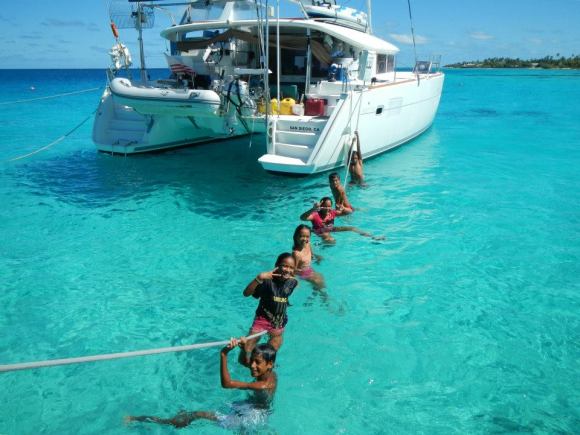
We explored the town almost immediately, and we found it clean and the people friendly. We found the stores pretty easily, including a bakery. Baguettes, again! Although they weren’t as tasty as what we had grown accustomed to in The Marquesas. Right near the wharf was a covered recreation area for the kids including basketball hoops, and there were several kids playing as we wandered past. Tim encouraged the boys to go play, and when they wouldn’t he gave them a little more incentive. He told them if they didn’t go play with the local kids, they couldn’t eat anything we bought in town, including and especially the baguettes. They were stubborn and went and sat on the wharf near the boat. After a little more exploring of the town, we saw the kids again, and Tim talked to them and told them about the boys, and they are welcome to come play down by the boat. The kids quickly accepted this offer and found the boys near the boat. Brenden was going back and forth between the wharf and Exodus by shimming along the dock lines, getting dipped in the water along the way. Of course, this looked fun, so some of the other boys wanted to try it as well. Before long, they were all swimming, jumping off of Exodus, playing catch with our “futbol americain” and generally having a really good time. Tim would throw the football and they would try to catch the football as they jumped off the dock. Eventually, they all went to play soccer, including the Exodus and Lady Carolina boys. When they got back, Brenden commented on how good at soccer they all were.
That evening we were invited to watch the dance practice at a covered area right near the wharf, and so we all went down to watch. The women of the town were practicing their dancing for the upcoming Heiva celebration, and we got to see the instruction and practicing and listen to the fantastic drum playing. It wasn’t a professional dance troop, to be sure, but we had fun watching and talking to people. The only downside was that after the overnight passage I was so tired I could barely keep my eyes open after sitting there for a while. Luckily, that wasn’t our only opportunity to watch them practice.
The next morning when we got up there was a group of younger children on the dock with flowers, and they wanted to “change” them for chocolate. After school, all the kids were back for more playing on Exodus.
After bypassing the opportunities in the Marquesas, Tim decided he wanted to get a tattoo. I was skeptical about finding someone here in Makemo, after all, the Marquesans are very well known for their tattoos, and I had no idea what we could find in The Tuamotus. After asking a few people and getting the same answer from all of them, the guys went to see Beko, and it turns out he’s a real artist. In addition to tattoos, he engraves black pearls with intricate designs. Tim saw his work, and thought, yeah, this is the guy I want to do my tattoo. Would you believe his tattoo “machine” was broken? No tattoo for you. Tim and Steve suggested maybe they could fix it, but Beko had already thrown it out, so he’s no longer in the tattoo business.
Not to be discouraged, the guys then turned their attention to the carved pearls and made some complex trading deals for him to carve some pearls for us. Ok, not too complex, just some alcohol and a few boat items and they had their deals. As a bonus, they got to meet Beko’s brother Victor. Just like when you asked anyone in town about tattoos, they steered you to Beko, if you asked anyone in town about fishing, the only name you heard was Victor. Since that is right up Tim and Steve’s alley, they joined him for spear fishing one day, but the “piece de resistance” was going out fishing with him on his boat. If you haven’t seen it, go check out our youtube video called “Fishing with Victor,” and so not to spoil it too much I’ll just say it involves a harpoon rather than rods and reels. OK, since I spoiled it, I’ll tell just a little more. His boat is a hard bottom skiff, but unlike the Mexican Pangas which are driven by outboard from the back of the boat, just like our dinghy, Victor’s boat is driven from the front. What he does is follow the birds until he finds a Mahi Mahi (Dorado) and then he chases it until it gets tired. Then when he’s close enough he throws a harpoon at it. His success rate was amazing, and they came back with 4 huge Mahi Mahi. The only time he missed occurred because when he went to cock his arm to throw the harpoon the first time, he was interfered with by one of the fishing poles the guys had brought. They had a great time, and when they got back, we invited Victor back to Exodus that evening and he had dinner with us, but I had seasoned up some Wahoo and baked it, and I’m not sure it was his sort of meal. But he drank beer with us, and we all practiced our French, and overall had a very pleasant evening.
The only bad thing about being stern tied to the wharf was the weather. On the one hand, it was comforting to be tied securely as squall after squall passed over. But on the other hand, our orientation was such that the wind would blow dead astern, which means when it rained, the rained blew straight into the cockpit. So, with the cockpit continually wet it put a damper on our pot lucking activities on Exodus. One evening we ventured to the “restaurant” which wasn’t a restaurant the way we tend to think of them, but rather a place they will cook for you, if you make arrangements in advance. Similar to some of the smaller villages we visited in Baja California.
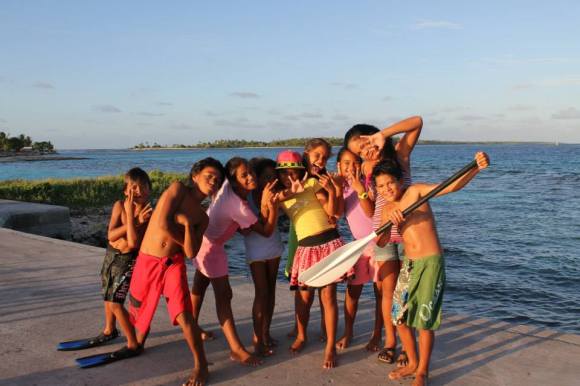
The first few days Lady Carolina was anchored rather than tied to the wharf as we were, but then they came in and parked right beside us. At this point, I guess Tim and Steve decided they needed to up the ante for the kid fun, and they rigged a rope swing on Lady Carolina. This was a huge hit, and even got the attention of the group of teenagers who had been hanging out on the dock but were too cool to come and play. In addition to enjoying the rope swing and eating all of Carolina’s SAO crackers, they also enjoyed Steve’s weight set, and they were pumping iron to our amusement. Well, I guess one rope swing on Lady Carolina just wasn’t good enough, so Tim and Steve attached a Lady Carolina halyard to an Exodus halyard, and then attached a third line to that, and created the rope swing of all rope swings that could be launched from the port stern of Exodus. By late afternoon, we must have had 50 kids on or around our two boats. It was a bit crazy and got away from us a bit, but amazingly nothing got broken or lost, well, except for Lady Carolina’s pulpit, which got a bit bent when a large kid used it as a springboard. A couple times we had to remind them to not stand on the lifelines and not jump on the net, but overall, they are a good group of kids. I spent some time with some of the older ones reading the French for Cruisers book together. They would pick a phrase and ask me something in English and I would try to answer in French. They seem to speak French more often here than in the Marquesas, even when interacting with each other. In the Marquesas, we heard a lot of Marquesan. I’m not exactly sure what the native language here is called. They seem to speak Tahitian, but a couple words they taught us they would say, “in Makemo” indicating it’s a local language, but I’m really not sure.
Rope swing
A military boat pulled up to the dock while we were there, and at first, we were wondering if we would get boarded and searched, but that was not to be. This was a French Navy boat with nothing to do with customs, and while they were there it was if the men all had a day’s leave as they explored the town dressed in shorts with their cameras. They were all so young, and surprisingly spoke very little English, but they seemed to get at least a small kick out of all the local kids playing on our boats.
Once we had planned to leave the village and we had told the children, we ended up staying one more day at the last minute, and I’m so glad we did. When I told the kids we were staying “a demain” (until tomorrow) they were so excited they hugged me, especially the girls who are “in love” with Alex, Brenden, Kyle, and Joel. It’s funny, they communicate this by making a heart shape with their hands. They wrote notes with lots of hearts on them and gave the boys silly band bracelets. They spent the day with me on Exodus helping me chop vegetables and teaching me French. One of the girls would say a phrase in French and then tell me, “repetez.” They told me, in French, that they wanted souvenirs from us because they don’t want to forget us. I told them, “OK I understand,” thinking I would think of some things and give them later. Apparently, what I actually did was give them permission to go to Alex and Brenden’s rooms and pick out what they want. They each came out with two shirts, dirty and smelly I might add, but they didn’t seem to care. I felt so bad I had to stop them because since they’ve been growing the boys don’t actually have that many clothes to spare, especially Alex. Oh, they pleaded with me to let them have shirts, so I dug around in Brenden’s cubby and found some (clean) older, smaller shirts and gave them each one. Another funny thing is when Brenden came back, he asked if I cleaned his room. I guess the girls thought the Legos needed to be tidied up a bit! The next day Carolina was able to dig out a shirt of Kyle’s and gave that to one of the girls too, they were so ecstatic.
Our last morning in town the girls were on the dock bright and early with more love notes for the boys. But even more exciting, Beko brought us our pearls, and they were exquisite. Tim “ordered” one with each of our names on them in addition to several others, and Brenden’s has a tuna on it, so he was happy. Beko also brought Tim and Steve bone carved necklaces, “for the captains.” I admired Tim’s because I had been wanting one like it, but I’m pretty sure that was not in front of Beko, so I’m not exactly sure what motivated his next visit, but he came back with necklaces for me and Carolina. He said with a smile, “for two captains.” The necklaces were gifts, thrown in with the pearls, which was very generous of him.
When we finally pushed away from the dock, after the drama of the anchor windlass, we made our way just a little bit northeast to a secluded anchorage, which was the perfect place to decompress. Brenden was feeling sick with a sore throat, so he was confined to the boat, but the rest of us went to shore in the afternoon to explore a bit. It was pretty windy, and Alex and I had a hell of a paddle to get to the beach, and unfortunately for Alex, he forgot his shoes, so he had to go back and beat upwind a second time.
After a day or two we made our way to the vicinity of the northwest pass. It took four hours in squally weather to get there, and Tim and Steve both spent the entire passage hoisted up in bosun’s chairs near the first spreaders. This was so they could have a higher vantage point to be able to see the coral heads that much better. And of course, they each had a VHF radio in hand, so the bantering never ceased. We had a difficult time finding a spot to anchor, and when we arrived, we actually had to wait for a pretty big squall to pass over us. So, after getting windblown and dumped on, we made our way into a tiny, protected lagoon, and here we stayed just for a couple hours while all the boys, except Brenden, did a pass dive. Brenden was still a little sick, so he remained in quarantine. When they got back from their dive, we all decided to stay the night, so we moved Exodus out of the lagoon and out near where Lady Carolina was anchored, so we would have a bit more swing room.
The next morning Alex woke up sick, and it turned out to be something like strep throat and he even had to take anti-biotics. I teased him that it was mono and kept asking him which of the girls in Makemo he was smooching on. When we raised anchor that afternoon, it was wrapped on a coral head, and Tim had to dive in to clear it. So, with Alex out of commission, Brenden had to step it up and work the anchor windlass, since I was at the helm and Tim was in the water. Brenden did a phenomenal job, and we were unstuck in no time. We took a “shortcut” out of the anchorage, because Tim had dove there and he was confident Exodus could get through, and our pass exit was just as uneventful as all of our other passes. Lady Carolina declined the shortcut route and took the safe, long way around, and their story afterwards was that they had a serious “oh shit!” moment where they only had a foot of water under the keel. But when all was said and done, we were both out safely by 5 pm and on our way to Tahanea.
Most cruisers are cautious. They scrupulously check weather, and when it came to these passes in The Tuamotus I’ve already written about how we all agonized over what time to arrive for slack tide, making sure we had proper sunlight to navigate the coral heads, etc., etc. But there are always exceptions.
While Lady Carolina and Exodus were anchored on coral heads near the pass at raroia, we got a radio call from an approaching vessel at dusk. It was someone we knew, s/v Skabenga, and they said they didn’t want to spend the night outside, so they were coming in, and did we have any advice. Holy Crap. Coming through the pass now? Where are we in the tides? Is there enough light to see? Where the hell will they anchor? Where we were wasn’t exactly an anchorage, maybe they could follow the lighted channel to the town? If it had been either Carolina or I who had picked up the radio, our responses would have been the same. Our advice to you is to stay outside for the night and come through the pass in the morning when you can, you know, see. But it was Tim who was first responder, and to be honest I don’t even really remember what he told them, because I was floored that it wasn’t advice to stay outside. All I remember are his words at the end, “good luck.”
So, in they come. No drama. They come just inside the pass and drop hook just off the coral shelf inside in I don’t know what depth, but probably pretty deep, since we had circled the area for an hour the day before looking for places to anchor. In the morning their back end looked like it was situated right on top of the coral. And after talking to Bruce later, it actually was. They had a foot or two under their stern. If it had been us, our saildrives would have been bashing but luckily their configuration is different and their saildrives are actually further forward up their hulls.
When it was light enough, they made their way across the lagoon and were no worse for the wear. So, what are we all stressing about?
Raroia Pearl Farm Tour (mostly by Steve from S/V Lady Carolina)
We had heard and read a lot about the black pearl industry in The Tuamotus before we got there and about how cruisers before us were able to buy pearls directly from the farms for very cheap, so we were excited when our friends on S/V The Beguine organized a tour of the pearl farm in Raroia for all of us. Paul and Celeste had been there the day before and spoken with the owner, so it was all arranged. There was a shanty dock that we all tied our dinghies to and some loud construction going on near the water. On the dock, two guys were pulling strings of scallops out of the water and putting them in wheelbarrows. Once full, they’d push the wheelbarrow into a large open warehouse type building, where most of the activity was going on. So, one of the first things we learned was that the black pearls come from scallops, not oysters.
We didn’t meet the owner that day, because he was away in Tahiti, but we spoke to the forewoman, and met several of the workers. They have quite an assembly line operation going on, even if on a small scale.
Steve, from Lady Carolina, did a really good write up on the operation, so I’m just going to use that here instead of recreating my own:
There were about 12-16 people processing the shells in total and another 5 or so people working on the surrounding structures. Some point form notes:
– I thought that pearls come from oysters however the shells certainly looked like scallops, so I am not sure what they were – The black pearls that they extract are about 12-14mm in diameter. – When they seed the oyster, they use a (guess) 10-12mm white ?pearl? (actually, some other shell from the Mississippi). This means that the black pearl is not ALL black pearl ?it’?s a thin coating on top. I never would have guessed that. Kind of like learning about Santa Claus – It takes the oyster/scallop 1 year from seeding to retrieving pearl – They do not harm the shellfish when removing the pearl in fact it is quite an operation as follows:
a) Divers retrieve large strings of oysters on a line. (15 or so on a ½? polypropylene line) that are submerged off on one of the many (argh!) buoys/lines that crisscross the atoll b) Oysters are brought to a temporary holding pen on the end of the dock of the processing plant. (In the water) c) Workers, as required, bring up strings of oysters, put them in a wheelbarrow and move them 75m to inside stage 1 d) Stage 1: Workers cut off the monofilament lines that attach oysters to ½? line with machetes and then use machetes to clean off numerous other smaller shells that are attached to the outside of the oyster. e) These cleaned shells are put in a crate and the crate put in a large blue (4m? diameter, 1m depth) ?pool? that is cycling salt water. f) Another worker drills/redrills the holes in the shells for the monofilament line. g) Oysters back in the holding tub h) Another set of workers remove the oysters from the tub and use a special wedge tool to just open the shell a little bit and then a small plastic wedge is placed in the shell to keep it open. i) The shells are placed upright, wedges up, in the same orientation in a single layer in another plastic crate and put back in the water j) The pearl extractor (we were told they make 100kUSD/year) takes an oyster shell and puts a set of handheld spreaders into the shell where the wedge was and opens up the oyster a bit more. Jiggles the oyster around to the correct orientation and then places the shell in a holder. k) When in the holder he uses to long tools similar to dental probes to cut a small incision inside of one of the organs to retrieve the pearl. Examines the pearl. Good paerl in one bucket, bad pearl in another bucket. If a good pearl the oyster is reused and another seed pearl is put in, if the pearl was bad, the oyster is put into the discard bucket. l) The whole operation that the pearl ?surgeon? does takes about 30-45 seconds m) The good oysters get new monofilament put through them and they are tied to strings n) The strings are taken to the temporary holding pen at the end of the dock and eventually put back out in the bay.
Everyone is happy that is working there (or so it seems but it is really repetitive assembly line work) but what is totally staggering is the VOLUME of oysters that are moving through the line coupled with the knowledge that it takes a year to culture a pearl?there has to be 100,000?s of oysters strung up just in this atoll!!! (That is assuming that the operation runs year round?.not sure if that is the case, either way it is a lot of oysters all over the place)
It is actually nice to see that they have a 100% sustainable business that is managed quite well. There are many pearl farms in each atoll and many atolls that have pearl farms.
On a sad note, we were not allowed to purchase any of the pearls as the ?boss? was not there. There apparently is a HUGE tax on the pearls and it is monitored closely. We hope to find someone that will sell us a bag of them under the table in the next atoll.
Pulling scallops from the water at the Raroia pearl farm
Coconut Crab Hunting (By Steve from S/V Lady Carolina)
Yesterday afternoon Tim, Craig, Louis and I braved the flies and went into shore to set up traps for coconut crabs. Apparently, whoever introduced flies to the Tuamotu’s did not want them to be alone, so he also introduced mosquitoes. I am not all that sure what the flies and the mosquitoes eat however they both have an impressively massive population. Perhaps they get together and potluck during the evenings. (I have not seen mosquitoes like this since being back in Calgary….they were pretty bad and we had to retreat for bug spray……well, and more beer of course.)
Given that we are not seasoned coconut crab hunters my only information was to split coconuts and stake them down to the ground with spikes so that the crabs do not drag them away. We spent about 1-1.5 hours finding crab holes, splitting coconuts and spiking them to the ground. There is no shortage of coconuts on this island. I bet that 99% of the vegetation is coconuts. We actually had a rough time finding trees suitable to make into spikes. After the traps were set, we returned to Exodus for our evening potluck.
A few hours later when it was dark, we ventured back on shore and quickly determined that flies cannot see well at night whereas the mosquitoes have excellent vision during any time of day.
After we bug doped up and started our trek with a 2.5-gallon plastic bucket, we walked towards the first trap. Perhaps the rum was the cause of the difficult walking, but I am going to suggest that walking on 1000’s of large ball bearings at night on uneven, rocky terrain was to blame. There are literally 1000’s of coconuts and associated palm leaves blanketing the forest(?) floor.
As we arrived at our first trap, we learned a couple of things.
1) Hermit crabs LOVE split coconuts. 2) There are as many hermit crabs on the island as coconuts.
Essentially, we spent 1-1.5 hours setting up hermit crab feeding stations. Well, just for good measure we threw a couple of the big ones into the bucket. You never know how good they taste until you try one.
After a little while we saw other crabs that were not hermit crabs. We have arrived!!! We found the crabs and they were relatively easy to spot and catch. There was some confusion and question as to whether or not these were coconut crabs however when we caught a couple they were running away with coconut in their mouths. Well, it was definitely a crab, and it was eating coconut soooooooo it makes sense that these are in fact coconut crabs. Off we go to catch more.
Soon the bucket was filling up with crabs that certainly did not want to be in the bucket. A 2.5-gallon bucket is not all that big, and the job of the bucket carrier was to shake, spin, beat down, chase and recapture the ones that got out. This was almost a full-time job and, in the end, if you could get the crabs mad at each other they would tangle up in a ball of pincers and hold each other down. How do you get a crab mad you ask? Personally, I found that shaking, spinning, beating them down and recapturing them did that plenty well. Every now and again one would spring free and had to be recaptured.
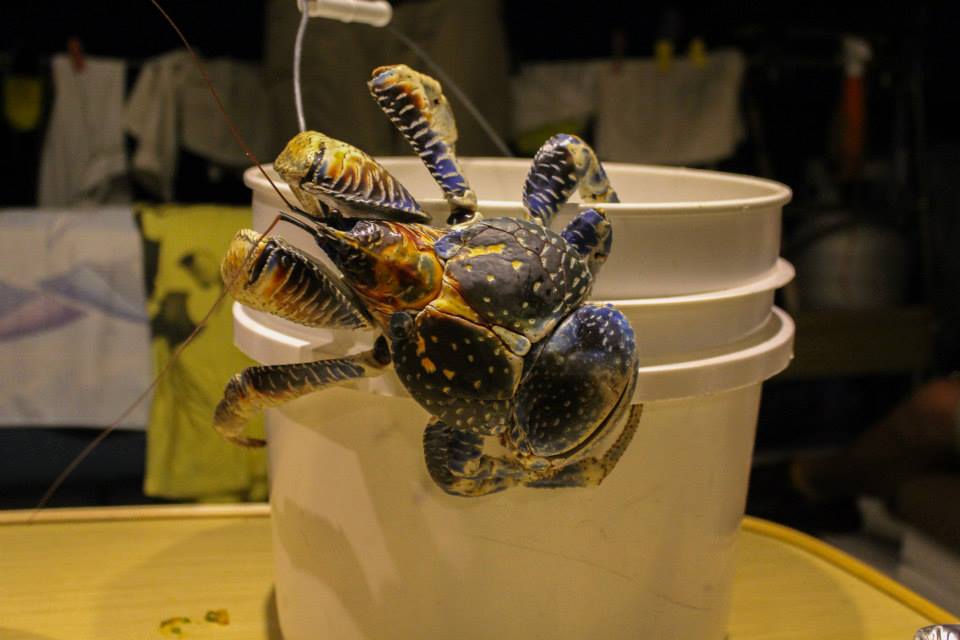
At about time that I figured out how to control the crab-mass Tim yelled out. “Holy crap, what is that?” At that point we all came over and he had his light shining on a fairly large 10-12″ long, 4″ wide vibrantly blue crab-lobster like thing! Aha!!!!! THIS MUST BE A COCONUT CRAB!!!!!
We all concurred that this WAS the coconut crab that we have been looking for. The only problem is that we did not have any bucket room. The solution? All of our work getting the other crabs was lost and we dumped the crab-mass. They did sit there in a pile for a few seconds until they realized that they were not in the bucket and then they scrambled for cover. A neat sight to see. They all put their opened claws up in the air and ran sideways while saying “aye, aye, aye!”
We then put the coconut crab in the bucket and proceeded to look for more. We looked for a while with no luck and then decided to cross the island to the windward shore to look for lobsters at low(ish) tide.
As we moved towards the windward shore the vegetation turned from 99% coconut trees to 99% brush. More like a wall. While traveling through the brush-wall we discovered another interesting thing. Whoever introduced flies and mosquitoes apparently knew that this was a mistake. I am not sure if he tried little mosquito traps or fly paper and got poor results or not but the end solution to the original mosquito and fly problem was to introduce spiders. Many spiders. 1000’s of spiders.
These are special spiders with HUGE abdomens full of silk. Or they used to be at least until they made their numerous webs. The webs were no match for our might, and we easily smashed through web after web after web with our faces.
On the other side we found the remnants of a (40-100′?) steel boat that was washed up really high (inches deep water). Pretty sobering to see such old thick plates of steel broken and twisted and laying in pieces on the reef that we were walking on. Mother nature sure is tough at times. Perhaps the guy that introduced the flies, mosquitoes and spiders was on that boat and this was his punishment? I certainly hope so.
On the other side we did not see lobsters but lots of eels, small fish and something big that splashed a lot and swam away. I did not see it, so I am not sure what it was. In any case, tromping through a shallow reef at night with a flashlight and seeing something big splash in the water and only seeing a shadow leave was an entertaining adventure. After that experience the files now have something to eat.
During this walk through the trees, brush, reef our brightly color crab hung happily on the bucket, right at the top just sort of hanging out.
We decided to make our way back to the boat. Instead of returning the way that we came we decided to try a different route. Great success, it took us 10 min to get through the brush and onto the leeward side back to the dingy. The island is shaped like a teardrop.
We took the crab back to the boat to let everybody see it. (Not exactly our original plan, arriving back at the boat with 1 crab for 12 people after 16-man hours) We took pictures of the crab (which is a really gorgeous animal….well, for a crab). Poked it for a while, played with it and since it was the only one we caught we decided that there are clearly not an abundance of them, so we returned it back to the jungle to let it do its thing. I am sure that he is at the fly/mosquito/spider potluck telling all of his friends “You are not going to believe what happened to me last night!”
We read about this in the Soggy Paws Compendium, and it became standard part of our anchoring process while in the Tuamotus. Basically, the bottoms of most anchorages are littered with coral heads of various sizes. So, even if you find a nice sandy patch to drop the anchor on top of, since the anchor chain lays along the bottom it can get wrapped around a piece of coral if the wind shifts a bit or even as you swing about on your anchor. So, in an effort to minimize the chances of this happening, Tim would attach anywhere from 1 to 4 floats along the chain to keep it elevated up off the bottom. The first few times he did it from the water after anchoring, and this could be quite a chore since you had to get the anchor chain and the float close enough to attach, and the anchor chain is heavy and the float is of course buoyant, so it would take some strength and a lot of kicking while breath holding to make this happen. Eventually, he figured out to just attach the floats from the bow as we are paying out the chain when anchoring. Much easier.
The “Soggy Paws Compendium” became our primary source of information and waypoints for the Tuamotus. Basically, this is an informal guidebook put together by a cruiser (s/v Soggy Paws). They have gathered input from various cruisers and blogs over the years and have organized it into a document for other cruisers to use. They have a compendium for most island groups in The South Pacific, but I had an abundance of guidebooks for The Marquesas, so I really didn’t delve into the compendium too much. That changed for The Tuamotus. All I had was Charlie’s Charts for Polynesia, which in general hasn’t been that helpful for anywhere because the chartlets are hand drawn and hard to read, the information is usually outdated, and the information on the passes are usually just worst-case stuff. Also, the French Polynesia guidebook I bought in Hiva Oa only covered the most heavily visited motus and didn’t even include the ones we wanted to visit.
So, the compendium provided us with a lot of firsthand accounts of the atolls, and in many cases even included anchor waypoints. We are grateful to the cruisers who came before us who took the time to write up their experiences and even more grateful to Soggy Paws who collected the information and made it available to everyone else.




 Gresham Family Exodus