Categories
Blog Post

New Net for Exodus

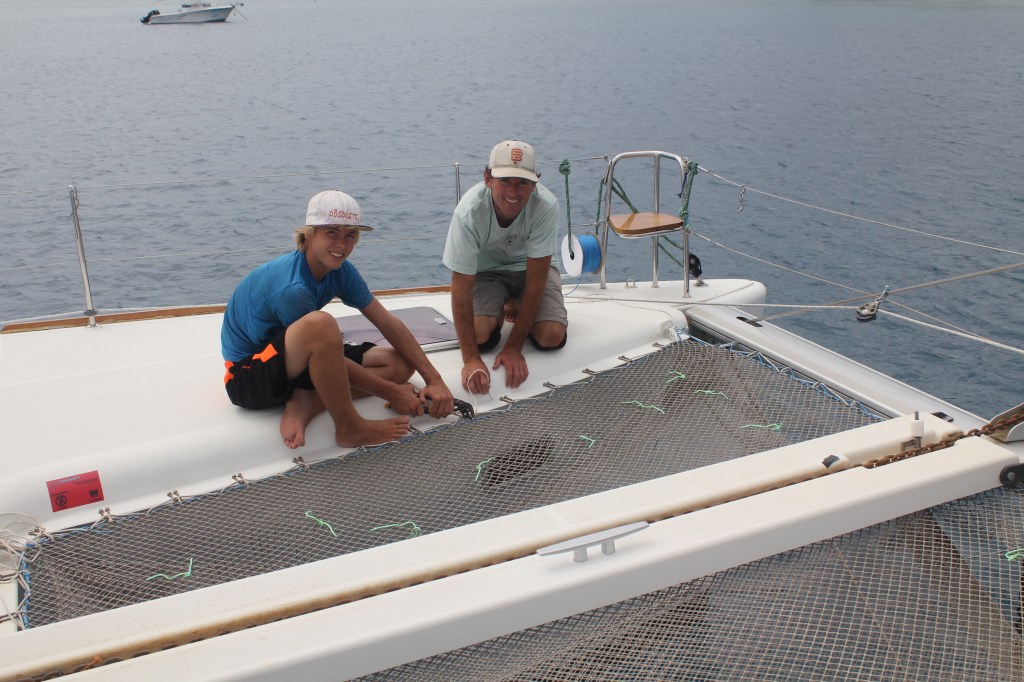
The netting (aka trampoline) on Exodus had become a bit saggy recently, so while Field Trip was in the states Tim contacted Mark and somehow convinced him to bring back a new net for us. This is no small parcel, but the $50 for an extra suitcase was way cheaper for us than having the net shipped to Fiji. So, cheers to Field Trip for doing us such a huge favor, and hopefully Tim bought Mark a beer or two!

Tim spent many hours getting the netting all lined up right, and he recruited help from Alex from time to time. They finished it while we were at Blue Lagoon, and it’s very nice to feel confidently supported now as you walk out on the foredeck!

Categories
Blog Post

Manta Ray Resort

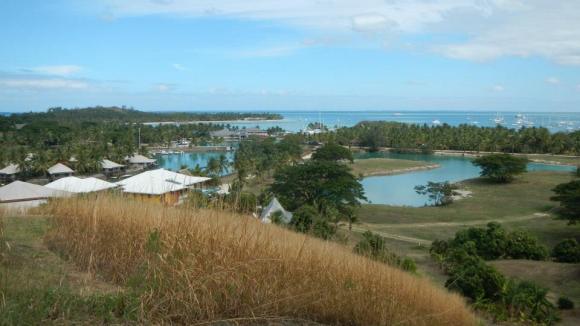
Manta Ray Resort is on the northeast tip of the island of Nanuyabalavu, and most cruisers when visiting the area anchor off the west side of Drawaqa Island, and we fell in line with everyone else. Lumbaz, Breeze, and Field Trip were all there already, along with a few other boats, so it wasn’t easy to find a good spot to anchor. The anchorage is steep to, so it’s difficult to find the sweet spot between having enough scope out and having enough swing radius. It’s also littered with coral heads, so the shifting current makes it difficult to keep your chain from wrapping. Our first time there we had to reanchor in order to put out more scope, and our second time there we had to reanchor because we wrapped a bombie. We were lucky that both times we were there, conditions were mild, because it’s really not a spot you’d want to be if there’s any sort of weather.

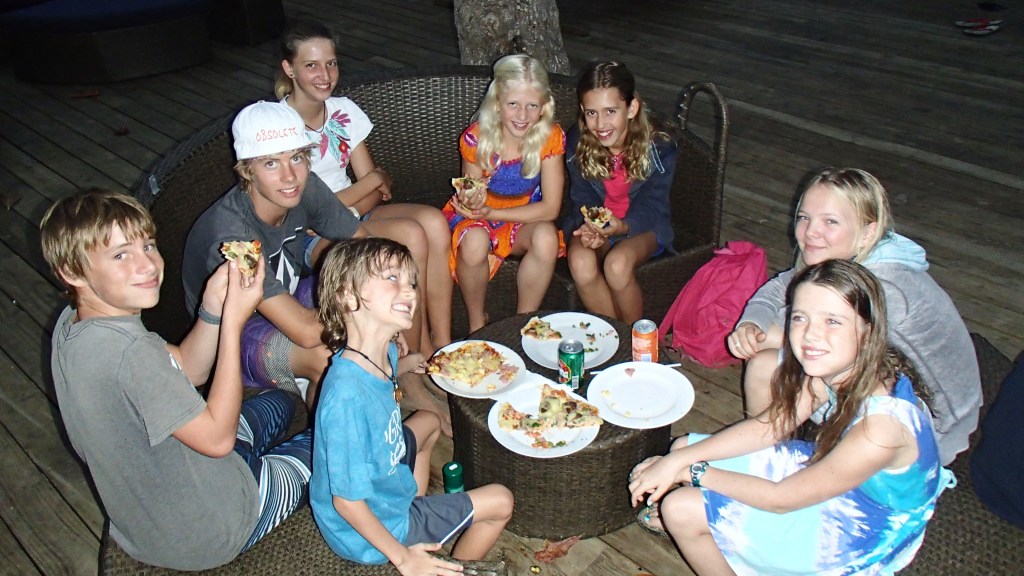
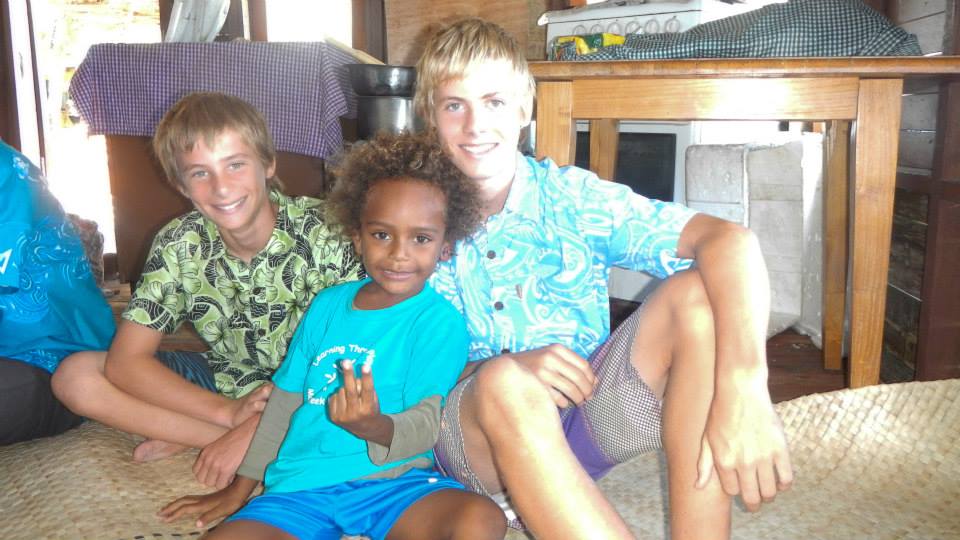
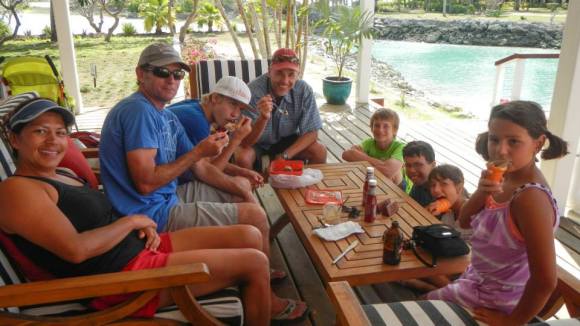
The resort is low key, nothing big like Port Denareau or Musket Cove. Our first evening there we took advantage of the restaurant and had a relaxing pizza dinner on shore. We ordered a couple pizzas at a time and just kept them coming until we’d had enough. Alex and Brenden were enjoying being back with their kid boat posse, and I was enjoying being back with some of my sailing sisters.

Pizza dinner at Manta Ray Resort

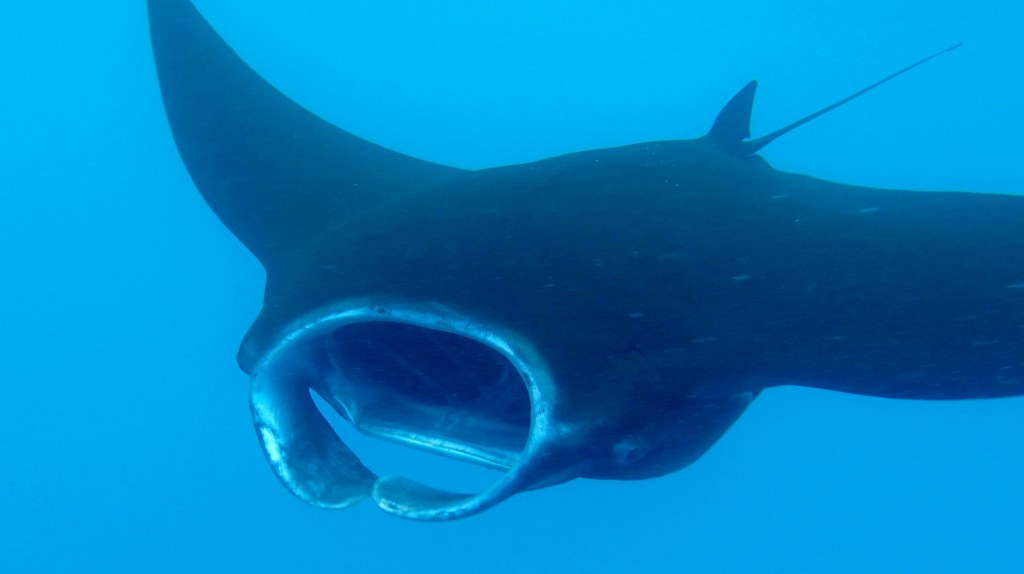
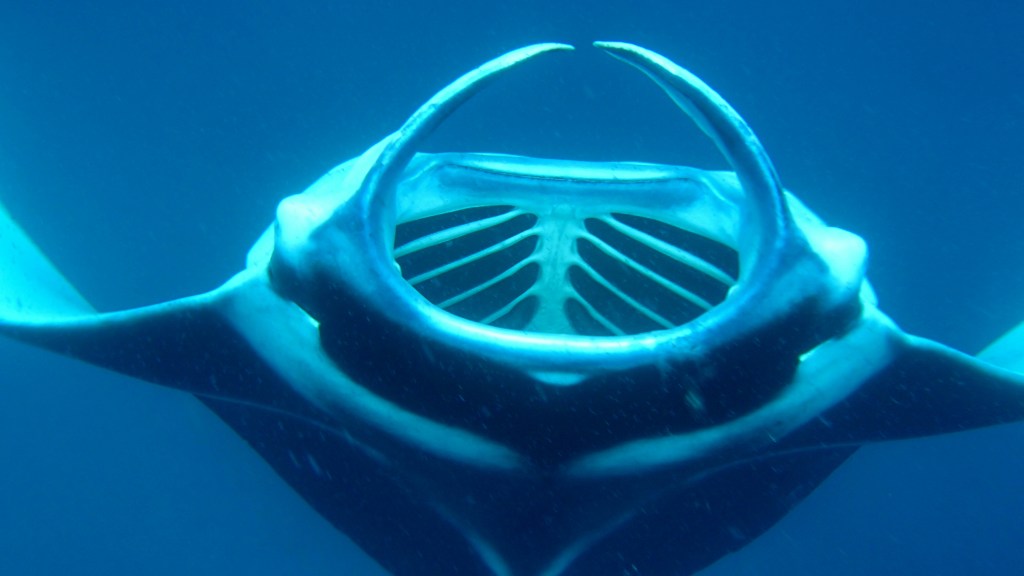
As the name might imply, the main reason people visit this location is to swim with the manta rays. At the right tidal conditions, the mantas feed in the waters between the islands of Drawaqa and Naviti. We would pay attention to the boat traffic from the resort, because they would send a scout boat out at about the right time to make sure the mantas were there, and then they’d load up a bunch of guests to go swim with them. When we saw the tourists heading out, we started gathering our gear and suiting up.

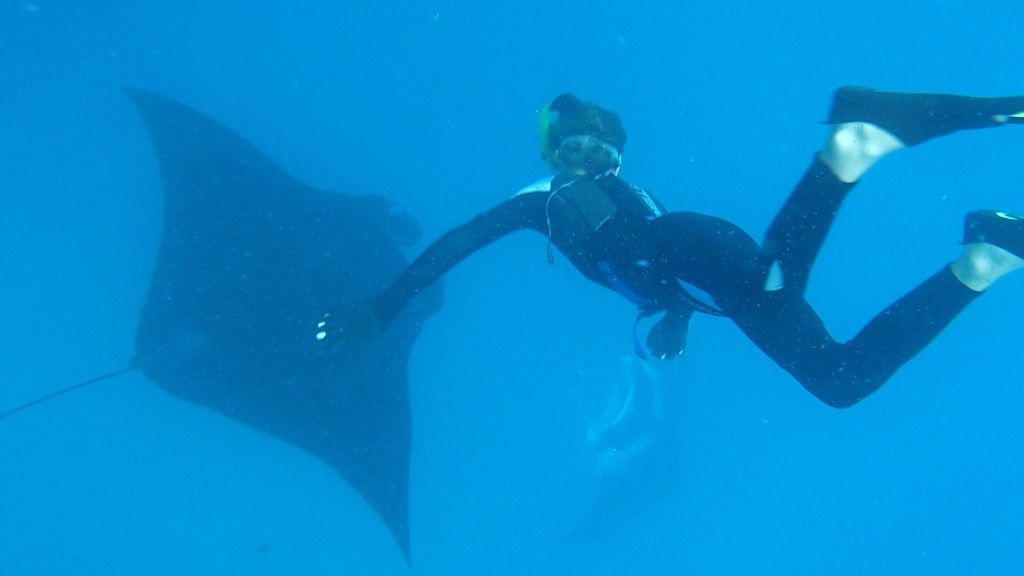
Swimming with the mantas was absolutely phenomenal, unreal almost. They are so big and majestic, and they really take very little notice of you. The bunch of tourists cleared out shortly after we got there, since they weren’t wearing wetsuits, and their stamina was much lower. Then we had the mantas all to ourselves. I enjoyed the mantas very much because they just swim around you without caring that you are there, kind of like the whale sharks in Mexico. Much better than the sting rays in Moorea that mob you because they want you to feed them. I think all of the kids could have swum with them forever, but eventually, the mantas headed off until the next feeding time. These manta photos were taken by our friends on Breeze.

Brenden dancing with the mantas
Categories
Blog Post

Port Denarau and Nadi

We knew that we’d want to stay a couple days on the main island of Viti Levu for mom to catch her flight back, so I inquired on one of the SSB radio nets if it was possible to anchor at Port Denarau. The answer that came back was no, and it’s a busy marina so it’s best to make a reservation in advance. Via SSB email I managed to secure a reservation, but since they didn’t have any moorings available, we had to shell out the big bucks for a spot at the dock. It turns out that you can, in fact, anchor out at Denarau, but you’re a ways out, so I guess technically the answer to my question was correct, I just asked the wrong question. Anyway, no harm done, because it’s nice to be at the dock every once in a while to be able to step right off the boat without having to dinghy back and forth.

Port Denarau is a full on tourist spot. Right next to the marina is a shopping mall and then there are resorts all over the place. Oh, and golf courses. Can you imagine going to Fiji on vacation to go golfing? Clearly, I can’t.

We had a leisurely dinner at one of the mall restaurants with mom before she left, and then we had a whirlwind day and a half at the dock. I took the bus to immigration to extend our visas and also hit the New World grocery store near the Nadi airport. Tim fixed the port saildrive (yes, again!) and the boys rinsed and brite boy’d all the stainless steel on Exodus. Our final morning we took a family bus ride into Nadi to go to the market for some fresh fruit and veggies. Then we hit the fuel dock and were off to the Yasawas.

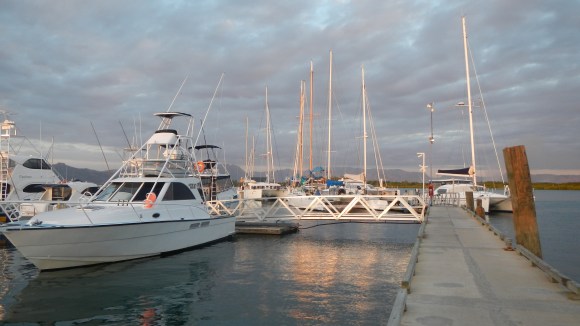
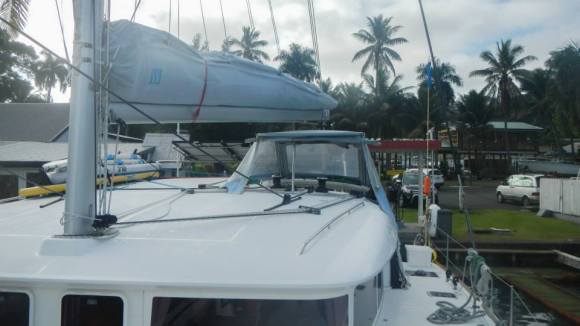
Exodus on the dock at Port Denarau

Provisioning. There is a small grocery mart at the mall right at Denarau which has a decent assortment of things but at high prices. I did the bulk of our provisioning at the New World grocery store near the Nadi airport. I had taken a bus to the airport to visit immigration, then I took a taxi from the airport to the New World. I had my taxi driver wait while I shopped, since I didn’t know how easy it would be to flag down another taxi out there.

It certainly wasn’t like the New World back in Kerikeri, New Zealand, but it was OK. I loaded up one cart with as much stuff as would fit and called it a day. I don’t remember exactly what the taxi cost, but it wasn’t expensive at all, in fact I remember being surprised how cheap it was at the time.

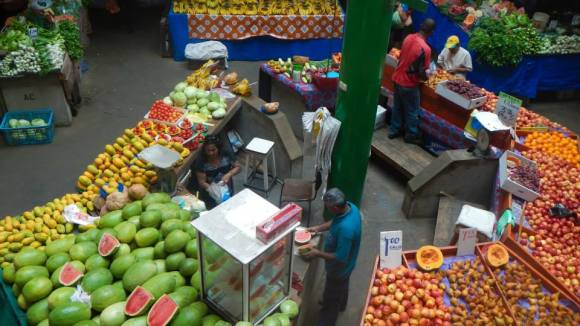
Nadi market. Taking the bus from Denarau to Nadi is quite easy and cheap and the buses run pretty regularly. The main bus hub in Nadi is right next to the market, so there was no trouble finding it. Tim went off to find a hardware store while I loaded down the boys with fresh fruit and veg. We have a system when we go to these markets. We start with the hearty, sturdy vegetables first, like carrots, cabbage, and ginger and as I buy things I put them in bags that the boys are carrying. When we’ve got several things then we stop and transfer all the sturdy stuff into the bottom of my backpack. Then we repeat that with the moderately sturdy stuff like eggplant and bell pepper. Then we load up the bags the boys are carrying with the more vulnerable items like lettuce and tomatoes. So, we end up making several laps around the entire market as we accomplish all this, and I only get one or two eyerolls from the boys as I drag them around the place. I will say that the vegetables I bought here at the Nadi market were the freshest and they lasted the longest of any that I bought anywhere else in Fiji. Perhaps it was just lucky timing, but it sure makes meal planning easier when all the vegetables aren’t spoiling on the same day.

While at the market two women approached me and told me there was another, better market to shop at and I should follow them. Even though this is Fiji, my warning sensors went off and I declined to follow someone away like that, plus we were supposed to meet Tim here at the main market, and I didn’t want to screw that up. I learned later that yes, there is another, smaller market of more locally grown items, so it would have been worth a visit, but I still stand by my decision making at the time.

Laundry. The marina has do-it-yourself laundry facilities with 2 washers and two dryers cramped in a very small space. But the showers are right next door making it easy to grab a shower while you’re waiting for your washing. You get the tokens from the marina office, and everything was in working order while we were there.

Fuel dock. We used the fuel dock at Denarau for diesel and gasoline. It’s a tight squeeze to maneuver into, so it was one of the many times we were happy to have a catarman with two engines, since you drive it like a tank and it spins on a dime (although heavy wind can make all of that not so easy!) It was also quite shallow, but our friends on another cat went before us and gave us depth intel, so we knew we would fit.

Visa Extension. Visitor visas in Fiji are good for only four months, but you can get a two month extension for a fee by visiting an immigration office. Any longer than that and the fees and effort level required go way up. Luckily we only needed the two month extension, and I was kicking myself for not taking care of it in Suva, since I walked past the immigration office there several times. Here at Denarau the closest immigration office was at the Nadi airport, which meant a 30 minute bus ride. No worries, though, I’m always up for an adventure on a local bus. The bus ride was long and hot, but largely uneventful. As usual, though, when riding a bus in unfamiliar territory I worried about missing my stop. Usually you can count on the the driver to remember, but I like to have a back up, so I enlist the locals around me to help make sure I don’t miss it. The first guy I asked either didn’t know where the airport was or didn’t understand me. But a woman with very good English heard me ask and assured me I still had a ways to go.

The bus doesn’t actually go up into the airport they just drop you on the main road. So, I walked the additional mile or so up to the airport, along the way asking at a security shack where I could find the immigration office: second floor of the international terminal. That was easy enough to find, but then I remembered that I had forgotten to take out money from the ATM at the mall before I left, so I asked someone where I could find an ATM. Turns out I would have to go over to the domestic terminal for that, so I gambled that I had enough money for the visa extensions and headed up the stairs to the immigration office.

There were several people sitting there waiting their turns, but there was no line, and no “pick a number” process. Everyone just seems to pay attention and know whose turn it is. When it was my turn I filled out a form and they told me how much it would cost, something like $96 Fijian per person. I panicked inside because I was pretty sure I didn’t have that much. I counted out all of my money including all of my coins and came up like 15 cents short. I told the lady who was helping me I didn’t quite have enough and that I could walk over to the ATM and come back. She let out a big sigh and then told me that would be fine, gave me my receipt, and told me I was all set. “What about stamps in the passports?” I asked. Oh, that, she said it takes a few days for the request to be approved and I need to come back to get the stamps. Well, that would be a problem since we were planning to leave Denarau the next day to go up the Yasawas and we weren’t coming back. So, I asked her if I could go to any immigration office, like maybe the one in Savusavu. She consulted in Fijian with one of her colleagues and they concluded that yes, that would be fine. I just had to be sure to save my receipt to show them in Savusavu that I paid.

I didn’t like having to leave the transaction without the passport stamps, but what could I do. Luckily, we still had a month before our original visas expired, so as long as we got to Savusavu by then it should be OK. (Spoiler alert: We arrived in Savusavu a couple days before they expired but the day I went to immigration I was informed that the lady who stamps passports was home sick so I would need to come back. So, I came back on the day they expired, and after a few phone calls, we did end up getting the passports stamped without issue.)

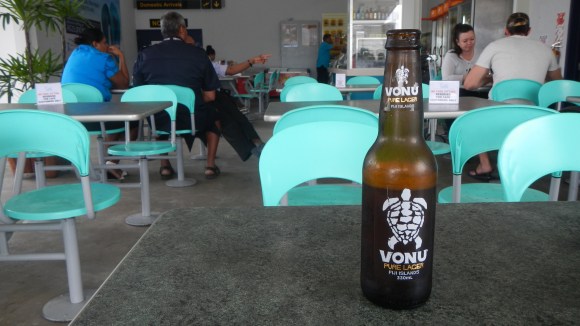
So, when I walked out of the immigration office at the airport in Nadi I had zero cash to catch a taxi back, so I headed over to the domestic terminal to take out money, and of course it gave me all $50 bills, which wouldn’t really work to pay a taxi driver. So, I hit the cafeteria, and since it was afternoon by this point I treated myself to an ice cold beer.

A Vonu at the Nadi airport cafeteria.

Categories
Blog Post

Bizarro Fiji

Originally posted on cruisingrunner

Our time so far in Fiji has been very special. We have had the opportunity to be in some wildly remote places where people still lead somewhat traditional lives, and the friendliness and hospitality of the Fijians never ceases to amaze me. It seems to me that their lives are at the proper pace, where neighbors are people, not blurs you barely notice as you rush around assuming your busy, self-important life. One Fijian tradition is that a visitor to any village offers “sevusevu,” and the ritual itself is quite simple. You offer to the village chief (or his spokesman if he’s not available) a bundle of Yaqona, which is dried pepper tree root. A short solemn ceremony in Fijian ensues, and after that it’s all smiles. You are now one of them. Part of their village. They welcome you into their community and into their homes, and if you’re lucky and your timing was right they will invite you immediately for a grog, that is the drinking of the kava, which is made from grinding up the yaqona. Each village we visited was different, but in each you still had that genuine sense of warmth and welcoming.

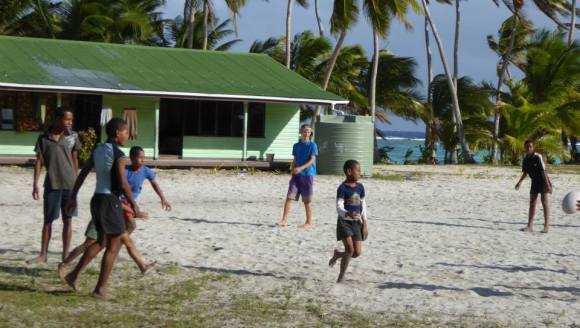
My son playing rugby with the boys on Fulaga

However, now we find ourselves in Bizarro Fiji where modest villages and friendly people have been replaced by mega resorts and parasailing. We are now in the islands west of the main island of Viti Levu, which is the dry, sunny side of Fiji. And where the sun always shines, you can bet that’s where the resorts will be. Our first stop was Musket Cove, a cruiser friendly resort that even has a small marina. For a small fee, cruisers can join their yacht club and then have full access to all resort amenities. Our first afternoon ashore while we were going about the business of joining the yacht club, I was observing all of the Fijian resort employees. They were all business and few smiles. The lady who runs the yacht club handed me some forms to fill out and then turned her back on me and went back to her business. I was reeling. I wanted everything to slow down, and I wanted to go back to Fiji. It was clear to me that this side of Fiji had been infected and I felt myself mourning that fact. But it was as if Tim read my thoughts, and he did the obvious thing, that is, he struck up a conversation with her. He gave her a big smile, asked how her day was going, and asked where she’s originally from in Fiji. It was as if everything came to a grinding halt and a switch was flipped, and she gave him a big smile back. Turns out she’s from Kadavu, one of the islands we’ve visited, so it gave us a little connection, and she was immensely friendlier to me after that moment. So, now I’m thinking that it’s not necessarily that the Fijians have been totally adopted our impersonal western ways, maybe it’s just that most of their western patrons are too busy to notice or care that there’s any other way. That there’s a Fijian way, and that it might be better.

The Musket Cove Resort

In our current anchorage, it’s gotten even more bizarre. We are anchored in the small lagoon of the small island of Mana, just north of Musket Cove. I had read that there are two backpacker’s hostels, a luxury resort, and a village here but today is the first day we went ashore. We had arrived on Saturday late afternoon so without doing a sevusevu, we basically stayed on the boat until this morning. Sundays are important days to Fijians, and we think that it’s somewhat disrespectful to show up in their village for the first time on a Sunday. Anyway, we figured that the village was the spot on the beach where all the fishing boats were, but Tim got out the binoculars and was surprised to notice that the two backpacker hostels are basically on the beach right at the village. Basically, part of the village. And there were people in bikinis — on the beach — right there at the village. Shocking. We usually wear our traditional Fijian outfits when we go ashore for sevusevu, but Tim was questioning the need to do that here. Clearly, it won’t be expected or even appreciated is what he was thinking. For some reason I clung to it, though. For some reason I felt that here, more than anywhere else, it was important to demonstrate that we appreciate and respect their traditions. I wore my full chumba and proudly walked down the beach in it amongst all the other scantily clad tourists. I’m pretty sure that no fewer than four different Fijian women said to me, “Nice chumba!” We asked a woman just off the beach who was selling handicrafts where we could find the Toraga ni Koro of the village, who is like the appointed village headman. In some villages you do the sevusevu with him if the chief is unavailable and, in some villages, he will take you to the chief and be your spokesman. Today, the woman we asked was with a little boy of about 4 years old and she said, “This is the Toraga ni Koro’s son, so he’ll take you to him.” So, the little boy took us further down the beach to his house where we were warmly greeted by his father, Dan. We said our polite hellos and he thanked us for stopping by and told us we were welcome anywhere on the island. That’s when I pulled out the yaqona and told him we would like to present sevusevu. He was slightly surprised but didn’t hesitate. There was a little tidying up to be done inside and then we were welcomed in for a seat on the woven mat. During the short ceremony his son played with the yaqona bundle like it was a big truck, and you could tell he’s been through these before because he clapped at just the right moment. Afterwards we had a short chat, and Dan explained that the chief was in another village and that he himself is quite young to be a village headman. He is one of the younger generation, but he appreciates that we came and respected their traditions. I wish I could remember all of his exact words because it was quite heartfelt, and I was happy to hear all of it.

I told him in response that we have continually been touched by the warmth of the Fijians and therefore we have grown to appreciate these traditions for ourselves too. But the truth is that because we were here in the middle of all this tourism, we WERE tempted to skip the sevusevu altogether, and then we WERE tempted to just go ashore in shorts and t-shirts. We had already been numbed by the resort scene and had forgotten about the value of making personal connections. Today was a very nice wake-up call.

I don’t know how long we will stay on the Bizarro side of Fiji, but while we are here, we are going to try to make a point of seeking out the villages among all the resorts.

After our Sevusevu today
Categories
Blog Post

Musket Cove Info

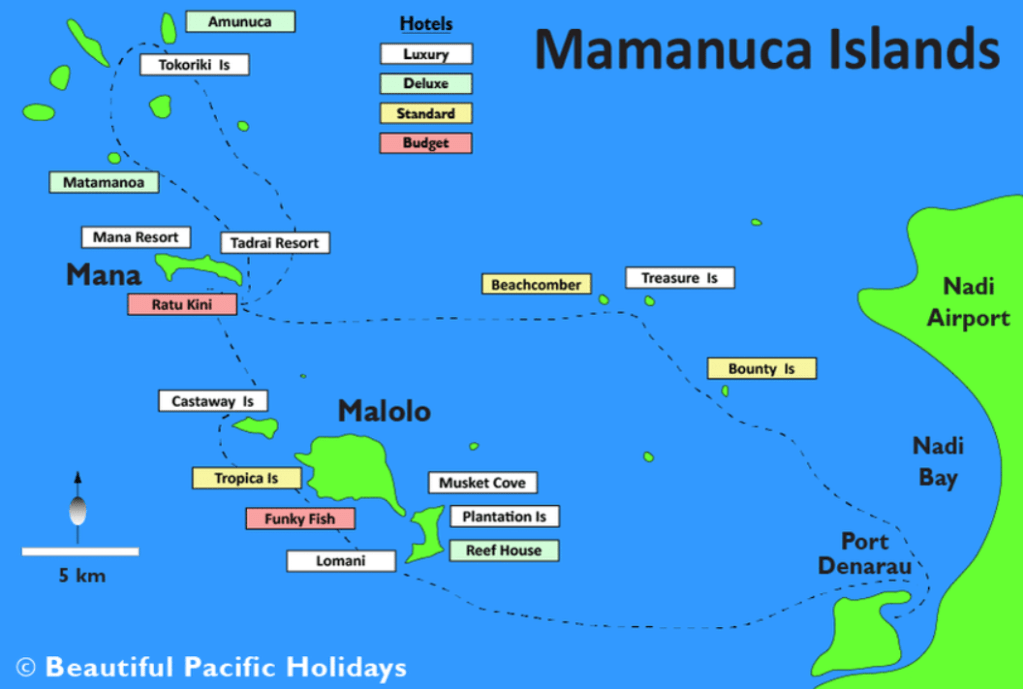
Musket Cove is on the island of Malolo Lailai, which was once an uninhabited island. It is a large resort with a small marina and mooring field, and so it was a bit of a culture shock to arrive after our recent more remote adventures. Even the Fijians who work there seemed caught up in Western Ways, too busy for a smile and a conversation. The woman at the yacht club was all business and obviously Tim was also feeling my need to slow down because he smiled a big smile at her and asked where in Fiji she’s originally from. She smiled, and it was like a switch was flipped as she told us she was from Kadavu and we were able to tell her that we had been there, but not to her actual village though. So, maybe it’s not that the Fijians are too busy for a conversation it’s just that most of their western patrons are too busy to care.

Musket Cove Resort

Yacht Club. Apparently, the owner of the resort has a soft spot for yachties, and there is a “yacht” club that costs only $10 to join for life, and in order to join you had to arrive by boat in Fiji from a foreign port. Joining gave us access to basically ALL of the resort amenities. So, we took advantage our last day with the Bellinis and enjoyed an expensive lunch and expensive beers, but on the plus side we also enjoyed nice beaches, the pool, hot showers, and Robin even went to a basket weaving class. Overall, this was a really good deal.

Ice cream after lunch at Musket Cove

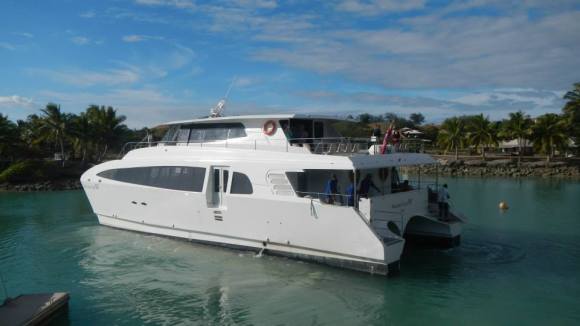
Ferry Service. There is a high-speed passenger ferry, The Malolo Cat, that runs several times a day between Musket Cove and Port Denarau on the mainland of Viti Levu. So, the Bellinis took that back rather than hauling up Exodus and motoring upwind for a few hours. Also, we used this ferry service when my mom arrived. Mom took a taxi from Nadi airport to Port Denarau, and I took the ferry from Musket Cove to meet her there. Then we both took the ferry back together. You get a pretty good discount on the Ferry being a Musket Cove Yacht Club member.

Malolo Cat ferry

Provisioning. Provisioning at Musket Cove was very, very limited. There is a small grocery store with limited produce and overpriced dried and canned goods. We were still pretty well stocked up from Suva, so we just topped up to have enough to get through the next couple weeks. They did have fresh bread and eggs, so that was nice for us.

One day when I was in the store with mom I was piling potatoes, really nice small golden ones, into a bag when behind me I hear a lady say, “well, I guess we won’t be having potatoes tonight.” My first thought was, “What a passive aggressive bitch!” but then I turned around and told her if she’d like some go ahead. But then she said, “No, no, go ahead, you take them all.” OK, I thought it again, “what a passive aggressive bitch!” but I didn’t take them all. She was obviously not a cruiser.

Laundry. There is a very small do-it-yourself laundry facility with two washers and two dryers. However, you don’t put coins or tokens into them yourself, rather you go to the store and pay for the laundry you want to do, and then at their convenence, someone from the store will come and start the washer or dryer for you. This was kind of a pain because sometimes you had to wait quite awhile for someone to come after you paid. I learned that with the dryers, if you unplugged them and then plugged them back in you could start them yourself, so I ended up taking advantage of this. Not that I skipped out on paying, I always paid for the laundry I did, but I just didn’t wait for them to come start it for me.

Trails and Running. My favorite part of musket cove was the circuit of trails they had all around the island, up and over hills, and flat around the periphery. We weren’t there long enough to get into any sort of routine, but I enjoyed the running opportunity a few times while we were.

Pools. My second favorite part of Musket Cove was the pool. Not that I spent any time in the water, it was just fun to relax resort style at a pool for a while. After a grueling haul-out at Vuda Point (a marina on the mainland) and working their butts off, our friends on Nautilus, who rarely slow down enough to just relax for a day, hung out with us by the pool one afternoon. Good times.

Categories
Blog Post

Intro to the Mamnucas

The Mamanucas are a group of small islands just off the west coast of the main Fijian island of Viti Levu. This side of Fiji is very different. Being on the leeward side of the big island, the land and air are both drier and it has much less of that tropical feel we had grown accustomed to, so we wouldn’t be going on any muddy hikes here. It’s kind of like the difference between the Hilo and Kona sides of the big island of Hawaii. The upside is that it is much, much sunnier, but the downside is that where you find the sun is where you will also find all of the resorts. These islands are the closest ones to the international airport so access for tourists is also much easier here than elsewhere around Fiji.

All of the islands are short day hops apart, so it was easy to move about quickly without much planning or preparation.

Overall, I’d say our visit to The Mamanucas was highlighted by the people we spent our time with rather than the destinations themselves, and as a cruising destination it’s mostly forgettable and you could easily skip it and not miss anything about the Fiji experience. Of course, the sunny weather was a nice change, although it did come with the trade off of being surrounded by tourists and resorts. We certainly don’t regret our decision to spend time here but we are mostly glad to have been able to spend the time with family and friends.

Categories
Blog Post

All About Suva

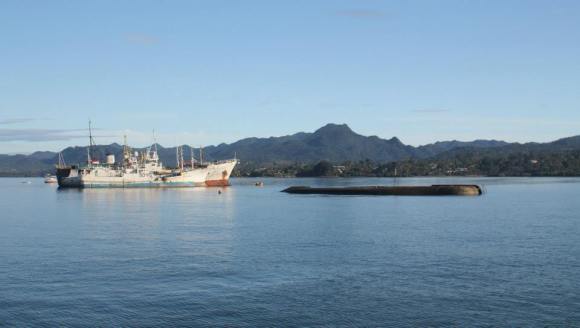
The daysail up to Suva was fast, but not too uncomfortable. As we pulled into the harbor we were happy to hear that almost the whole gang was there… everyone except Lumbaz. Caminante, Fluenta, and Nirvana, were all anchored in the back row, but in typical catamaran fashion we edged up to the front row and tried our best to anchor equidistant from other boats including a few derelicts and a wreck or two.

Derelict fishing boats and a sunken ship. Just a few of our neighbors anchored in the Suva Harbor

After a few days in Suva, here is an email I wrote that pretty well summed up my impressions:

Suva is a full fledged city, which has been quite a shock after being in The Lau Group for over a month. Here are the highlights so far: 1) Our first evening here we walked across the street to have a cheap dinner out. It was cheap, but it really wasn’t that good, BUT the highlight was that our kids almost immediately joined in playing with the local kids. They played some sort of tag and also did some relay races. 2) We are here with friends, four other kid boats, and while I write this we are waiting for another to arrive (they are within VHF range already). 3) Cost-u-less. It’s like costco with items in bulk but they also have a lot of US and NZ products. They even had Tim’s beloved vanilla coffee creamer! 4) The Suva market… holy fresh fruits and vegetables! And the second floor has kava and all sorts of Indian spices. 5) Everything is cheap! I can’t tell you how many times I’ve said, “that’s cheaper than Mexico!” Except for rum. 😦

Here are the downsides, not that I really feel the need to complain… 1) The weather has been crappy. In the 5 days I think we’ve seen the sun for a total of 4 hours. Luckily, we have access to gasoline so our generator has been humming, and Tim is working on version 10.0 of the rain catcher. 2) The Royal Suva Yacht Club showers are neither high pressure nor hot. 3) There is a prison very near the Yacht club, but on the upside when we pass the guys in orange jumpsuits they are every bit as happy as your average Fijian. 4) Yeah, I can’t think of any other downsides.

It didn’t take the kids long to make friends in Suva

Here’s a little more information about Suva:

Royal Suva Yacht Club. Inside the breakwater at the head of the harbor there is a small marina, and on shore there you can find “The Royal Suva Yacht Club.” We joined for 1 month, it wasn’t too expensive, but turned out to be more than what it was worth, given that I only used the showers once. They have happy hours every night with cheap Fiji bitter on tap, which was a bonus. There was a big grassy area for the kids to run and play, and apparently the popular game while we were in Suva was cops and robbers.

Laundry. They have a very cheap drop-off service at the yacht club. It was almost half the price as the drop-off services in Savusavu, and they even returned it the same day. Almost. When I went to pick up my bag in the afternoon the guys face drained of all its color when he saw me, because he knew he had already given out all the bags of laundry he had. Without telling me what was going on he went to the VHF radio and started hailing the vessel “Another Adventure,” a boat we had actually met when we were in Fulaga. After calling twice with no response I finally asked him if he had given my laundry to Another Adventure, and he told me that yes he did, but it was my fault because our boat name wasn’t written clearly on it. That isn’t true, but I let it slide, I knew he was just at a loss for what to do because he didn’t even have any idea if Another Adventure was still in the harbor, and if they weren’t, then what? I asked him if I could use his VHF, and I called one of our friends and asked if they knew if Another Adventure was still there, and yes, in fact they were anchored close by. So, I told the guy at the yacht club I would go out in our dinghy to get our laundry. But I half smiled as I told him I wasn’t going to pay him yet. He smiled back. We got our laundry back, no problem, which was a huge relief.

Fuel dock. There is a shallow fuel dock at the Yacht Club, so we took some depth soundings from the dinghy to see if it was deep enough for us, and with our 4 ft draf there was plenty of water for us. We went in the morning, just before high tide, and we had 6 ft under our keels. While at the dock we were able to obviously fill our diesel tanks, but we also got to take advantage of a fresh water spigot and we gave Exodus a much needed rinse off and scrub down.

Exodus at the fuel dock in Suva

Suva Market. I know I’ve already mentioned the Suva Market, but oh my god! I can’t overstate how much I loved the Suva Market. I went pretty much every day and would buy the freshest things I could find. Forget shopping malls and clothing stores, after living this cruising life there’s nothing I enjoy more than browsing table after table of baby bok choy, tomatoes, and eggplant. All locally grown and all dirt cheap. They had imported items like apples, carrots, and bell peppers (now known to us as capsicum), and I splurged occassionally, but mostly I stuck to the huge plate of locally grown with the $1 Fijian price tag. For the most part, the Suva Market is just like the Savusavu or Nadi markets only about 10 times the size. The one special thing about the Suva market is the upstairs area with all of the dried goods (including bulk popcorn!) and Indian spices. I could browse up there for quite awhile too! I loaded up on curry powder, because we have found that the curry powder here is much better than what I used to buy in the supermarket back home. I will need to find an Indian market when we go back. I also found ground cumin here too (now known to us as Jeera powder).

Suva Market!

Bulk foods and Indian spices on the 2nd floor of the Suva Market

Other Provisioning. The Cost u Less that I mentioned earlier was quite a taxi ride away, so Tim and I went together and spent half a day and probably $1000 to fill a taxi to its maximum capacity. Closer to the harbor there are several supermarkets, including two MHCC’s. The one where I did our final provisioning is in a totally western style shopping mall. The boys and I walked down there and then took a taxi back.

Taxis. Taxis are everywhere in Suva! And in Fiji taxi drivers earn an hourly wage rather than some sort of commission based on their fares, so the drivers are always more than happy to wait for you while you do your shopping or any other errands. You pretty much can’t walk down the street without several taxis slowing down and honking at you to see if you want a lift. Taxis are cheap too, so we never hestitated to grab one if we didn’t feel like walking or were too loaded down. Usually I would walk down to the market (about a 20-30 minute walk) and then take a taxi back.

Overall, our visit to Suva reminded me a lot of when we went to Pago Pago, American Samoa: Probably would have been enjoyable under other circumstances but visiting among stops at actual island paradises AND being mostly consumed by provisioning and other work made it certainly no highlight. Except for the market.

Categories
Blog Post

Desperate Enough to Love Cabbage

Originally posted on cruisingrunner

Before leaving home I did a lot of reading about provisioning. There were so many “tricks of the trade” that I needed to learn about storing fresh foods, which foods last the longest, and how to minimize what you have to keep in the fridge. And one of the recurring tips I encountered was that cabbage is a great thing to buy, because it lasts, like forever. So, of course when we were in Mexico, I kept buying cabbage. Cabbage is a cruiser’s staple, and we were cruisers now, so I bought cabbage, what else could I do? But the thing is, we never ate cabbage at home, and we don’t actually really like cabbage. So, yes, I kept buying it, but then I kept throwing out rotten cabbage. No matter how long it lasted, we never ate it. I did eventually learn my lesson that cruising WILL cause you to change some of your eating habits, but it’s NOT going to magically make you like cabbage.

Fast forward a couple of years, and now I’ve learned another lesson. One that took going 5 weeks between provisioning (our longest so far) for us to learn. We provisioned in Savusavu, Fiji to spend some weeks in The Lau group, and after being gone 3 weeks we were pretty well depleted of all things fresh on board, the exceptions being potatoes and garlic. In Matuku, we were given some mandarins and papayas, which were absolutely heavenly, but after 5 weeks, we were seriously craving vegetables that didn’t come from a can. In a village on the island of Kadavu they had these huge bunches of leafy greens that they were selling, and I didn’t even know what they were when I practically started throwing money at them. It turns out they were taro leaves, and a friend told me that at a Tongan feast she had had a bad reaction in her throat to taro leaves and that Big Mama (of Big Mama’s yacht club in Tongatapu) had told her that if you don’t cook it long enough that’s what can happen. I still bought it and I cooked the crap out of it, but I was worried, so I ate it myself without giving any to anyone else. I swear I was looking out for their well being and NOT just hogging all the greens for myself!

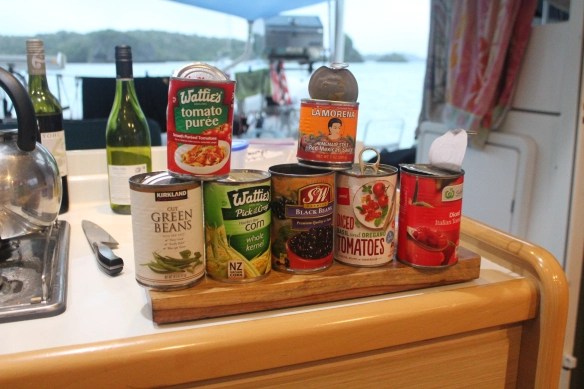
Anyway, while we were anchored at Namara Island, Tim and a friend dinghied over to the next island of Dravuni in order to do our sevusevu presentation, and when they came back it was like Christmas, because they were able to buy just a few provisions there. Eggs, a loaf of bread, and last but not least, a head of green cabbage. We didn’t care that it was cabbage, we were having salad at dinner that night! We didn’t have any other veggies, but not to worry. Just add some chopped cashews, canned mandarin oranges, uncooked ramen noodles, and homemade sesame oil/ginger vinaigrette dressing and you’ve got yourself a real cruiser’s salad.

So, it turns out cruising CAN magically make you like cabbage. You just have to be desperate enough.

Dinner from a can
Categories
Blog Post

Not Plans, Intentions

Originally posted on cruisingrunner

A while back, a fellow cruiser advised me that out here, we don’t have “plans” we have “intentions.” That resonated with me. Coming from a schedule oriented professional background there is something about the word plan that gives changes to that plan a negative connotation. Right? If everything goes according to plan, that’s good, right? Well, it’s a rare cruiser whose plans, I mean intentions, don’t change quite frequently, and there are so many reasons why these changes happen: It could be a boat maintenance issue, weather, influences of other buddy boats, need for internet, need for fresh provisions, weather, a change in heart, or simply reality setting in regarding how quickly you can really get through a specific area or island group. We have certainly made our fair share of changes in intentions on this journey, the first one coming almost immediately after leaving home. To think back on it now, we must have been crazy. We left California at the end of February with the intent of hustling down the coast of Mexico to Central America to The Galapagos and then making a late crossing of the Pacific to The Marquesas. I’m thinking we simply didn’t understand the vastness of the miles we were intending to cover and how difficult that would have been given our lack of experience. When we got to La Paz, or more specifically, the beautiful islands in the vicinity of La Paz, we had a serious timeout moment. First of all, we had learned that the anchor we had was simply not big enough for the boat and we would need to order a new one, and who knew how long THAT would take. Second, the area was amazing with beautiful bays and snorkeling, and did we really want to rush away from the Sea of Cortez so soon? It turned out the answer was no, and after a week or so of research we decided to stay in Mexico for a full year and then make the jump to The South Pacific the following season. And even after giving ourselves so much time, we still never made it to Central America. We left to The Marquesas from Puerto Vallarta only ever making it as far south in Mexico as Tenacatita (just north of Barra de Navidad).

Currently, we are in Fiji, and we’re smack dab in the middle of totally reassessing our intentions both on micro and macro levels. On the micro level, we left Savusavu 3 weeks ago intending to tour the Lau group, starting in the south and working our way north, and then hitting an island or two on the east side of Vanua Levu before making our way down around the northwest side of Viti Levu to the Nadi area to meet up with our friends who are coming to visit us. Now we are in Fulaga (southern Lau) with four other kid boats, and we have been having a great time and have stayed much longer than we intended. So, now instead of heading north we will take a shorter route directly west, probably to the island of Matuku and then Kadavu (and the great Astrolabe reef) and then around the southwest side of Viti Levu. Of course, this is dependent on an upcoming weather window that looks like it’s deteriorating due to an intensifying front heading our way, so all of this could be different tomorrow. We may just set up permanent residence here in Fulaga.

On the macro level, we have always planned, I mean intended, to go to Australia for this next cyclone season and there we would end our journey and sell Exodus. Yeah, we’ve just chucked that plan right out the window. When we got to New Zealand last November it was a welcome change to leave the tropics and spend some time in a temperate climate with a different geographic makeup, and it also felt good to be somewhere a little more like home for awhile. But now that we are back up in the islands, we aren’t quite ready to head back to that so soon. I mean, if we go to Australia that would really only give us about 3 to 3 1/2 more months here in the tropics. Since we still want to get out of the cyclone belt during cyclone season, we are now furiously researching heading north to The Marshall Islands. We hear mixed things about it, but we also heard a lot of mixed things about staying in the Sea of Cortez for the summer, so you just never know. So, it’s really looking like Fiji to Tuvalu to Kiribati to The Marshall Islands just might shake out to be the right choice for us. Of course, we have friends heading to Vanuatu then Micronesia the The Philippines, so who knows!

But the point is, we’re not locked into anything. We are cruisers. We have intentions, not plans.

Categories
Blog Post

Fulaga (pronounced Foo-LONG-a)

Originally posted on June 13, 2015, by cruisingrunner

We beat to weather for a day and a half to get here, but it was worth it for so many reasons. Fulaga is in The Southern Lau Island group in Fiji, and on a rhum line from where we were in Taveuni, it is about 150 nmi at a heading of 145 deg true, which is SSE. Since the trade winds blow from the E to the SE, you can see why trying to go SSE might be a bit difficult. We basically picked a weather window where we could sail close hauled at a good speed and then the winds died, and we motored east. It was bumpy and bouncy pretty much the whole way, but like I said it was worth it. And here’s why:

1) Fulaga is somewhat off the beaten path. Within the big picture of tourism, it is actually TOTALLY off the beaten path. There is no tourism here. There is no airport and no cruise ships come here. A total of about 400 people live on the island spread across 3 villages, and here is largely subsistence living. A supply ship comes once a month with petrol and other items like flour and sugar. To pay for their shipments they export hand carvings to Suva to sell to tourists.

The reason I first said “somewhat” off the beaten path is that cruisers do come here, but it’s not on the main circuit. Mainly, because it is a pain to get here since, as I mentioned above, you have to beat against the trade winds to get here from any of the official ports of entry. Our track from Minerva Reef to Savusavu passes very close to here, but we couldn’t stop on the way, because you have to officially clear in to an official port of entry before you can visit any of the other islands. In the village here, they told us that last year they had a total of 60 yachts visit, and they are very proud of this growing number and the fact that people seem to always stay longer than they originally intend and that some yachts even return the following year. We were the fourth boat to sign the guest book this year.

2) It is absolutely beautiful. This is something I simply cannot describe with words. When we have internet, I will have to include some photos.

3) The people are hospitable and courteous. After completing our sevusevu with The Chief and being accepted into the village, we were assigned to a “host family” and it turns out our family’s clan is the chief’s clan. Our hosts are Simon and Senna, and Simon is the chief’s son. He explained to us that in the village there are many clans and each clan has a responsibility. For example, one clan has the responsibility for fishing, and another has the responsibility for managing water and food supplies.

We have heard from other people about islanders always asking for things and wanting the cruisers to fix their stuff (outboard engines, etc.) and we have had a few experiences along those lines ourselves. We are always happy to trade, donate, and help out, but it always feels a bit hollow when it’s continually asked for and expected. Here, it’s like there must be some sort of rule that the villagers not harass the yachties. At the sevusevu they request a $50 (Fijian) payment for anchorage in the lagoon. While some people have a problem with them charging an anchorage fee here, I don’t at all, especially if it’s part of what’s influencing their behavior towards us. I am suspecting that the fee they collect from us puts us on equal footing, from their perspective. They don’t need to try and get stuff from us, because we are paying them to be there. I think it’s a much more respectable position for them to be in. Yesterday, they also had a small market and fund raiser (for the school I think?) where they sold food and crafts to the yachties. I wasn’t able to go, but in theory, I really like the idea. Again, they aren’t just asking for stuff, they are providing goods and services in return for payment. When we were having lunch with Simon and Senna, Tim kept asking about community projects and if they needed or wanted any help for anything. He basically offered to help them fix anything that might need fixing and while Simon never said, “no,” he also never jumped at the chance like we were expecting based on stories we’ve heard from friends about other islands. They mostly just seem to be interested in sitting down and talking with us and serving us loads of food.

We joined them for church on Sunday, in fact, all of the cruisers here in the atoll went in for church. It is a Methodist church, and the entire service was in Fijian, but the singing was amazing. However, between the singing and the sermon, one of the men stood up and addressed us in English and welcomed us and asked us to bear with them as they have the service in their own language. It was a nice gesture.

Sort of a cute side story… our first evening here, Senna served us these little muffins with tea, and Brenden was hungry and seemed to really like the muffins so he had a couple. Senna was so pleased she kept offering him more and smiling and laughing, and in the end he ate something like 8 of them. The next time we went for lunch, after enjoying fish and rice and taro root there was some speaking and laughing in Fijian and the only word I recognized was “Brenden.” Then Senna brought out a huge plate of the muffins and set them right in front of Brenden. She was so tickled by how much he liked them, and she let him bring all the leftovers back to the boat.

Today, some of the people from the village are coming over to the beach where we are anchored to fish and catch crabs, and they said any of us can join them if we like. Then we will have a big picnic on the beach for lunch. The weather is pretty crappy; gray skies and 20 knot winds, so I hope it isn’t canceled, but we’ll see.

4) The geography is stunningly unique. We have been to many volcanic islands before, and we thought we had seen pretty much every stage in the life cycle, from the tall peaks of The Marquesas to the low lying atolls of The Tuamotus, but this one is unique to us. It is an atoll, with a pass and a lagoon, but it’s younger than the ones in the Tuamotus, so there is still a lot more land and there is even some elevation to the land. In fact, we have to walk over a hill to get from the anchorage to the village. It is older than the islands in The Societies, like Bora Bora, that have a large island in the middle of the lagoon, but unlike The Tuamotus, there are still small islands within the lagoon not just coral heads, and one of them is even inhabited. One of the most striking features has to be the small, mushroom shaped islets scattered around the lagoon. They give the geography some depth as you visually survey your surroundings, rather than just the uniform sea of turquoise of an older atoll.

5) The anchorages are numerous and flat calm. Between the fringing coral reef and the remaining fringing islands with their hills and numerous palm trees there is ample protection from the wind and sea of the Pacific Ocean. As I type this we are having 25 knot winds and, at least according to the forecast, something like 3 meter seas outside, but we are sitting on dead calm water as comfortable as ever. And if the wind direction changes, there’s another anchorage to go to in order to avoid a lee shore fetch within the lagoon. And when winds are light, you can pretty much anchor anywhere. We spent a couple days anchored near that pass when the weather was calm in order to enjoy easy access to pass snorkeling.

6) The underwater life is breathtaking. In this case I’m speaking from limited exposure and hearsay, since I don’t actually get in the water too often. The one pass snorkel that I did was during non-optimal conditions: on a dropping tide so the current in the pass was outgoing meaning poor visibility. If you go during a rising tide with the water rushing into the pass from the ocean, the water is much clearer and the visibility obviously much better. However, even with that “poor” visibility, it was very nice. All of the coral was alive and thriving and there were so many fishes of all sizes. In the area of the pass where the current flows the strongest there was a bunch of soft coral, not brightly colored, but still stunning as it flowed and swayed with the rushing water. We also snorkeled on a coral head in between the fringing reef and one of the islands, and it was every bit as good as the snorkeling on coral heads we did in Raroia (The Tuamotus), which at the time I described as snorkeling bliss!

7) There are white sand beaches, good for camping and running. For many days we anchored near a sandspit adjacent to a long white sand beach, the only thing was that it almost completely disappeared at high tide. That did not discourage the kids, though. Our first afternoon there, construction of the kid beach village began. They cleared a small patch of land that would stay dry as the tide rose, and they built huts of branches and palm fronds, pitched a total of 5 tents (4 for sleeping, one for “storage”), and kept a fire burning pretty much 24/7 (only having to call for help with the fire once.) They climbed the palm trees for coconuts and made things like woven mats (girls) and bow and arrows (boys). They slept there for three nights and even cooked some of their meals there. They loved the the freedom and adventure of it all.

The kids are not the only ones who have enjoyed the beach. At the right tide level, it was nice for long walks, sunset yoga, and of course, running. Our first morning I had to hit the beach at about 6:30am in order to run at low tide, but each day I was able to go a little bit later. It’s not too warm here, so running well after the sun rises isn’t a problem.

8) We have good friends here with us to share this experience. A place like this can only be made more special if you have special people to share it with. Out here, when you say good-bye to people you can never be quite sure you will see each other again, because we all have our own paths to take, and even if you make tentative plans, plans can easily change. Here in Fulaga we have had the good fortune to reunite not with just one, but four other buddy boats that we have previously spent time with. Two of them, Nirvana and Nautilus, left New Zealand about 3 weeks before we did, and we never knew if we would catch up. One of them Fluenta, left New Zealand after us bound for Tonga, so we certainly never thought we’d see them again at least in the near term. But they changed their plans mid-voyage and here they are in Fiji with us. The last one, Lumbaz, left New Zealand at the same time we did, and we had a lot of fun with them in Minerva Reef, but once getting to Fiji, who knew if our paths would lead the same way. But here we all are, in one of the most remote places in Fiji, together. The kids are having a great time, but don’t think it’s just the kids who are enjoying each other. It’s a great group of parents as well, and we are developing quite the little community. Thinking back, it’s pretty much the same group of kid boats who were “stuck” at Big Mama’s together in Tongatapu at the end of last year, waiting for a weather window to head to New Zealand. We know this little community is quite temporary, but we are enjoying it while it lasts, and it definitely has a positive impact on my overall impression of our experience in Fulaga.

I cannot stress enough that if you ever cruise the south pacific, this place is an absolutely DO NOT MISS. And I don’t toss those words around lightly. We currently have no plans for leaving, so I have no idea when we will have internet again. However, when we do, I will be sure to post some photos, which will almost certainly not do the beauty of this place justice.