Categories
Blog Post

Clearing Into French Polynesia

The checkin process was very simple and easy.  No long waits.  No drama.  Of course, we hired an agent through the Pacific Puddle Jump registration and paid $200+ so if it hadn’t had been easy, that would have been a waste of money.  The best part about the agent fee was getting an exemption from the bond requirement.  You see, immigration is very tightly controlled in French Polynesia.  Non-EU citizens are only allowed to stay for 3 months out of 6 months, so unlike Mexico where all you had to do was leave the country and re-enter, in French Polynesia you have to leave for a longer period of time.  There are ways to get exceptions and extensions, but they involve either a lot of leg work ahead of time (with 2 visits to the French Embassy in your home country) or some sort of health or boat issue when you’re here.  Anyway, I think the tight immigration is actually a good thing for French Polynesia in that it is probably preserving the Polynesian culture rather than opening it up to a bunch of rich western immigrants who want to get away and settle here. 

Back to the bond requirement… when you arrive in French Polynesia you either have to have a return airline ticket already booked or if, like us, you are arriving via your own boat, you need to post a bond equal to the amount of an airline ticket back to your home country.  Then when you clear out of the country, you get your money back (getting hit by an unfavorable exchange rate twice, presumably).  So, by hiring this agent they arrange an exemption to the bond requirement.  They also had a representative in Hiva Oa take us to the Gendarmerie and help us get checked in and arrange our duty-free fuel paperwork.  The Hiva Oa rep’s name was Sandra, and she was immensely helpful in many ways.  Sandra is the one we called when the tsunami sirens were going off.

When she took us to the Gendarmerie, we rode in the back of her pickup truck, which was covered, but it was stiflingly hot back there.  We rode with another boat full of people, so we crowded in, and all cleared into the country together.  At the Gendarmerie there was just one form to fill out, which included a section to declare all of your tobacco, firearms, medicines, and alcohol.  I remembered one of the blogs I read said you could just write something like, “that which is needed for the household,” or something like that, but when I asked Sandra, she said I should simply write down exactly what we brought.  Without my spreadsheet in hand there was no way I would be able to write exactly, but I took my best shot, and overall, I way underestimated our alcohol inventory.
Categories
Blog Post

A Little Bit about Atuona

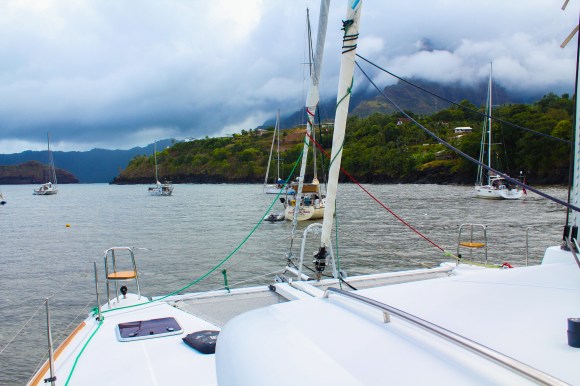
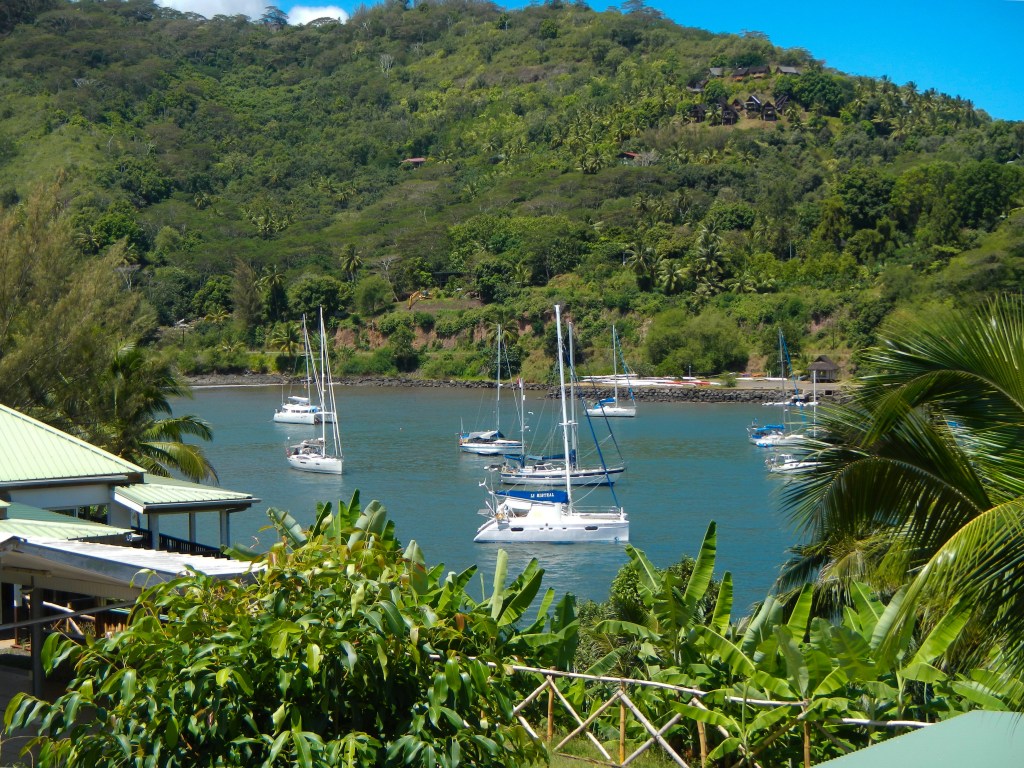
Atuona is the most windward official port of entry in French Polynesia, so many puddle jumpers make their first landfall there.  The harbor, called Baie Taaoa (aka Traitor’s Bay) is small and it faces southwest.  There is a breakwater reaching almost halfway out across the entrance to the bay to protect from some of the swell that comes in, but it is generally known as a pretty rolly anchorage.  We found it quite pleasant while we were there.  I guess when there is a particularly severe storm down in the Southern Ocean it can generate a lot of swells from the south which makes this anchorage pretty much untenable.  Luckily, we didn’t experience that.  When we arrived, there were 12 boats bow and stern anchored, and I think while we were there we saw as many as 18-20. 

Boats packed in the anchorage

The town of Atuona is really nice even if it is quite a walk from the harbor.  Traitor’s bay is actually a double lobed bay.  Baie Tahauku is the eastern lobe where the harbor is, and Baie Atuona is the western lobe where, well, Atuona is.  The walk takes about 30-40 minutes, and you get some nice views as you walk around the point between the lobes.  But it’s also pretty easy to get a ride too.  One time I was walking along alone, and someone stopped to give me a ride.  At home, would I have ever accepted a ride like that from a stranger?  He didn’t speak English, but I was able to tell him to drop me at the post office.  Needless to say, the people there were quite nice.  There are several stores, and provisioning was good.  Our first trip to town I went a little crazy buying outrageously expensive fruit like pears and tangerines, since we had been out of fresh fruit for a while.  But after a few days we were buried in the fresh local fruit, like pamplemousse, bananas, and mangoes, that people gave us.  Contrary to all the hype among cruisers, you CAN get eggs here.  I brought only enough eggs from Mexico for our crossing, and we’ve never been without eggs since arriving.

Our first trip to town we hit the Gendarmerie, the ATM (which had a much-loved air-conditioned kiosk), all of the stores, and one of the “snacks” in town for a pretty gross burger and a couple beers.  We had a fine walk back to the harbor munching on baguettes the whole way.  We learned that the gas station right on the harbor has baguettes in the morning, and you can pre-order, so you don’t have to go in crazy early to make sure you get some. 

Snack Make Make

I thought the town smelled like Hawaii.  Maybe it was all the tropical fruit and the moist air.  But it definitely reminded me of Hawaii.  It would rain a few times each day for just a short bit, making it a fire drill to get all the hatches closed on the boat so we don’t get drenched inside.  This is where we made it part of the process when leaving the boat to make sure all hatches are closed.  Yes, we learned the hard way.

Atuona was beautiful and smelled like Hawaii

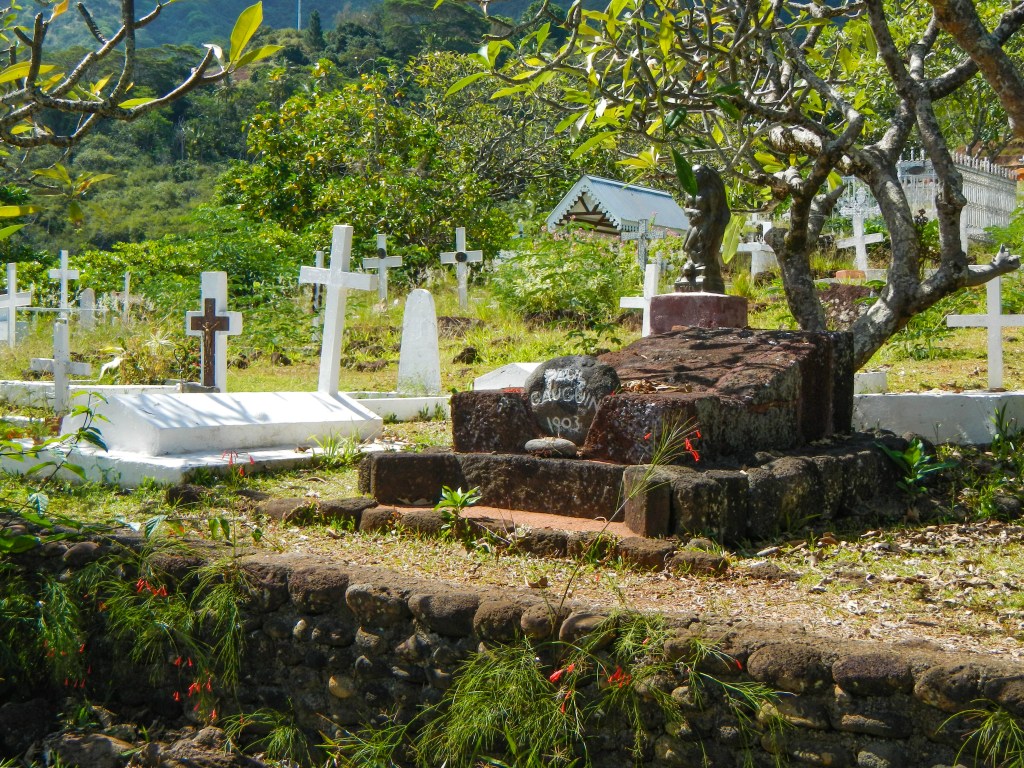
Any tourist propaganda you read about Atuona will include the fact that Paul Gaugin and Jaques Brel are buried there.  I had never even heard of Jaques Brel, but apparently, he was a famous Belgian singer.  Of course, I knew the French painter Paul Gaugin, and I kept mentioning we should walk up to the cemetery.  I never had any takers.  So, one of our last days there I headed into town alone to see the cemetery and pick up a few final provisions.  It was a short, steep walk up to the cemetery, turning right just before the Gendarmerie.  There was some roadwork being done on the very narrow road, and the workers stopped so that I could comfortably pass.  The cemetery was quaint, and yes, I saw and photographed both graves, but the view of the town and the bay from up there was spectacular.  I was OK having that moment alone.

Gaugin’s grave

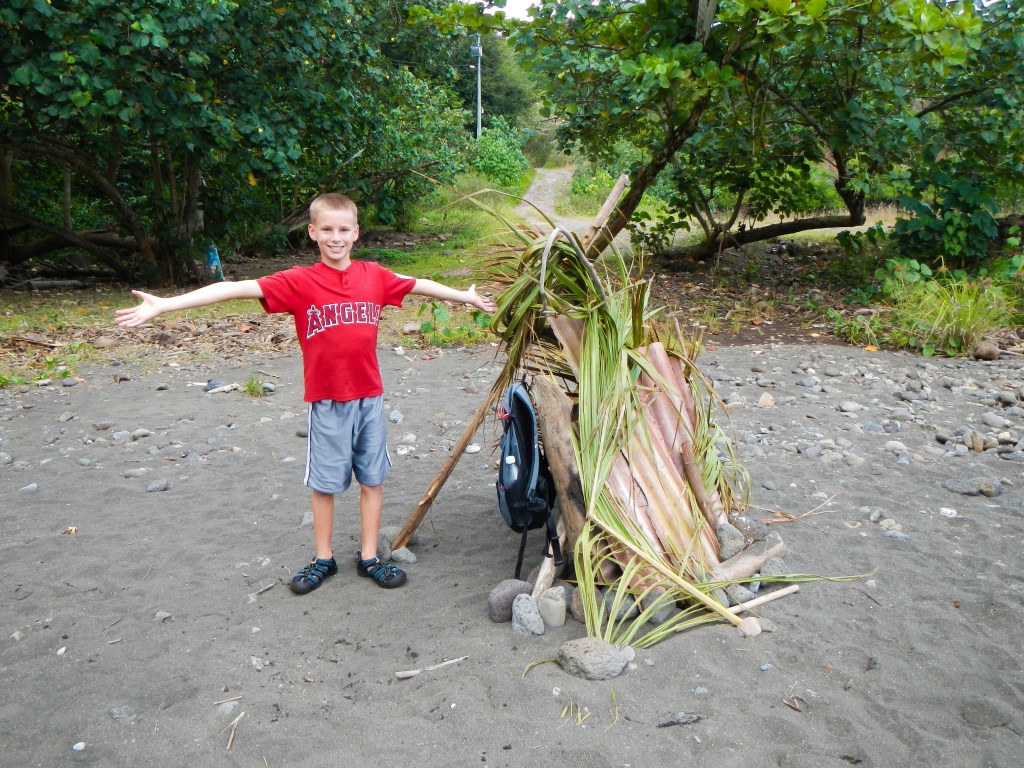
We met another kid boat there almost right away.  They were on s/v Mojumbo and they were from Tasmania, finishing the final leg of a 4-year circumnavigation.  Zeke is 14 (I think) and Nena is 12, and they were very welcoming to Alex and Brenden and took them to shore to play a couple times.  Once Lady Carolina arrived, they were quite the gang, and when I just now asked Brenden what he remembered about Atuona, he said, “oh, that was my favorite place because we built really cool forts on the beach.” 

One of Brenden’s beach forts
Categories
Blog Post

Anchors Down – Tsunami Warning

While we were still a couple miles out of the Atuona harbor, I was picking up a couple boats on AIS, and I recognized one of the names, Senta.  They weren’t anyone we had ever met, but they often checked in on the radio nets, and I was quite happy to see someone familiar.  So, I hailed a couple times on VHF and finally got a response.  Turns out it wasn’t the owners on board, but a hired crew to bring the boat here.  The guy was really nice, told us there were 12 boats in the anchorage, and that he would be happy to help us with our stern anchor when we got there.  12 boats.  I’d seen photos of the anchorage at seminars back in Mexico, and 12 seemed like a lot.  Everyone was likely using stern anchors both to keep the boats pointed toward the harbor entrance, into the swell, and also so that everyone would fit.

When we arrived, we went immediately to the back of the anchorage near shore, because with a shallow draft and all, that’s just what cats do.  We found a nice spot in what I felt like was too shallow of water, but there was room, and we totally nailed the bow/stern anchor setting.  Alex and Brenden are such a good help at this, and since EVERYONE in the anchorage was watching the new boat come in, it’s good we didn’t give them any drama. 

Our Euphoria was temporarily disrupted when a siren alarm started going off.   Now, we knew about the earthquake that had happened off the coast of Chile (thanks Colin), so our first thought was, “oh no, tsunami!”  No one else in the anchorage seemed to be taking any action and there wasn’t any radio traffic about it.  So, I radioed Sandra, the agent on shore who would help us with our clearing in process the next day.  She assured us it was just a test, and there was nothing to worry about.  What a relief!  We couldn’t imagine having to haul up anchor and head back out into the ocean right after we had gotten there. 

Later we learned that is exactly what had happened to people the day before.  They had a real tsunami warning and evacuated the harbor.  I guess they learned they needed to test their system as a result.  The skipper from Senta stopped by and we had a chat, and it turns out it’s a totally different Senta, not the one we knew of in Mexico after all.

Categories
Blog Post

A Little Bit About The Marquesas

The Marquesas are the youngest of the islands in French Polynesia.  But they must be older than the Hawaiian Islands, since there are not active volcanoes. (I’ve never googled that, though, so don’t quote me on it.)  The landscapes are stunning with high peaks and lots of tropical greenery. 

OK, I have to dip a little into the guidebook for some of the following history, however, I’m somewhat shocked that my “Guide to Navigation and Tourism in French Polynesia” still refers to the “discovery” of the islands.  As if they didn’t exist before Europeans visited.  But I digress.

Anyway, the islands were really first discovered and settled by people believed to have migrated from Melanesia, sometime around 1-20 AD.  The first Europeans to *cough* discover *cough* them were the Spanish.  They went to Fatu Hiva and Tahuata, but first they were like, “what,” and then they were like, “huh,” and then they just got bored.  So, they didn’t stay long.  The Marquesans are famous for repeatedly repelling occupation by various French, British, and American explorers, militaries, and missionaries.  It was only in 1838 that French Catholic priests were there to stay on the island of Tahuata.  During all the contact with the Europeans, the Marquesan population was severely decimated, in fact, they came close to disappearing altogether.  While we were there, I noticed a concerted effort that has been made in recent decades to preserve the Marquesan language and culture.  One archaeological display in Taiohae (on the island of Nuku Hiva) said the Marquesan language was almost entire replaced by Tahitian at one point.  Fortunately, they are not reviving the practice of cannibalism, but the art of tattooing the body is making a strong come back.  Their dancing is concentrated on a yearly festival where there are competitions among the islands.  I heard it said that the missionaries frowned on the erotic and suggestive nature of the dancing, but I don’t know if that ever really came close to dying out.

The Marquesans are quite religious, with Catholicism being the most obvious Christian sect on the islands, and that is here to stay, there is no chance of the ancient Marquesan religions making a comeback. 

They are in an odd time zone, being 9.5 hours set back from UTC time.  Their currency is the French Polynesian Franc, and we didn’t notice any signs of any poverty.  They are highly subsidized by the French, but at the same time they are a proud people who are proud to be Marquesan, not French.  So, this creates a sort of love/hate relationship.

I loved the Marquesas, and I’m saddened by the fact that we had so little time there.

Categories
Blog Post

Arrival Euphoria

It is difficult to describe the feeling of Euphoria you get when you have finished setting your anchor after a 22-day ocean crossing.  The boat is still and peaceful.  There are no watches to stand.  There are other people around.  You feel relief.  You feel a sense of accomplishment.  You feel happy.  The closest thing I can compare it to is finishing a long-distance race that had a particularly grueling last couple of miles, but you still managed to PR.  Oh, and the race had to be in some exotic location, and you got to stay and explore afterwards.  Surprisingly, we weren’t in a hurry to get off the boat.  We were just happy to be there.  We opened a bottle of 2000 Spanish red wine we had been hauling around for a while, and the boys got to drink sodas for their “safe arrival cocktails.”  We made snacks and hung out in our cockpit all afternoon as others from the anchorage came by to say hi and welcome us.  (No one brought us baguettes, though.) 

Peacefully at anchor in Atuona, Hiva Oa


People say that you can smell the land as you get close.  I tried, and I didn’t notice much of a difference, but as we were entering the anchorage Brenden, who has a much more acute sense of smell than I do said, “it smells sweet like pollen.” 

Categories
Blog Post

False Start

When we shoved off from the dock after clearing out in Nuevo Vallarta, it was exhilarating.  We were leaving Mexico for new adventures starting off with an ocean passage unlike anything we had ever done before. 

Not so fast. 

The VHF radio chatter started amongst our buddy boats, and we soon learned that the Paradise Village clan had come up with their own secret language, but no one bothered to tell us about it.  Apparently, everyone was going to “waypoint 1,” except for Chara who was going to “Waypoint 0.”  I mentioned that we had no idea what they were talking about, so Steve said he would send us an e-mail, because apparently there would be a huge breech in national security should they let it slip what these waypoints were over the radio.  We checked email about an hour later, and well, there was no email.  Thanks to Chara who was both kind and sane enough to tell us over the radio that Waypoint 0 was La Cruz and waypoint 1 was Punta de Mita.  You see, after clearing out you are supposed to leave Mexico immediately, so I guess they thought the Port Captain had nothing better to do than track us on VHF.  Anyway, all that aside, “what the hell, I thought we were leaving!?!” 

Turns out that they were all going to wait until the next day to leave.  I was a little irked because first of all I was ready to leave, and second of all, no one told us what was going on.  Well, Tim talked me down from the ledge, and we ended up staying the night in Punta de Mita.  I wanted to leave, but Tim wanted to stay with everyone else.  It seemed silly to me because 1) We wouldn’t be having any party that night (like Tim was anticipating) because all the dinghies were tucked in their beds for the passage, 2) There’s no way we would all stay together over the long passage anyway, and 3) OK, at this point I can’t remember what #3 was but there was definitely a #3 and I’m sure it was a very good reason.  In the end, of course, it didn’t really matter when we left, and on the very positive side Brenden and Kyle got in some last-minute surfing at Punta de Mita, so that helped my soul be at peace with all of it.

Spoiler alert: Of course, we didn’t have a party that night, because like I said, no one was going to launch their dinghy.  We DID stay together on passage much longer than I thought we would.  And I’m sure #3 was still a very, very good reason.

Categories
Blog Post

Clearing Out Formalities

Just like when you travel by other means, when you travel on your own yacht, you have to officially clear in and out of each country.  This usually means some sort of interaction with Customs and Immigration.  Unlike other means of travel, you also have to interact with the local Port Captain in the port you are clearing in/out of.  For some reason these formalities are always a mystery, and Mexico was no different.  I don’t know why it’s so mysterious, maybe laws and processes change, maybe individuals in the official offices implement processes in different ways, maybe urban legends among cruisers get perpetuated to the point that no one knows what’s going on. 

Anyway, as time got close, I kept hearing from various people, OK mostly from Lady Carolina, that you had to go to Paradise Village to clear out.  That made no sense to me, how could a single marina have a monopoly on all traffic exiting Mexico from Banderas Bay?  So, when we got back to La Cruz after our trip south, it was time for me to try to sort it out.  My first stop was Katrina, the PR rep from the La Cruz marina, and she actually had a printout with written instructions on how to clear out.  Wow, could it really be that easy?  It indicated that Nuevo Vallarta was the port in Banderas Bay where you had to clear out from, not La Cruz or Puerto Vallarta.  So, that made more sense, Paradise Village is IN Nuevo Vallarta so it’s not that you have to clear out from the Paradise Village marina but rather from the Port of Nuevo Vallarta.

The instructions said that before your departure date you should phone the Nuevo Vallarta Port captain and make him aware of your intentions to leave.  Then you should email copies of your passports, ship’s papers, etc., to him so he can arrange your departure with immigration and customs.  Then on your departure date you take your boat to Marina Nuevo Vallarta and get a temporary slip to complete all of the formalities.  So, since 10 March was a Monday, I phoned the Port Captain the week before.  He took our boat information, insisted that we not email him anything, and that we should just come to Nuevo Vallarta to clear out.  I felt good at first, but then I started to doubt.  Perhaps he still needs the paperwork in advance, he just doesn’t want us to email it.  I consternated over it, and then just decided to go there by bus on the Friday before.  The trip coincided nicely with the Latitude 38 PPJ sendoff party at the yacht club at Paradise Village, so it wasn’t really even a special trip.  It was a good thing we did, because my worries were correct, and he did need the paperwork.  We got all of that taken care of, and after we paid our fee, we had an appointment to check out on Monday at 10:30 am.

So, we pulled into Nuevo Vallarta about an hour early, hailed Marina Nuevo Vallarta on VHF to arrange a temporary place to park Exodus and headed over to the Port Captains office.  He told us we could wait on Exodus for everyone to come see us.  From our end tie we could see the various officials visiting Lady Carolina, who were over on A dock at Paradise Village (you obviously don’t have to move to Marina Nuevo Vallarta if you are staying at Paradise Village, the officials will come there too.)  Eventually we were visited by all three government organizations (immigration, customs, and port captain) including an inspection by a German Shepherd. The poor puppy had trouble boarding Exodus and fell partly in the water, only to be rescued by his leash and collar.  Then we were free to go.  That was it, easy peasy.

Ready to pull away from the dock
Categories
Blog Post

Not Enough Wind?

We started tracking a weather window about 4-5 days before our planned ready date of March 1.  We had previously learned that you could request a “moving spot” forecast from saildocs.  In your request you give a point GPS location, a heading, a speed, and your desired time increment and you get a text file that gives you the forecast along that path.  We wanted to compare different departure days, but there was nowhere in the request to give it a day/time to start the forecast.  It always started it at the time the request was received.  We emailed saildocs, and their response was no, that feature isn’t available, but that’s a good idea.  So, basically what we did was move the start location back 24 hours in order to get a forecast for what it would look like if we left a day later.  A little clunky, but it worked.  Then Tim wrote an excel program that took into account the polars for Exodus, and we were able to compare 3 different departure days by comparing how many miles we would cover in the first 5 days.  Once I put the final touches on the program, it was a breeze to use every morning as we got new forecasts and tried to determine the best day to leave. 

There was what seemed to be a good window to leave right around 1 March, but since we had only just started tracking it, we weren’t sure if it was really good in a relative sense or not.  Plus, we weren’t really thinking we’d leave on 1 March even though that was our ready date.  We were thinking March 2 or 3 was more realistic.  It was not to be, though, because the weather window closed and there was basically no wind for about a week and change.  Lady Carolina wasn’t able to leave yet anyway, since they were waiting for new glasses that they ordered for Kyle at Costco.  We kept tracking the weather and it started looking like the next window would open up around March 9-11, which was great because that’s about when Kyle’s glasses were supposed to be ready.  We never really confronted the decision that we might have to make of whether to wait for Lady Carolina or leave as soon as the weather looked good.  The weather gods took that ominous decision out of our hands and made it so both things coincided, and we could all leave together at the first weather window.

So, as it got close, we started discussing our plans with other cruisers.  Winds looked decent for a 10 March departure.  We wouldn’t break any speed records, but we were ready to go, and we would at least move along, so we were going to go for it.  As it turns out, Mike from PV Sailing/North sails on Channel 6-8, who is also the weather guy for the VHF net hadn’t yet declared a weather window for the puddle jump and he was saying it wouldn’t open for another 2 weeks.  Screw that.  We were ready, and our own observations led us to believe we would be just fine.  However, it seems there were very few other people willing to go out on their own limb like that, and pretty much everyone we talked to said something like, “well, there’s no wind so we are going to wait.”  I get that people might not be ready yet, but if you are really and truly ready, there was plenty of wind.  At least that’s how I saw it.  I can’t tell you how sick I got of hearing how there was no wind.  One of our friends even told me how they were on another boat and some blowhard was going on and on about how the boats who were getting ready to leave are nuts to leave when there’s no wind.  No wind?  I just didn’t get it.  You can really only look out with any sort of certainty for 5 days, and the forecast we were looking at told us we could make 500-600 miles in those first 5 days.  Good enough for us.

Anyway, wind or not, our little clan of Exodus, Lady Carolina, True Blue V, and Chara were ready to go, and we left.

Spoiler alert: Our winds were fine.  We made 583 miles in the first 5 days, and the entire trip in just over 22 days.  Better than many who left when the weather was “good” and much, much better than some. 

Categories
Blog Post

Final Provisioning

Final provisioning was a bit of whirlwind, so much so that I barely remember it and it’s kind of a blur.  Recall that we had done a fair amount of provisioning when we stayed in Paradise Village in January, so theoretically this last haul should be easy.  We rented a car for just 24 hours, again from Paradise Village, and we were off to the races.  We went to Costco, Mega, and Walmart, as well as a couple hardware stores.  My approach was to provision for 3 months, long enough to get us to Papeete.  Obviously, you can’t provision fresh items for 3 months, but we did load the fridge up with as much cheese and veggies as it would hold.  A lot of the veggies don’t get stored in the fridge.  Heartier ones like cucumbers, carrots, onions, garlic, potatoes, apples, oranges, and others get stored in bins in our cabin and as the fridge slowly empties things get rotated in.  The freezer was about as packed as it ever gets with all kinds of meat and about 12 packs of tortillas (we knew we were going to miss our tortillas after we left Mexico). 

You might be surprised that the rest of the world does not store eggs in the fridge.  Nope.  I store 4 dozen eggs in open containers in our cabin, rotate them every other day or so, and they stay surprisingly fresh.  I used to keep the lids on the lock ‘n’ lock storage containers and keep them in the cupboard, and I had a horrible time with mold growing on the outside of the eggshells, so I would have to wipe them clean everyday so the mold wouldn’t penetrate the shell.  Then I realized that a little light and ventilation go a long way, and I never have any egg mold problems anymore. 

We kept hearing and reading and hearing and reading that things are outrageously expensive in French Polynesia, especially soda and alcohol.  So, we went a little crazy.  We bought 8 cases of Pacifico, 2 cases of Pacifico Light, 10 bottles of Bacardi Anejo, 6 bottles of Captain Morgain, 4 cases of cokes and 4 cases of sparkling water.  Supplementing all the alcohol we also have the odd bottle of Seagrams, Kahlua, Tequila, etc.  We were very pleased with how prepared we were, but then came the challenge of where to stow it all.  We came to a quick conclusion that we would have to turn one of the heads into a storage closet.  Who needs 3 heads on their boat anyway, I mean really.  We decided it would be Brenden’s simply because the back of the boat in Alex’s room already has a lot of weight in it (this is where our battery bank is).  When we broke the news to Brenden, he quickly turned to Kyle and said, “you warned me this would happen!”  Although, in all fairness I’m pretty sure Lady Carolina assumed we would give up one of our 3 heads much sooner than we did, I guess we just like fixing macerator problems.

Stowing everything is quite a chore and can take hours.  Partly because there’s so little space and it’s like a puzzle getting everything to fit, and partly because I’m super anal (no, really?) and I keep an inventory log of how much we have of stuff and where it is stored.  So, as I’m putting things away, I update the log as I go.  This helps me when I need to reprovision (I don’t have to pull everything out and take inventory) but it is also very useful when I forget where I put something.  I never have to go through the stress of not knowing where my Anejo is or how many bottles I have, oh the horror.

Once we turned the car back in and I slept for 12 hours straight I went into triage mode until we left.  I kept track of what we used and every few days I’d hit a store (either in La Cruz or I would bus to Mega) and I would replenish what we used.  This got really old, and by the time we left 11 days later, I was glad not to see another grocery store for a while.

Spoiler alert: Overall, our approach to provisioning was successful.  We made it to Papeete easily without any major provisioning along the way.  The only non-fresh item we ran out of was boxed milk, so I underestimated our milk usage, but I was able to restock that myself by backpack in Nuku Hiva.  And contrary to popular belief, eggs are available EVERYWHERE in French Polynesia.  We left La Cruz with 4 dozen eggs, and I never ran out.  They are more expensive than in Mexico, but overall, they seem to be fresher too, so I don’t mind.  There are really only 2 things I wish we had left Mexico with more of:  1) Apples.  We ran out about a week into the passage, and since apples are a daily snack staple in our family, we really missed them.  They store well and keep awhile, so we easily could have brought 2 or 3 times more than what we brought (we brought about 24).  2) Gasoline.  We used our generator quite a bit on passage since the autopilot sucks a lot of juice and the sun doesn’t shine all the time.  

A tower of Pacifico waiting to be stowed


Categories
Blog Post

Lego Trading

One of the major activities of Brenden and his buddies in La Cruz was Lego trading.  Brenden even labeled one of his containers “Valuable Legos” that he would use for trading.  Each kid was interested in different things and had different priorities, and they would spend hours on the dock or in one of the boats working out their deals.  Some parents were protective of what their kids were trading away, but I really wasn’t interested in it.  Brenden has so many Legos even if he gave any away, let alone trade them, I wouldn’t mind.  But I did cousel him about being fair.  Since he was one of the oldest of the Lego trading crowd I wanted him to be sensitive to not taking advantage of the younger kids.