While still at home we put together a pretty comprehensive medical kit. Thanks to Uncle Mike we have enough sutures to sew up a small village when we get to the south pacific, and thanks to Mom we have antibiotics purchased in Mexico (where you can get them without a prescription). The boys’ pediatrician actually gave us prescriptions for azithromycin as well. Luckily we haven’t had to use much from the medical kit, but after a dive one day Tim developed a pretty severe earache. I checked inside (using the ENT scope, also provided by Uncle Mike) and it was definitely inflamed and pussy, so I started him on Cipro right away. Shortly after, Alex’s ear flared up as well, so I started him on Azithromycin since I felt better giving him a drug that I knew for sure was the right dosage amount for him. They both got better and were cleared for diving again within a week. Unfortunately, Alex got another infection, or maybe this one never cleared up all the way. Of course, it flared up just hours after we left BLA village for La Ventana, and he had trouble sleeping that night due to the pain. Since there is a medical clinic in the village, we went back the next morning. We asked Kyle from Lady Carolina to go with us to the clinic since he’s fluent in Spanish, and the doctor gave us amoxicillin and ear drops, and it did the trick, albeit Alex was out of commission for diving for 10+ days. It is a free clinic but they accept donations of anything you want to give. I gave her 200 pesos, which is less than $20, and at the time I had no idea if that was the right amount, and in hindsight I wish I had given more, since the treatment was effective and all.
Like I said, we are well prepared for worse mishaps, but luckily to this point we haven’t needed it
The boys are generally able to entertain themselves with minimal electronics time, especially traveling in the company of Lady Carolina and their two boys. They swim, make up games, play on the beach, read Big Nate books over and over again, and they’ve even started writing their own fish guidebook because they have noticed that none of the fish books indicate the tastiness of a fish. However, sometimes an organized activity is what they need. So, while in Las Rocas, Tim organized a scavenger hunt for them. He made a list of things they had to find on the beach, split them into two teams (Alex/Joel, Brenden/Kyle, surprise, surprise) and sent them away. Here is the list:
Piece of small dead cactus
Something that could have been left by a
Something likely dropped by a panga
Plastic bottle (+1 if it has a lid on it)
Piece of styrofoam (must float)
Something red
Something blue
String or fishing line or net
Beer or soda can
Cool seashell
One bone from a fish (+1 if it’s a puffer)
Beach glass (worn so you can’t see through)
Bird feather over 10 inches long
Piece of driftwood
Very flat rock
Something metal
Piece of clothing
Sexy mermaid
A hat (yes, a hat)
Something that crawls
Alex and Joel won but by a very slim margin. They found a puffer fishbone, which pushed them over the top. I’m sad to say that neither team found the sexy mermaid, but Alex and Joel enjoyed their prize of M&Ms and Skittles nonetheless.
Stepping it up a notch, while we were at Ensenada el Pescador Tim and Steve put their heads together and made a treasure hunt with a series of clues for the boys to follow. They had to go talk to some guy on shore for their first clue, and it turns out he didn’t speak English as well as Tim and Steve thought, so he didn’t really understand what they asked him to tell the boys. They had to find a cactus with a red ribbon on it and use GPS locations and compass bearings. The last clue was in the water, they marked it by a weight attached to a float, and the note on the float said to dive down to get the next clue, but by the time the boys had read the note they had pulled up the weight, and then they had trouble finding the clue. In fact, they never found it. Tim and Steve dove for it and they couldn’t find it either. So, they had to tell them the prize was underneath Lady Carolina, and all four of them enjoyed a package of Oreos as the sun was setting.
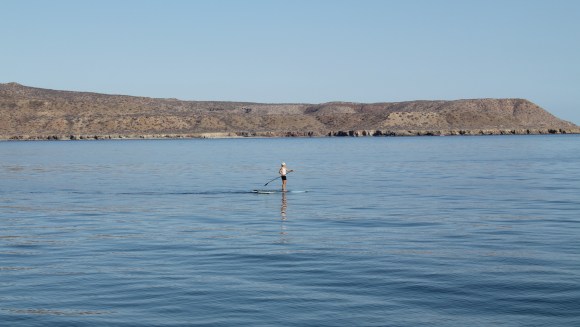
We (and by that I mean Tim) bought 3 paddleboards when we were in San Diego. I have no idea why we need 3, but that’s what we have. Two of them are of the inflatable variety and one is rigid. In fact, we have yet to even inflate both of the inflatable ones. I was always pretty sure I would enjoy paddleboarding, and I tried it for the first time at San Francisquito. It was amazing. I went out for over an hour, and really only headed back because I hadn’t taken any water with me. The only real downside is that after about 20 minutes my toes start to go numb, so I have to sit down and paddle for just a bit until I regain feeling. The inflatable paddle board is more stable and the rigid is faster and tracks better in the water. I tend to use the inflatable one because it’s lighter and Alex and I can put it in the water and also because there’s less concern about running it into Exodus (since it has softer sides). I have only fallen off once, and that was when a panga went by and I showed little concern for the wake when I really should have. Luckily, I didn’t lose my sunglasses. Paddleboarding provides at least part of what I used to get out of running all the time. Namely, the solitude and the very simple goal setting (I’m going to paddle there and turn around). However, it doesn’t come close to being the aerobic workout and I still immensely miss running.
Well, we have made it to our summertime destination: BLA. Most cruisers who stay in the sea for the summer spend August and September up here because it’s far enough north that the chance of a tropical storm is pretty slim (although not impossible, we watch it closely) and there is a natural hurricane hole in the vicinity. This summer the number of boats was in the low 20s, and here’s a listing of those I recall: Exodus, Lady Carolina, True Blue V, Sea Note, Interabang, Karma Seas, Odyssey, Entre Nous, Drifter, True Companion, Mai Tai Roa, Sara M, Lungta, Slipper, Take Five, Let it Go, Charra, Dazzler, Deja La, No Mas, Code Blue, Iver. The next essay will shed a little light on the summertime adventures of this crowd. There was also a small crowd who spent the summer down near Puerto Escondido. It’s further south, but Puerto Escondido is about as good a hurricane harbor as it gets. Through the radio nets we kept in contact with at least 3: Jake, Harmony (of Anacortes), and Apolima. There were probably more since not everyone has an SSB radio and not everyone that does checks into the nets. There are beautiful anchorages in the BLA area, and back in the spring someone made the comment that there’s really nothing further north in the sea past San Juanico worth seeing. I’m thinking this was spoken by someone that was going home for the summer and had never ventured up to the rugged, less traveled, and beautiful area.
Later on I’ll write a little more about the BLA village, but our first stop there was a quick one because we just wanted to resupply before heading up to La Gringa for the full moon party. So, I thought this would be a good representative example to share of what it’s like when we reach civilization and try to do a quick turnaround back out to the land of no stores and no internet.-We arrived just before noon, and our first shore excursion was in the afternoon, and it was primarily a scouting and emergency fresh items excursion. I photocopied the map of the town from the guidebook so I could carry it around, and we (along with Lady Carolina) walked around visiting the various tiendas. We were looking for things like who had non-refrigerated eggs, who had a good meat counter, who had what in terms of fresh veggies, and when the next shipment was due to arrive. We also found out where we could have laundry done by asking someone in the Yellow store who took us to Lulu’s house next door. She agreed to do our laundry and turn it around in a day if we brought it the next morning. Kyle was with us to help us solidify that transaction in Spanish. We also found out where we could dump trash, and where there were a couple of internet “cafes.” The next morning we found out there was a morning VHF cruisers net run by Pit on Karma Seas, and he told us where we could get propane.
Our second shore excursion was for getting as many things done as possible. We do things in a strategic order considering we have to haul everything around in our camping backpacks. We dropped off laundry, and we were a little challenged negotiating a price. Lulu wanted to charge by the item, which if added up would have been outrageously expensive. So, Steve offered 200 pesos (each), which she accepted, but which I thought was pretty low balled and was surprised she didn’t counter back. Next we hit the internet “cafe” across from the yellow store. Cafe is in quotes because it was no cafe at all. It was actually a toy store with a couple of computers plugged in. They let us connect our computers directly since they didn’t have wifi. We quickly took care of banking and any other vital internet business. Next, we hit the yellow store and did provisioning of nonperishables. Sufficiently loaded up we headed back to the boat.
The next excursion was that same day, and it was to get propane. It turns out they only had the capability to gravity feed our tanks or we could purchase a full tank and leave a deposit for the tank, and we opted to do the latter. It was a larger tank than ours, but luckily it still fit in our compartment, and it ended up lasting us the entire rest of the summer. And Andres at the propane place was kind enough to give us a ride back to the beach. Yet another shore trip that afternoon was simply to pick up laundry.
Our final trip was the next day to provision for perishables, since a fresh shipment had arrived. And since each store had a slightly different variety, we had to hit multiple stores to round out our purchases. We were very happy to find the nice meat counter at Mochtazuma, the grapes at Isla, and the nice large garlic at Gueillermo’s. We never did find unrefrigerated eggs. I guess they are catering more to the gringos here than expected.
No matter how hard I try, school still just seems like this extra chore that we have to do before we can have fun. It’s almost like it’s ingrained in all of us that school = boring. I wonder if I could shift our attitudes if I just started calling it something else. In any case we have at least made a few changes that make our school day more efficient, and we all like that. The first thing I did is totally scale back Alex’s History and Geography curriculum and I eliminated Art History. I swear if we did all the work his lesson manuals call for we’d be doing school 8 hours a day. So, I’ve made some priority calls. I decided that a large part of what he was getting out of these subjects in addition to the specific information (which I think is far less important anyway) was reading comprehension and critical thinking and inferring. That is, reading a topic and then answering questions about it that aren’t directly given in the text. I decided that between the other two subjects of Reading and Science he was getting enough of that skill development. So, now for History and Geography all we do is read the text so he’s somewhat familiar with topics, but we don’t do all the extra work or tests associated with it.
Another change I made is with the structure of our school day. We are now doing independent work in the morning and then lessons after that. This way, the boys are never having to wait for me to start their school day. They get up, have breakfast, and start their independent work. It’s making the school days end earlier in the afternoon.
I really enjoy doing school with the boys, but I have to say they aren’t that crazy about it. We’ll keep working on it as it’s all a learning process.
We have continued our sightings and encounters with various sea creatures. An exciting one was when we spotted a hammerhead shark while on passage from San Francisquito to Salsipuedes. This one has to be a rarity: We found a pearl in one of our clam shells when preparing dinner at El Quemado. It’s a good size pearl, but being from a clam rather than an oyster it lacks the opalescence of the pearls we are used to from jewelry, and instead it simply looks like a plastic marble.
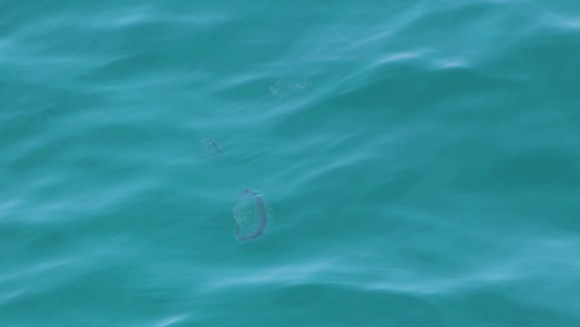
Jellyfish. My, have we seen a lot of jellyfish. In fact, way back in La Paz, someone advised us that we would see a lot and that we should get full-body “jelly suits” to protect us from stings. They are basically lycra suits that would be more comfortable to wear than our full wet suits when the water warmed up. We ended up not getting them, but I don’t think it would have mattered. Most common stings were on faces and hands, which would stick out of the lycra suit just as they stick out of our wetsuits. And the water never got so warm that wearing the wetsuit wasn’t an option (except for Concepcion Bay, of course). The absolute worst encounter, or most amazing depending on your perspective, was our last morning at Isla Partida. We all went out for a dual family snorkel. I had seen jellies in the water when I was paddle boarding, but nothing that seemed too crazy. I was first in the water and swam away from the dinghy a little bit, looked around for a while, then realized I was completely immersed in a jellyfish forest. It was like they all converged on us after we got there. I couldn’t get back to the dinghy fast enough. I kept waiting for the stings to come on my face and neck, but I only felt a couple dull ones. However, it was extremely disconcerting being surrounded like that even without significant stinging. I kept imagining them all over my hair! I got out of the dinghy and was soon joined by Carolina and Joel as well. Tim said that if you dive down deeper there aren’t as many, but I just couldn’t do it.
Jellyfish at Isla Partida
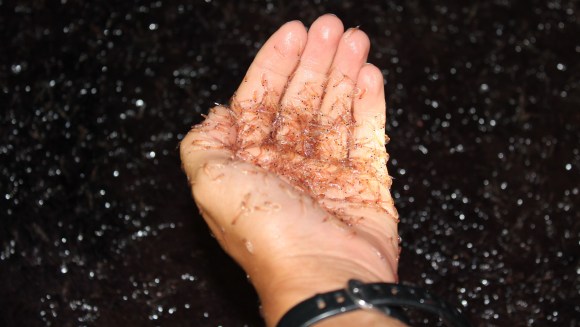
While at Animas Slot the boys found a surprise when they were supposed to be rinsing dishes on the back swim step. Brine shrimp by the millions. It was so gross, but that didn’t stop the boys from scooping them up and inspecting them. Anything to put off rinsing dishes, I guess.-We’ve had turtles in many of the anchorages we’ve been in, and one of the things we’ve noticed is how loud they are when they come up to take a breath. They are about as loud as a sea lion, but they don’t release their breath with as much force. It is actually quite uncanny how they sound just like people. Air breathers, we both are.
Brine Shrimp at Animas Slot
And speaking of sea creatures, now may be a good time to muse a bit on how much the movie Finding Nemo has shaped our anthropomorphic views of them. After coming back from spearfishing, Alex asked Brenden if he had seen a turtle, and when Brenden said yes, Alex said, “thought so.” Alex was in the dinghy and he heard Brenden saying “uuuude” while his snorkel moved up and down. (uuuuude = Duuuuude)
It doesn’t matter how hard we try to think otherwise, but jellyfish are always “my little squishy” and crabs are always combative and say, “Hey, hey!” Seagulls are always dull-witted scavengers who say, “Mine, mine!” Sea Turtles are always laid back surfer dudes and pufferfish always, “… need a little help here!” and say, “shark bait ooh ha ha!” Rays are always annoying and sing crazy rhyming educational songs, and we all wish that we could speak whale. Love. That. Movie.
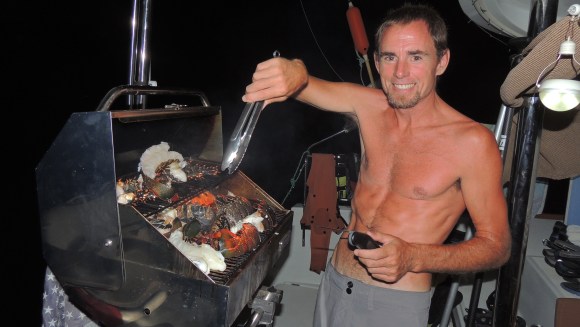
The lobsters were plentiful at San Francisquito, and we had two lobster fests on Exodus. The first was with Lady Carolina, Charra, and Dazzler, and we had a great evening with great food and plentiful drinks. The second was with Lady Carolina and Interabang, and it was another great evening. One humorous aspect, though, is that Derek and Trisha didn’t know they were being invited for dinner. I guess that’s what happens when you send the men over to do the inviting. Apparently, Tim and Steve told them “party on Exodus” so they came with their beverages and full bellies. We tried our best to push some lobster off on them as well.
Lobster Fest at San Francisquito
At Isla Partida the guys caught yellowtail, so we had our first sashimi fest on Lady Carolina. Steve prepared a plate of sashimi and was down below and asked Brenden if he would like to try some. I wasn’t a witness to this spectacle, but apparently Brenden demonstrated his skill at shoveling in sashimi at a pretty good clip. And Steve didn’t stop him because he was so tickled at how much this 10-year-old apparently loved himself some sashimi. Afterward, the rest of us were sure wishing he had stopped him, since it was a tasty treat and there was so much less of it. At later sashimi fests, we typically let everyone get a fair share before we turn Brenden loose on it.
Also at Isla Partida, Tim and Steve landed a HUGE dorado while dinghy fishing. Something like 5 ft long and over 30 pounds. Needless to say it wasn’t easy to land that in the dinghy and the reel malfunction and circling hammerhead shark didn’t make it any easier. Both families enjoyed dorado for many meals from that catch.
The huge Dorado Tim and Steve caught at Isla Partida
Our fun with bugs and other winged creatures had been going on pretty much since La Paz, so now seems like as good a time as any to give a bit of a summary of all of these critters. The first bugs we encountered were the bobos, and the first time they invaded was on Isla Espiritu Santo, I think, and they invaded us en masse. Bobos are basically small flies, and the upside is they don’t bite or sting, but the downside is that they are as annoying as all hell. They especially like to land on your face, and they have this uncanny ability to detect when you are busy using both hands so that neither is available for swatting. Unlike typical houseflies, who you can get to fly away by simply moving, these bobos seem to stay stuck until you actually swat at them. We find ourselves making some pretty crazy facial expressions trying to get a bobo to get lost, and it is simply infuriating. They are slower than houseflies, so very easy to kill, and I tended to find bobo graveyards all around the boat. I guarantee, with bobos around you WILL at some time or another find yourself smacking yourself on your forehead, and feeling satisfied with the kill.
The next encounter was with bees, also on Isla Espiritu Santo. Basically, bees visit boats for one reason only, to find freshwater. They send a few “scouts” and if they report back then they bring all their friends to your boat. Of course, we’ve heard all about how important bees are to our ecology and our first reaction was absolutely not to harm them, but try to help them. Tim had the idea of putting a small amount of freshwater outside then they would be attracted to that and leave us alone. He put a bucket of water on one of the back swim steps, and it resulted in a most amazing bee invasion. They drank the water pretty quickly and were then swarming around in a frenzy. So, he put another bucket up on one of the bows hoping to draw them away from our main living area. Not long after we had an even larger swarm all over the front of the boat. It was totally out of control. At sunset all the bees go home, but it turns out that they remember when and where they have found water, and the next morning they brought even more of their friends to visit. We ended up having to move anchorages to get away from them. Fast forward a couple months, and I’m sorry, I’m really really sorry, I know bees are important and without them the human race will die out and everything, but we kill bees, we really must kill them. We have learned that outside whenever we must rinse with fresh water we must post-rinse the swim step with a bit of seawater. It will attract some bees but they will recognize it as not drinkable and won’t report back and bring all their friends. Any bee that manages to get inside the salon absolutely must be killed. At Isla Coronados I left some frozen meat out on the counter to defrost and the condensation attracted hundreds and it was quite a bee blood bath that afternoon. We try really hard not to let them in the salon at all so the killing can be at a minimum, but seriously, anyone that gets in is at that moment doomed. One thing totally outside of our control is how much dew is on the deck in the morning, and dew is a huge bee attractor. One of our worst experiences was at Honeymoon Cove on Isla Danzante when Gary and Marsha were with us. We had hundreds of bees on the deck lapping up the morning dew. We left that anchorage in a hurry that morning. We have all been stung, and we find that the worst stings are on the feet and hands. I got stung on the finger (early in our journey, when I was actually still trying to help the bees) and I screamed like a baby and writhed in pain for at least 20 min. Stings on the hands and feet cause a lot of swelling, and we’ve all been subject to “fat hand” or “fat foot” as we affectionately call it. Once we got into the summer and had a few rainy days, the bees were a lot less prevalent, presumably, then they don’t need us sailboats as their freshwater sources.
Of course we encounter mosquitos every now and then. They are most common when we are anchored near mangroves or estuaries, and they tend to feast mostly on the boys at dusk and dawn. Tim and I haven’t really had too many mosquito bites. We’re just glad that where we are now the mosquitos are just a nuisance, not transmitters of horrible illnesses.
Then comes the mother of all biting insects so far. They are bugs that absolutely must be the spawn of the devil. Yes, I’m talking about jejenes. They are also, not so affectionately, called no-see-ums because they are so small. You can see them, but just barely. They pack a huge, burning bite that develops into a small itchy bump, sometimes with a day or more delay, and the bump itches for many days up to a week. Our first encounter with them was at Isla Salsipuedes. In the late afternoon after anchoring I paddle boarded over to Lady Carolina, and we were chatting and through the course of the conversation jellyfish came up. I don’t really remember exactly what we were talking about but I remember both of my calves starting to burn a bit. I joked that the power of suggestion of jellyfish made me start feeling stings, and I paddled back to Exodus not thinking much more of it. The next day the bumps started itching, and the rage was on. Bites just kept showing up, primarily on my legs. For days bites kept showing up. We had heard that they crawl, so you can’t protect yourself with clothing or covers, and we also heard that they can infest your boat and you have to wash all your bedding to kill them all or you will just keep getting bit. At this point we were at Isla Partida, far away from any laundry facility, and I was a crazy woman with fire in my eyes. I couldn’t take it anymore. I gathered up all our loose clothes, all of our bedding, all of the boys stuffed animals, and I bagged up every last bit of it. If I couldn’t wash and drown them, I would suffocate them. Then I spent all afternoon vacuuming every nook and cranny of Exodus. It was poor timing because it was the day after the mini-Chubasco, so we had a fair amount of cloud cover, which means not much power generation to run the vacuum, but I didn’t care. I was on a mission to seek revenge on every little biting creature that was tormenting me. I should probably mention at this point that I have very poor tolerance for itchy bug bites. I have a high pain tolerance for many things, I can give birth (3 times) with no anesthesia and I can run a marathon, but I absolutely cannot take the pain of small, red, itchy bug bites. I scratched my legs until they bled. Repeatedly. Well, they eventually subsided, and I have no idea if my bagging and vacuuming really mattered at all or if I was just feeling the delayed effects of bites from Salsipuedes. But I did know that those bugs needed to be avoided at absolutely all costs. Of course, we ran into them a couple more times, and my legs now bear permanent scars from my inability to refrain from scratching those nasty little bites.
As far as creepy, crawly bugs go, we’ve only seen the lone earwig or cockroach once or twice. According to cruising books and blogs, cockroaches are a huge cruiser nightmare. They hide in all things ashore, especially cardboard, in fact, its often advised to not bring any cardboard from your shopping excursion onto the boat. We also talked to some folks who saw cockroaches on their dock lines at a marina, so they now spray their dock lines with bug spray. Cockroaches, unfortunately, do fly, so at some point there’s only so much you can do. Luckily so far we’ve only had the lone guy to deal with and we’ve expended with him swiftly and haven’t had to deal with any sort of infestation. Brenden is officially our bug hunter/killer. He’s swift and efficient, and it’s sort of entertaining to watch.
Buying flour here can be a bit of an adventure as well. At home I would buy a bag of flour, put it in the cupboard, use it when I needed it, and never, ever, found any creepy crawlies in it. Here, every bag of flour needs a bit of inspection before it gets to stay on board, and I’ve even taken to opening bags at the store before even buying them. So far we’ve managed to avoid any sort of dry goods bug infestation, but we use airtight containers and put bay leaves in everything, so hopefully that’s will keep working for us.
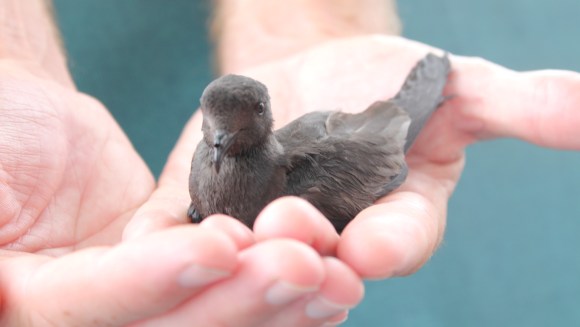
There have also been some larger winged creatures who have visited Exodus. The most entertaining incident (in hindsight, as far as I’m concerned) was the evening at Isla Partida before the mini-chubasco. I had just finished taking a shower, had dried off a little bit, and was just stepping out of the shower stall when something came flying down from the hatch above and smacked me in the head. It landed on the floor and quickly regrouped and started flying around in a frenzy. It didn’t take me long to realize it was a bat! It was a small one, but I still hightailed it back into the shower stall, slammed the door, and started calling to Tim. God bless him, he came quickly (because my blood-curdling scream made him think I was in some sort of imminent danger) and he managed to cover the bat with some rags and carry it outside and release it. Whew, what a relief. Of course, mom screaming over a small bat has become quite a joke around here, only slightly more entertaining than mom screaming over a bee sting. Anyway, I dried off, came out of the bathroom and was getting dressed in our cabin, when I swear to god, something came flying into the salon, down into our cabin, missed my head by only fractions of an inch, I’m sure, and settled under the stairs. Seriously? Two things flying into (or near) my head in one night? This time it turned out to be a small black bird that just needed a little sanctuary, and we let him stay on the boat as long as he needed to.
The next morning, after the mini-chubasco, the black bird (or a similar one) was nestled under our cockpit table. Tim made it comfortable, gave it something to drink, and a little later it was gone. Or was it? When Brenden woke up he discovered a bird on his bathroom floor. He felt so bad because he stepped on it a little before he saw it, and he felt very obligated to take care of it until it was ready to fly away. After hanging out for a while, it tried to fly away out of Brenden’s hands, and it briefly landed on the deck before falling overboard just off the stern. Brenden immediately starts figuring out a way to retrieve it when we all spot a seagull make a beeline straight for the little bird. Before any of us really realized what was happening, the seagull snatched the bird up in its beak and flew away. You could actually hear the little bird let out out a squeak as it was being crushed. Brenden screamed out in horror and sorrow. He cried and cried. He said when he first saw the seagull flying over he thought it was coming to take care of the little bird, like a substitute mom. Then he said it was all his fault that the little bird couldn’t fly because he had stepped on it in his bathroom. We told him the bird must have been hurt or something to come on to the boat at all in the first place, but it took a while to console him. It was all very sad, and we all got to see quite close up how harsh nature can be sometimes.
Living on a sailboat, weather becomes a much more integral part of your life. Good forecasts are important because if you get caught by surprise you can set yourself up to be quite uncomfortable and in extreme cases you can find yourself in real danger. Unlike at home when we were primarily concerned with temperature highs and lows and whether it was supposed to rain, if we were concerned at all, out here we are much more concerned with wind speed and direction, and if planning a passage, what the sea state is supposed to be like. When at a major port with internet access, getting these forecasts as often as we want is pretty easy. But most of the time we are out at more remote anchorages without internet, so we rely solely on our SSB radio. We have two ways to get weather forecasts via the radio: 1) Voice nets and 2) Data downloads (via the pactor modem connected to the radio). There are two morning radio nets that provide weather forecasts. The superior by far is the Sonrisa Net, which includes an extensive forecast by Gary (that I described in my last essay, Gary is the guy who hosted the cruisers 4th of July part at El Burro Cove). The other is the Amigo Net, which includes reading wind and sea state forecasts from the solmatesantiago website. This is actually not all that useful in the Sea of Cortez when you are just coastal cruising and hopping from anchorage to anchorage, because the winds can be dominated a lot by local landform effects, so there’s often the disclaimer that in the Sea of Cortez this forecast is good mainly for “down the middle.” If I miss a voice net because I sleep in or don’t have good enough reception, not to worry, the information from both of these nets is also available to download. The main way to download weather products is by using the saildocs service, which is a free document service for the bandwidth challenged. There is an extensive NOAA weather product library, and solmatesantiago forecasts are also available. Additionally, you can grab the text of any webpage using saildocs, and Gary actually uses voice to text software and publishes the text on his website, so that it can even be downloaded. The main NOAA products we’ve used so far are tropical forecasts by the National Hurricane Center for the NE Pacific. There is an “outlook” file that just tells you if there are any lows brewing and gives percent likelihood of it turning into a tropical cyclone. Then there is a “discussion” file that goes a little more in-depth and provides more information than just tropical storms (like gap winds in the Tehuantepec). And if there is a tropical storm in progress, there are storm specific files that can be downloaded that give details and forecast track and intensity. Last, but not least, we can also download .grb files (“Gribs”) through saildocs. We typically use these only when planning for our longer passages.
In addition to the low likelihood threat of a tropical storm, summertime in the Sea of Cortez brings another weather “feature” to look out for: the Chubasco. A Chubasco is a very intense but relatively shortlived squall accompanied by thunder and lightning. They are caused by convection over the land but have the tendency to move out into the sea any time from the late afternoon to early morning, but most common in the middle of the night. I read some blogs from last summer’s cruisers and also talked with the folks on Interabang, who experienced a 60 kt Chubasco early in the summer last year. Luckily, this year, Jake (on the sailboat Jake) started a nightly Chubasco report on SSB radio. He was in or around Puerto Escondido all summer with internet connectivity, so every night he checked on the convection situation and then reported it out to all of us. To be clear, there’s no way to really predict if a Chubasco will hit a specific anchorage. However, Jake was able to let us know what convection was going on over on the mainland and whether we were likely to have a quiet night or whether we should be on alert. The best reports were when Jake told us there was no convection. Of course, hearing the report was sometimes a challenge if atmospheric propagation of the radio signals wasn’t cooperating. Sometimes it seemed like some sort of sick joke what we could or couldn’t hear… it would often go like this, “This evening it should be quiet in the Puerto Escondido area, and up in BLA it SHHH–HISS–CRACKLE–HISS. Any questions?” Those of us up in the BLA area got in the routine that if we actually got a good copy on the report we would repeat it for everyone else, so most nights at least one person got it. I took these Chubasco reports very seriously and woe to the Exodus crew member or even the guest on Exodus who talked or shuffled cards during the report. I was never shy about shushing anyone! When there was a threat of a Chubasco, or even if there wasn’t really, we started taking extra care to button up the boat at night. We had no idea how Exodus would react to 60 kt winds, but we tried to put away and secure everything, so at least we wouldn’t lose any gear in the blow. We also tied down the mainsail bag and secured the solar array panels.
We did end up getting what is affectionately called a “mini-Chubasco” when we were at Isla Partida. That night on the Chubasco report, Jake was “cautiously optimistic” that we would have a quiet night, but we semi-secured everything anyway, just in case. The wind woke us at about 2 am, and both Tim and I got up and quickly did some last-minute tucking in here and tightening up there. We only saw about 22 knots sustained with gusts up to 30 kt, from all directions. The lighting show was pretty spectacular though, so all the portable electronics (handheld VHF, laptop, iPads, iPhones, Camera) were quickly stored in the oven, an effective Faraday cage, for the rare chance we actually got struck by lightning. We came through it completely unscathed, and the good news is our anchor held firm. Love that Rocna!


 Gresham Family Exodus