Categories
Blog Post

Highlights of Matuku and Ha’afeva

October 15-19, 2014

We had a blustery day sail from Uonukuhihito to Ha’afeva, making the jump from the eastern to the western island group of Ha’apai. However, when we arrived at the Ha’afeva anchorage on the west side of the island, we found that it would be an uncomfortable spot in the strong southerly wind that we were having. So, instead of dropping anchor, we just did a drive by and then proceeded just about 2 miles to the southwest to the small island of Matuku. Matuku is a rectangle shaped island with its long side lying east to west and reefs sticking out from the corners. While not an ideal anchorage, it provided reasonable protection from the strong south winds.

As we were nearing the anchorage, we could see that there was a village there, and there was a group of children on the beach huddled in the shade of a palm tree. As we got closer and Alex and Brenden came out on deck, there was obvious excitement among the kids on shore and they shouted and waved. As soon as our anchor was set the boys took the paddle boards ashore, and they took a soccer ball. You should have heard the squeals of delight from the village children as Alex and Brenden approached the beach; it was too cute. While the boys were ashore, the schoolteacher, Isaac, borrowed one of the paddle boards and came out to Exodus for a visit. He was quite young, early thirties, and from the capital city of Tonga, Nuku’alofa, so this teaching assignment in a small village in the Ha’apai was a big change for him. He explained that usually the new teachers get these assignments. He told us that he had seen many yachts, but he had never been aboard one, so he was glad to get to come see Exodus. He was also very interested in going spearfishing with Tim and Jack, and he also invited us to the school in the morning.
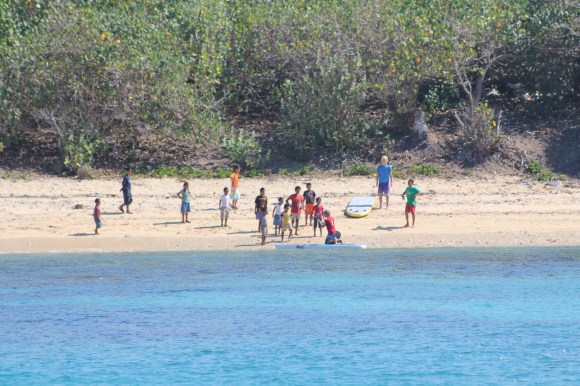
Kids on the beach at Matuku
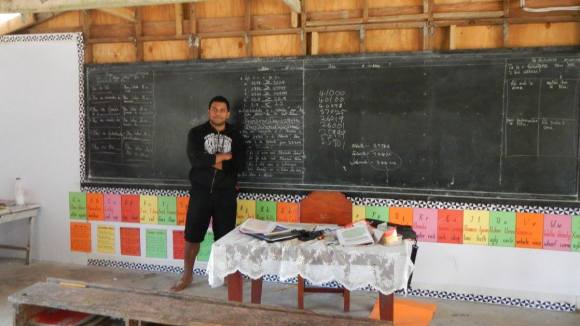
Isaac the teacher

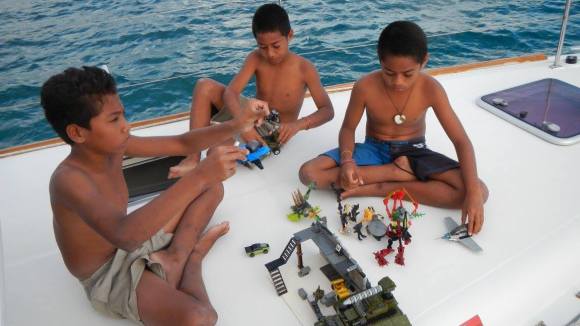
The village was small with a total of 14 children aged 12 and under. Older children go to one of the bigger cities for school, so Alex was the biggest kid on the island. We had to get up and get ready for school by 8:30 (not an easy task, especially for Brenden who likes to sleep in well past 9). When we got there it turns out they didn’t really have school since they finished exams and were having a little break. So, they just played some more soccer. I took a few small items for the school (pencils, paper, crayons), and Camille (our friend on s/v Iguana) took some lollipops, which were a huge hit. And we also gave them the soccer ball, which was accepted with applause. The kids mostly don’t speak English, so it’s even harder than when we were in Makemo, because at least we knew a few catch phrases in French, but I don’t exactly have a book called Tongan for cruisers. When I asked Alex if it was hard, his response was, “when you have a (soccer) ball, you don’t need to speak the language.” Three of the older boys (12 yrs. old) came out to visit Exodus a few times when the boys were not already on shore. They used the lids of ice chests as kick boards to get to us. They seemed to be especially fond of Brenden, which I thought was maybe because he’s exactly their size, but Alex told me it’s because Brenden sang Jingle Bells with them. Of course! Brenden entertained them for a couple of hours on Exodus one afternoon, and they even taught him a little Tongan. The sat on deck outside his bedroom hatch and he handed them Legos to play with, since they couldn’t go in his room because they were wet. They kept asking us if we were going to leave the next day and all of them, including Brenden, were begging us not to. He was having fun with his new friends. Of course, when we would leave was solely dependent on the wind.
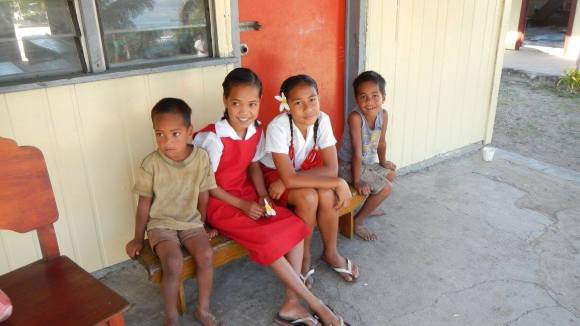
Ready for school
Legos on Exodus

When Tim and Jack went spearfishing in the morning, they came back with a tuna (Tongan – Atu) and two huge red snapper (Tongan -Fongamea) and they took them to shore to share with the village. I didn’t go, but apparently it was very well received, and they even got to meet the chief. In the afternoon they went spearfishing again with Isaac, the teacher. Isaac was totally amazed at how deep they dive and for how long they can hold their breath.

The winds stayed strong but they shifted from the south to the east, so we moved back up to anchor off the west side of the island of Ha’afeva. The village is on the east side of the island, so we took about a 20-30 minute walk along an easy trail to get there. A little girl immediately approached us and asked us if we wanted mangoes, and of course the answer to the question, “Do you want mangoes,” is always, “Yes!” so she climbed a tree and brought down several green, hard as a rock mangoes and wanted to charge us for them. We passed and asked where the store was. When we got to the building we thought was the store, it was locked up, so we just kept walking. A Chinese guy was walking along in our direction, so we asked him about the store, and he gestured for us to follow him, and it turned out he was the store owner and opened up for us. In Neiafu, there were many Chinese people running the shops, but I was surprised to find it the same in a small village in Ha’apai. The store was organized so that everything is behind the counter, and you have to ask for what you want, which was slow and frustrating for us, because the Chinese guy didn’t speak English, and well, we don’t speak Tongan or Chinese. However, soon a Tongan man came in who spoke English, so he helped us out.

We didn’t really do much during our stay at Ha’afeva, mostly because of the weather. I was able to get in a few good runs on the system of trails, trying to avoid the village in my running clothes. Other than that, we mostly had lazy rainy days on board catching up on school, playing games, and making cookie dough. We had planned to snorkel on the wreck of an old Korean fishing boat that is near the anchorage, but we never did get around to it. Tim and Jack finished a few boat projects together, and I made one more trip into the village store, because Brenden was concerned about how low we were on ramen noodles.
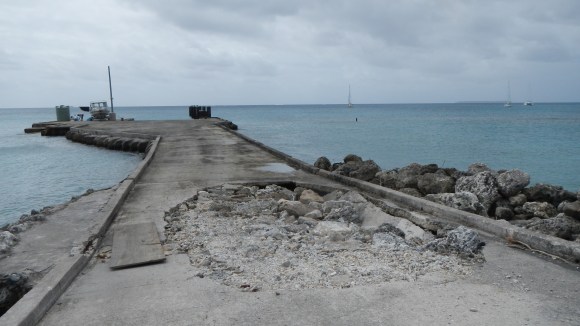
Cyclone evidence at the wharf at Ha’afeva
Categories
Blog Post

Fish and Kids are Good Icebreakers

Originally posted on October 24, 2014, by cruisingrunner

Tonga calls itself “The Friendly Islands,” but of all the places we’ve been so far, I’d say they actually seem to be the least friendly. However, the longer we’ve been here, and the more people I interact with, the more I have started to notice a pattern. There seems to be a direct correlation between how “friendly” someone seems and how confident they are in their English speaking skills. So, I’ve come to the conclusion that people who may on the surface appear unfriendly, or at least less friendly, are really just shy and self-conscious. Contrast that with Pago Pago, American Samoa, where everyone speaks very good English and everyone is super friendly, including the many Tongans I met who live there. Also, contrast that with French Polynesia, where there simply was no expectation of them to speak English. They spoke French, and it was up to us to try our best not to butcher the language too badly, all with varying degrees of self-consciousness.

Now that we are out in the much more remote areas of Tonga, we are finding this even more. It’s quite possible to walk through an entire village without speaking to anyone, which creates a dilemma for us. We aren’t exactly the most friendly or outgoing people ourselves, but we recognize how rude it is to go to a village without talking with the people who live there, if for no other reason than to thank them for letting us be there. Luckily, we’ve got a couple of good ice breakers: Kids and fish.

Every village has kids. Usually a lot of them. And kids seem to be less concerned about whether or not they can speak the same language with other kids. For example, when we were approaching the island of Matuku, we could see right away that there was a group of about 12 to 15 kids on the beach watching us. They were waving politely, but once they saw Brenden and Alex, they started running around the beach and they took their waving up a notch. They were obviously excited to see other kids. Shortly after getting the anchor set the boys got on the paddle boards and headed to shore, one of them with a beach soccer ball situated between his feet. I’m not sure if it was just the excitement of the boys heading to shore, or if someone caught a glimpse of the ball, but whatever it is, we could hear the squeals of delight from the kids on the beach loud and clear. And when we looked towards shore we saw them all running towards Alex and Brenden and helping them get their boards up. Shortly after they arrived, all the kids, including Alex and Brenden, vacated the beach, presumably to somewhere suitable for a game of barefoot soccer. The village teacher, Isaac, ended up paddling out to visit with us, and he invited us to school the next morning too. The boys ended up spending quite a bit of time on shore during our stay there, and when they weren’t on shore, three of the older boys from the village would come out to Exodus to visit. They sang jingle bells with Brenden, played with legos, and even taught a little bit of Tongan. Isaac ended up going spear fishing with Tim and our friend, and in the end he gave us many coconuts and kasava root. I could go on, but the point really is just that the kids were our opening for interaction. When you have kids, you automatically have something in common, and it makes overcoming the language barrier and getting a out of your comfort zone a little easier for the shy and self-conscious. I’ve heard babies and young children are even better for this, but I’ll just have to take that on faith.

Every village likes fish, too. Bringing a fish to shore to share with the people of a village can get you an audience with the chief and usually lots of island fruit in return too. Too bad the mangoes aren’t ripe yet.

-D.

The kids of Matuku are crowded in the shade of a palm tree watching Alex and Brenden paddle to shore
Categories
Blog Post

Spent After So Little

Originally posted on October 18, 2014, by cruisingrunner

The island of Ha’afeva is great for running, relatively speaking. There is a major road between the anchoring side of the island and the town that is a very well kept dirt road, which means I don’t get scrapes along my ankles, calves, and shins from any overgrowth. There are also many side chute roads that are in various states of maintenance, and they made for lots of little ways to get sidetracked and make a long run not quite so monotonous. And by long run, I mean 5 miles, because that’s about all I’m up to. I ran slow, with “Allstar” by Smashmouth in my brain the whole time (curse you, Alex!) And by slow, I mean s…l…o…w. Knowing this was the first decent terrain I’d had to run on in about 2 weeks, I tried not to judge myself. Not judging is hard, though. I felt great at milestone 4.5, so I extended my goal from 5 to 5.5 miles in order to run just a little bit further than my last “long” run. Of course, I seriously hit the wall at mile 5, and it was a severe effort to keep moving my legs at all after that. But since I had already resolved to go 5.5 miles, I found it impossible to stop, because I rarely stop before I reach whatever distance I’ve set out for myself, only because of abnormal pain or, well, bathroom issues. I say “abnormal” pain, because there’s always a little bit of normal pain with any long run. The last half mile lasted forever, and when I was finished, I was spent. I felt like I used to feel after a 12 mile long run at home. Like I said, I was spent.

I am looking forward to running in the cooler climate of New Zealand. Not that I can blame my pathetic run entirely on the heat and humidity, but it certainly doesn’t help.

-D.

Categories
Blog Post

Highlights of Uonukuhihito

Upon leaving the island of Uoleva, we went around the south tip of the island and crossed the Ava Auhanga Mea pass. This pass is a break in the reef between Uoleva and the small island of Tatafa to the south. Then we cut south through a tiny opening in the coral between Tatafa and a huge coral bombie. Our guidebook provides this warning, “NOTE: VERY STRONG CURRENT. Mariners should use extreme caution. Do not attempt this course unless traveling south to north on an incoming tide.” Well, OK. We were going north to south, but we did it a close to slack water with at most 1-1.5 knots of current and there was no wind to speak of, so there was no issue at all. We also had excellent visibility, so even though the opening was quite narrow, we could clearly see the coral on both sides and made our way south without any problems. Once through, we travelled on a line to the south-southwest keeping an eye out for bombies the entire time.

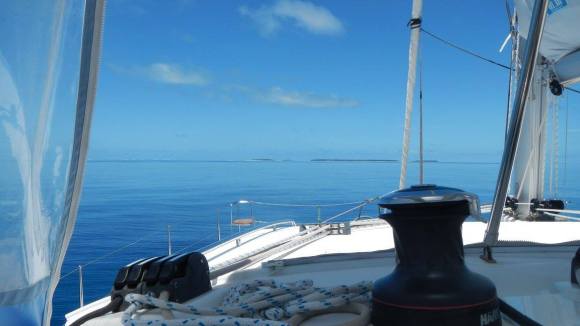
A glassy sea on the way to Uonukuhihito

We anchored off a sand spit between two very small islands called Uonukuhihito and Uonukuhahake (yeah, you try to pronounce them!) It was an amazing spot, and I think the picturesque wow factor as we pulled up was second only to when we first arrived on the eastern side of the lagoon in Raroia (The Tuamotus, French Polynesia). The boys were a bit burned out after all the activity at Uoleva, and they preferred to just sit around and watch movies, but I ventured ashore and walked the sandspit, avoiding the cows (yes, more cows!) however it was impossible to avoid the flies. They were everywhere and it didn’t take them long to invade our boats. I think the flies are one of the reasons we didn’t stay here longer than we did.

Cows on the beach

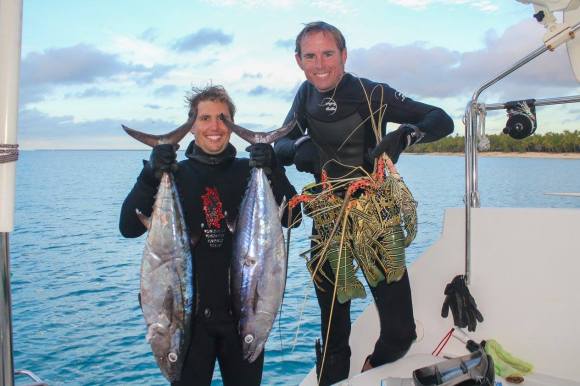
The highlight of our stay here was without a doubt when Tim and Jack dinghied a few miles to the south to an island called Limu and came back with 6 fat lobsters and two large dogtooth tuna. Needless to say, we had quite a feast!

Tuna AND lobster. What a treat!
Categories
Blog Post

Dogs and Cows and Birds

Originally posted on October 11, 2014, by cruisingrunner

I’ve gotten used to the dogs. Throughout most of the south pacific islands that we’ve visited, stray dogs are prevalent. Mostly, they ignore you, but I’ve gotten used to the occasional run in where I have to assert myself as the alpha dog and yell, “no!” and then wave around whatever I’m carrying (a loaf of bread, a VHF radio, whatever) like I really mean business. Supposedly dogs in Tonga can be a real menace, but so far, I’ve managed to come out of every interaction as the top dog on the totem pole.

But when running on the island of Ha’ano, it wasn’t dogs I was having to worry about. No, it was cows. Yes, you read that right. Cows. Just like the dogs don’t like me running around or near their territory, these cows didn’t particularly care for my presence anywhere on their island either. While I was still on the boat I looked ashore and saw cows, grazing I suppose, on the beach where I had been previously landing the paddle board. However, I wasn’t concerned and I set off for the beach anyway. They are only cows, after all. As I approached on my paddle board I was a little unnerved that all five cows were standing quite still and had their gazes fixed exactly on me. Now, even though I grew up in an aggie community where there was a big cattle ranch, I do not have much experience with cows, but my general impression is that they would simply ignore me as they and I went about our separate businesses. As I got closer, they still did not avert their gazes, until I reached the beach, and then they all followed their apparent leader back off the beach and into the brush. The “leader” was larger than the rest, with horns, and when as he turned around I got a good view of the fact that he still had all of his parts. This was no steer for slaughtering, this was a bull for making more baby cows. A bull. Crap. It was like a family out for a picnic, papa, mama, big brother, little sister, and maybe grandma or something, and I walked in and disturbed their meal.

I sat down and changed my shoes, and I had no visual on where the cows and their papa bull had gone off to. And as I got up and walked towards the “road” for my run, I still didn’t know where they were. Until I did. Suddenly I was face to face with one of them. Not the bull, but not one of the smaller ones either. And she started mooing. Not the lazy mooing I’m used to hearing in the far off distance, but more like moo yelling, and it was clearly directed at me. She moo yelled, and moo yelled, and I had no idea if she was calling the papa bull or what, so I just backed away and when I was far enough she stopped mooing and I turned around and ran. I was actually afraid of a cow. Anyway, my entire run was consumed with what would I do when I got back if they were blocking my path back to the beach. Or if they sprang out of the bushes and attacked me along the way. Cows springing. Funny. When I got back after my run, I spotted the papa bull on the other side of the road than the path to the beach, and he spotted me too. He just watched me, as I never turned my back on him, and as I made my way down the path and away from the road. I don’t know where his moo yelling mate was, but he let me go in peace.

And then yesterday on the island of Uoleva, I had birds to contend with. Little white birds who took exception to me running on their end of the beach. They cawed at me and when that didn’t scare me away, they started bomb diving me. Two little white birds took turns flying at full speed to within a couple feet of my head.

Why are all the animals in Tonga against me getting a good run in?

Running on Uoleva has been difficult, because it’s a very soft sand beach, and my calves and glutes are sore as a testament to it. My foot hasn’t been hurting me, but I haven’t really been making the progress towards longer runs that I would like, so the prospect of a half marathon next month in New Zealand is looking pretty dim.

-D.

Categories
Blog Post

A Wet Run

Originally posted on October 7, 2014, by cruisingrunner

We are anchored off the island of Uoleva in The Ha’apai group in The Kingdom of Tonga. There is a beautiful white sand beach that extends around the entire circumference of the island, and I was excited for the potential of doing some beach running again. It’s better for my foot, after all. The weather has been overcast and cool, so I donned my capri leggings under my shorts and headed to shore on the paddle board with our hand-held VHF radio tucked nicely down the middle of my sport bra. It’s a “waterproof” radio that really doesn’t like to get wet, so I figured that was the safest, driest place to transport it as I paddled my way to shore.

The paddleboard I ride is a big, fat, sturdy blowup one that is quite stable; in fact, I’ve only fallen off once, and that was due to the wake of a panga (small power boat in Mexico) zipping past me. I’m pretty confident on the paddle board. I land it safely on shore in reasonable amounts of surf getting just my feet and ankles wet as I hop off and pick it up to carry it up the beach. In some surf conditions, I have learned to watch carefully for a while so I can time my landing with the smallest of the waves in the set. Today, the surf was almost nonexistent, just a little lapping on the shore, and I got careless.

I have read that, while at sea, people fall overboard more in calm conditions than really rough ones, because they forget they still need to be careful. Everyone dons a harness and clips in when the weather deteriorates, but most seldom do when it’s calm. I think this mentality is what did me in today as I tried to land my paddleboard on shore. The conditions were benign, and I let my guard down, and a little tiny wave turned me sideways just as the tip of the board touched the shore and I toppled off in a most ungraceful fashion. I couldn’t believe I was almost completely submerged in about 5 inches of water. The only part of me that stayed dry was my left shoulder, and my running shoes that I had simply placed on the top of the board went in as well. And forget about keeping the radio that was wedged down in my bra dry. And here I thought that was such a clever location to carry it.

Anyway, I arrived on shore totally soaked and cold, and since my running shoes were wet and sandy, I decided for a slow, barefoot run in the very soft sand. My calves will certainly be feeling it tomorrow.

Categories
Blog Post

Uoleva

Uoleva is the island just to the southwest of Lifuka (where Pangai is located), and it was definitely one of our favorite places in Ha’apai. It is a small island with a white sand beach around the entire perimeter, although I never did do a circumnavigation. The sand was packed enough to run with shoes but soft enough to run barefoot too, so I had plenty of options. There are two anchorages listed in the guidebook, and we anchored in the southern one. Our second anchor location was the much better of the two anchor spots we had with fewer bombies to get your chain wrapped around. A couple of low-key resorts are on the island, and we inquired about dinner at one of them (the one furthest south, I don’t remember the name) and it would have been 50 pa’anga per person including a cultural show, but in the end, we decided to skip it.

The beautiful beach at Uoleva

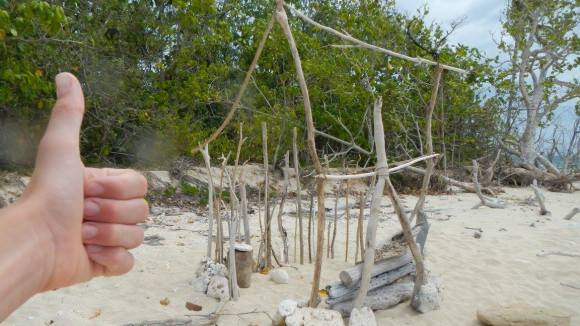
The boys kept busy on the beach and had a good time, even though they were seriously missing other kid boats at this point. They built a fort, no, it was more like a house, and they got pretty engrossed in the project. Tim even had to whistle them home for dinner at dusk. They weren’t lonely for long, though, because a kid boat that we met in Pago Pago pulled into the anchorage and stayed for a few days. S/V Wildlife has a 14-year-old boy and 12-year-old girl, and they actually live here in Ha’apai, on the island of Nomuka (spolier alert: we will visit them there a little later in the journey). They have a whale watching charter business, and that’s actually why they were at Uoleva, to take some tourists from the resort out on their boat. I don’t know what came over me, but I gave the boys the entire week off from school. We hadn’t been with other kids for a few weeks, so I let them spend their days with the kids from Wildlife building another hut, gathering coconuts, and going dinghy surfing. They had a lot of fun, except that Brenden, and only Brenden, got covered in bug bites, kind of like no-se-um bites that we used to encounter in Mexico. He seriously suffered, because they were all over his back, chest, and naval. I’m guessing that since they were on shore at dusk, and because he’s Brenden and he doesn’t just sit and play in the sand, he lays in it and rolls around in it, which is why the bites were where they were and not on his ankles and calves.

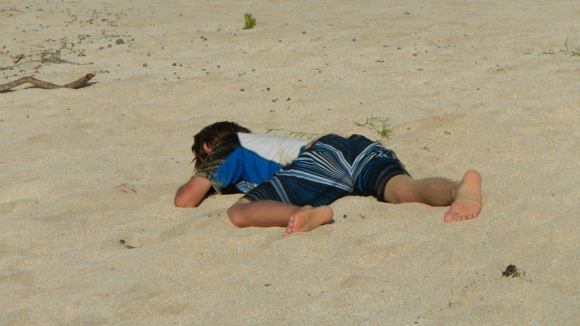
Brenden on the beach, no wonder he was covered in bug bites
Beach hut version 1.0
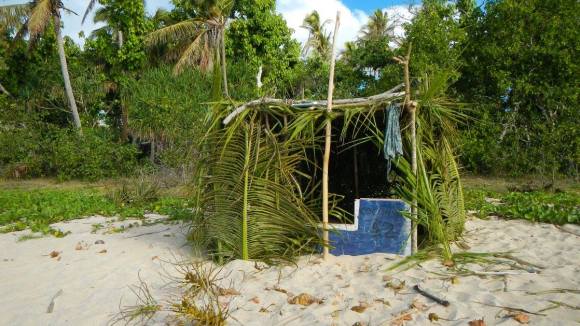
Beach hut version 2.0

There was very nice snorkeling along the reef on the south side of Uoleva. Lots of live coral, sharks, and big and small fish. This was one of the better spots we snorkeled in all of Tonga.

We stayed at Uoleva so long partly because we had to wait out some weather, but it was also just a nice place to be. We enjoyed several fun and relaxing evenings with Iguana, and a couple times it was even warm enough to venture out to the net of Exodus to enjoy a little breeze and fun conversation. Just like old times.

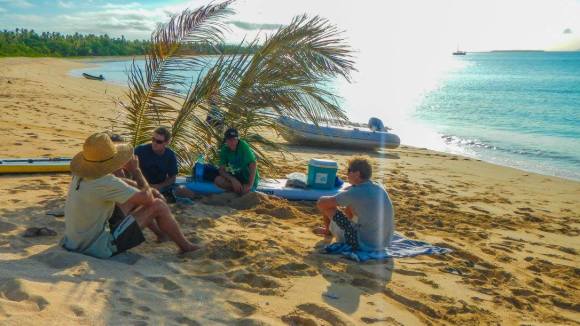
Drinks on the beach with friends at Uoleva

Uoleva Photo Log – Link

Categories
Blog Post

Clearing In/Out of Ha’apai

We had heard from other cruisers that they make it easy for you in Ha’apai, that they will let you clear in and out at the same time so that you can keep working your way down the island group without having to circle back to Pangai to clear out. As I was heading to shore, I met up with Jack and Camille, who had already made a visit to customs and were returning with one of the big snappers Jack had shot that morning. They explained to me that the guy at customs was balking at the idea of letting them clear in/out at the same time, that he was requiring them to leave Pagai and then come back to check out. So, they were going to “trade” the fish for being able to check out today. So, I latched on to them and hoped the customs guy would group me with them and let me clear out to. That took some convincing. But let me back up a bit… walking from the dock to the customs office with this huge fish was a bit awkward, because it got a lot of attention. Everyone wanted to see it and basically everyone wanted it. Jack said he was giving it to a friend and then they would want to know who the friend was. In the end I think the whole town knew that we were bringing a fish to the customs office. The guy in the office was amazed at the size of the fish and accepted the “trade” of fish for clearance eagerly. But then he told me that I would need to go to the next island and then come back to clear out. I basically begged that “I’m with them, we’re travelling together…” and eventually he relented.

The immigration office is right next to the customs office, and the ladies there had no problem checking us in and out. Some people said you didn’t even need to go to immigration, but the man at immigration in Neiafu very clearly told me that we did, so I followed his instructions.

As usual, figuring out what the actual rules are can be quite tricky in Tonga. What you are allowed to do can vary from day to day and official to official.

Categories
Blog Post

Pangai, The Regional Capital

Pangai, the regional capital of the Ha’apai group, is located on the west side in the middle of the island of Lifuka. We went straight from Ha’ano to Lifuka, skipping past the island of Foa, but I guess you can’t do everything. To be honest, Pangai was a pretty sorry sight. Cyclone Ian had blown through earlier that year and basically devastated the whole area. It just broke your heart to see the aftermath still fresh. The place seemed hot, dusty, and exposed. There was evidence that a lot of construction was going on, including little modular, portable homes, which is good, because according to wikipedia over 2000 people were left homeless after the storm.

We spent only 2 days there, one to check in and one to check out (more details on that process to follow in the next post). The boys and I were keen to get some internet, so we went to the only place in town with wifi, The Mariners Cafe. You had to pay for each device and then she would type in the password for you. Pretty good way to keep those leacherous cruisers from using their high gain antennas from their boat to connect to your wifi once you’ve given them the password. Turns out the data speed was too slow to actually do anything. After about a half an hour trying to pay bills, I just shut it down and relaxed and enjoyed my drink. Then we walked around the town and found a couple of small stores and some ladies selling a small amount of produce. Other than that, there wasn’t much to Pangai, and we were happy to move on to the next island of Uolevu.

Pangai is still reeling from the aftermath of Cyclone Ian
Categories
Blog Post

And Then Again, Sometimes it’s not About Luck

Originally posted on October 3, 2014, by cruisingrunner

Our friends are in Suwarrow now, and they just emailed about the daunting sight of the boat that was lost on the reef there during the big blow back in August. I wrote about it when it happened, not the actual event because I didn’t have any of the details about it then, but I wrote about my reaction to the event, and how a little bit of luck can sometimes be the difference between a close call and losing your boat. I now feel compelled to write an addendum. Back when it happened, it was obviously a hot topic of discussion amongst us cruisers, and I noticed how there was a trend of differing reactions between the captains (i.e., husbands) and the first mates (i.e., wives) in our group. The captains all immediately wanted to know what they did or didn’t do, why their ground tackle “failed,” and to put it bluntly, what mistakes did they make. Looking back I think I was almost irritated at the time, because there seemed to be a subtle air of arrogance going around, like, “I would have done things better,” or “I would have taken better care of my equipment.” They didn’t seem to like my assertion that sometimes it’s all about luck. Perhaps when you are the one in charge of keeping your home and your family safe, leaving room for luck to be a major player isn’t easy to accept. You want and need to be in control.

Well, while we were in Neiafu, I ran into a guy from one of the boats who was in Suwarrow while we were there and who was also there when that boat ran aground. Unsolicited, he enthusiastically told me the whole story, from his perspective anyway. Turns out the captains were right, and luck had almost nothing to do with it, except for having the bad luck to be in Suwarrow during that weather system in the first place, I suppose. To make a very long story short, yes, their ground tackle failed (I still don’t know the details of that one, though), but the did actually have plenty of reaction time. They first decided to just try to hold their position in the anchorage, almost hitting the boat of this guy telling me the story a couple times. Then they decided to leave the anchorage, but stay inside the atoll. Then, they decided to come back into the anchorage, and in the process drove right over the reef. That’s it. There you have it. They drove into the reef. My image of them getting blown onto the reef with very little reaction time was a complete myth. OK, at this point I’m actually feeling uncomfortable that he’s telling me all this, I mean I didn’t even ask, and it starts to feel like we’re gossiping, like we’re bad mouthing people who aren’t even there to tell their side of the story. So, we go our separate ways, and I keep pondering what actually happened. Since I felt bad about hearing the story myself, you might wonder why I’m perpetuating the “gossip” and passing it along . I can explain. I ran into the guy later that day, and he told me he didn’t finish the story. He wanted to tell me WHY he had told me. He said that there’s a lot of misinformation out there, and he thinks people should know what really happened so we can all LEARN from it. His takeaway is that you don’t stay in an anchorage when it’s not safe. Sometimes you have to make the difficult decision to just leave, as the winds were howling but not enough to make being at sea actually dangerous, just uncomfortable. My takeaway is that I was probably being unfair to the cruising community and especially all the captains by writing about it in a way that made it seem like they were simply unlucky. Their decision making did, in fact, have a lot to do with it. Some people might make better decisions, and some may have even made worse, but they had a fair amount of control over their own destiny, and that is the point.

We are now in the Ha’apai group of Tonga, which is only about 60 nmi south of Vava’u. We are anchored off the island of Ha’ana, and there is a dirt road along the lenght of the island which made for a nice, easy, flat, 3 mile run yesterday. Today is Sunday, the day of rest in Tonga, and since there is a village here on the island I will not be venturing ashore for a run.

-D.