It was in Funafuti that “The Northbound Fleet” started to gel. We loosely organized an SSB radio net and made our way north together with not so much coordination.
The Northbound boats were: Exodus, True Blue V, Navire, Anahata, Free Spirit, Clara Katherine, Ariel IV, EOS II, and Skua.
Skua didn’t have and SSB radio, but we stayed in touch with them via inReach.
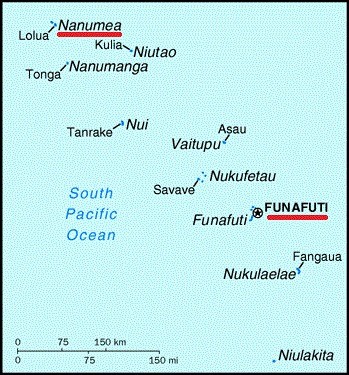
We wanted to visit one or two other islands north of Funafuti en route to Kiribati, so, we wrote a letter requesting permission and we gave a copy to both Immigration and Customs (at the Government building, not at the wharf). It is still unclear who is in charge of this process, and it seemed like maybe there was a bit of turf war going on. Two other boats before us had requested permission only from Customs and they were denied. I personally talked to the lady at the Immigration office, and I believe that she was the one who got the ball rolling to get the permissions. To cover all bases, we were glad we submitted letters to both offices.
However, when our approvals came back there was some conflicting information. The immigration office told us we had permission to stop for 1 day and that they would call the police on the islands and that no letters were needed. The customs office asked us how long we wanted and when I said one week he said no problem. He gave us letters that gave us permission for one week. (When we got to Nanumea, the Police Officer originally told us we only had one day permission, but then when we showed him our letter from customs, he honored the one week.)
The process for getting these approvals took well over a week, and many follow up visits to both immigration and customs. All of the boats that we are aware of were approved once they made their request to both customs AND immigration.
On our way back south I emailed the Immigration office in Funafuti requesting permission to stop at Nanumea inbound. Surprisingly, my email was answered immediately, but permission was denied. She said that their laws only allow for stopping outbound, not inbound.
This an email I sent out while we were anchored down at the south end of the Funafuti atoll, near the island called Mateiko:
Most of the boats in the fleet here (we are 9 total now!) have moved down to anchor in the southern end of the lagoon to get away from the “big city” for a couple days. We’ve met a lovely couple from Sweden (Ariel IV) who cruised with their 3 boys when they were younger, and they organized a bonfire on the beach yesterday. They were going in to get the fire started, and they radioed to see if the boys would like to come help. I thought it was a very nice gesture, and I all of a sudden realized how important it is for the boys to have time with people without Tim and I around, so they can forge their own relationships. No, it’s not other kids, but there’s no reason they can’t get to know the adults too. Alex was happy to take his machete and get coconuts for everyone. After about 45 minutes they came back to get Tim to join the party too, while I stayed on board to enjoy the boat to myself. In case you were wondering, yes, I did walk around naked in the rain. Just because I could.
The worst of the wind and rain happened during the bonfire, but when the boys got back, it was clear that it didn’t put a damper on any of the fun. The fire didn’t even go out!
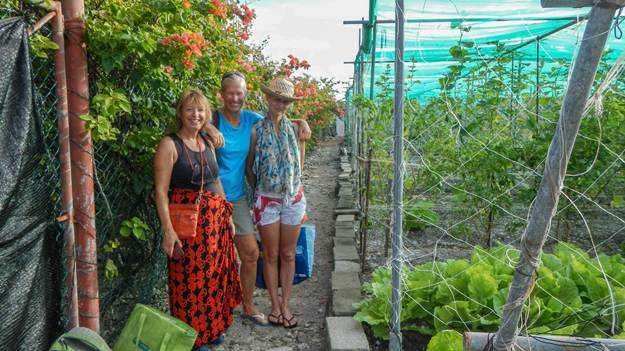
This was one of the highlights of Funafuti, especially after thinking that fresh vegetables would be hard to find. On Tuesday and Friday mornings you go early in the morning (when we were there it was 7:00 on Tues and 6:30 on Fri) and put your name on a list, which is basically a queue. Then you come back an hour later and you get to go in order to pick out piles of vegetables: cabbages, green bell peppers, lettuce, and cucumber. We were also able to order for pick up on a Thurs morning, and there were a few additional things available, like green beans.
When we were there, we met two young Taiwanese men who are university students doing their internships there. Apparently 8-10 years ago Taiwan funded this project to teach the Tuvaluans to grow vegetables above ground, in containers. Now it’s operated by the Tuvaluans, except for the occasional interns.
This is an email I sent out to friends and family, and I’ll just include it here rather than re-write about this incident:
Yesterday was a lovely day until about 5 pm. We were invited to a picnic here with the people from the island of Kioa. Kioa is in Fiji, but it is not inhabited by Fijians. 67 years ago, a small community from the island of Vaitupu in Tuvalu purchased the island of Kioa and migrated there. Now, there are many people who migrate back here to Funafuti, either permanently or temporarily, and they make up one of the small sub-communities within Funafuti. They even elect a community leader, and they have many social gatherings, like this picnic yesterday. Why were we invited? Call it being in the right place at the right time. When we were in Rotuma we met another boat called Navire with a very nice couple from New Zealand. Well, they had a passenger with them, called Kailopa, and they were giving him a ride from Kioa to Funafuti so he could visit family. Kailopa is wonderful man, and we enjoyed getting to know him a bit in Rotuma, and now that we are in Funafuti he is including us in all the festivities. Also, he has a grandson who is 17 years old named Joseph, and Joseph is being very good to Alex and Brenden, and he’s even been out to Exodus for some dinghy surfing!
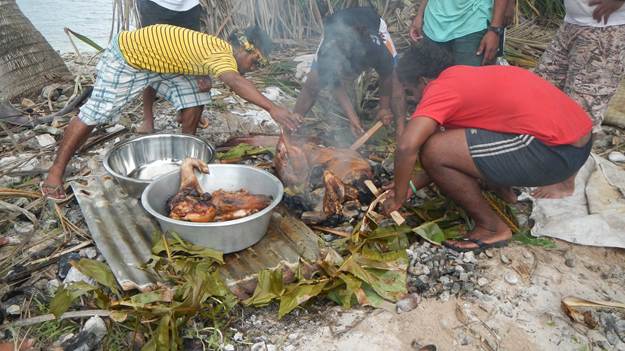
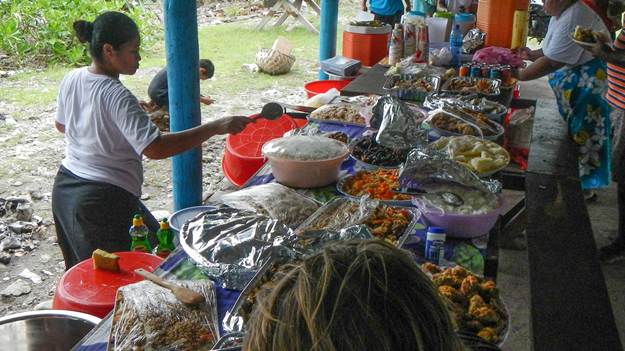
So, the picnic yesterday was great, I would say about 50-60 people including lots of kids. They cooked a pig in a lovo, and they also BBQ’d chicken. They apologized that there wasn’t any fish, but they said the boys who normally do the fishing were practicing rugby and didn’t have a chance to go fishing. Alex was OK with that. The picnic was down at the very southern tip of the island, about a mile away, so we took Navire and Exodus down there and anchored off the beach. It wasn’t a great anchor spot since it was steep to, so we were close to shore without a lot of chain out, but as long as the wind direction and strength stayed the way it’s been for the past week, nothing to worry about.
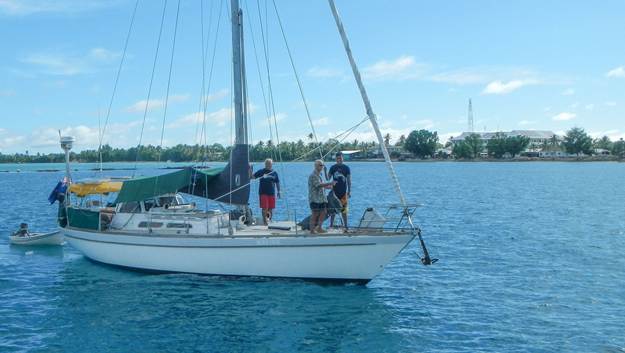
Navire heading down to the picnic with Kailopa and Joseph on board
Taking the pig out of the lovo
Quite a feast
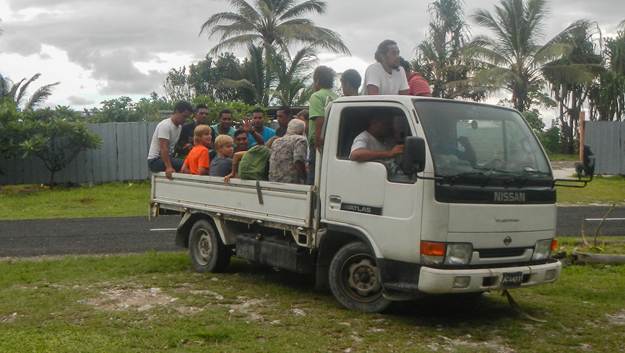
After lunch everyone piled into the back of a pickup truck and headed to the stadium for a big rugby game. Tim and the boys joined them, but I stayed behind “with the women”. Shortly after, I noticed that the wind was blowing from a strange direction, from the NW, so I headed back to Exodus. With this wind direction we were laying exactly perpendicular to a lee shore facing the fetch from across the entire lagoon. But the wind was only 11-12 kts, so I set an anchor alarm with a tight tolerance, and sat down to do some writing without worrying. I actually thought to myself, “If it were blowing 25 kts, *then* I’d have something to worry about.”
Piled in the truck headed to the rugby game
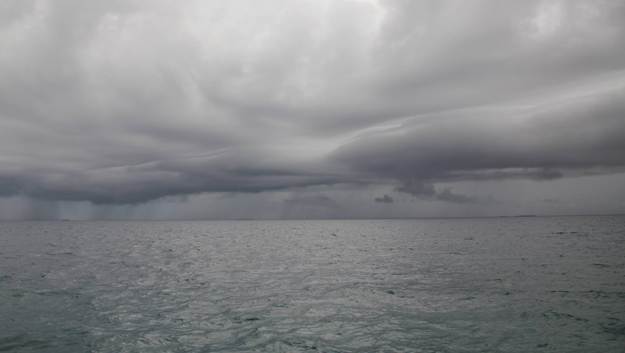
The storm rolling in
Well, pretty soon it was blowing 25-30 kts and we were hobby horsing in 4 foot wind chop. Exodus was doing fine, but I kept my eye on Navire, which was unattended because David and Janet also went to the rugby game, and after about 30 min of these conditions I could tell they were dragging back after a few particularly violent up and down movements of the boat. I started thinking about what I could do, and quickly concluded that I couldn’t really do anything. First of all getting to Navire would be difficult in these conditions, there’s no way I could drop our dinghy by myself so I would have to swim, and not being a particularly strong swimmer, that didn’t seem like a smart thing to do either. Plus, I would have no idea what to do when I got there. *Maybe* I could figure how to start the engine, but maybe not. And I’ve never driven a monohull, so would I just be making a bad situation worse? Plus, and this was really the decisive factor for me, I couldn’t very well leave Exodus unattended. We were also in a precarious position and I could just imagine getting to Navire and then Exodus starts dragging, and I’m on a boat I have no idea how to save while I watch the boat I *do* know how to save drag onto the shore. I wished to myself that it *was* Exodus that was dragging, because then I could do something. I got on the radio and called for assistance, but that was really an impractical thing to do since we were away from the main anchorage so I would basically be asking someone to dinghy down to help, but still, if by some chance someone was willing and able, I had to try. Then I looked to the shore and was so relieved to see everyone on the shore getting ready to head back to the boats. They had seen the weather rolling in and had come back early.
Navire got their anchor up first, and wow, did the waves toss them around as they headed out of the anchorage. I joked that even Lady Carolina had never provided such a show during our adventures together. Exodus tried to follow quickly, and we got the anchor up as the wind was still blowing 30 kts and the rain was pelting down (being the princess of the boat I got to stay dry under the helm bimini driving the boat, but don’t think that driving Exodus in 30 kts of wind is easy!) Not long after the anchor was up Alex started yelling that a surfboard went overboard. So, Tim jumped on a paddle board to retrieve it, and my job was to keep Exodus pointed into the wind while drifting back slowly to pick him up, since there would be NO way he could paddle back upwind to us. Alex kept a visual on Tim the whole time and let me know when he was near the back step so I didn’t engage the engine. At this point it was imperative that they got both boards and Tim on board very quickly, because without propulsion, Exodus is at the mercy of the wind and will get pushed back rather quickly towards the shore. The boys managed this operation flawlessly, and we were off again. I’m not kidding, not a minute later, our large plastic tub, which was full of rainwater to do laundry, slid overboard. Tim sees it slipping but can’t quite get there in time. So, he yells, “diver down!” and he’s back in the water. If we weren’t in such a serious situation, it would have been funny. Perhaps with time we’ll laugh about this. (Spoiler alert: it’s now about 6 months later and I *am* kind of laughing about this.)
So, by the time we’ve completed our man overboard drills it’s completely dark. We follow our track back to the main anchorage as Exodus bounces all around and things fly around the salon and galley, like books, apples, wine bottles. As we approached the anchorage we were able to make out all the anchor lights and one of the boats was broadcasting AIS, which helped get us oriented to the layout of the anchorage in the dark. We were able to make it close to our original anchor spot, but out a little further in order to have more room. We put out plenty of chain and got the anchor set and shut down the engines. At this point the squall passed and the wind died down.
This was one of mother nature’s reminders that we cannot get complacent and we have to be prepared for the unexpected. We are not in the tradewind belt anymore; we are up in squall alley, and a squall can blow in any time. Plus, in addition to squalls, the general forecast is somewhat less reliable. Down in Fiji during the cruising season, the weather is mostly caused by systems far to the south, the highs and lows as they travel across the southern latitudes cause the tradewinds and then the periodic backing winds as a trough from a low goes over. Since the systems causing the weather are relatively far away, errors in the forecast of the tracks of those systems result in relatively small errors in the wind forecast up in Fiji (land effects aside, of course). However, up here, the systems causing our weather are closer and less stable, so forecasts are all over the place and much less reliable. After thinking all of this over, I now have a full appreciation for how difficult it will be to pick a weather window for our next passage north.
As a follow up, it turns out that the “squall” that hammered us that day was a trough passing over us from the north. When I figured this out it was somewhat comforting news, in that it *was* forecast, of only I had been watching the right weather products. We had another such trough go over us several days later, and because I had been on watch I knew approximately when the rainy, squally weather would start, and I knew approximately when the axis of the trough would pass over. Thank you NWS-Honolulu.
We were pretty sad when we were leaving Fiji without True Blue V. They were the ones who had originally put it in our heads to go to The Marshalls, so when they changed their minds and decided to stay in Fiji for the off-season, we were missing their company. However, in true cruiser fashion, guess who pulled into Funafuti just a couple days after we did? That’s right, True Blue V changed their mind again after the Fiji Met report was issued, which warned that the El Nino could cause the cyclone season to be even worse in Fiji this year. So, we were back together with one of our long-time buddy boats after all.
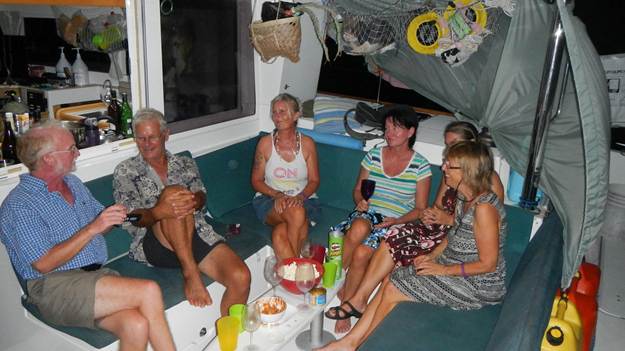
And we had another encounter with a “blast from the past” while anchored in Funafuti. Sally is a woman we met way back in Mexico and we had also run into her in The Marquesas. She crews on different boats and manages to see the world that way. Imagine my surprise when a dinghy pulls up to Exodus and there’s Sally with a warm greeting for us. So, we had a get together on Exodus with all of our old and new friends to catch up and get to know each other better.
In my last narrative I explained that due to last minute changes by the Fijian government Rotuma is no longer an official clearance port, and therefore we left without all the proper paperwork from Fijian customs. So, now upon our arrival in Tuvalu, it was time to find out if that would matter or not.
Navire had arrived the day before us, so I asked them how it went for them. They were lucky, because they hadn’t even realized they didn’t have all the right paperwork. They went to immigration first and gave them the form they had gotten from the officials in Rotuma, and then when they went to customs, and were asked by them for a form, Janet, in all honesty, told them she had left all the paperwork with immigration. Apparently, customs didn’t seem too concerned about it, and they cleared in without issue.
I decided to just follow the same tactic. We went to immigration and left them the immigration clearance form from Rotuma. Then we dinghied down to the customs office at the wharf, and the customs guy was very nice. The office was air conditioned, and he invited us to sit down, and he even gave Tim the password to the Wi-Fi. All the while island hip-hop music was playing in the background. When we got to the part where he asked for our customs clearance from the last port, I told him I had given my form from Rotuma to the immigration office. He insisted that I should have a customs form, but I insisted that I didn’t, so he asked if he could look through all of my paperwork from Fiji. He found my coastal clearance form from when we departed Savusavu way back in May, and he said, “This will work.” I didn’t question anything, just smiled and thanked him, and we were on our way. That is, after chatting a bit more about Funafuti and enjoying the air conditioning.
Way back when we departed New Zealand our plan was to spend the cruising season going from Fiji to Vanuatu to New Caledonia and finally ending in Australia. However, shortly after arriving in Fiji a realization came over us. It was already the end of May, and we’d need to be in Australia in less than half a year. That just seemed WAY too soon for us to leave the island cruising lifestyle again and go back to a culture oh so similar to our own.
So, our main options at that point were to stay in Fiji for cyclone season or head north out of the cyclone belt. I have to admit that the thought of staying in Fiji was tempting, especially since we had a few friends who were planning to stay, but in the end we decided the risk of a cyclone was still above our tolerance threshold. So, north it is!
There was one other consideration, though, and that was the sale of our beloved Exodus. Our three years were winding down, and one of the reasons we had always planned to end our journey in Australia was in order to sell Exodus there. Australia has a big sailboat market, and when we left California, we actually thought we’d be able to cruise for three years and then sell Exodus for close to what we paid. However, in the meantime the economy has changed, and the USD has become stronger, and while usually this would be a good thing for travelers, it was most certainly NOT a good thing when you want to sell your boat in Australia and the amount you owe the bank is in USD. So, this just meant that the argument for going to Australia was much weaker than before, so Marshall Islands here we come! We still had to think about selling Exodus, though, so we figured we would list it for sale when we got to The Marshalls, advertising that we’d deliver it anywhere in the South Pacific from Tonga to Australia. (Spoiler alert: it’s now May 2016 and the jury is still out on whether this is a good approach or not.)
Heading north was not going to be easy. First of all it’s a long trek:
Fiji (Rotuma) to Tuvalu (Funafuti) = 270 nmi
Tuvalu (Funafuti) to Kirbati (Tarawa) = 700 nmi
Kiribati (Tarawa) to Majuro (Marshall Islands) = 360 nmi
Total = ~1330 nmi
For some perspective:
Fiji to New Zealand = ~1100 nmi
Second of all, it has the added complexity of crossing the equator and all the funky weather that entails.
And lastly, it would be some of the most remote cruising we have done, making provisioning and maintenance that much more challenging.
But in the end, we decided: Challenge Accepted!
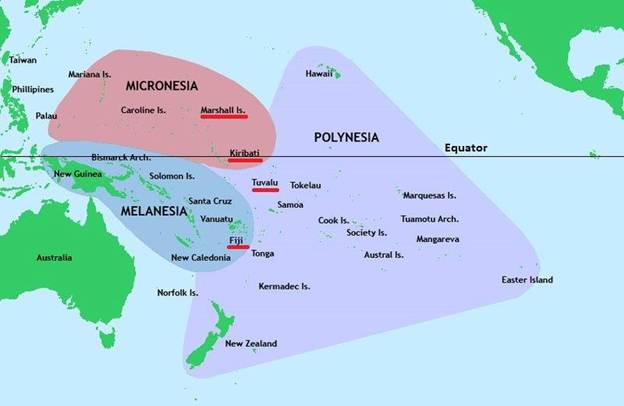
The islands of the South Pacific with Fiji, Tuvalu, Kiribati, and Marshalls highlighted
We said good-bye to Fiji with an early morning departure from Rotuma on Saturday, 7 November. A two and a half day passage brought us to Funafuti, the capital of the island nation of Tuvalu. We spent 11 days in the atoll of Funafuti, mostly at the main island of Fongafale, but also with a couple brief visits at other anchor spots. Picking a weather window to leave Funafuti turned out to be a difficult task, but in the end we were compelled to leave in order to avoid bad weather in Funafuti. It was another two and a half day passage up to the northern most island in Tuvalu, called Nanumea. We thoroughly enjoyed Nanumea and ended up staying there two weeks before departing on Monday, 7 December northbound for Tarawa, Kiribati.
After departing Rotuma, we spent about a month in the island nation of Tuvalu. In the next narrative you’ll meet The Northbound fleet, including The Mighty EOS II and find out what a Sparklebox is.

 Gresham Family Exodus