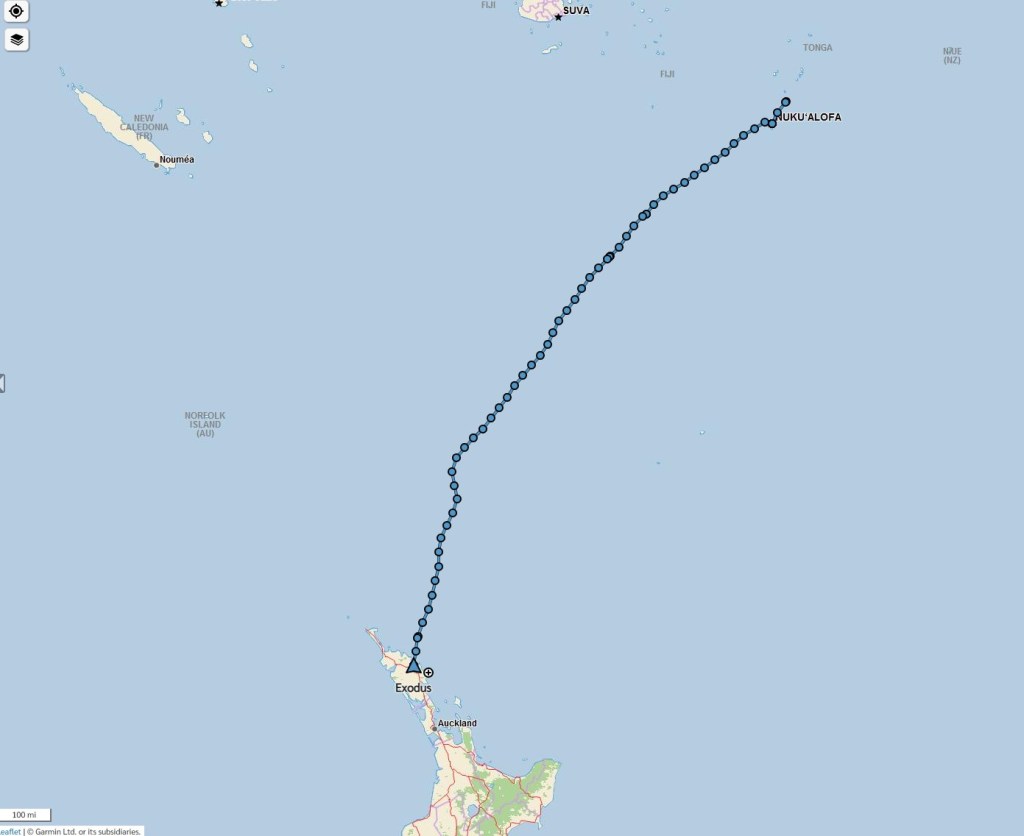
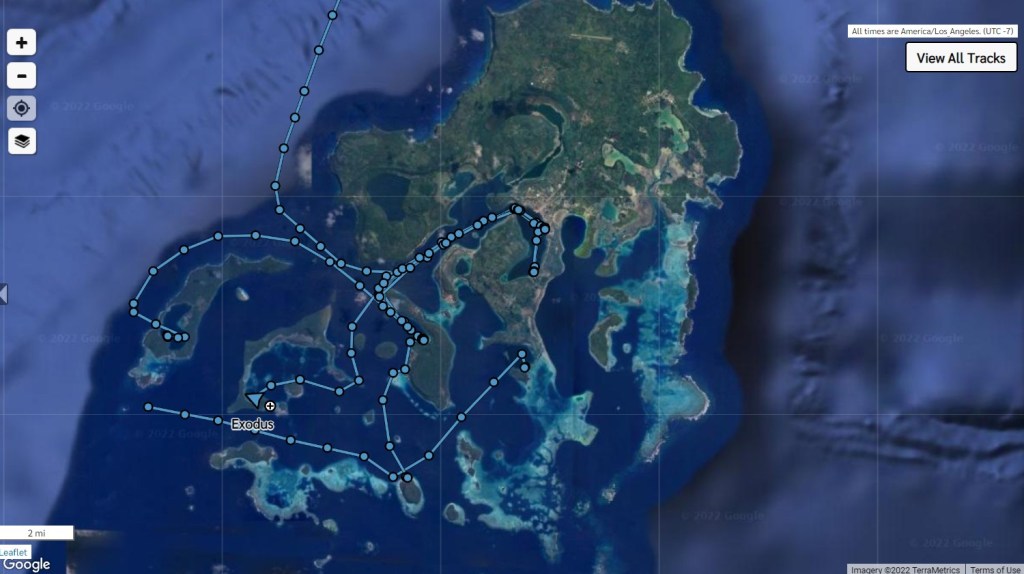
We had a glorious day sail from Kelefesia in the Ha’apai group down to the island group of Tongatapu, which is the southern-most island group in Tonga and also where the capital city of Nuku’alofa is located. We arrived at Big Mama’s Yacht Club on the small island of Pangaimotu on a Thursday, and our plan was to clear out of Tonga the following Thursday at the latest because our visas would expire on that Saturday. We met that goal of being ready to leave, but the weather smacked us down and reminded us that we will leave when mother nature says it’s time. We ended up staying 16 days at Big Mama’s, reanchoring twice: once to move in closer to get out of the wind so Tim could go up the mast and once after returning from the fuel dock. We finally left Tonga on Saturday, 15 November, with an entire fleet of southbound boats. After a two-day passage we spent three absolutely magical days at Minerva Reef before embarking on the dreaded passage to New Zealand. That passage turned out to be one of our easiest, and we pulled onto the quarantine dock in Opua just before midnight on Wednesday, 26 November.
From Tonga to New Zealand with a stop at North Minerva Reef
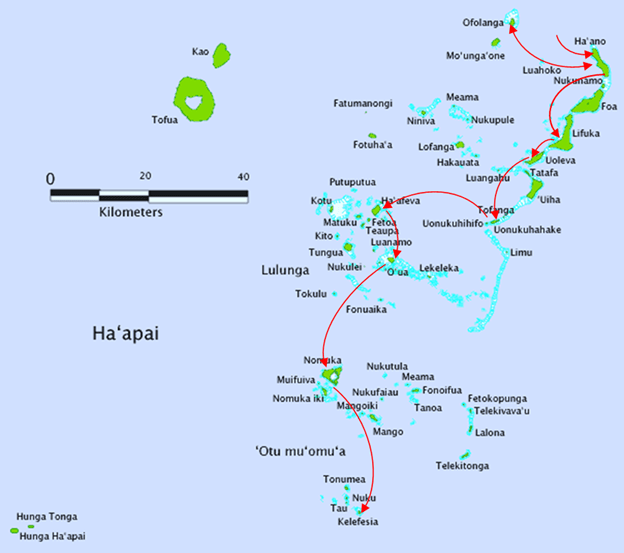
We departed Vava’u in the evening and had a slow overnight sail down to Ha’apai, arriving at the island of Ha’ano. The next day we took Exodus on a day trip out to the west to the island of Ofolanga for some snorkeling and spear fishing. We stayed at Ha’ano for a couple more peaceful days and then moved for one night down to the island of Lifuka and the capital city of Pangai to officially clear into the island group.
Quickly moving on, the next stop was the island of Uoleva where we enjoyed the beautiful white sand beach and running into old friends. We stayed at Uoleva overall for about a week and then moved down to anchor off the very small island Uonukuihito, which is part of a chain of small, long, skinny islands connected by sandspits. Here there were just too many flies, so we didn’t stay long.
We made the hop over to the top of the western islands and the island of Ha’afeva, but the wind was blowing hard from the south making this anchorage not too comfortable. So, after a drive by at Ha’afeva, we moved down to the nearby Matuku and had some fun with the village kids for a few days. When the wind shifted back to a more easterly direction, we moved to Ha’afeva where we visited the village, did some running, and had a couple of lazy rainy days.
Next stop was O’ua, where we stayed only 2 nights due to a rolly anchorage before moving on to Nomuka, which unfortunately also had a rolly anchorage, so we landed in a more sheltered spot on nearby nomukaiki for several days. Our last stop in Ha’apai was the best spot of all: Kelefesia. It’s a small anchorage with only marginal protection, but we were glad we made the effort to go there. We said good-bye to Ha’apai early in the morning on Thursday, 30 October bound for the Tongatapu and the capital city of all of Tonga, Nuku’alofa.
We spent a couple days preparing in Neiafu, and then Dad and Karen (Papa and Nana) arrived on Wednesday, 10 September, and the next day we went out to our spot on the island of Nuku for just one night. Then we made a quick day stop to Port Maurelle in order to snorkel at Swallows Cave before heading back out to our favorite spot out amongst the reef at Kenutu Island (anchorage #30) in order to catch up with Dafne and a couple other kid boats.
After a few days of hiking, kayaking, paddle boarding, and coconut shucking, we made a day stop at a tiny island to the south, Fonuafo’ou, and since the anchorage was quite rolly we went back to Port Maurelle for the night. The next day we went back into Neiafu for some internet, restaurant food, and land tourism. On Thursday 18 September, we went back out to Nuku, once again to catch up with the kid boats. We spent just one night at Nuku before moving around near anchorage #16 to grab a mooring at Lape Island in order to go their famous Tongan Feast. On the way we made another snorkel stop at a small island of Lua’ofa (just of the tip of Nuapapu). When we left Lape Island we went to ‘Ovalau Island (anchorage #40) where we caught up with Novae. Our last stop while Dad and Karen were still with us was back at the Hunga Lagoon, and on the way, we did one last day snorkel at the island of Ovaka.
We went back to Neiafu where we enjoyed a couple more restaurant dinners (including an early birthday dinner for Brenden) and then sadly said good-bye to Dad and Karon on 24 September. The next day was Brenden’s actual birthday, and he requested to go back to anchorage #11 in order to buy a painting from the Ark Gallery for his birthday present. Then we sailed back to Neiafu in order to organize our inter-island group clearing out and do some provisioning. After we cleared out, we enjoyed one last dinner at The Aquarium Cafe then motored at dusk back to Nuku. Before finally leaving the Vava’u island group we made two more overnight stops at small islands to the south: Lua’ui Island (anchorage #34) and Fonua’one’one (anchorage #36). We said our final good-bye to Vava’u on Thursday 2 October and departed for the Ha’apai island group.
We basically showed Papa and Nana the entire Vava’u Island Group. Neiafu –> Nuku –> Port Maurelle –> Kenutu (Anchorage #30) –> Fonuafo’ou –> Port Maurelle –> Neiafu –> Nuku –> Lua’ofa –> Lape Island –> Anchorage #40 –> Ovaka –> Hunga –> Neiafu (bye to Papa and Nana) –> Port Maurelle –> Anchorage #11 –> Neiafu –> Nuku –> Anchorage #34 –> Anchorage #36 –> bound for Ha’apai
After completing chores and fixing the port saildrive, we finally got out of Neiafu again and headed to anchorage #16 on 28 Aug. Anchorage #16 is at the island of Vaka’eitu near “the coral gardens” and Lape Island, and we went there with Lady Carolina and True Blue V. Who else? We stayed a couple of days and then moved to the island of Nuku, which is a small island just off the larger Kapa Island south of Port Maurelle. Technically, it’s anchorage #8, but we didn’t exactly drop where the guidebook says. This is a great spot; one of our favorites. On 1 September we were joined by some other kid boats, and we all navigated through the reef over to anchorage #30 at Kenutu Island. There we celebrated Joel’s 10th birthday with a big beach bash. After a couple days everyone left, but we stayed a little longer to enjoy some solitude. On 6 June we went back to Nuku island to hook back up with all the kid boats, but then the next day we went back to Neiafu to get ready for Papa and Nana to visit! Our adventures with them will have to wait until the next Chapter.
Neiafu –> Anchorage #16 –> Nuku Island –> Anchorage #30 (Kenutu) –> Nuku Island –> Neiafu
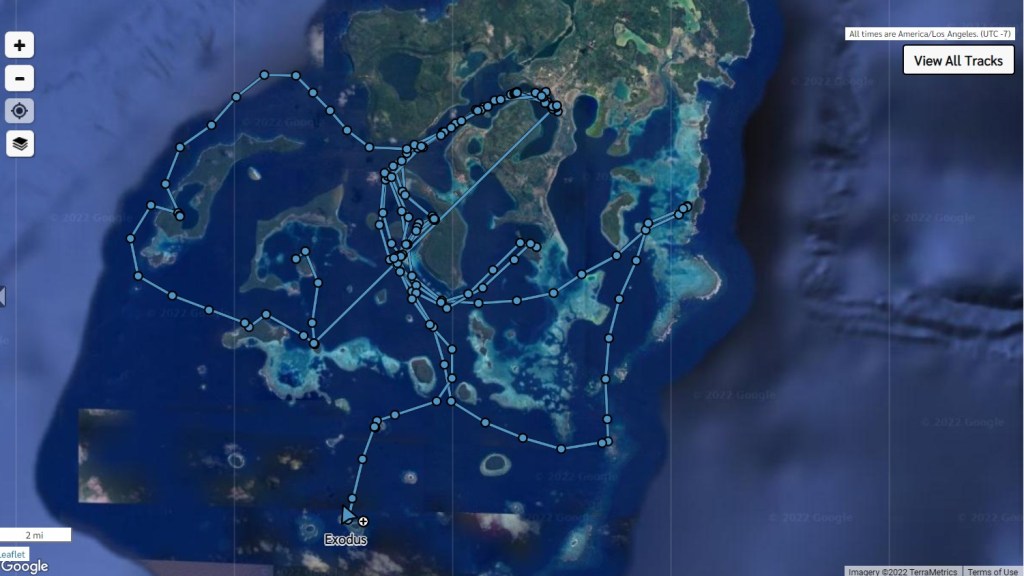
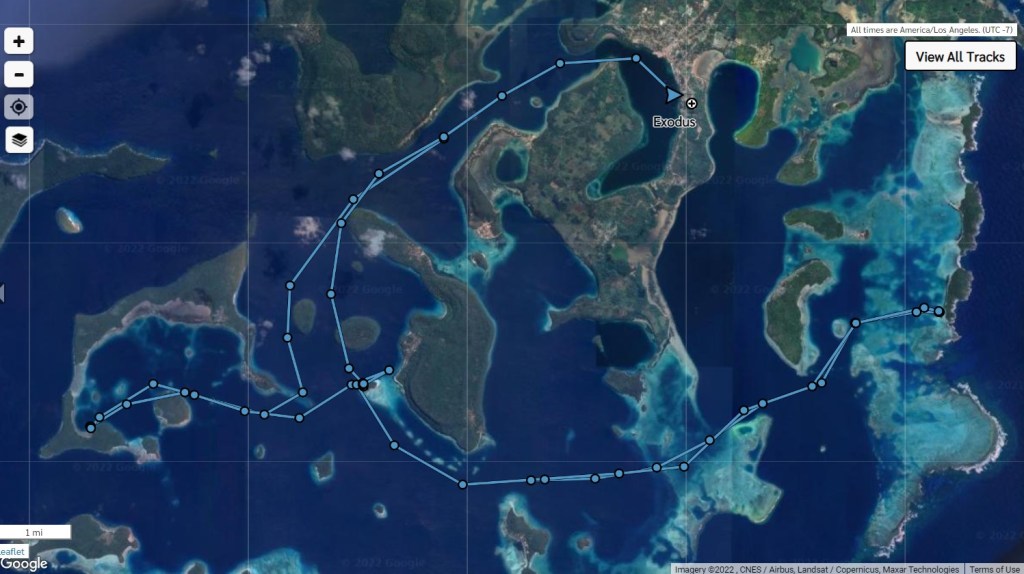
We left Pago Pago on the morning of 5 August and had a three-day passage to Vava’u, which is an island group in The Kingdom of Tonga, and a popular charter cruising destination. Overall, we spent a wonderful month and a half in Vava’u, and this essay will only cover the first half of that, because there is just so much to say. We cleared in at the port of Neiafu and stayed for about four days, until our friends from back home, Yi and Johnny, came for a visit. Once they arrived, we headed out the channel and around the corner to a popular anchorage called Port Maurelle (aka Fangakima, aka Anchorage #7) on Kapa Island. This was a good home base for some snorkeling and whale watching excursions and it also has access to a decent running trail around the island. After a couple days there we sailed to the outside of the island group to the lagoon formed by Hunga and Fofoa Islands. The entrance to the lagoon was very narrow, and once through we tried to anchor on the southeast side of the lagoon off of a nice beach, but we were unsuccessful in finding a spot with suitable depth, so we ended up anchoring on the southwest side of the lagoon off of Fofoa Island. On the north side of the lagoon is Hunga Village and a resort with moorings (where Anchorage #13 is located), but we didn’t venture up that way. Our next stop was more towards the western end of the island group to Tapana Island (aka Anchorage #11) for our first Tongan Feast. Then we went down to ‘Euakafa Island (aka Anchorage #32), where we hiked to the tomb of a Tongan Princess. By this time, Yi and Johnny’s visit was coming to a close, and we spent one last night at Port Maurelle before heading back to Neiafu for them to catch their flight. Before we got sucked into shopping and internet in Neiafu, we turned right around and headed back to Port Maurelle, and once again used it as a home base for some snorkeling excursions. Eventually, we needed to go back to Neiafu for provisioning, completing a couple boat projects, and going on a pub crawl. We took a timeout from “city life” and moved down to the south end of the channel at Anchorage #2, near the town of Toula. Finally, we were ready to head back out to the islands and we departed Neiafu for anchorage #16 and the coral gardens on 28 August.
The rest of our Vava’u adventures, including a visit from Papa and Nana, will be covered in the next essay or two.
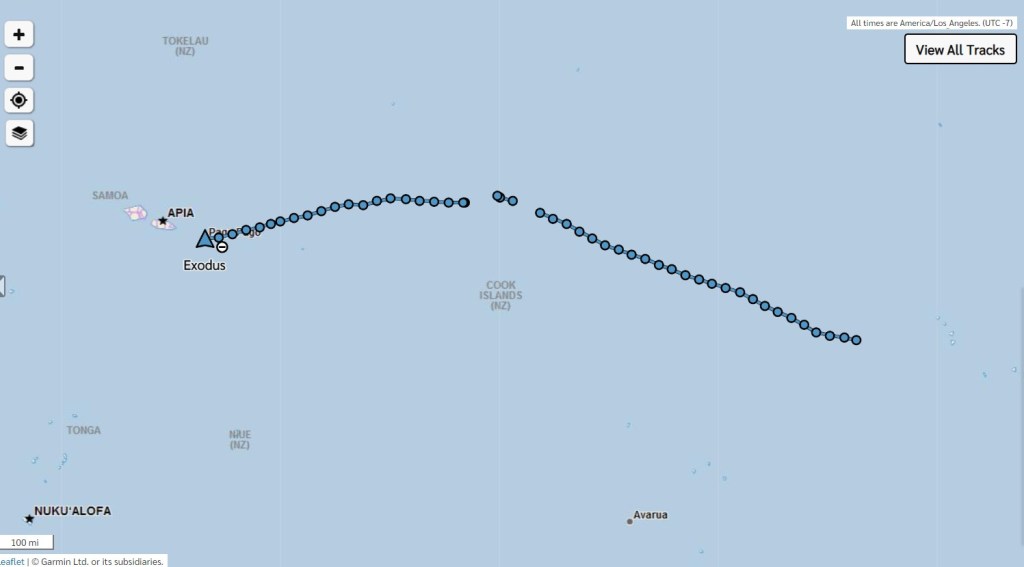
We had a long, uncomfortable, five-day passage from Mopelia (our last island in French Polynesia) to Suwarrow (our first and only island in The Cook Islands), arriving on Monday, 21 July. Suwarrow was a packed anchorage, and we spent five very social days there before heading to Pago Pago, American Samoa. In Pago Pago we had a lot going on, including massive reprovisioning, 40 kt winds, anchor dragging, and Alex’s 13th birthday. Admittedly, we were happy to leave Pago Pago bound for Tonga the morning of Tuesday, 5 August.
Mopelia, French Polynesia –> Suwarow, Cook Islands –> Pago Pago, American Samoa
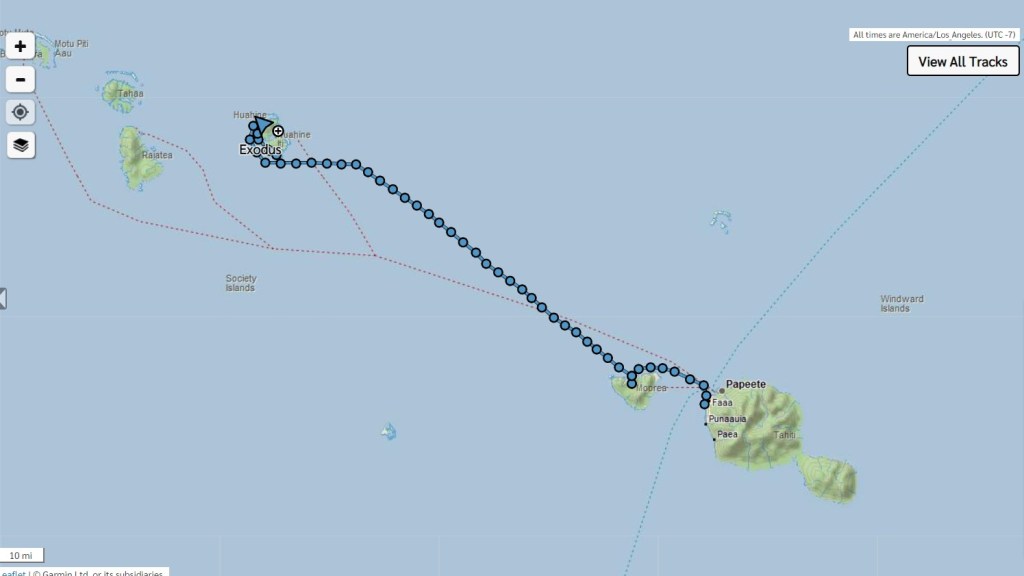
We had a two-night passage from Tahanea in the Tuamotus to Papeete, Tahiti. We spent five chore filled days in Papeete before Andrew arrived, and the next day we motored over to the island of Moorea and anchored with a crowd of boats just outside the mouth of Baie d’Opunohu for a few days. For a change of scenery, we moved inside the deep bay to a spot called Robinson cove and then for another change of scenery we moved back out to our previous spot.
We spent about a week total in Moorea before sailing overnight to Huahine. There are many options for anchoring at Huahine and we were regretting that our time on our visa was running out and we couldn’t hit them all. So, we first stopped just inside the pass at the town of Fare, which is a really nice small town with surprisingly good provisioning. After getting our happy hour and ice cream fix, we moved down inside the reef to the southernmost anchorage of Avea. It was an absolutely beautiful spot, and we stayed 3 days but could have stayed so much longer. But Bora Bora was calling us before our visas expired.
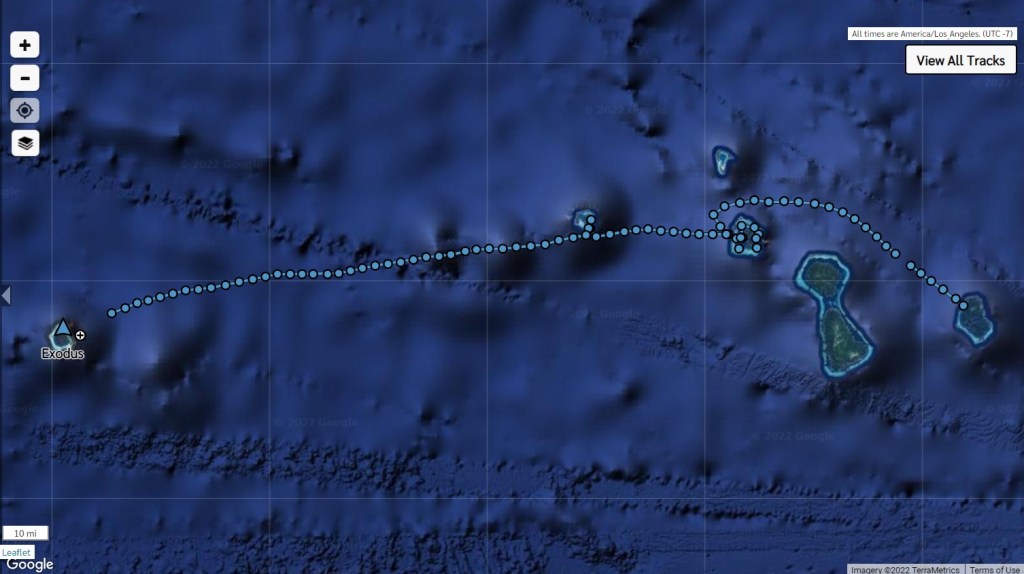
We left Anaho Bay on Nuku Hiva in the Marquesas late morning on 10 May, and we had an uncomfortable yet speedy 3-night passage down to Raroia (write-up to follow). We timed our arrival pretty well (totally lucky), and we made our way through the pass and across to the east side of the lagoon to a most spectacular anchorage. After a few nights, we moved just a bit south to yet another spectacular anchorage, but we stayed there only one night, since the weather was looking good for a pass dive, which meant moving over to west side of the lagoon near the town and the pass. We had a bit of trouble finding a suitable place to anchor, but we finally settled on the north side of the pass anchored on a bombie (a coral head) on a lee shore. Luckily, the wind cooperated and stayed under 20 kts, so we were comfortable staying there a couple nights before heading out the pass for an overnight passage to Makemo.
When we arrived in Makemo, we stern tied to the wharf at the village of Pouheva near the pass. We ended up staying there a full week, because we had so much fun with the people of the village. Afterwards, though, we spent two days at a more secluded anchorage a bit north of the village to decompress from all of our interaction. Finally, we moved near the northwest pass to do some pass diving, and once again we had a hard time finding a suitable place to anchor. It wasn’t the best anchoring situation, so we stayed only one night before leaving on a very slow overnighter to Tahanea.
We had to go intentionally slow, so we didn’t arrive to early, in fact, we were flying only a triple reefed genoa. We still arrived too early, so we waited for the sun to come up before entering the pass. Once inside, we decided that the sun wasn’t high enough to safely navigate the lagoon and all of its coral heads, so we anchored at a nice spot just inside the pass for a few hours. Later, we headed over to the southeast side of the atoll to a pleasant and protected anchorage where we hung out with a few new kid boats for a couple days. When the weather window looked right for the passage to Tahiti, we moved back to the anchorage near the pass for one night and the next morning we said good-by to The Tuamotus.
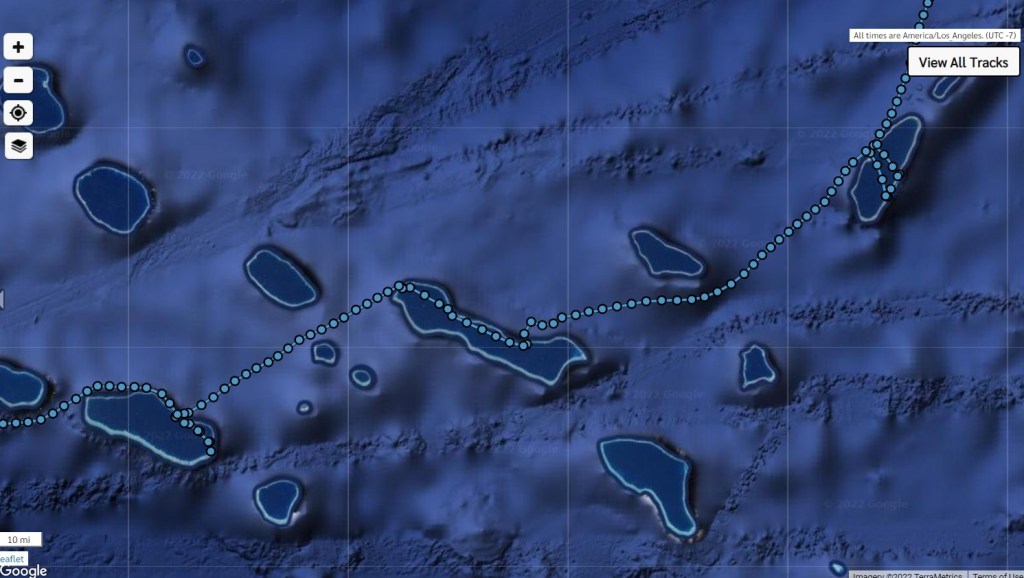
Our route through the Tuamotus – from right to left: Raroia, Makemo, Tahanea
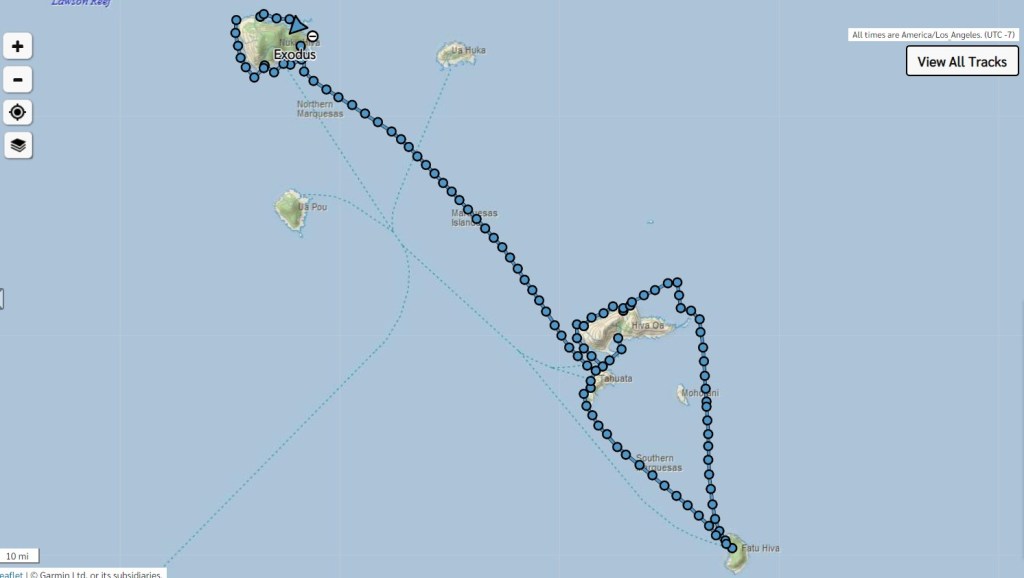
After 22+ days at sea we arrived in the town of Atuona, on the island of Hiva Oa, about mid-day on Wed, 2 April. We spent longer there than we thought we would, about a week, decompressing, welcoming our buddy boats, and seeing the island. And oh, my, the baguettes. But when the week was up, we were way more than ready to leave.
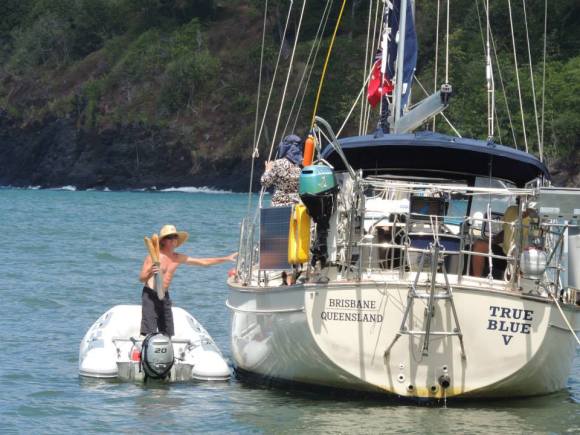
Tim delivering baguettes to True Blue V when they arrived
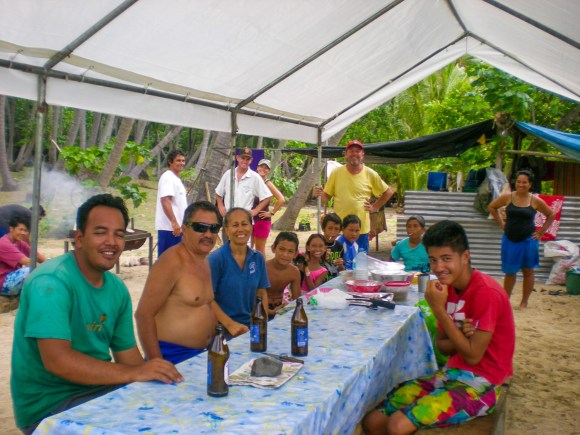
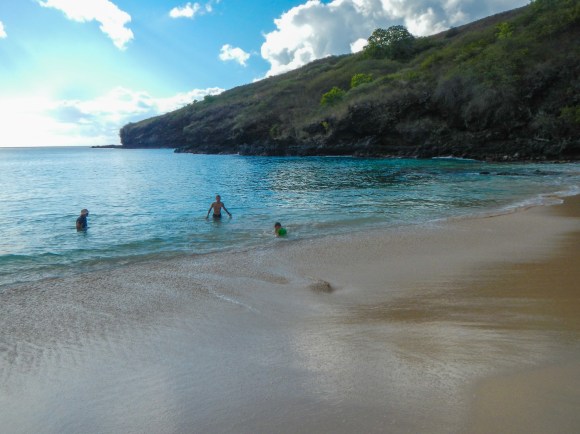
Our first stop after Atuona was a short sail across a channel to the northern end of the island of Tahuata to a “secret anchorage.” It was secret because Craig and Leann got the tip (and a waypoint) from a friend, and it isn’t described in the guidebook. It was a bit rolly, but we set a stern anchor to keep us pointed into the swell. Unlike most of Hiva Oa, there was a beautiful, white sand beach, and the boys were all very excited to be able to swim again. When Tim and Steve (Lady Carolina) went ashore they met an extended Marquesan family, and one of the women was a retired teacher, and she spoke very good English. We ended up having a huge potluck with them on shore the next day.
Potluck on Tahuata
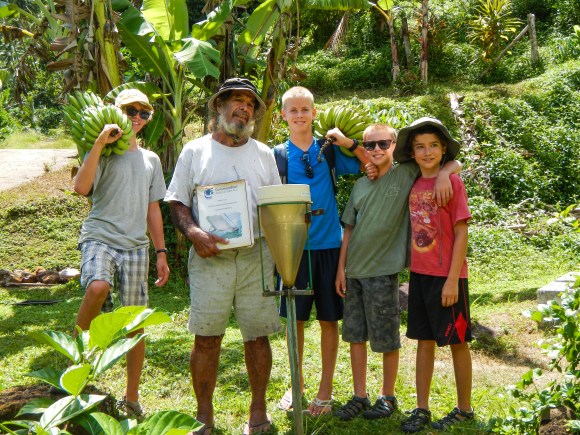
Our next stop was the northern side of Hiva Oa. We had great winds as we once again crossed the channel, but then the wind died and became gusty when we got in the shadow of Hiva Oa. Then, when we rounded the northwest corner, we got blasted with 20+ knots wind right on the nose. We were headed for Hanaiapa, which is about midway along the northern side of the island, but True Blue V was ahead of us, and they said the wind just keeps getting worse, so we all decided to abort and pull into Baie Hanamenu just around the northeast corner. This was a pleasant anchorage, but we stayed only one night, and I never even bothered to go ashore. Tim’s notes in in our logbook says “Fresh water spring with pool on shore. Beautiful and Cold!!” (Yes, occasionally he writes something, and he tends to use a lot of exclamation points.) The next morning, we left on the early side so we could motor the 6 miles east to Haniapa before the winds kicked up, and we skirted the uncharted coastal section hoping to catch a fish. No white sand beach here, like most of the Marquesas, and we stayed a couple days including a shore excursion to the village and a visit to the “yacht club” although there were no services at all in town. We had good holding in the anchorage, but the guidebook wasn’t lying when it said don’t proceed too far into the bay due to scattered coral heads.
With William at the Hanaiapa Yacht Club
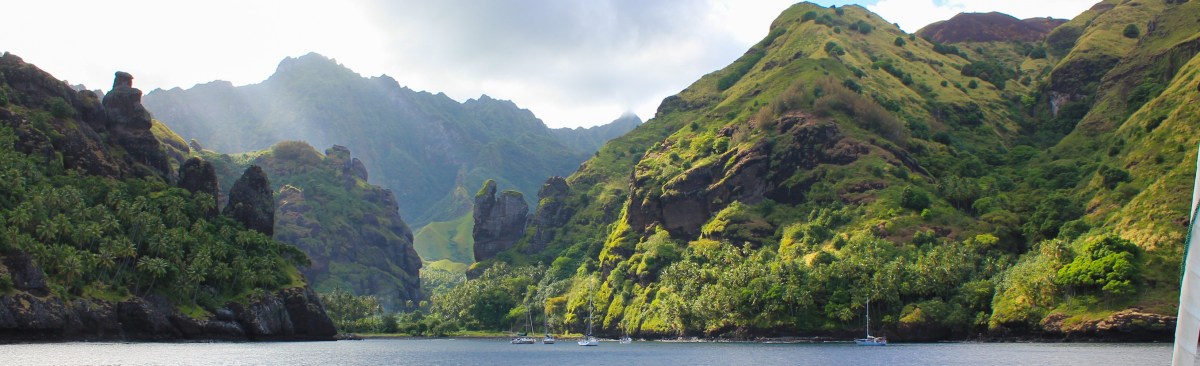
On 15 April (happy Tax Day) we were planning to leave Hiva Oa for an overnight passage down to Fatu Hiva, but we felt a little restless in the morning, so we moved around to the next bay, Hanatekuua, for the day. It had a beautiful beach, but we never left the boat, just prepped for the overnight passage. We left just before sundown, a little later than our buddy boats, and we knew it would be an upwind slog until we rounded the NW corner of Hiva Oa and headed south, so we just motor sailed while hugging the coast rather than attempt to sail north and tack. We still tacked a couple times (I learned the next morning, because all that action was on Tim’s watch), but we made it around pretty painlessly. Once headed south to Fatu Hiva we were still on a close haul, but we were able to make it there on one tack, which is good. It was a lumpy bumpy passage, and I was worried Fatu Hiva wouldn’t live up to all the hype, but when we approached the anchorage called Bay of Virgins, I was in awe. Absolutely stunning. People think the photos look like Jurassic Park. See below for all of our adventures in Fatu Hiva, including the much-hyped waterfall hike, but for now just know that we stayed 5 days, but we could have stayed much, much longer.
Fatu Hiva Arrival
We made an early morning departure and had a nice day sail back down to the island of Tahuata, this time working our way up the west side. We started at Hapatoni, where we got hammered by a squall right as we were arriving to anchor. This is a two lobed bay, and since we were anchored in the northern lobe, we were technically in Baie Hanatefau not Hapatoni. We had a group shore excursion with Lady Carolina, True Blue V, and Chara, and we didn’t find the guidebook quite accurate when it said this village has the friendliest people in the Marquesas. Not that they were unfriendly or anything, but they certainly didn’t stand out. Paddle boarding around the two bays was nice, and I also had my first and only snorkel in the Marquesas here. And again, contrary to what the guidebook said, it was NOT good snorkeling. We certainly weren’t in the Sea of Cortez anymore. Visibility was horrible, and there weren’t that many fish.
The next morning, we left a day ahead of our buddy boats and motored up the west side of Tahuata and did a drive by of the village of Vaitah, which has a nice, big anchorage where there were lots of boats. It’s supposedly a nice village, but it just didn’t draw us in, so we kept going north up to Hanamoenoa. This was a phenomenal anchorage with a beautiful white sand beach. We had a nice afternoon playing on the beach and a nice evening on board with just our family. I would say this was the perfect anchorage, except for two things. We didn’t think the holding in the anchorage was that great since it took us a few back downs to get the anchor to dig in, and, oh yeah, Alex got stung by a jellyfish, so that put a bit of a damper on things.
Playing on the white sand beach at Hanamoenoa
On 24 April we said good-bye to the southern Marquesas and headed for Nuku Hiva. We made the difficult decision of skipping Ua Huka, and we were going to leave Ua Pou as a game time decision, depending on how many anchorages we decided to go to on Nuku Hiva. Our first stop was Controller Bay in the SE corner of the island. It is a very large, deep bay with several lobes and different anchoring options. We were the first of our group to arrive, and we chose the main lobe off the village of Taipivai. Herman Mellville fans will note that this is the setting of his book Typee (which I keep trying to read but keep putting down in favor of some other tasty morsel.) It is a HUGE bay, and there was only one other boat when we arrived. We explored the town, hiked to another waterfall, and caught up with our old friends from Sara M and True Companion. Then we motor sailed just a bit west to the main bay, Baie de Taiohae, which also happens to be the administrative capital of The Marquesas. We spent 5 days in the very crowded anchorage getting all of our chores done and getting our wifi fix on before motor sailing just a few more miles west to Daniel’s Bay.
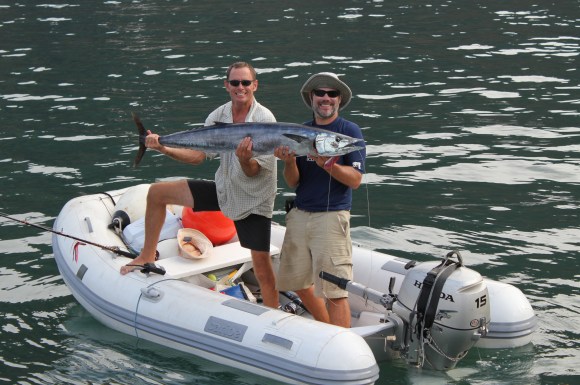
The official name of the bay is Baie de Taioa, but it is called Daniel’s Bay after a Marquesan man called Daniel who used to live there and was very friendly to cruisers. The story we heard of why he doesn’t live there anymore is that the TV series Survivor paid him to relocate, and they tore his house down and used the area as the setting for “Survivor Marquesas.” We heard that at one of the seminars back in Mexico, and I have no idea if it’s true. There was a small settlement on the shore and what seemed to be a bit of construction, so maybe he’s moving back? The highlight of our stay here had to be “Wahoo! Tuna!” when Tim and Steve came back from dinghy fishing. (If you haven’t seen the video yet, check it out, it’s hilarious.) Daniel’s bay was nice and sheltered and was one of the least rolly anchorages we had been in. Not to be missed there was a fantastic hike to yet another beautiful waterfall. Our friend Alan from s/v Sara M went with us, and that was lucky since he had been before and knew the way. Although he did throw Joel in the water at one of the river crossings. Or maybe it was Joel who threw Alan in the water. Or maybe Alan was just trying to help Joel and they both went down. Anyway, no one was hurt, but they were both a little wet. The waterfall was amazing, and I say that even though I never even saw it. The fall was embedded back within a vertical crevasse, and there was a large pool at the base. All the guys jumped in the water and were able to swim under some boulders to get to the pool at the base of the crevasse, and therefore, the base of the waterfall. They had a lot of fun. I just sat along the edge of the outside pool with my feet in the water not letting the crayfish nibble at my toes.
Wahoo!
When we left Daniel’s bay, we were headed up around to the north side of the island over to the NW corner to Baie de Anaho. But once again we had an aborted passage trying to go upwind on the north side of an island because we got slammed with 20+ knots of wind. We had heard that this island was easier to navigate around than Hiva Oa. We heard that the wind funnels through the valleys and if you stay close to shore on the north side, you’ll get a nice beam reach on your starboard side. WRONG. When we realized we wouldn’t make it all the way to Anaho, we pushed forward another couple miles to Hakaheu, but Lady Carolina turned around and went to Haahopu, which was actually on the west side of the island. Hakaheu was a nice bay, and we were the only boat there. It’s not discussed much in the guidebook, and it’s listed on our charts as uncharted, but it was a great place to duck into. We had planned to stay just the one night and then press on to Anaho, but Tim went to shore and met a father and son who live there named Albert and Germain. The boys and I joined them ashore, and they showed us all around their property where they have many animals and fruit trees. They were very nice, and their English was only slightly better than our French, so communication was challenging, but we all were pretty motivated and just tried our best. We had a nice time and Brenden especially like the baby goat that followed him all around. They loaded us up with Pamplemousse and invited us for a meal with them the next afternoon. There’s no way we would miss that, so we would stay an extra day. Lady Carolina joined us the next day for the meal on shore and since Albert was doing the cooking, Tim and I showed them around the property. They had a ton of dogs and Albert explained that they are for hunting pigs, which got Steve’s attention, and he asked if he and Tim could go hunting with him. They made a plan to go the next morning, so we would stay yet another night. They all got up very early but came back with backpacks full of fresh fruit but no pig meat. No worries, our freezer was full anyway.
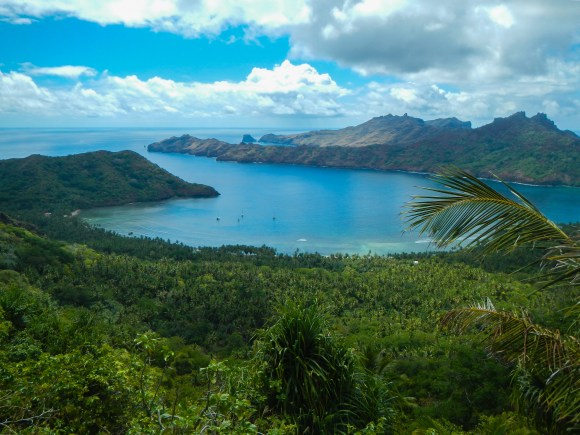
We were pushing our stay in the Marquesas a bit long, but we still had one more bay to visit, Anaho, which the author of one of the guidebooks I used said was his favorite spot in all of the Marquesas. I could immediately see why, it’s one of the loveliest anchorages we had been in, well worth the bash to get here. Unfortunately, it rained quite a bit while we were there, so we didn’t quite get to fully enjoy it. On the 6 or so mile trip to get here from Hakaehu Lady Carolina landed a huge wahoo. We were on the radio with them, and Steve was telling us to go ahead and pull in our lines since we are set for fish for a while and then… whrrrrr…. fish on. Tim also wrestled aboard a 5.5 ft wahoo. So, then we were REALLY set for fish. We traded some with some locals for bananas, traded some to another boat for some dorado, and gave some away to another boat we’d seen several times previously at other anchorage. We had a HUGE wahoo dinner on Lady Carolina and another HUGE one on Exodus. Tim, Steve, Carolina, and I went on a hike (sans kids) up over a ridge to the next bay where there is a town and we heard you can get baguettes there. It was a long hike, and I enjoyed it because it gave me that same feeling I get from running (getting the heart rate a little bit up and then just pushing along). We scored some baguettes, but they were frozen and since it was such a small town, we tempered our desire to buy 8 each and cut it down to 4 each.
A view of the anchorage at Anaho
Tim, Steve, Carolina, and I also hiked over to an organic farm and picked our own green beans, lettuce, radishes, and eggplant, and we also got some tomatoes and peppers that were already picked. The owners of the farm were very friendly and gave us fresh coconuts to drink the water out of. They also let us try some of the various melons they had. The part of the hike back that was along a trail just off the beach was amazing and I regret I didn’t have my camera with me. White sand, blue water contrasted with dramatic black volcanic boulders. No, it wasn’t a quick trip to the store for veggies, but it was a journey worth taking. While we were at the farm the boys all hiked up to the top of the ridge the other direction towards the town in the next bay to collect mangoes. Would you believe they came back with 96 nice green mangoes? Our plan was to give or trade them to people in The Tuamotus, since we had heard they have far less access to fresh fruit than they do in The Marquesas.
Sadly, on Sat, 10 May, we said good-bye to the Marquesas and headed south to The Tuamotus.

 Gresham Family Exodus