Categories
Narrative

Formalities Fiasco

Rotuma was supposedly an official port of entry for Fiji, so we were intending to clear out of Fiji from there. The government facilities are not near the Oinafa harbor, rather they are on the other side of the island at the village of Ahau. We were planning to just walk there (or hitch a ride) when we were ready to clear out. However, one day while on shore near Oinafa we were visited by some officials, and we made arrangements for them to come to the boat a few days later to clear us out. That seemed easy enough.

But then the drama began. True Blue V emailed us from Savusavu and told us that the customs office in there was now saying that Rotuma is not an official port and that the customs official had been recalled, however, immigration was still operating on the island. We decided to take no action, because the officials we had talked to on shore had said nothing about there being any issues clearing out, and we didn’t want to start asking questions only to be told that we had to go back to Savusavu to clear out.

So, the day we cleared out and the officials came to the boat we noticed that Immigration and Bio-Security were represented but no Customs. They were pleasant, told us to be sure to tell other cruisers that Rotuma is an official port so more people come there, gave us some clearance paperwork, and stamped our passports. I noticed that the paperwork they gave us was only immigration. So, I asked if this was all we needed for our next port and they said yes. So, I decided to get more specific and asked if there was anything we needed from customs in order to clear out, and they all said no. In the end we clearly departed Fiji without completing all of the official outbound clearance requirements. Luckily, we didn’t have any trouble clearing into Tuvalu, but that’s only because the customs official in Funafuti wasn’t too much of a stickler. Of course, we don’t know if this will impact us if we ever want to clear back into Fiji.
Categories
Narrative

“Walk” to the “Market”

The day we were planning to clear out we decided to venture into the main town to check out the Friday vegetable market on the other side of the island. Tim and I set out quite early, walking along the road, hopeful that someone would stop and offer us a lift. The people that we passed along the way were all very nice, and they all wanted to give us stuff. I had a bag full of kasava and papaya before we ever got anywhere near the market

However, after walking for about 30-40 minutes, we were still hoping for that ride. Then we came across a couple with a teenage son waiting by the side of the road. They were Bula and Betty and their teenage grandson. Bula and Betty were dressed up to go to some traditional celebration, and I think their grandson was just hanging out with them. They were waiting for the transport truck to come by to give them a ride and they invited us to get a ride with them; they were certain we could get a lift to the town. We quickly accepted that offer, so we stayed with them chatting for awhile. And then a little while longer. And then longer still. They didn’t seem concerned or irritated at how long it was taking for the transport to come, so I tried not to be either. Finally, it arrived, but it was going the opposite direction, back the way we came. They motioned us in anyway assuring that we’d have a way to get to the main village with the market. So, we piled in.

The transport was a big pickup truck with a covered bed, and there were already 15 or so people in the back, mostly women, and all dressed up for the occasion. I sat next to a woman who was clearly part of the upper class, judging by her manicured nails, her shoes, and her jewelry. She was talkative, and her English was excellent, so she was obviously well educated as well. Soon she was telling me that “I needed to tell my husband to come down from there. Doesn’t he know the condition of these roads?!” I realized that Tim was standing up at the open back end of the truck almost leaning out the back while holding on to a rail at the top. Clearly, he was trying to have a good look around as we drove along. At first I just smiled and ignored her, trying to pass her comment off as a joke. But she kept after me, and so finally I told her there’s no way he would listen to me even if I did say something. She was clearly a little disappointed in my unwillingness or inability to control my husband.

When we arrived at the location of the party, Bula helped us arrange another ride to the town, which was now about as far away as you can get from somewhere on this island. We took the north way around, so in the end we got to see the entire island in all its beauty. When we got to the village we went straight to the biosecurity office, because it was getting somewhat late and we didn’t want to miss them if they went to the wharf to clear us out. It turned out they were just getting ready to leave, so we hopped in their car with them and got a ride back to the wharf.

We never did make it to the market.

Categories
Narrative

Kava Party

A woman stood on the wharf and called to us to get our attention and gestured for us to come to shore. So, we dinghied over and met Rakiti, a friendly, talkative woman, and she invited us to come to shore that evening for some music and some kava. It turns out that although they don’t do the sevusevu ceremony in Rotuma, they do like to drink the kava. It turns out that Rakiti was actually a Tuvaluan from the island of Rabi. She used to do dancing at one of the resorts on Viti Levu in Fiji. Her husband is from Rotuma, and they were enticed back there by an offer for her husband to be the music teacher at the local high school. So, her husband Jonathon is a music teacher, and a pretty good guitar player, so he entertained us with his playing while we passed the kava cup around.

Categories
Narrative

Navire and Kailopa

OK, I need to start with a little bit of background on this one. There is an SSB radio net called Gulf Harbor Radio run out of Auckland New Zealand by some former cruisers, and since the husband is a meteorologist and gives the best weather forecast information out there, most of us in the South Pacific, especially when going to/from New Zealand, tune into their net religiously. While still in Fiji, I e-mailed David, the meteorologist, and told him that we’d be heading north for cyclone season this year and asked him which weather products he thinks would be the best to monitor for crossing the convergence zones. He must get tons of emails, but he responded promptly, and the rest of the story about my dialog with David isn’t really relevant here, but I will mention that he put me on to monitoring the “streamline” weather fax, an excellent visual which clearly shows convergence zones along with all other major weather phenomena.

Anyway, during our passage to Rotuma, as I was brooding about being alone without any buddy boats, I received an email from a boat called Navire. They are Janet and David from New Zealand, and they got our contact information from, you guessed it, Gulf Harbor Radio. They were already in Rotuma, and would also be heading up through Tuvalu and Kiribati up to the Marshalls, and they were looking forward to our arrival. So, halfway through our first passage alone, we instantly had a buddy boat again.

But that’s not really all I want to say about Navire. I need to introduce Kailopa, and that requires even more background information. Rabi isn’t the only island in Fiji with transplanted Polynesians. There is another island in Fiji just to the south of Rabi called Kioa, and on Kioa is a community of people who migrated from the island of Vaitupu, which is north of Funafuti in Tuvalu. Their story is a far less tragic than that of the Banabans, in that their relocation was totally voluntary, and a little farsighted, in my opinion. Back in 1947 they purchased the island Kioa as an alternate homeland, due to weak soil and overcrowding on Vaiutup. They used money they earned during WWII from the US military who occupied their island. Kioa was initially settled by 37 people, and later a couple hundred more followed. On both Rabi and Kioa, there are now third generation inhabitants who consider these islands their home, where they are from, and in 2005 they all became full Fijian citizens.

So, while Navire was in Fiji they visited the island of Kioa, and they struck up a friendship with a man named Kailopa. To make a long story short, they ended up bringing Kailopa along with them, giving him a ride from Kioa to Funafuti, Tuvalu, so he could visit with friends and family he hasn’t seen for a long time, including his teenage grandson, Joseph. So, Kailopa became their crew for the journey from Kioa to Rotuma and then from Rotuma to Funafuti. We had the opportunity to meet him and spend time with him in Rotuma, and he was easy going and nice to be around, and he would spend much of his free time fishing off the back of Navire. But it doesn’t matter how easy someone is to be around, once you are together in a small space like a boat 24/7, easy can easily become not so easy. Many of us struggle with sharing this small space with the family members that we love. So, it takes special people to do what David and Janet did for Kailopa, and it takes a special person to do what Kailopa did to go with them in order to see his family again.

Categories
Narrative

Snorkeling the Wreck (or Not)

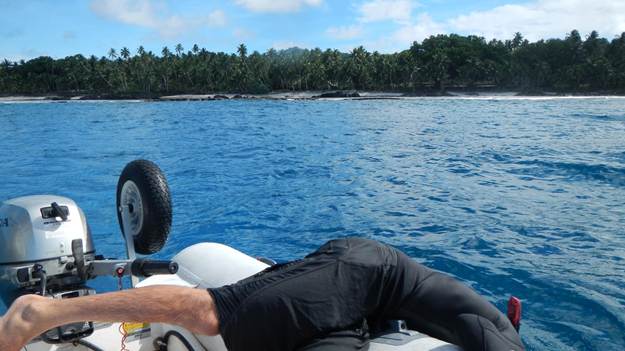
Tim had gotten some previous intelligence that there were some wrecks near the anchorage that were shallow enough to snorkel on. He had gotten confirmation from some locals, but he still didn’t have precise GPS coordinates to go find them. He studied the satellite imagery and had identified a couple spots he thought might be one of the wrecks, so I was game to go out with him for an afternoon excursion. We dinghied here and there, and Tim tried so hard to find the wreck, putting a mask on and sticking his head in the water having a look at the various places we stopped. We never did find any wrecks, all ship shaped dark blobs on the satellite image turned out to be just coral. But I appreciated his effort, and we ended up having a pretty nice afternoon together.

No shipwrecks here!

Categories
Narrative

Spearfishing Woes

The boat Menkar had a father/adult son crew from France, and it turned out that the son, Sylvan, really liked to spearfish too. So, one day Tim, Sylvan, and Brenden went out hunting. I don’t remember what Tim and Brenden came back with, but Sylvan shot a snapper, and everything we had heard was that Rotuma has ciguatera, so in that case, snappers are not really the fish you want to eat. He ate it anyway, and sure enough ended up with ciguatera. Apparently, he had just recovered recently from a previous bout with it, so he already had quite a lot of toxins built up in his system, so there’s no telling if this fish itself was severe or not. But Sylvan ended up with a pretty severe case and was in and out of the hospital there in Rotuma and their departure to Tuvalu had to be delayed.

Also, when they came back from spearfishing the dinghy had a leak, and Tim was totally blaming Sylvan (privately, of course), and I believe Menkar loaned us some of the adhesive needed to apply a patch to the dinghy. Later, Tim figured out that it was his own spear tip on his own gun that had caused the offending abrasion, and even though he hadn’t blamed Sylvan directly, he did go over and let Sylvan know how it happened after all.

Categories
Narrative

The Supply Ship Party

The nearest town to the wharf is called Oinafa, and on our first day we went ashore to pay our respects to the chief. There’s no sevusevu ceremony practiced here, but we thought it would be good form to go introduce ourselves and all. We quickly learned from the people in the village that this wasn’t necessary at all. We are free to explore the island and come to the village whenever we want.

So, when the supply ship, that only comes once a month, arrived and was docked at the wharf, we figured we should go check it out. There were so many people gathered around that we thought it would be a great opportunity to meet some people. Everyone was very nice and friendly, and we found out that it’s not just a supply ship but also a passenger ship taking people to/from Suva. There were tons of kids on board, because there was a sporting tournament they were going to participate in. We were approached by many people curious of where we are from and how we like Rotuma so far, but later, as I reflected on all those we had spoken to and most were in some official capacity like police officer, marine safety person, self-designated yachtie chaperone, etc. So, I have to say my favorite person from that day was Freddy. Freddy is just an old guy who lives in the village who wanted to come and welcome us and find out about our story. He’s never left Fiji, and when Tim asked him if there was phone service on the island, I’m pretty sure he had no idea what he was talking about. Freddy seemed particularly interested in the boys, and later I had to chastise them because they didn’t engage at all. They were grouchy at us for making them go ashore, and they couldn’t see past that and give Freddy the interaction he so obviously wanted. We were there talking to people for some time, so the boys went to run along the beach, an absolutely beautiful beach by the way. They came back to let us know the storm was coming, and by the looks of the sky they were right, so we ran to the dinghy, but it was too late, we got caught in the downpour on the way back anyway. So, already wet, we decided to take advantage of the torrential rain and have showers. Well, three of us anyway, the fourth spent the time setting up rain catchers so then our tanks and jerry cans were full.

Supply ship party in Rotuma
Categories
Narrative

Rotuma Narrative

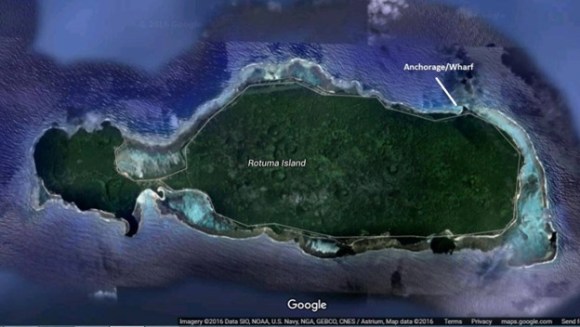
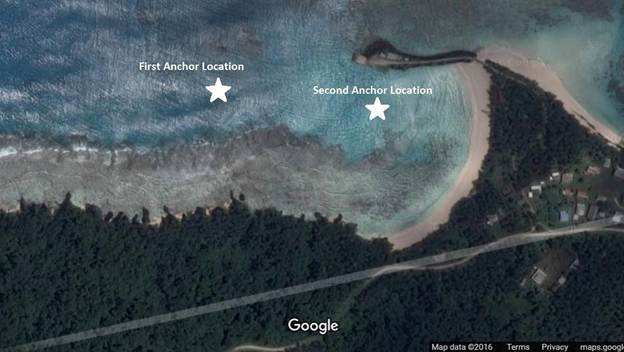
Rotuma is an isolated island located about 250 nmi north of the rest of the islands of Fiji. Although it is administratively part of Fiji, culturally it is like a different country, and the Rotumans are Polynesian rather than Melanesian. Rotuma is a young enough volcanic island to not yet have a fringing reef and lagoon, so the anchoring situation can be somewhat precarious depending on the weather. The main anchoring location is near the main wharf on the northeast side of the island. There is a little bit of a lip of land that can just protect you enough from the prevailing trade wind direction. Anything from the north and forget about it.

The Island of Rotuma

When we arrived (with very little light), there was one boat anchored outside of the main wharf area (s/v Navire), and one boat anchored inside the wharf area almost on the beach (s/v Menkar). We ventured inside and were promptly visited by a couple guys in a dinghy warning us that the groundswell from the north was causing breaking waves on the beach in the little harbor and it wasn’t that safe to be anchored in there. What about the boat already there? It turns out they have a retractable keel and they were able to tuck way up into the shallows behind the wharf, which was an area less affected by the swell. With not much daylight to work with we decided to just go anchor out and reassess in the morning. It was a bit rolly out there, but certainly not as rolly as being on passage, so we still all got a good night sleep. After two days the swell had subsided and we safely moved Exodus inside the little harbor.

Exodus anchor locations at Rotuma

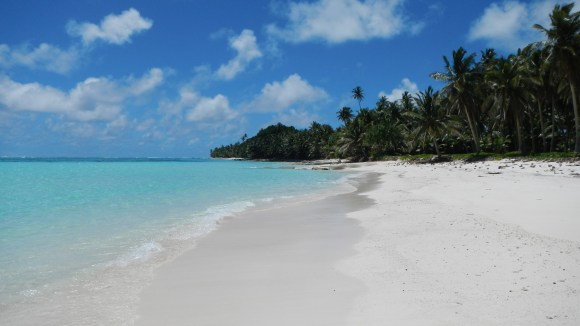
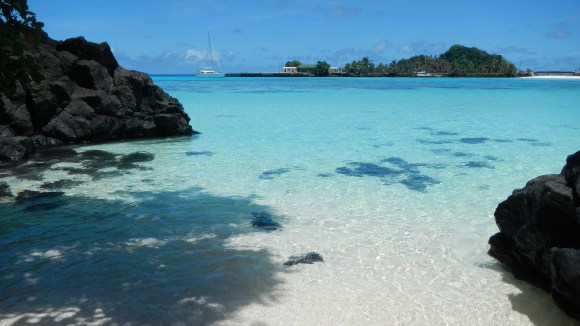
Rotuma has got to be one of the nicest places that we’ve visited. The geography reminded me a lot of Hawaii, with dramatic black volcanic rock and fine white sand beaches. Seriously, the beauty of this island cannot be overstated. The people here are consciously and actively resisting development and tourism. This place could easily have resorts all over it, but they don’t want it that way, and you just have to respect that. We were absolutely loving the warmer water too! It was a perfect 85 deg F, and I went swimming almost every day.

A beautiful beach in Rotuma
Categories
Narrative

Rabi to Rotuma

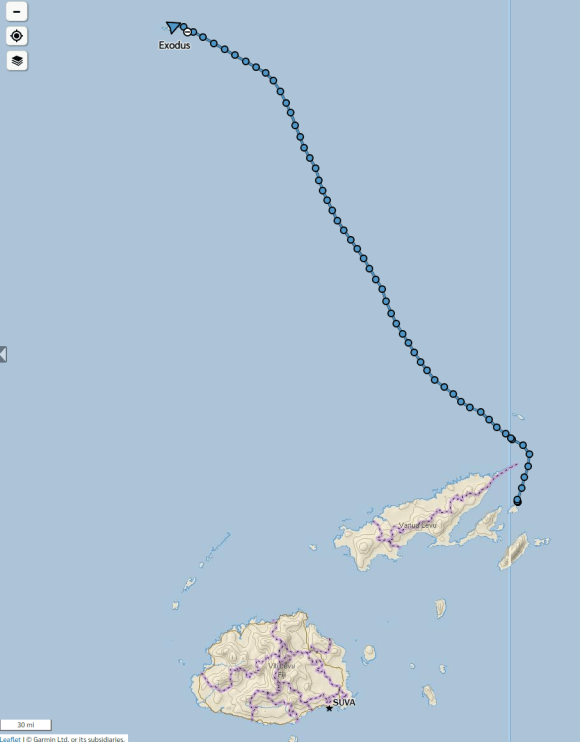
After our Rabi departure, the wind helped us out a bit by shifting to the SE making it easier for us to get up and around the NE corner of Vanua Levu. After that, the wind settled into a more ESE direction and it was dead downwind sailing the rest of the way. Exodus and crew love this point of sail. It’s not our fastest, but it’s by far our most comfortable.

It was sort of strange because this was our first offshore passage on which we were alone since our very first passage down from San Diego to Cabo San Lucas. We had grown so accustomed to having buddy boats around that we were feeling a little alone and isolated. The mahi mahi livened everyone’s spirits, though. Well, except for mine, because we caught it on the reel rather than the handline, and I really hate having to slow the boat down under sail. So, Tim and I got into our usual “playful banter” that goes something like, “Slow Down, you’re killing me!” “I’m doing my best, I don’t know why you use the reels anyway!” “Well, I’m so sorry that catching fish annoys you so much!” Yeah, yeah, playful banter. Good times. After the mahi there was a fishing ban in effect for all fish except yellow fin tuna. And we didn’t use the reel.

The morning of our second day on passage, I realized that we didn’t stand a chance of making it to Rotuma before dark, and this sort of realization can be quite dejecting. Even if a passage is mostly comfortable, it’s always better to be snug in an anchorage as the sun goes down. However, after Tim got up the wind really picked up and we were flying along. But it was still quite frustrating, because even at this windspeed we wouldn’t make before dark. Unless… we fly the spinnaker! Our spinnaker is not a light wind sail as some are. In fact, it won’t even stay full in less than 10 kts of wind. However, the last time we flew it in 20 kts of wind, as were the current conditions, Tim ended up with a broken toe during the dousing process. But desperate times call for desperate measures, so out came the chute! The worst part of the whole operation was turning into the wind (and 2-3 m swells) in order to drop the main. We even eventually got the spinnaker down without any drama. And thanks to the spinnaker, we were having safe arrival drinks in the cockpit as darkness arrived.

However, we barely made it in time. We were pulling into the anchorage with only the lighting of dusk to see by. There isn’t a fringing reef or pass to worry about, but there is a little bit of reef that sticks out here or there as well as some scattered bombies, so there is no way we would have been able to approach the island at that late hour without satellite imagery to navigate by.

Rabi to Rotuma
Categories
Narrative

Somosomo Narrative

When we finally had a good wind angle, we made an early morning departure for a day sail up to Somosomo, Taveuni. It was a fast sail, close hauled with 20 kts of wind, and I have to admit that after a late-night drinking rum with Breeze I was just a tad bit hung over for this passage. Finally, we got in the lee of Taveuni, and the wind totally died, so we motor-limped up through Somosomo straight (between Taveuni and Vanua Levu) and anchored off the town of Somosomo.

As we approached, we got a VHF call from Fluenta, and they were anchored just a little ways north, and we arranged to meet up in the morning to hit the veggie market and say one last good-bye. Immediately after that call, we got a call from a boat called Ariel IV. They are a Swedish couple who cruised before with their kids when they were young and are now doing it again just the two of them. We had heard about them from both Breeze and Field trip, because they were also planning to go up to Marshall Islands. It was great to make contact and exchange email addresses so we could hopefully meet up somewhere on the way north. (Spoiler alert: it turns out to be a very good thing we had “Dr. Eric” in our Northbound Fleet.)

We spent the evening getting our last internet fix for a while, and then in the morning we went ashore to see Fluenta. Liz and I rode with Max’s parents down to the next town to the south, I think it was Waiyevo, to buy some fresh fruit and veg. It was no Savusavu market, but it did the trick.

The vegetable stalls near Somosomo

In the meantime, the kids hit the MH grocery store and shared one last tub of ice cream together, for old time’s sake. I found myself focusing on the little bit of provisioning I wanted to do instead of on my last bit of time with Liz, but fortunately email reaches us wherever we are, and we’ve been able to stay in close contact as they headed south back to New Zealand, and we headed north to sweat our butts off.

Finally, we had to say good-bye to Fluenta. And a sad good-bye it was, indeed. It was especially sad to think that little Benjamin likely wouldn’t remember us. The boys had grown quite fond of him, and I think the feeling was mutual. Benny, as the kids call him, loved to come to Exodus and play with “Aggie” and “Bummie.” As he was just beginning to talk, these were his personal versions of “Alex” and “Brenden.” He had an extra special name for Tim which originated from our time in Suva together. One night at a yacht club happy hour Tim took Benjamin around looking at the geckos on the walls and ceilings, so of course Benjamin knew Tim only as “Gecko.” (He never did say my name while we were together, but Liz assured me that we separated he would often randomly list off our family members, and sooner or later my name was included too.)

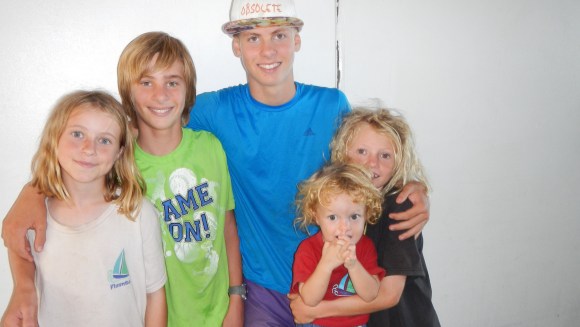
Close as cousins, this group. Victoria, Brenden, Alex, Benjamin, and Jonathan