While at Koro Island we noticed the temperature starting to rise. It became obvious that summer was just around the corner. For example, I could only do yoga in the very early morning and eggs and veggies not kept in the fridge started to spoil much faster. Although at that point it wasn’t “summer in Mexico” or “Marquesas” hot yet, we knew it wouldn’t be long, and it really started to drive home the reality that we were going towards the equator this year. Are we really prepared for the sweaty, sleepless nights again? (Spoiler alert: ready or not, those nights are coming!)
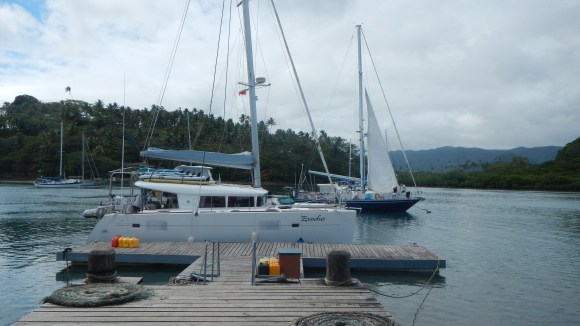
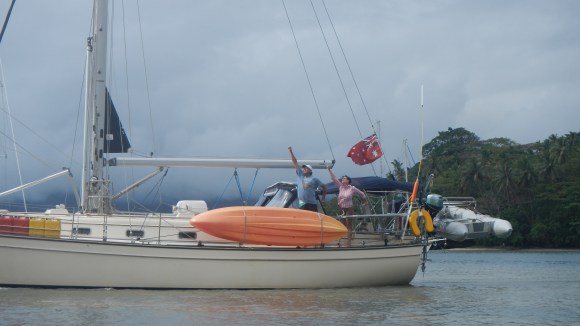
No, I’m not talking about the weather. I’m talking about our friends on a boat called “Breeze.” We had last said good-bye back at The Blue Lagoon in The Yasawas, and we had absolutely no idea they were in the vicinity, nor did they even know we were still in Fiji. I was standing at the galley chopping some vegetables for a salad for lunch when I looked up and saw Breeze right off our stern. “No way!” I shouted. This was such a nice surprise, because we had been alone in Dere Bay for a couple days and the weather wasn’t turning as quickly as we had hoped for us to head north to Taveuni.
Exodus and Breeze in Dere Bay
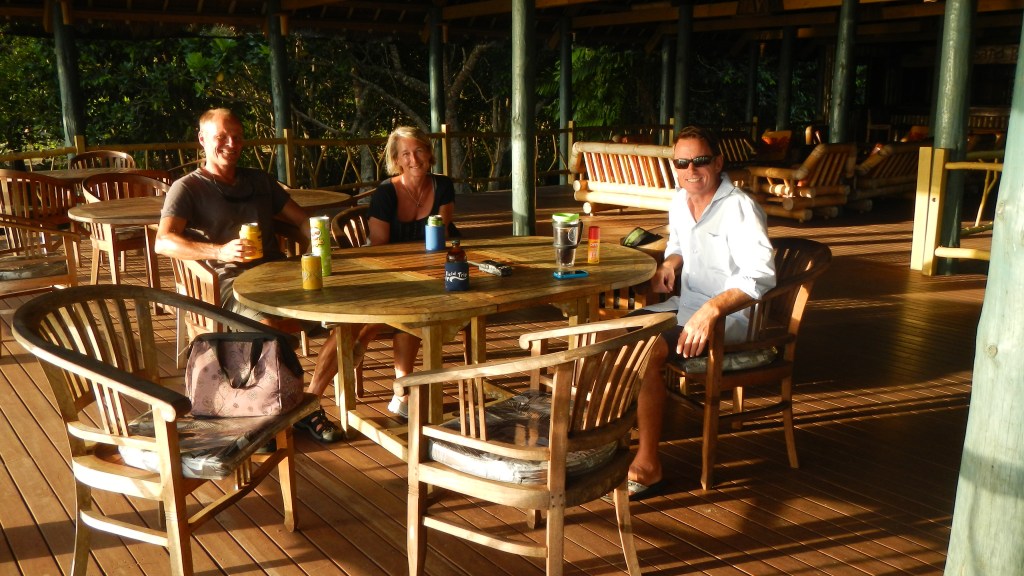
We first met Breeze way back in Papeete. Their boat was on the hard getting repaired from an encounter with a whale, while we were just blowing through Papeete as quickly as we could. So, at that point who knew if our paths would ever cross again. Well, it turns out that they did, several times more as we were together off and on in Tonga, New Zealand, and Fiji. But the thing is that we were always with a group of kid boats, and even though Tim and Per share a passion for spear fishing, it seemed that we hadn’t really gotten to know Per and Sabina all that well. So, that makes this visit in Koro all the more special as we spent pretty much every evening together: drinks on Exodus, drinks on Breeze, drinks on shore… we shared rum, good stories, and even ventured into a little political talk as we shared observations about our countries (good and bad) and we got to learn a little bit more about Sweden.
Drinks on shore with Per and Sabina (s/v Breeze)
Alex and Brenden had sadly accepted that they would be without their kid boat buddies for a while, so they were glad for another chance to hang out. Ella is right in their age group, and she and Alex share a lack of passion for the cruising lifestyle, so I was glad that they all had a little fun together, even if a lot of it was video game playing and trying to get internet on shore. They were being typical teenagers together, and sometimes that’s just what they really need.
We had heard from some of the local expats that the resort restaurant serves dinner sometimes if you make arrangements ahead of time. It was a bit of a challenge finding someone to make such arrangements with, but we managed to sort it out and one of our last evenings there we had a pleasant dinner on shore, although it was a bit strange since the resort continued to have that deserted feel and there was only one other table of customers at the restaurant. The curry I had was good if nothing special but the best parts of dinner ashore was the company and, as always, that I didn’t have to cook!
Koro Island is approximately 30 nmi south of Savusavu, making it a very manageable day trip. Since our ultimate goal was to depart Fiji and head north, it may seem strange that we would start out by going due south, but there is, in fact, some method to our madness, and as usual it has something to do with weather. Basically, in order to go north we would have to first get around the big island of Vanua Levu, which meant a long stretch going due east toward the island of Taveuni. Since the trade winds blow anywhere from SE to E, as you can imagine, trying to go due East presents a bit of a challenge. So, we basically used the island of Koro as an intermediate waypoint on a long tack. The strategy was to leave Savusavu and go south to Koro when the trades are blowing more from the east, and then after a couple days when the switch back to the SE we could easily head NE from Koro to Taveuni. This mostly played out according to our strategy, only we had to stay at Koro six days rather than just a couple.
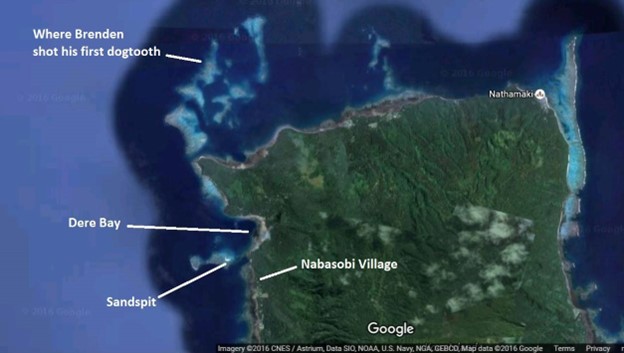
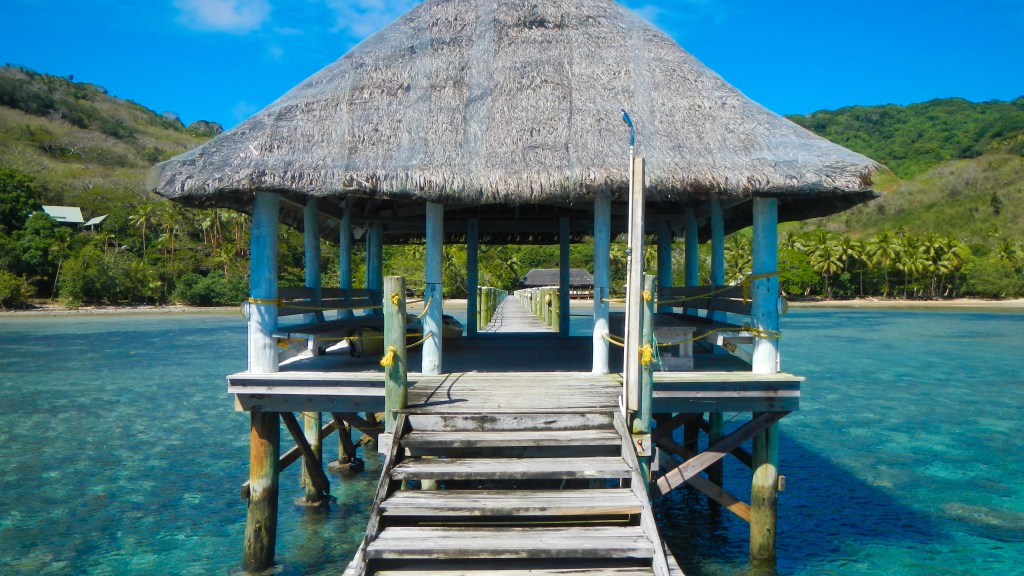
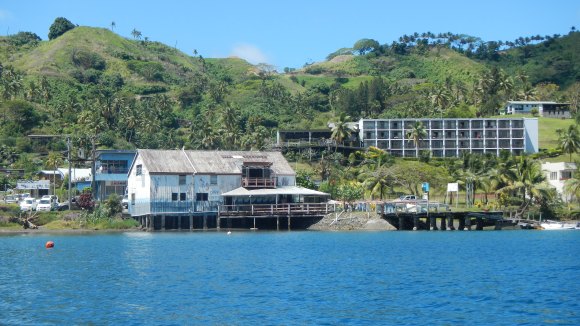
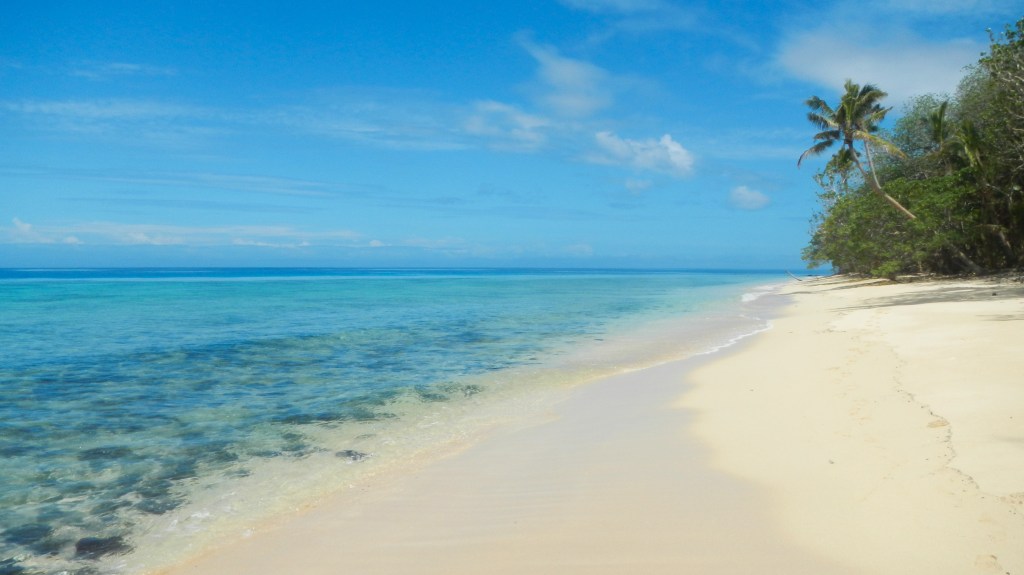
The sail itself from Savusavu to Koro turned out to be a very pleasant day sail with light winds on the beam. We went to Dere Bay on the northwest side of the island, which is the usual place cruisers go for protection from the trade winds. When we arrived there were no other boats there, but that wasn’t much of a surprise given how late it was getting in the season. We picked up one of the mooring balls and then went straight away to shore. Dere Bay has a ridiculously long pier extending out over the shallow coral so there’s a suitable place to tie up small boats. We made our way up to a resort, which had a nice deck and bar/restaurant area, but it was totally deserted. There was a woman in a small office, so we talked to her about paying for the mooring and which way we should go to the nearest village to do sevusevu.
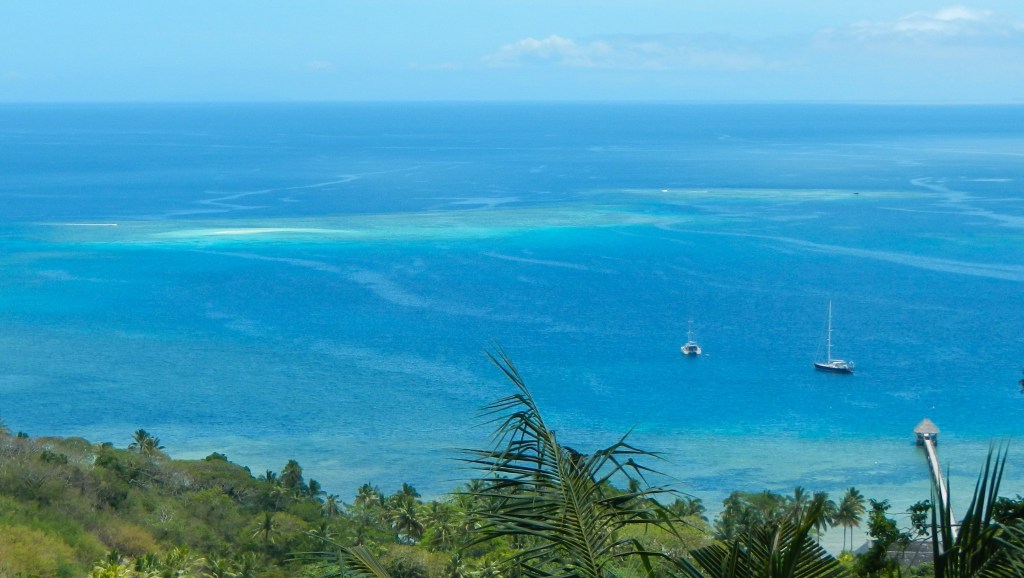
The north side of Koro Island
So, we ended up walking about 30 min partly along a trail and partly along a dirt road down to the nearest village to the south, which is called Nabasobi. This was our final sevusevu in Fiji, and it turned out to be lucky number 13. Each one is different depending on what’s going on in the village at the moment and on the personality of each chief. Lucky number 13 was the first time the chief did the sevusevu wearing shorts (not a sulu) and it was also the first time the chief sat around chatting with us afterwards. We ended up hanging out for about an hour. This one was also the first time we were served cold drinks (Fanta orange, Brenden’s favorite), and on a hot day, it was like magic.
Everyone said there were lobsters at Koro, so I had high hopes that we would get some of these, as Carolina used to call them, butter delivery vehicles. Tim tried his best and went diving at night while Brenden drove the dinghy for him, but unfortunately he only found very small ones. Not wanting to decimate the lobster population of Koro, of course he left those alone.
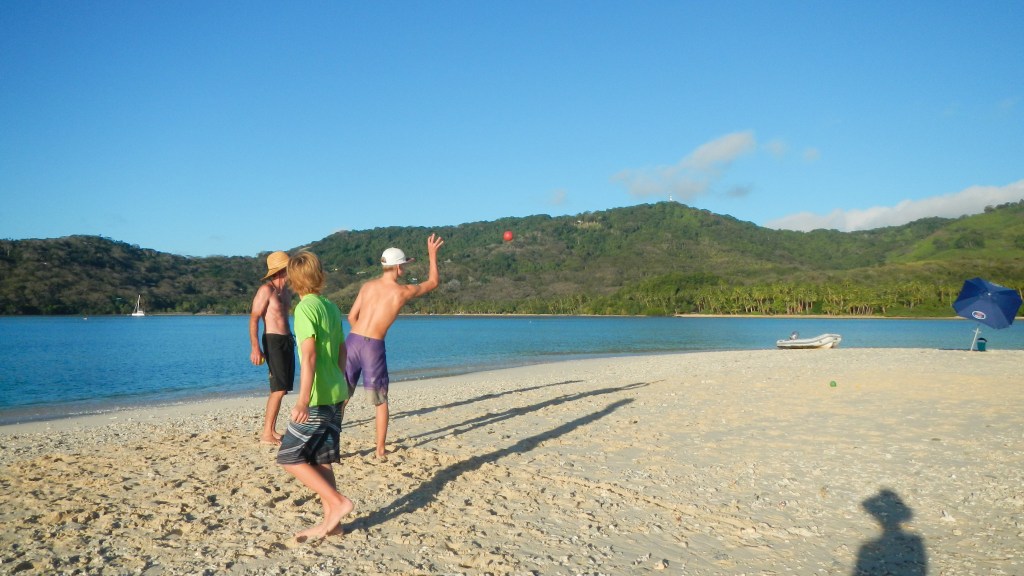
At the south side of the anchorage there was a sand spit that dried at low tide. I spotted just the tip of it at high tide when I was out for a morning paddle, so we decided to turn it into an afternoon family outing. We threw a beach umbrella, some drinks, and the bocce ball set into the dinghy and headed over at low tide and played some serious games of bocce. Well, as serious as anything gets with Brenden around.
Bocce ball on the sandspit at Dere Bay
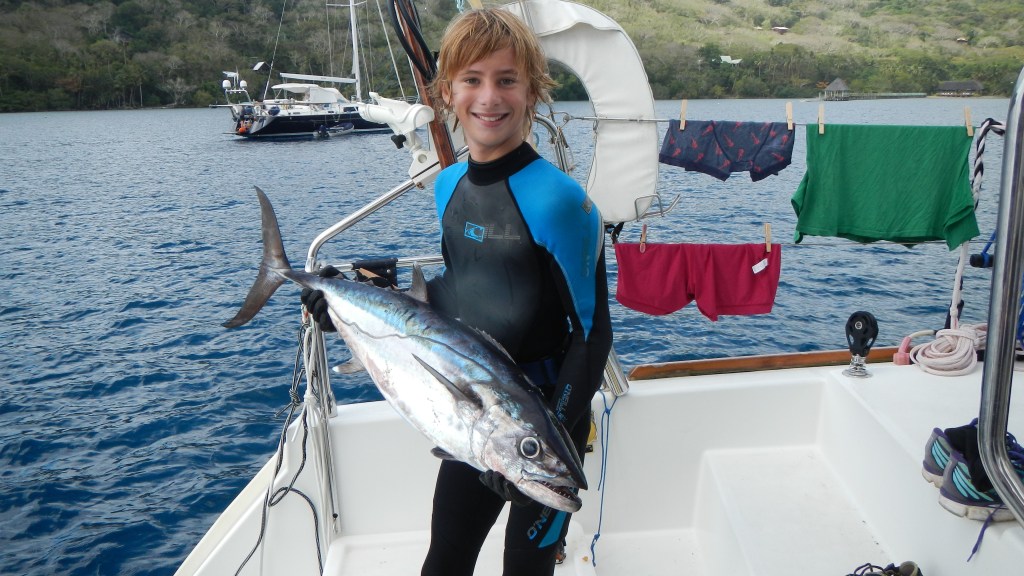
Our days at Koro were memorable for a few reasons, but for Brenden, it all has to do with his spearfishing “firsts.” He had two milestones, and the first was being able to load his speargun without help. The rubber bands that propel the spear forward when fired are quite strong, and until now Brenden had to pass his gun off to Tim after he took a shot in order to reload it. However, I guess all of those pullups he’s been doing have paid off. But the real memorable milestone is that he speared his first dogtooth tuna! The dogtooth is a prize among spearfishermen, so Brenden was so happy, absolutely beaming. He wanted to be sure to tell Jack (Iguana) and Hans (Nautilus) as soon as we had internet again. We were all quite happy with his accomplishment, actually, because dogtooth is very tasty sashimi indeed.
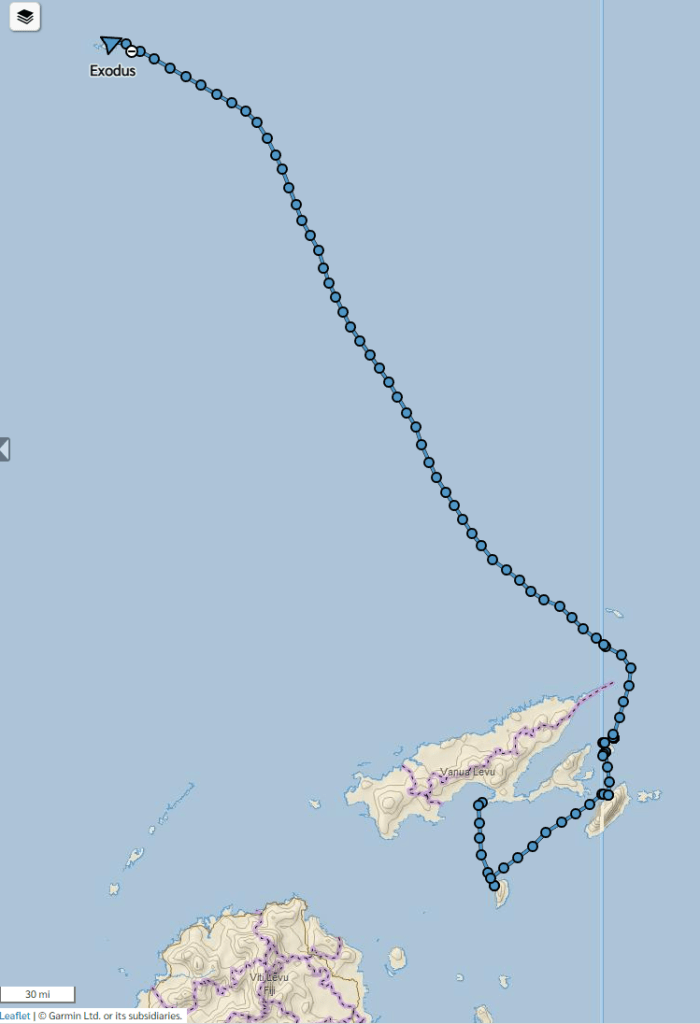
With a functioning watermaker and a boat full to the brim of provisions, we departed Savusavu on Sunday 18 Oct and stayed one night out at the Cousteau anchorage to be poised for an early morning departure. A day sail took us down to Koro Island, and although we thought we would stay only one or two days, we ended up staying six. Then we had a fast day sail up to the town of Somosomo on Taveuni where we stayed one night in order to top off our fresh provisions and say a sad good-bye to our friends on Fluenta. After that it was off to the island of Rabi where we stayed one night at Katherine Bay on the south end of the island. Then we made our way up the western side of the island and after a day stop at the main village of Nuka, we went up to the northwest side of the island to Albert Cove.
We departed Albert Cove in the evening on Halloween and had a downwind two day passage up to the northern most island in Fiji, the island of Rotuma. After five days at Rotuma we departed in the early morning on Saturday 7 Nov bound for Funafuti, Tuvalu.
(Savusavu) –> Koro Island –> Somosomo (Taveuni) –> Katherine Bay (Rabi) –> Nuku (Rabi) –> Albert Cove (Rabi) –> Rotuma –> (Funafuti, Tuvalu)
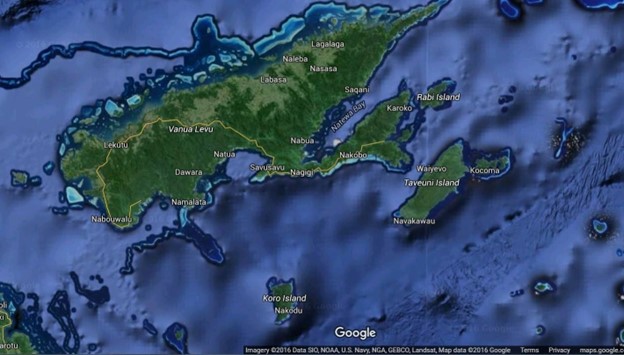
Map of the area showing Savuavu, Koro, Taveuni, and RabiSavusavu to Koro to Taveuni to Rabi to Rotuma
The next installment will be the last one for Fiji as we visit the islands of Koro, Rabi, and Rotuma. Then it was time to press north in order to be out of the cyclone belt for cyclone season.
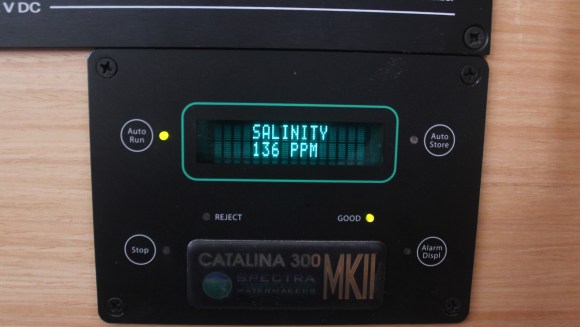
The watermaker issue wasn’t getting any better on its own so by the time we got back to Savusavu we knew action would need to be taken. We couldn’t head north through the remote islands of Tuvalu and Kiribati with a watermaker that can’t produce safe drinking water. Before biting the bullet and ordering a new membrane, we tried running a cleaning solution through the one we had. Our friends on TBV had the solution we needed and luckily, they let us buy it from them. Tim went to every place that might even have a small chance of having it, but no luck. So, we took Exodus out in the bay to do the procedure. We carefully followed all the instructions, and the only tricky part was that the water needed to be within a specific temperature range to be effective, but we sorted out a way to do that, and we kept our hopes up that this would solve our problem. Yeah, no. It made absolutely no difference in our salinity readings, so we went ahead and ordered the new membrane. Tim had quite the time sorting out the shipping instructions with the company he ordered from. We used DHL, because we had been told that is the only reliable way to get something shipped to Fiji, and the Waitui Marina is the DHL hub.
It took about another week to arrive, and sure enough, that was the problem. The new membrane produced much, much lower salinity readings. So, our conclusion is we must have destroyed our membrane by filling our water tank with dock water in New Zealand. Since the water maker uses tank water to flush itself after it’s been run or at 5-day intervals if it isn’t run, it’s important for the tank water to be chlorine free. Chlorine in the water can damage the membrane, and even though we thought we properly filtered the dock water, perhaps not.
In any case we were quite relieved to be leaving Fiji with a functioning watermaker and we just couldn’t get enough of looking at those low salinity readings.
We were leaving Savusavu mid-October, and we wouldn’t be arriving in The Marshall Islands until late January, early February. Since I had no idea what provisioning would be like along the way in Tuvalu and Kiribati, I decided I would stock Exodus with four months’ worth of food. This would have been much better to do in Suva, but I managed to get the job done in Savusavu.
The first step was making the list, well actually the first step was taking inventory. I keep an inventory spreadsheet, and I try to keep it more or less up to date, but since we were low on provisions and lockers were relatively empty, I figured it was a good time to go through and see exactly what we already had. And clean the lockers while I’m at it. Then, in order to make the list I went through my spreadsheet and tried to estimate how much of each item we would need for four months and subtracted what we already had to see how much I needed to buy. OK, truth be told I actually was much more of a nerd and added all kinds of functionality to the spreadsheet, but I won’t go into it so as not to be too much of a bore. Actually, this whole topic of provisioning is boring me, and I’m the one who lived it, so I think I’ll move on.
We temporarily parked Exodus at this rickety dock to load up 5 carts worth of groceries. Diesel too.
We celebrated Brenden’s 13th birthday while in Savusavu, as well as Jonathon’s and Victoria’s, so it was fun that all the kids got to be together this year. Last year for his 12th birthday Brenden was brooding over the fact that Lady Carolina had left us in Tonga, so I’m really glad it worked out that Fluenta stayed in Savusavu. Brenden’s request for his birthday was, “Pizza, pasta, cookies, and ice cream.” And we were able to deliver on all accounts.
It’s hard to believe that “baby B” is now a teenager, although at the same time it’s not. As with every year, he seems to be right where he should be.
We hadn’t gotten Alex a 14th birthday present yet even though it was well over a month since we celebrated it, so Tim went all out and got the boys a surfboad and a kite for kitesurfing (purchased from our friends on Eleutheria.) The surfboard is a big improvement for dinghy surfing over their other foam Costco boards, but they still haven’t dedicated the time to master the kite.
We had spent about 5 days in Savusavu at the very beginning of our Fiji adventure, and at that time we stayed on a Copra Shed mooring ball for no particular reason. This time as we were approaching the harbor I again radioed Copra Shed, because what can I say; I’m a creature of habit. Copra Shed didn’t answer, but Waitui Marina called back and the friendliest voice I’ve ever heard on the radio asked if she could help us in anyway. That was Jolene, and she hooked us up with a mooring for our entire 3 week stay this time in Savusavu. The Waitui facilities aren’t as posh as Copra Shed, but the price is less, and it always feels good to be patronizing an establishment with helpful people.
Waitui Marina in Savusavu
One of the first things I had to take care of in Savusavu was get our passports stamped for the visa extension I had paid for back in Nadi. So, I took our passports and the payment receipt to the immigration office and hoped for the best. Although there were two or three people in the office, I was told I would need to come back another day because, “the lady who stamps passports is sick.” Kind of funny that the function of stamping passports is a single point failure given that it is, after all, the immigration office. But there’s nothing you can do but smile and go along with it. When I came back a couple days later, the day our original visas were to expire, the “passport stamping” lady was well and in the office, so after about a half hour of making phone calls back to Nadi, she handed me our stamped passports and I was on my way.
We caught up with some friends we hadn’t seen in a long time… Eleutheria and Skabenga who we hadn’t seen since French Polynesia, and Hot Spur, who we hadn’t seen since, wow, Mexico. Everyone had their various adventure stories to tell about “how I spent the cyclone season” and it was fun to hang out and catch up. We also met a new kid boat, a French speaking family from Belgium on a boat called Sept a Vivre. They had kids just the right age to hang out with Alex and Brenden, but sadly they were only in Savusavu for a short time. We had hoped that we might run into them again later in The Marshall Islands, but, spoiler alert, that never quite panned out.
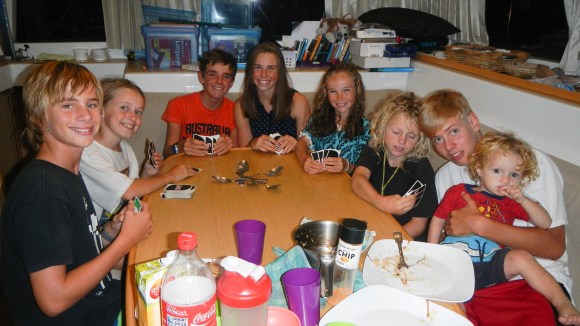
A game of Uno on Exodus
The sad good-byes were really getting old and now it was time for good-byes with Fluenta and True Blue V. Fluenta was going back to New Zealand for cyclone season and TBV was going to wait another season out in Fiji. TBV had been the ones to put the idea of going to The Marshalls in our heads, but in the end they decided they would stay in Fiji instead. I’m not going to get too sappy as I write about these good-byes, because spoiler alert: we will see Fluenta again at Taveuni before we leave Fiji, and in true cruiser fashion, TBV will change their plans again and join us heading north after all!
Even though we really needed to get to Savusavu to sort out the watermaker issue, we decided to head just a little bit south for a few days to the island of Namena, which is a small island in the middle of a marine reserve. I thought when Tim learned that he couldn’t spearfish there he would change his mind about going, but I guess the pristine diving still enticed him. I really didn’t want to go. More than ever, I was ready for fresh provisions and restaurants, and I really had my heart set on arriving in Savusavu sooner rather than later. However, I was much less grumpy about the decision about going to Namena when we arrived to find our good friends on True Blue V already there.
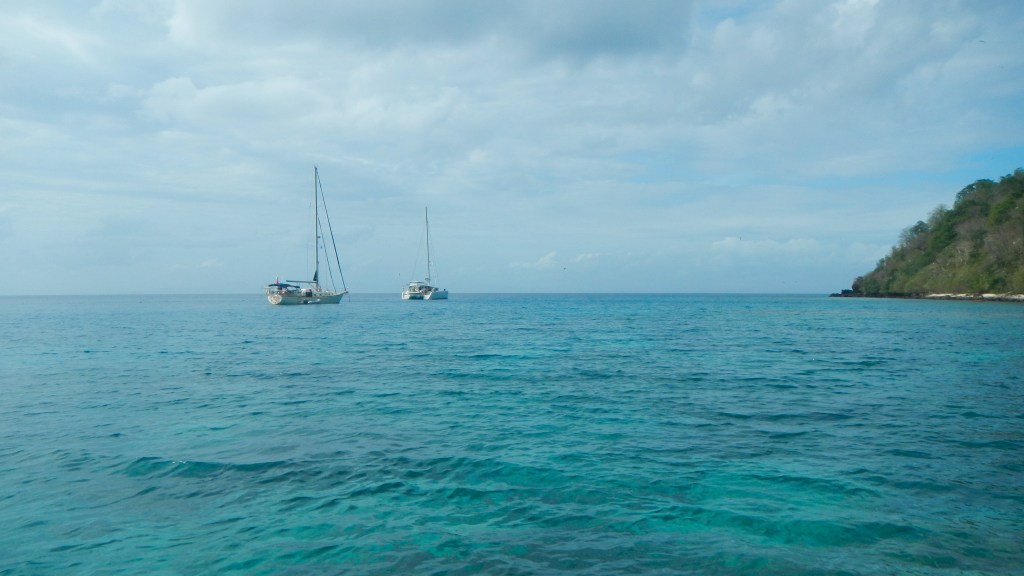
The Universe is set right again: True Blue V and Exodus anchored next to each other
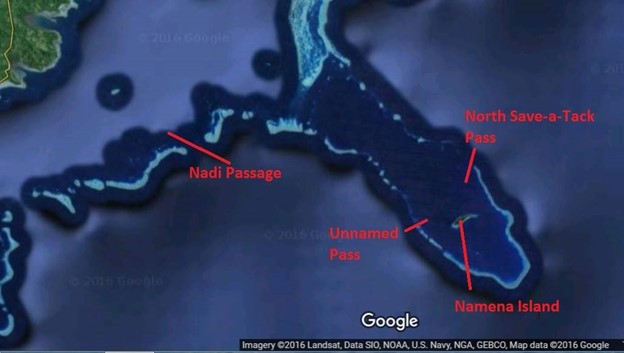
The satellite image below shows where we exited and entered the various reef systems. We exited the Vanua Levu fringing reef through what is labeled “Nadi Passage.” It was wide and it was easy to see due to the breaking waves on the reef, but there were some strange wave patterns in the pass due to current which were a little unsettling as I viewed them from a distance. We entered the Namena reef through an unlabeled pass that we had chosen by examining the satellite imagery. There was a wider, obviously deeper pass further to the south, but the pass we chose a little more direct. In the pass there were two pinnacle coral heads that we spotted rather late but still avoided in plenty of time.
Namena reef system
We anchored on the north side of the island, and we mostly had light winds while we were there, but they say you can also anchor on the south side if the prevailing wind is from the north. The island is mostly uninhabited, in that there is no village or anything. But there is a single dive resort on the north tip of the island, but from our vantage point in the anchorage you barely knew it was there, except for the dive boats. There is also a dive operation based in Savusavu that brings people out to dive the Namena reef.
The weather was actually perfect during our stay, or maybe just a bit too hot, and Tim and Brenden broke out the huka to do a dive out on on the reef. They went to a dive spot called “The Chimneys” and it turns out that these were the same two pinnacles that we had previously avoided as we entered the reef. They thoroughly enjoyed the dive, but from these two you don’t hear about how pretty and healthy the coral was or how many fish there were, no you only hear about all the big fish that would swim right up to them, taunting them because they couldn’t spearfish.
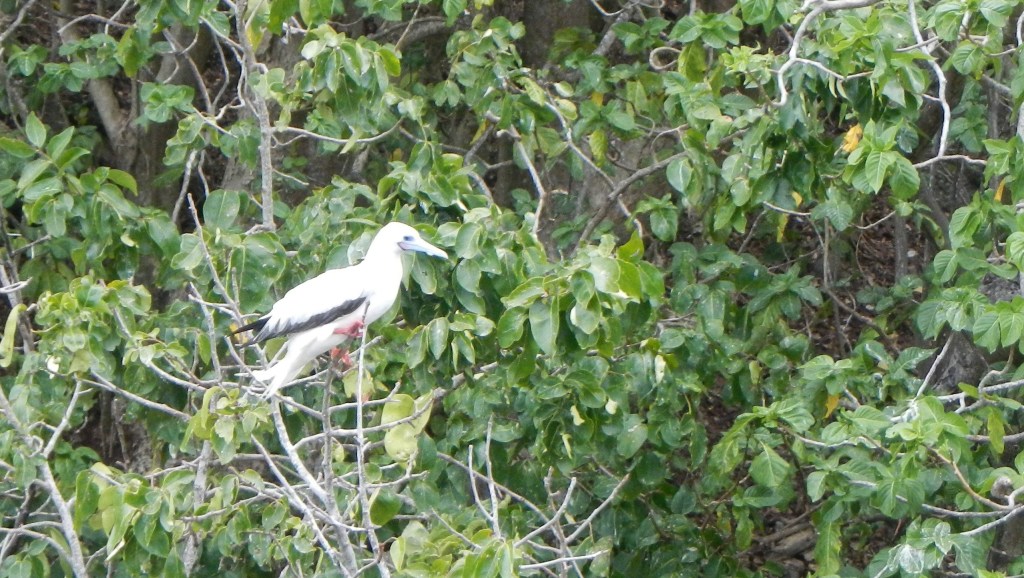
Myself, I enjoyed the crystal-clear water by taking the paddle board around the island and exploring an amazing white sand beach on the other side. One of the unique things about this island is the abundant bird life. The boobies (red footed) and frigates are so numerous; it reminds us a bit of Isla Isabel in Mexico. We were pondering what makes this island have so many birds when we haven’t seen that anywhere else in Fiji, and we think probably because there’s no fishing allowed so they have abundant food close by, and also because there’s no predators, no humans to take their eggs. I also went on a brief snorkel with Max and Liz on the southwest tip of the island, and it was nice healthy coral and lots of little “aquarium fish.”
Red footed boobieBeautiful beach on the south side of Namena
On another day Tim took both boys out on hooka dive. Yes, Alex even went this time. This time it was to the north pass to a dive spot called “Grand Central Station.” Tim seldom writes notes in our logbook, but after this dive I found the following note in his handwriting: “Awesome dogtooth! Walu, fish, sharks, coral”
When we departed Namena we left up through North Save-a-Tack pass and had an easy day sail up to Savusavu. It was a cold, rainy, and foggy day, so the visibility was pretty bad, but we were happy for two reasons: 1) We were able to sail, like actually sail with no engines or anything. After all the upwind motoring we’d been doing to get back east, it was very nice. and 2) We were accompanied by a pod of dolphins. Back in Mexico it seemed like you couldn’t move 2 miles without seeing dolphins but since then they’ve been more sparse. They swam with us for a while and it was good fun.

 Gresham Family Exodus