Categories
Uncategorized

Clearing In to Tuvalu

In my last narrative I explained that due to last minute changes by the Fijian government Rotuma is no longer an official clearance port, and therefore we left without all the proper paperwork from Fijian customs. So, now upon our arrival in Tuvalu, it was time to find out if that would matter or not.

Navire had arrived the day before us, so I asked them how it went for them. They were lucky, because they hadn’t even realized they didn’t have all the right paperwork. They went to immigration first and gave them the form they had gotten from the officials in Rotuma, and then when they went to customs, and were asked by them for a form, Janet, in all honesty, told them she had left all the paperwork with immigration. Apparently, customs didn’t seem too concerned about it, and they cleared in without issue.

I decided to just follow the same tactic. We went to immigration and left them the immigration clearance form from Rotuma. Then we dinghied down to the customs office at the wharf, and the customs guy was very nice. The office was air conditioned, and he invited us to sit down, and he even gave Tim the password to the Wi-Fi. All the while island hip-hop music was playing in the background. When we got to the part where he asked for our customs clearance from the last port, I told him I had given my form from Rotuma to the immigration office. He insisted that I should have a customs form, but I insisted that I didn’t, so he asked if he could look through all of my paperwork from Fiji. He found my coastal clearance form from when we departed Savusavu way back in May, and he said, “This will work.” I didn’t question anything, just smiled and thanked him, and we were on our way. That is, after chatting a bit more about Funafuti and enjoying the air conditioning.

Categories
Uncategorized

Running on the Runway

Originally posted on cruisingrunner

No, the title of this blog post isn’t some clever metaphor, because literally, I went running on an airport runway. We recently spent almost two weeks in Funafuti, the main atoll of the country of Tuvalu, where they have an airstrip that was originally built by the U.S. during World War II. Apparently, the Americans used Funafuti as a staging area for preparation for the Battle of Tarawa in the neighboring island nation of Kiribati (where we are headed next, by the way). The airstrip today is used as the only airport in Tuvalu, therefore by definition it’s an international airport, with twice weekly flights to/from Fiji. The island is not very big, and it’s long and narrow, so the airstrip runs right down the middle of town taking up much of the usable land.

But the airstrip is much more than a runway. In the early morning and early evening it’s a hub of community activity. There are walkers and joggers, rugby games and soccer games, kids riding bicycles and, of course, tons of motor bikes zipping along. During the heat of the day, mostly all that remains are the motor bikes and an occasional car or truck. There are no fences or security barriers, but one of the local women told me that all of this activity is technically “illegal” and that you aren’t actually allowed to be on the runway. Clearly this law isn’t enforced in any way.

Runway or playground?

When it’s time for a plane to land, there still isn’t much in the way of security. The fire engine comes out and gives three warning sirens spaced about 5-10 minutes apart, although I don’t remember the exact timing. After the first and second warning you still see a few motorbikes crossing the runway, but by the third siren, it’s mostly clear. We were able to stand basically right on the side of the runway as the plane touched down. Seriously, it would have been harder to get any closer without standing right on the runway itself. When it’s plane time, the entire airport vicinity becomes buzzing with activity. Women set up handicraft displays and there’s tons of people just milling about. Taxis are in the parking lot and the duty free truck shows up for last minute purchases by the departing passengers. After the plane takes off again, the activity gradually dissipates and everything goes back to normal.

Plane day!

So, after we were a few days there in Funafuti, I joined the evening crowd on the runway and went for a slow, hot run. Unfortunately, I went just a little too early, and the sun was still a bit too high in the sky, so I pretty much overheated after 10 minutes. But I was stubborn about it, and didn’t quit until I completed a full lap, up and back, of the runway.

Categories
Uncategorized

The Buck Doesn’t Stop with Me

Originally posted on cruisingrunner

Sometimes it’s hard, because consensus simply isn’t possible when partners have different risk tolerances. We discuss, persuade, argue, each of us convinced that we are correct in our position. Just to give you an idea of the kinds of things I’m talking about, here are a few examples: anchoring locations relative to land/reefs, entering an anchorage or port at night or in low visibility, and reefing the sails. I am more conservative with a tendency to follow the old salt rules of thumb, and my husband is, well, less conservative, with a tendency to make in the moment decisions. Don’t worry, this post isn’t going to be your typical cruising wife husband bashing diatribe, so stick with me.

Usually, when we have one of these “discussions” it’s my husband who gets his way, because he is supremely confident, and I generally back down first. But, of course, I don’t back down quietly. I make my dissension evident; sometimes loudly and sometimes passive aggressively. It’s easy to devolve into fluctuation between irritation with him and despair at my situation, having felt like I’ve lost my voice.

Obviously, we are still alive, and our boat hasn’t sunk, so my husband can’t be doing all that bad. But there *have* been times when non-ideal corrective action has had to be taken, like having to re-anchor in the middle of the night because we ended up too close to a shallow pinnacle or having to reef the sails in strong winds *after* a squall has engulfed us. When this happens, I always want to take the high road, I really do, but I usually cannot contain the smug little look and the occasional blatant verbal, “I told you so.”

The thing is that my attitude, my behavior, simply isn’t fair. First of all, it needs to be said that there’s nothing my husband has done that has been dangerous. He has never made a decision that has put our family at risk, rather it’s risk of damage to our boat that I sometimes question, not risk to any of our lives. But second of all, and the point I really want to make, is that at the end of the day, at the end of the discussions and the arguing and the I told you so’s, the buck doesn’t stop with me.

It stops with him.

And that’s a lot of responsibility, quite a burden, if you think about it. Even still, he carries it willingly and, yes, confidently, and I wouldn’t want it any other way. So, I judge from a very comfortable position, indeed. Would it kill me to be part of his team and support him every once in awhile instead of second guessing him all of the time? Maybe. But perhaps I can at least pick my battles for the *really* crazy stuff he comes up with.

Categories
Uncategorized

Tuvalu and Funafuti

According to a few sources, Tuvalu is one of the top 10 least visited countries in the world. (And it’s kind of funny that 2 others of the 10 are Kiribati and Marshalls, our next two destinations.) It is a Polynesian nation, being situated on the western side of the so-called Polynesian triangle. There is a total of 9 islands: six of them being atolls, with only 3 of those being suitable for a sailboat to enter.

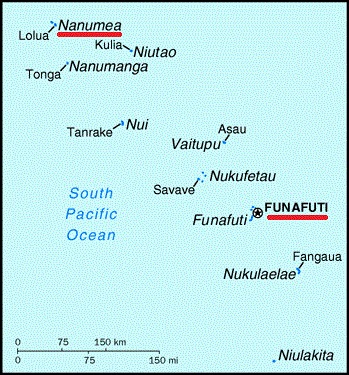
The total population of Tuvalu is about 11,000 with 60% of the people living in the capital of Funafuti. Funafuti is where we started our Tuvalu adventure, and the other atoll we visited is the northernmost island, which is called Nanumea. You can see both islands on the map of Tuvalu below:

The island nation of Tuvalu

We have been to many atolls, but Funafuti is a very old one, much further on in its life cycle than any of the others we have visited. The lagoon is very deep and there are very, very few coral heads in it. The motus, or islets that form the perimeter of the atoll, are very low lying, and overall, it was not exactly the most picturesque place we’ve been to. Apparently, the atolls of Tuvalu could be the first geographical victims of higher ocean levels due to climate change. (Recall the story of the people from Vaitupu, Tuvalu who migrated to Kioa, Fiji in the 1940s due to poor soil on their home island). What I have read with the boys has said that by the end of the century these islands could be under water.

Overall, Funafuti was a very pleasant surprise, though. All of the reading I had done regarding our path north didn’t have much nice to say about the various capital “cities.” But Funafuti is a real gem. The people are very nice, even if a bit reserved at first (not unlike other Polynesian countries we’ve been in.) Things were pretty cheap and most things were available, so I really didn’t need to do 4 months worth of provisioning in Fiji.

The infrastructure is quite good and the roads are well-maintained, but you won’t find many cars driving on them. Most people get around town on scooters, or “motor-bikes” as they call them. Even though it seems like there are more scooters than people in Funafuti, you will often see several people piled on a single scooter, and helmets? Not a chance. Babies on scooters? Of course!

The air and water temperatures have of course gotten warmer as we inch closer and closer to the equator. In Funafuti we had water temperatures of approximately 89 degrees F and air temperatures even higher, so needless to say we spent a lot of time in the water. We even busted out the water hammocks from Mexico!

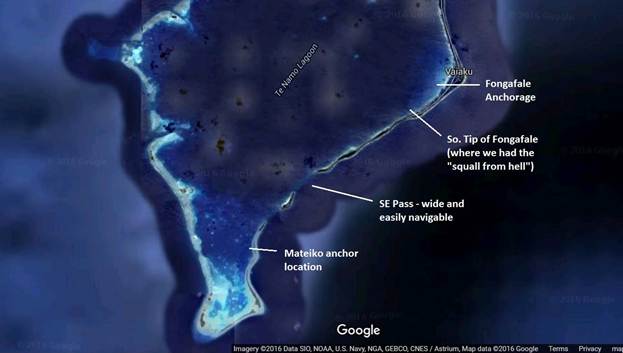
The main island in Funafuti, where most of the people live, is called Fongafale, and that is where we anchored most of the time. But we did venture to two other anchor locations, and you can see them all on the following satellite image.

Satellite image of Funafuti

On arrival we entered through the SE pass, and it was wide and easily navigable with minimal current and no obstructions. When we departed Funafuti, we left through the northern pass, not shown on the image above, but it was equally easy, and we actually went through it with minimal light at dusk.

Categories
Uncategorized

Why North?

Why North for Cyclone Season?

Way back when we departed New Zealand our plan was to spend the cruising season going from Fiji to Vanuatu to New Caledonia and finally ending in Australia. However, shortly after arriving in Fiji a realization came over us. It was already the end of May, and we’d need to be in Australia in less than half a year. That just seemed WAY too soon for us to leave the island cruising lifestyle again and go back to a culture oh so similar to our own.

So, our main options at that point were to stay in Fiji for cyclone season or head north out of the cyclone belt. I have to admit that the thought of staying in Fiji was tempting, especially since we had a few friends who were planning to stay, but in the end we decided the risk of a cyclone was still above our tolerance threshold. So, north it is!

There was one other consideration, though, and that was the sale of our beloved Exodus. Our three years were winding down, and one of the reasons we had always planned to end our journey in Australia was in order to sell Exodus there. Australia has a big sailboat market, and when we left California, we actually thought we’d be able to cruise for three years and then sell Exodus for close to what we paid. However, in the meantime the economy has changed, and the USD has become stronger, and while usually this would be a good thing for travelers, it was most certainly NOT a good thing when you want to sell your boat in Australia and the amount you owe the bank is in USD. So, this just meant that the argument for going to Australia was much weaker than before, so Marshall Islands here we come! We still had to think about selling Exodus, though, so we figured we would list it for sale when we got to The Marshalls, advertising that we’d deliver it anywhere in the South Pacific from Tonga to Australia. (Spoiler alert: it’s now May 2016 and the jury is still out on whether this is a good approach or not.)

Heading north was not going to be easy. First of all it’s a long trek:

Fiji (Rotuma) to Tuvalu (Funafuti) = 270 nmi

Tuvalu (Funafuti) to Kirbati (Tarawa) = 700 nmi

Kiribati (Tarawa) to Majuro (Marshall Islands) = 360 nmi

Total = ~1330 nmi

For some perspective:

Fiji to New Zealand = ~1100 nmi

Second of all, it has the added complexity of crossing the equator and all the funky weather that entails.

And lastly, it would be some of the most remote cruising we have done, making provisioning and maintenance that much more challenging.

But in the end, we decided: Challenge Accepted!

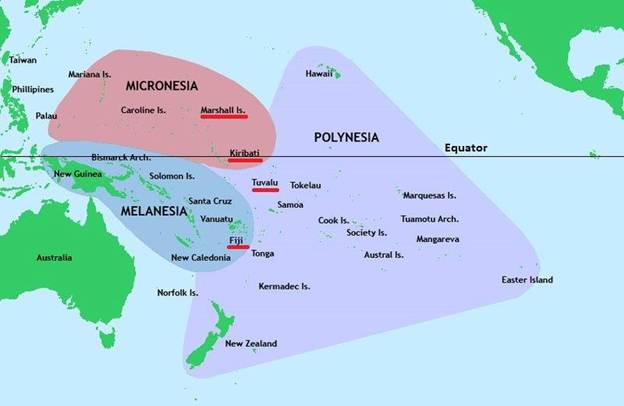
The islands of the South Pacific with Fiji, Tuvalu, Kiribati, and Marshalls highlighted

Categories
Uncategorized

Tuvalu Route Recap

7 Nov – 7 Dec 2015

Route Recap

We said good-bye to Fiji with an early morning departure from Rotuma on Saturday, 7 November. A two and a half day passage brought us to Funafuti, the capital of the island nation of Tuvalu. We spent 11 days in the atoll of Funafuti, mostly at the main island of Fongafale, but also with a couple brief visits at other anchor spots. Picking a weather window to leave Funafuti turned out to be a difficult task, but in the end we were compelled to leave in order to avoid bad weather in Funafuti. It was another two and a half day passage up to the northern most island in Tuvalu, called Nanumea. We thoroughly enjoyed Nanumea and ended up staying there two weeks before departing on Monday, 7 December northbound for Tarawa, Kiribati.

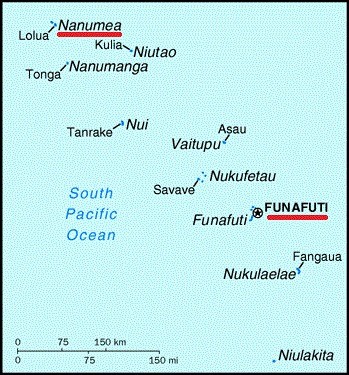
(Rotuma) –> Funafuti –> Nanumea –> (Tarawa, Kiribati)

The island nation of Tuvalu

Categories
Uncategorized

Looking Forward to Tuvalu

After departing Rotuma, we spent about a month in the island nation of Tuvalu. In the next narrative you’ll meet The Northbound fleet, including The Mighty EOS II and find out what a Sparklebox is.

Categories
Uncategorized

Formalities Fiasco

Rotuma was supposedly an official port of entry for Fiji, so we were intending to clear out of Fiji from there. The government facilities are not near the Oinafa harbor, rather they are on the other side of the island at the village of Ahau. We were planning to just walk there (or hitch a ride) when we were ready to clear out. However, one day while on shore near Oinafa we were visited by some officials, and we made arrangements for them to come to the boat a few days later to clear us out. That seemed easy enough.

But then the drama began. True Blue V emailed us from Savusavu and told us that the customs office in there was now saying that Rotuma is not an official port and that the customs official had been recalled, however, immigration was still operating on the island. We decided to take no action, because the officials we had talked to on shore had said nothing about there being any issues clearing out, and we didn’t want to start asking questions only to be told that we had to go back to Savusavu to clear out.

So, the day we cleared out and the officials came to the boat we noticed that Immigration and Bio-Security were represented but no Customs. They were pleasant, told us to be sure to tell other cruisers that Rotuma is an official port so more people come there, gave us some clearance paperwork, and stamped our passports. I noticed that the paperwork they gave us was only immigration. So, I asked if this was all we needed for our next port and they said yes. So, I decided to get more specific and asked if there was anything we needed from customs in order to clear out, and they all said no. In the end we clearly departed Fiji without completing all of the official outbound clearance requirements. Luckily, we didn’t have any trouble clearing into Tuvalu, but that’s only because the customs official in Funafuti wasn’t too much of a stickler. Of course, we don’t know if this will impact us if we ever want to clear back into Fiji.

Categories
Uncategorized

“Walk” to the “Market”

The day we were planning to clear out we decided to venture into the main town to check out the Friday vegetable market on the other side of the island. Tim and I set out quite early, walking along the road, hopeful that someone would stop and offer us a lift. The people that we passed along the way were all very nice, and they all wanted to give us stuff. I had a bag full of kasava and papaya before we ever got anywhere near the market

However, after walking for about 30-40 minutes, we were still hoping for that ride. Then we came across a couple with a teenage son waiting by the side of the road. They were Bula and Betty and their teenage grandson. Bula and Betty were dressed up to go to some traditional celebration, and I think their grandson was just hanging out with them. They were waiting for the transport truck to come by to give them a ride and they invited us to get a ride with them; they were certain we could get a lift to the town. We quickly accepted that offer, so we stayed with them chatting for awhile. And then a little while longer. And then longer still. They didn’t seem concerned or irritated at how long it was taking for the transport to come, so I tried not to be either. Finally, it arrived, but it was going the opposite direction, back the way we came. They motioned us in anyway assuring that we’d have a way to get to the main village with the market. So, we piled in.

The transport was a big pickup truck with a covered bed, and there were already 15 or so people in the back, mostly women, and all dressed up for the occasion. I sat next to a woman who was clearly part of the upper class, judging by her manicured nails, her shoes, and her jewelry. She was talkative, and her English was excellent, so she was obviously well educated as well. Soon she was telling me that “I needed to tell my husband to come down from there. Doesn’t he know the condition of these roads?!” I realized that Tim was standing up at the open back end of the truck almost leaning out the back while holding on to a rail at the top. Clearly, he was trying to have a good look around as we drove along. At first I just smiled and ignored her, trying to pass her comment off as a joke. But she kept after me, and so finally I told her there’s no way he would listen to me even if I did say something. She was clearly a little disappointed in my unwillingness or inability to control my husband.

When we arrived at the location of the party, Bula helped us arrange another ride to the town, which was now about as far away as you can get from somewhere on this island. We took the north way around, so in the end we got to see the entire island in all its beauty. When we got to the village we went straight to the biosecurity office, because it was getting somewhat late and we didn’t want to miss them if they went to the wharf to clear us out. It turned out they were just getting ready to leave, so we hopped in their car with them and got a ride back to the wharf.

We never did make it to the market.

Categories
Uncategorized

Kava Party

A woman stood on the wharf and called to us to get our attention and gestured for us to come to shore. So, we dinghied over and met Rakiti, a friendly, talkative woman, and she invited us to come to shore that evening for some music and some kava. It turns out that although they don’t do the sevusevu ceremony in Rotuma, they do like to drink the kava. It turns out that Rakiti was actually a Tuvaluan from the island of Rabi. She used to do dancing at one of the resorts on Viti Levu in Fiji. Her husband is from Rotuma, and they were enticed back there by an offer for her husband to be the music teacher at the local high school. So, her husband Jonathon is a music teacher, and a pretty good guitar player, so he entertained us with his playing while we passed the kava cup around.