OK, I need to start with a little bit of background on this one. There is an SSB radio net called Gulf Harbor Radio run out of Auckland New Zealand by some former cruisers, and since the husband is a meteorologist and gives the best weather forecast information out there, most of us in the South Pacific, especially when going to/from New Zealand, tune into their net religiously. While still in Fiji, I e-mailed David, the meteorologist, and told him that we’d be heading north for cyclone season this year and asked him which weather products he thinks would be the best to monitor for crossing the convergence zones. He must get tons of emails, but he responded promptly, and the rest of the story about my dialog with David isn’t really relevant here, but I will mention that he put me on to monitoring the “streamline” weather fax, an excellent visual which clearly shows convergence zones along with all other major weather phenomena.
Anyway, during our passage to Rotuma, as I was brooding about being alone without any buddy boats, I received an email from a boat called Navire. They are Janet and David from New Zealand, and they got our contact information from, you guessed it, Gulf Harbor Radio. They were already in Rotuma, and would also be heading up through Tuvalu and Kiribati up to the Marshalls, and they were looking forward to our arrival. So, halfway through our first passage alone, we instantly had a buddy boat again.
But that’s not really all I want to say about Navire. I need to introduce Kailopa, and that requires even more background information. Rabi isn’t the only island in Fiji with transplanted Polynesians. There is another island in Fiji just to the south of Rabi called Kioa, and on Kioa is a community of people who migrated from the island of Vaitupu, which is north of Funafuti in Tuvalu. Their story is a far less tragic than that of the Banabans, in that their relocation was totally voluntary, and a little farsighted, in my opinion. Back in 1947 they purchased the island Kioa as an alternate homeland, due to weak soil and overcrowding on Vaiutup. They used money they earned during WWII from the US military who occupied their island. Kioa was initially settled by 37 people, and later a couple hundred more followed. On both Rabi and Kioa, there are now third generation inhabitants who consider these islands their home, where they are from, and in 2005 they all became full Fijian citizens.
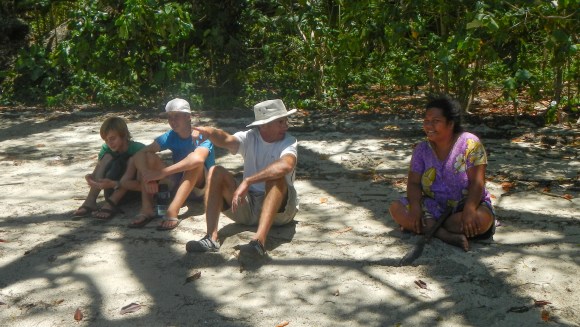
So, while Navire was in Fiji they visited the island of Kioa, and they struck up a friendship with a man named Kailopa. To make a long story short, they ended up bringing Kailopa along with them, giving him a ride from Kioa to Funafuti, Tuvalu, so he could visit with friends and family he hasn’t seen for a long time, including his teenage grandson, Joseph. So, Kailopa became their crew for the journey from Kioa to Rotuma and then from Rotuma to Funafuti. We had the opportunity to meet him and spend time with him in Rotuma, and he was easy going and nice to be around, and he would spend much of his free time fishing off the back of Navire. But it doesn’t matter how easy someone is to be around, once you are together in a small space like a boat 24/7, easy can easily become not so easy. Many of us struggle with sharing this small space with the family members that we love. So, it takes special people to do what David and Janet did for Kailopa, and it takes a special person to do what Kailopa did to go with them in order to see his family again.
Tim had gotten some previous intelligence that there were some wrecks near the anchorage that were shallow enough to snorkel on. He had gotten confirmation from some locals, but he still didn’t have precise GPS coordinates to go find them. He studied the satellite imagery and had identified a couple spots he thought might be one of the wrecks, so I was game to go out with him for an afternoon excursion. We dinghied here and there, and Tim tried so hard to find the wreck, putting a mask on and sticking his head in the water having a look at the various places we stopped. We never did find any wrecks, all ship shaped dark blobs on the satellite image turned out to be just coral. But I appreciated his effort, and we ended up having a pretty nice afternoon together.
The boat Menkar had a father/adult son crew from France, and it turned out that the son, Sylvan, really liked to spearfish too. So, one day Tim, Sylvan, and Brenden went out hunting. I don’t remember what Tim and Brenden came back with, but Sylvan shot a snapper, and everything we had heard was that Rotuma has ciguatera, so in that case, snappers are not really the fish you want to eat. He ate it anyway, and sure enough ended up with ciguatera. Apparently, he had just recovered recently from a previous bout with it, so he already had quite a lot of toxins built up in his system, so there’s no telling if this fish itself was severe or not. But Sylvan ended up with a pretty severe case and was in and out of the hospital there in Rotuma and their departure to Tuvalu had to be delayed.
Also, when they came back from spearfishing the dinghy had a leak, and Tim was totally blaming Sylvan (privately, of course), and I believe Menkar loaned us some of the adhesive needed to apply a patch to the dinghy. Later, Tim figured out that it was his own spear tip on his own gun that had caused the offending abrasion, and even though he hadn’t blamed Sylvan directly, he did go over and let Sylvan know how it happened after all.
The nearest town to the wharf is called Oinafa, and on our first day we went ashore to pay our respects to the chief. There’s no sevusevu ceremony practiced here, but we thought it would be good form to go introduce ourselves and all. We quickly learned from the people in the village that this wasn’t necessary at all. We are free to explore the island and come to the village whenever we want.
So, when the supply ship, that only comes once a month, arrived and was docked at the wharf, we figured we should go check it out. There were so many people gathered around that we thought it would be a great opportunity to meet some people. Everyone was very nice and friendly, and we found out that it’s not just a supply ship but also a passenger ship taking people to/from Suva. There were tons of kids on board, because there was a sporting tournament they were going to participate in. We were approached by many people curious of where we are from and how we like Rotuma so far, but later, as I reflected on all those we had spoken to and most were in some official capacity like police officer, marine safety person, self-designated yachtie chaperone, etc. So, I have to say my favorite person from that day was Freddy. Freddy is just an old guy who lives in the village who wanted to come and welcome us and find out about our story. He’s never left Fiji, and when Tim asked him if there was phone service on the island, I’m pretty sure he had no idea what he was talking about. Freddy seemed particularly interested in the boys, and later I had to chastise them because they didn’t engage at all. They were grouchy at us for making them go ashore, and they couldn’t see past that and give Freddy the interaction he so obviously wanted. We were there talking to people for some time, so the boys went to run along the beach, an absolutely beautiful beach by the way. They came back to let us know the storm was coming, and by the looks of the sky they were right, so we ran to the dinghy, but it was too late, we got caught in the downpour on the way back anyway. So, already wet, we decided to take advantage of the torrential rain and have showers. Well, three of us anyway, the fourth spent the time setting up rain catchers so then our tanks and jerry cans were full.
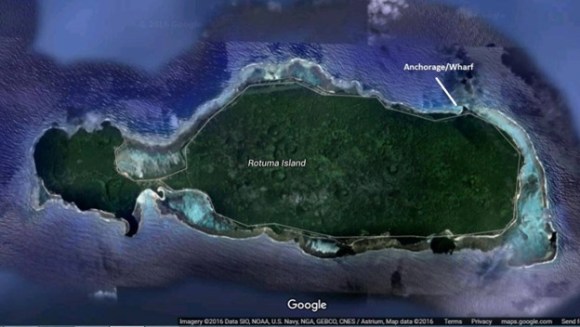
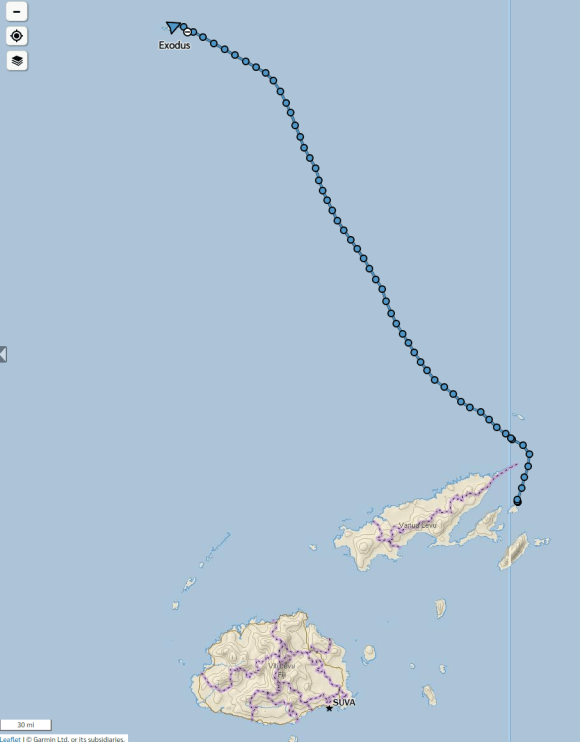
Rotuma is an isolated island located about 250 nmi north of the rest of the islands of Fiji. Although it is administratively part of Fiji, culturally it is like a different country, and the Rotumans are Polynesian rather than Melanesian. Rotuma is a young enough volcanic island to not yet have a fringing reef and lagoon, so the anchoring situation can be somewhat precarious depending on the weather. The main anchoring location is near the main wharf on the northeast side of the island. There is a little bit of a lip of land that can just protect you enough from the prevailing trade wind direction. Anything from the north and forget about it.
The Island of Rotuma
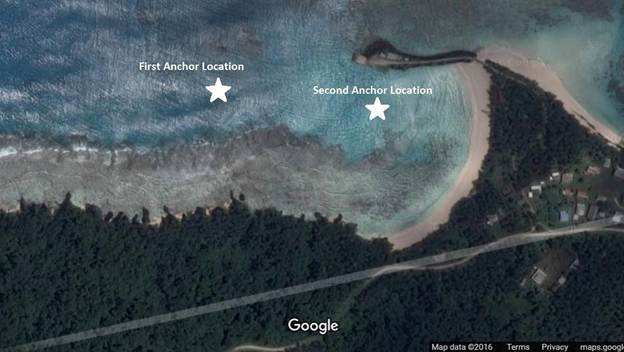
When we arrived (with very little light), there was one boat anchored outside of the main wharf area (s/v Navire), and one boat anchored inside the wharf area almost on the beach (s/v Menkar). We ventured inside and were promptly visited by a couple guys in a dinghy warning us that the groundswell from the north was causing breaking waves on the beach in the little harbor and it wasn’t that safe to be anchored in there. What about the boat already there? It turns out they have a retractable keel and they were able to tuck way up into the shallows behind the wharf, which was an area less affected by the swell. With not much daylight to work with we decided to just go anchor out and reassess in the morning. It was a bit rolly out there, but certainly not as rolly as being on passage, so we still all got a good night sleep. After two days the swell had subsided and we safely moved Exodus inside the little harbor.
Exodus anchor locations at Rotuma
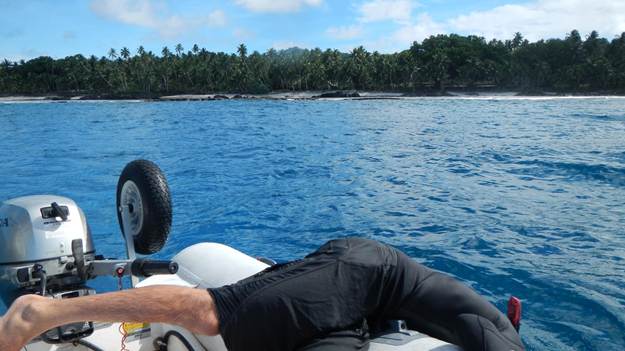
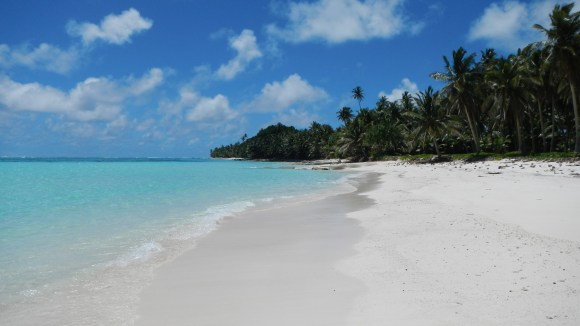
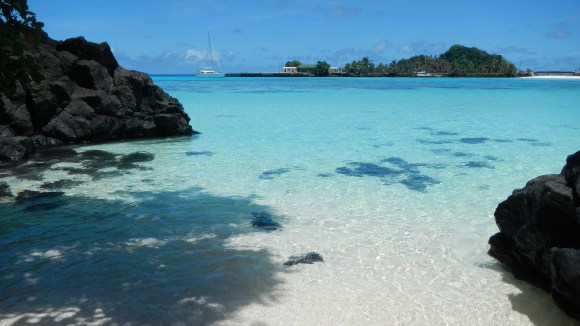
Rotuma has got to be one of the nicest places that we’ve visited. The geography reminded me a lot of Hawaii, with dramatic black volcanic rock and fine white sand beaches. Seriously, the beauty of this island cannot be overstated. The people here are consciously and actively resisting development and tourism. This place could easily have resorts all over it, but they don’t want it that way, and you just have to respect that. We were absolutely loving the warmer water too! It was a perfect 85 deg F, and I went swimming almost every day.
After our Rabi departure, the wind helped us out a bit by shifting to the SE making it easier for us to get up and around the NE corner of Vanua Levu. After that, the wind settled into a more ESE direction and it was dead downwind sailing the rest of the way. Exodus and crew love this point of sail. It’s not our fastest, but it’s by far our most comfortable.
It was sort of strange because this was our first offshore passage on which we were alone since our very first passage down from San Diego to Cabo San Lucas. We had grown so accustomed to having buddy boats around that we were feeling a little alone and isolated. The mahi mahi livened everyone’s spirits, though. Well, except for mine, because we caught it on the reel rather than the handline, and I really hate having to slow the boat down under sail. So, Tim and I got into our usual “playful banter” that goes something like, “Slow Down, you’re killing me!” “I’m doing my best, I don’t know why you use the reels anyway!” “Well, I’m so sorry that catching fish annoys you so much!” Yeah, yeah, playful banter. Good times. After the mahi there was a fishing ban in effect for all fish except yellow fin tuna. And we didn’t use the reel.
The morning of our second day on passage, I realized that we didn’t stand a chance of making it to Rotuma before dark, and this sort of realization can be quite dejecting. Even if a passage is mostly comfortable, it’s always better to be snug in an anchorage as the sun goes down. However, after Tim got up the wind really picked up and we were flying along. But it was still quite frustrating, because even at this windspeed we wouldn’t make before dark. Unless… we fly the spinnaker! Our spinnaker is not a light wind sail as some are. In fact, it won’t even stay full in less than 10 kts of wind. However, the last time we flew it in 20 kts of wind, as were the current conditions, Tim ended up with a broken toe during the dousing process. But desperate times call for desperate measures, so out came the chute! The worst part of the whole operation was turning into the wind (and 2-3 m swells) in order to drop the main. We even eventually got the spinnaker down without any drama. And thanks to the spinnaker, we were having safe arrival drinks in the cockpit as darkness arrived.
However, we barely made it in time. We were pulling into the anchorage with only the lighting of dusk to see by. There isn’t a fringing reef or pass to worry about, but there is a little bit of reef that sticks out here or there as well as some scattered bombies, so there is no way we would have been able to approach the island at that late hour without satellite imagery to navigate by.
Our intention was to leave Rabi in the early evening for the two-day passage up to Rotuma. We got a bit of a late start due to an issue with the port engine. And now, since I am the one who writes these narratives, I get to be the one to tell my side of the story. I would like to take the opportunity now to say that I had been telling Tim since Savusavu that the port engine was exhibiting off-nominal behavior at start up. What I had noticed, and what I had communicated to him, was that it would take much longer than normal for water to start coming out, and that the first burst of water wasn’t a burst at all like it normally is, rather it was more of a trickle, and it would take some time for the bursting behavior to build up. Tim’s response to this was to lecture me about how the impeller and water-cooling system works, and the behavior I was observing was clearly consistent with the way it works. Well, that may be, but all I know is I have been starting the engines for almost three years, and what I observe now is different behavior than what has always been “normal.”
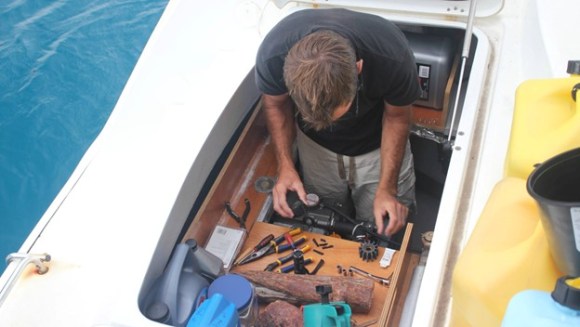
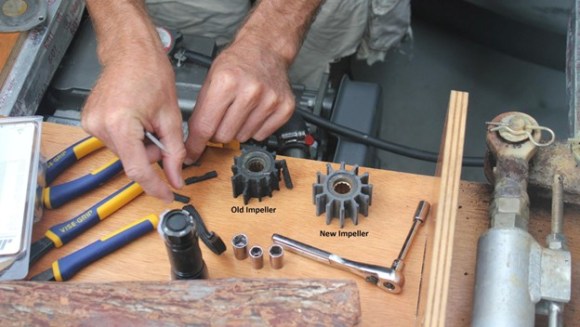
Anyway, this time, when we were ready to depart Rabi and I started the engine, no water at all came out of the Port side. When it became obvious to me that no water was going to come, I quickly shut down the engine. Tim had me restart it so that he could see for himself, and then he went into trouble shooting mode. Luckily, this wasn’t too hard to troubleshoot, since the intake impeller is the obvious first place to check. Sure enough, our impeller had pretty much shredded to pieces and had only one of its original 12 “blades” still fully in tact. We had a spare, Tim replaced it quickly, and off we went. And I didn’t even say “I told you so.” (Not then, anyway.)
Tim in the engine compartment changing the impellerOld and new impellers
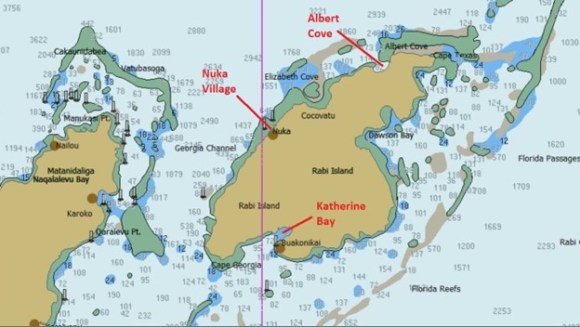
For obvious reasons, we got a late start leaving Somosomo for our daysail up to Rabi Island. So, after making our way through the reef system labeled “Florida Reefs” on our open CPN charts we knew we wouldn’t make it any further than Katherine Bay on the south tip of the island before darkness set in. Neither Open CPN nor Navionics are very accurate for all these reefs, so we relied mostly on satellite imagery and our own eyes for all of our navigation.
Rabi Island
Katherine Bay is a beautiful, lush, green bay lined with hills and mangroves. Our first anchor attempt was way up into the head of the bay, but it did not seem like good holding and the anchor didn’t dig in after a couple tries. So, we moved out a bit to the anchor waypoint listed at the end of this post. We had a quiet evening in Katherine Bay without even leaving the boat, and in the morning, we were off to make our way up to Albert Cove.
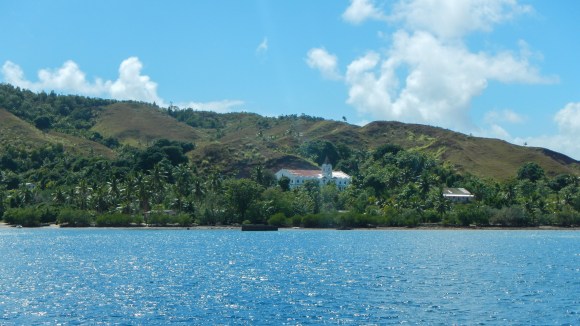
A church on the hill at Katherine Bay
On our way up to Albert Cove we made a brief stop at the main village, called Nuka. We had gotten the impression either from something we had read or something someone told us that we needed to go to Nuka to check in with the local police and request permission to visit the island. It turns out that really wasn’t necessary. In fact, they asked us why we come to check-in; don’t we know that Rabi is part of Fiji? So, maybe now is a good time to explain that the people of Rabi are not native Fijian. They are from an island, which is now part of Kiribati, called Banaba and formerly known as Ocean Island. They were relocated to Rabi shortly after WWII because their island became barely habitable due to phosphate mining by the British and then the invasion by the Japanese during the war. Their story is a sad one as they seem to have gotten screwed from every direction. This website is a good one for more information if you are interested: http://www.banaban.com/contents/en-us/d17_Banaban-historical-overview.html
Today, they seem to be doing OK being administratively part of Fiji, however their infrastructure was a bit tired as it was obviously decades old. During our brief visit to Nuka, we found the people, on the surface, to be much less friendly than the Fijians we had grown accustomed to interacting with. They reminded me much of the Tongans; it’s not that there’s any ill feelings towards you, it’s just that they are not so extroverted as the Fijians. We seriously could have walked through the whole town without anyone talking to us, but we know better than that by now, and we stopped and talked to several people, and they were all nice, helpful, and curious about us. It’s just that we had to make the first move. They seemed pleasantly surprised when we greeted them with, “Mauri,” which is how you say hello in their language, Gilbertese, instead of the well-known Fijian, “Bula.” The “anchorage” at Nuka isn’t ideal, so we didn’t want to leave Exodus unattended for too long, but we visited a couple shops and stopped to talk to some moms who were gathered near the school. We also had a short conversation with a teacher, so we learned that their school system is integrated with Fiji, so in addition to their own Gilbertese language, the kids learn English AND Fijjian.
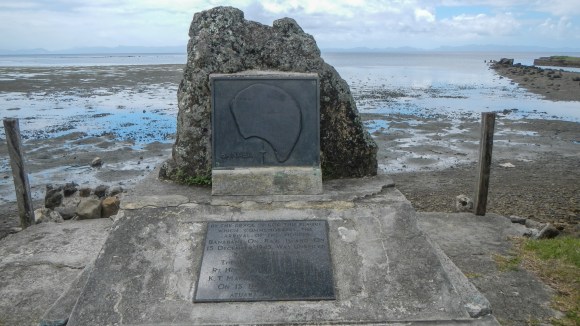
The wharf at Nuka villageThe primary school in NukaA tribute to the Island of Banaba
As we transited between Nuka and Albert Cove, we stayed inside the reef, and it was easy to navigate and spot the bombies, since we just kept a lookout the whole time. As we arrived at Albert Cove we saw two boats already in the anchorage, so I can’t say that we got a prime anchor location. And as luck would have it, a squall blew through and it poured down rain on us just as we were dropping anchor. Oh well, I guess Tim needed a shower anyway.\
Exodus anchored at Albert Cove
One of the boats already there was one I had briefly met in Savusavu. They are a memorable couple, because they are from Israel, and you don’t meet many cruisers out here from Israel. They invited us over to their boat, and it’s always nice when people love their boats, but this guy was way over the top. The whole afternoon turned into a “look how cool my boat is” session. It was a very nice boat, and he has obviously put a ton of thought into it, but he has also obviously put a ton of money into it. As he was borderline lecturing us on safety and how he has redundant EVERYTHING in his boat, I wanted to say, “you know most people don’t have the budget for that sort of redundancy and they have to put careful thought into their prioritization rather than achieving safety by brute force spending…” but I held my tongue. Anyway, after we were back on Exodus, Brenden asked, “Where’s Israel?” and I realized perhaps I needed to step up on the geography education. I told a friend about Brenden’s lack of knowledge about Israel, and the response was classic, “what kind of American are you?”
In Albert Cove there is a family who lives on shore: husband, wife, and wife’s father. Their two kids live and go to school in Nuka, and some weekends they come to stay with their parents here in Albert Cove. There also seemed to always be a group of fishermen there with them, and they liked for us to use the binoculars to look for birds before they headed out to fish. The woman’s name is Maria, and she was quite friendly, and I went ashore a couple times just to hang out and chat. One day she took us on a guided hike to the other side of the island. It was a pleasant hike, and on the other side we met a family who had just arrived and was going to establish themselves on their family land. The man’s name was Tarawa (easy for me to remember because that is the capital of Kiribati). He has had a long career in Suva, and now, you could say, he is retiring and settling here with his family. Even though they had just arrived by boat the day before, their hospitality was impeccable, and they served us what I think was warm, sweetened milk.
Having a rest during our hike with Maria
One evening, after dinner and after the darkness had set in, one of us, I don’t remember which one, noticed a fire on shore. Now, people often burn trash, so we are used to seeing fires and smoke coming from the kind of places that might make you a little nervous back home. But this fire seemed different. It grew quickly in intensity, seemed quite uncontrolled, and seemed to be coming right from where Maria’s house was. “I’m sure it’s fine,” was our first split second reaction, but then that was quickly overcome by, “but what if it’s not?” So, we rushed to shore with all the buckets we could find hoping we would get there in time to help before everything went up in flames, and when we got to shore Maria calmly came out to greet us. Everything was fine, of course, and her father was just burning some trash. Silly palagis.
On the morning we were planning to depart, we went to shore to say good-bye with a few thank you gifts in hand. Maria and her husband weren’t there, it was just Maria’s dad and a man called Teri, who also lives nearby in Albert Cove. We left some magazines and a cleaned-up, fixed-up pole-spear that Tim had once found while out diving. Later, just before we were ready to depart, Teri swam out to Exodus in order to give us a lobster for the passage. Brenden called dibs, but he’s a crazy kid.
When we finally had a good wind angle, we made an early morning departure for a day sail up to Somosomo, Taveuni. It was a fast sail, close hauled with 20 kts of wind, and I have to admit that after a late-night drinking rum with Breeze I was just a tad bit hung over for this passage. Finally, we got in the lee of Taveuni, and the wind totally died, so we motor-limped up through Somosomo straight (between Taveuni and Vanua Levu) and anchored off the town of Somosomo.
As we approached, we got a VHF call from Fluenta, and they were anchored just a little ways north, and we arranged to meet up in the morning to hit the veggie market and say one last good-bye. Immediately after that call, we got a call from a boat called Ariel IV. They are a Swedish couple who cruised before with their kids when they were young and are now doing it again just the two of them. We had heard about them from both Breeze and Field trip, because they were also planning to go up to Marshall Islands. It was great to make contact and exchange email addresses so we could hopefully meet up somewhere on the way north. (Spoiler alert: it turns out to be a very good thing we had “Dr. Eric” in our Northbound Fleet.)
We spent the evening getting our last internet fix for a while, and then in the morning we went ashore to see Fluenta. Liz and I rode with Max’s parents down to the next town to the south, I think it was Waiyevo, to buy some fresh fruit and veg. It was no Savusavu market, but it did the trick.
The vegetable stalls near Somosomo
In the meantime, the kids hit the MH grocery store and shared one last tub of ice cream together, for old time’s sake. I found myself focusing on the little bit of provisioning I wanted to do instead of on my last bit of time with Liz, but fortunately email reaches us wherever we are, and we’ve been able to stay in close contact as they headed south back to New Zealand, and we headed north to sweat our butts off.
Finally, we had to say good-bye to Fluenta. And a sad good-bye it was, indeed. It was especially sad to think that little Benjamin likely wouldn’t remember us. The boys had grown quite fond of him, and I think the feeling was mutual. Benny, as the kids call him, loved to come to Exodus and play with “Aggie” and “Bummie.” As he was just beginning to talk, these were his personal versions of “Alex” and “Brenden.” He had an extra special name for Tim which originated from our time in Suva together. One night at a yacht club happy hour Tim took Benjamin around looking at the geckos on the walls and ceilings, so of course Benjamin knew Tim only as “Gecko.” (He never did say my name while we were together, but Liz assured me that we separated he would often randomly list off our family members, and sooner or later my name was included too.)
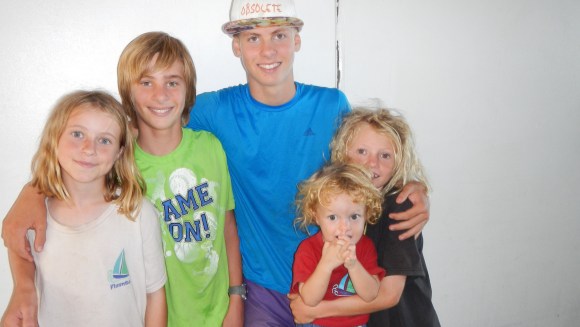
Close as cousins, this group. Victoria, Brenden, Alex, Benjamin, and Jonathan
After being spoiled in Savusavu with easy running opportunities, we spent almost a week moored in Dere Bay on the northwest side of Koro Island. Koro is about 25 miles south of Savusavu and we had an easy day sail with light NE winds. When we arrived, we found Koro to be an enjoyable yet strange kind of place. It’s an intersection of traditional Fijian village life with western culture, but the western part does not dominate in such an offensive way as it does over on the dry side of Fiji in places like Port Denarau, Musket Cove, and even up into the Yasawa Islands. There are 14 villages on Koro, and our first afternoon we walked to the village closest to the anchorage, called Nabasovi, in order to present sevusevu to the chief. As we got to the village, the first people we encountered were a man, his wife, and their grown son, who were all sitting on a large woven mat in the shade. They motioned to us to come and sit with them, and we chatted a bit while the wife bounced their young grandson to sleep on her knee. They didn’t automatically assume we were from a boat, and they seemed just a bit surprised when we said we wanted present sevusevu. The son went to put on a sulu, and he acted as our spokesman with the chief, and after the brief sevusevu ceremony we had a nice visit with the chief and his wife.
It turns out that the likely reason they didn’t automatically assume we were from the yacht is that in addition to the two resorts at Dere Bay there is a small expat community who also live on the island. So, there are always white people about. And new white people are not always there to do sevusevu, as it is in some of the villages we’ve been to on other islands where the majority of their white visitors are from yachts. As an aside, the Fijians call white people “Palagi,” but we aren’t sure if it’s just a label or if it’s somewhat derogatory. Tim always refers to us a Palagis with them, and they always laugh, but I can’t tell if they are laughing because they think it’s funny just because he knows the word or because he’s actually saying it. I should have just asked by now, and if we come back to Fiji, I think I will.
Anyway, back to the expat community… there are western style houses, some quite luxurious in size, dotting all the hillsides around the bay. Tim and I took a walk, and the place is partitioned into at least a couple hundred lots, some with complete homes, some in various stages of construction, and some totally empty except for the wooden sign with the lot number. We met a few of the people who live there: A woman from Brazil, a man from British Columbia, and a family of 5 from Colorado. They were all very low key, down to earth people who enjoy the slow lifestyle and natural surroundings. And they seem to get on well with the locals. The Colorado family’s eldest son (9 years old, I’d guess) even attends the Fijian school and sometimes stays in the village. He has a “village family” that he stays with. As I mentioned, many of the lots are empty and a lot of the construction is halted, so it’s not like the expats have totally overrun the place. They seem to coexist there in more inconspicuous way than perhaps my cynical self was expecting.
I mentioned that there were two resorts in the bay but let me explain. I’m not sure what the business model is for these places, but they can’t be making much of a profit since we never saw any guests! Dere Bay Resort has a long wooden dock that extends all the way out over the coral and at the end is a floating dock where we could tie up the dinghy. Once you’ve made your way up the dock to the resort you see the small pool and the shady, welcoming restaurant/bar area. Except that there was never anyone there. Often not even any staff. It was $10/night for our mooring ball and in the end, I was having trouble finding someone to pay, because the staff was so scarce. Our last afternoon there, some of the expats were using the pool and they told us the resort does dinner on Saturdays, and since that day was Saturday, we tried to put in a reservation. It wasn’t until late in the afternoon that someone showed up, but they very graciously accommodated us. So, we had dinner at an almost completely empty restaurant, but the company was good, and the view was stunning. There was one other table of expats having dinner as well, and I think if it weren’t for their reservation the restaurant would have been dark that evening just like every other evening. Clearly, this resort does not exist strictly to make money.
If I were told about a beautiful coral lined bay with a lush green hillside that has two resorts and a resident expat community, I would naturally envision a bustling, thriving atmosphere, with happy hours at the bar and dive boats taking the tourists out to the reefs a few times a day. But that’s just it. This place was empty. Still. Quiet. Sometimes it was quiet the way an uninhabited island is quiet. So, in the end, we quite enjoyed Koro for its beauty and for the unique culture “clash” we observed. Unique because it didn’t seem much of a clash at all.
The opportunities for running on Koro weren’t great, but at least they existed. There’s a network of cement and dirt roads, but some of the hills are quite steep, so in the end I opted for running along the trail that we took to get to the village. The small muscles around my ankles were sore the next day from stepping carefully over roots and crab holes. I was also careful not to get too close to the village because I was wearing short running shorts and a tank top, not my usual village attire covered from my shoulders to my knees. It is getting hot now in Fiji, because summer is just about here, so I had to go somewhat early in the morning before the heat was too stifling. It was a Saturday morning, and I met two girls from the village walking down the beach to collect shells. They seemed curious about what I was doing and laughed because when I stopped to talk to them I was out of breath. I guess none of the expats are runners.




 Gresham Family Exodus