Categories
Uncategorized

Our First Grog

As things were winding down at the beach picnic, discussion turned to the kava party (aka grog) they would have that evening. They insisted we were all invited, so, not wanting to miss a party, we raised anchor and moved over to the village for easier access.

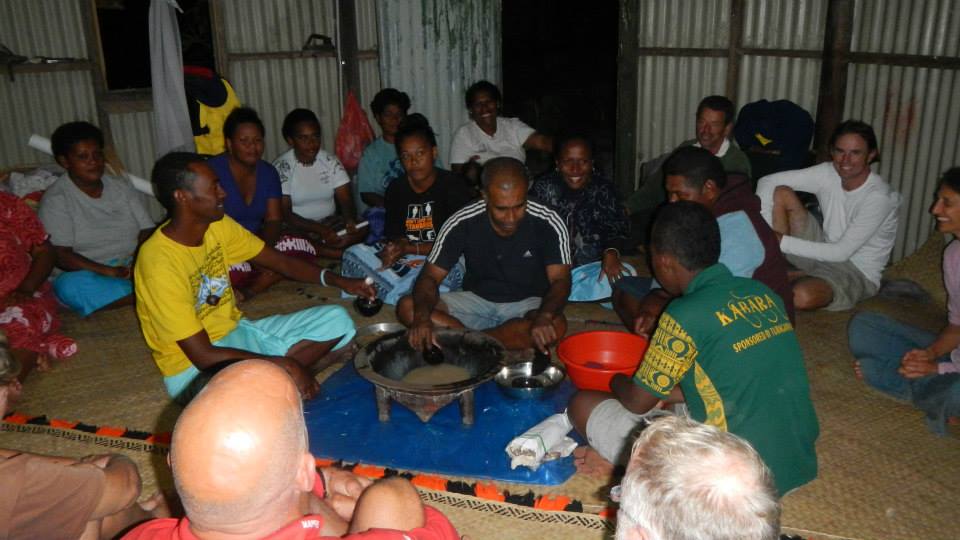
A grog is basically a social gathering for drinking kava, which is a drink that is made from a powder of dried, ground pepper tree root (called yaqona, the same stuff we present to the chief for sevusevu). Kava is very important in Fijian culture, not just because of the physical effects it has on you, but because of its central role in the social aspect of society. We’ve been told that they drink kava every night. Not always in huge gatherings or big parties, but often, even usually, with a small group of friends or family.

When we first arrived at the grog, it was mostly yachties and only a few locals, and somehow our friend Hans (s/v Nautilus) was whisked off to another, apparently more exclusive, grog with only locals and for a while we were wondering where he was. When he turned up a little later, he hung out for a while, then said his party was better (smiling the whole time) and went off again. Feeling not a little bit jealous to be at the grog with more white people than locals, I was happy as that changed as the night progressed and we drank round after round of kava.

They make the kava right there by putting the ground uproot in a mesh bag and swishing and squeezing it in the water. They serve it out of a large hand carved kava bowl with small coconut bowls and when it’s your turn to drink you can request, “low tide, medium tide, high tide, or tsunami.” When they offer you the bowl to drink, you clap your hands once and say, “Bula!” then it’s down the hatch all at once. When you are done you say, “Maca” meaning empty, and everyone claps three times. Then it’s the next person’s turn. (Although later I learned that you are only supposed to say “Bula” and “Maca” for your first bowl and then after that you don’t say it. But it has also been made clear a few times that the specifics aren’t so important in these social grogs, just have fun and enjoy the company.)

After each round the server waits for the caller to yell, “Taki” meaning something like “let’s drink” before the next round can begin.

The Kava here in Fiji seems to be much better than what we drank in Tonga, and it also seemed to get much better as the night progressed. Eventually, there was singing and dancing, including a conga line that somehow, I ended up leading. During the evening Tim made a friend, Tai, whom he chatted with for a while, and when the dancing started, Tai leaned over and told him, “If we act like we are having a very important conversation then we will not have to dance.” Needless to say, Tim was grateful for that! The next day, Tim repaid him with a couple of barracuda.

I have no idea how many rounds of kava we drank, but I think it was more than 10 and less than 20. It’s difficult to describe what its effect feels like. There is a definite numbness to the lips and tongue that you feel right after each drink and seemed to intensify as the rounds racked up. Towards the end I was feeling the numbness all the way down in my throat. When I was feeling like it was time to go, I was at a loss of how to politely extract ourselves, but then the locals took care of that for us. At some point, they basically told us it was time to go.

Now, they say the kava doesn’t make you drunk and that it’s not a narcotic. But when we got up to leave, I felt seriously bad. It was a lot like being drunk, I felt weak and nauseous, and I stumbled about a bit, but it was distinctly different as well. I finally nailed it this morning: it was like being physically drunk while still having a clear head. And luckily, no hangover! On the walk back my friend Gennie distracted me from how bad I felt by talking to me and by the time we got back to the boat I just collapsed in bed.

Categories
Uncategorized

Kid Boat Corner

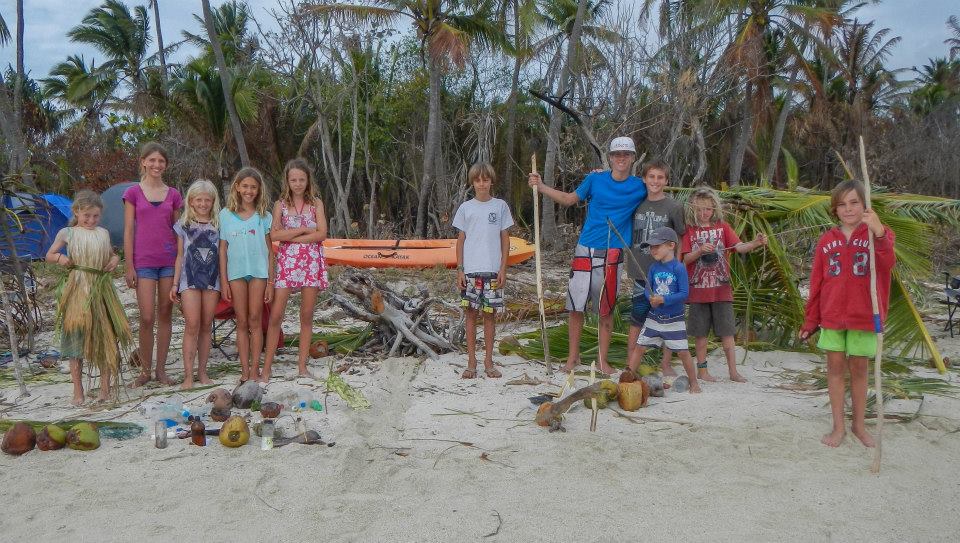
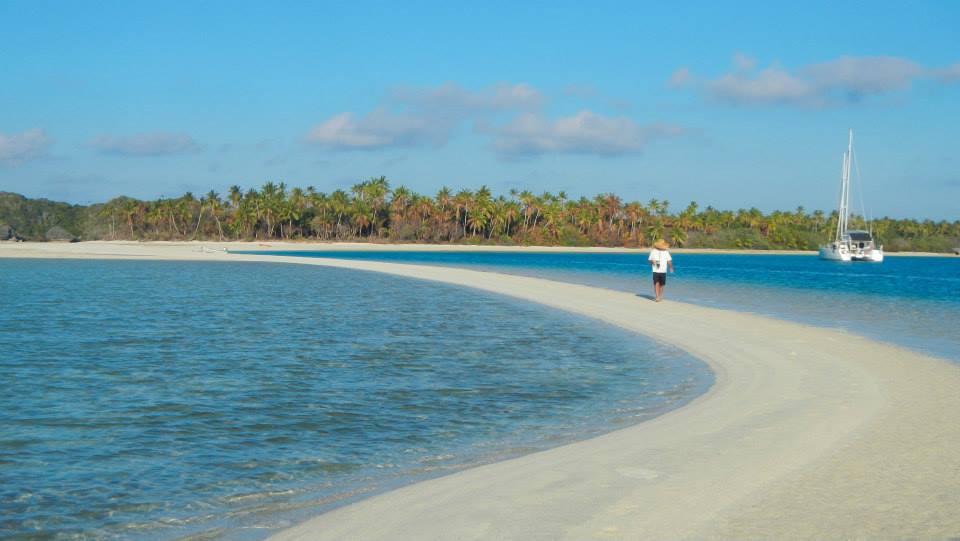
Our favorite anchorage in Fulaga was at “The Sandspit,” aka “Kid Boat Corner” and the only downside was that it was far from the pass, so it was quite a dinghy ride for the spear fishermen. However, for the rest of the family it was a great spot. The anchorage had very good holding and it also had great protection, so it was a preferred place to be during periods of very strong trade winds. There is an absolutely gorgeous white sand beach that almost entirely disappears at high tide, however at other times it was the perfect place for me to go for a run or for the kids to play. Even with the disappearing beach, the kids were able to stake out a spot that stays dry, and that’s when construction of kid boat village began. They built huts out of tree branches and palm fronds, and they pitched several tents and lived there for the better part of four days. Brenden was the exception: he spent his days there, but he chose to sleep in his own bed on Exodus rather than on the beach because, well, he likes to sleep. Alex, on the other hand, I hardly saw for the whole 4 days. It seems like the kids only interacted with the parents when they needed to restock their food supply. They drank coconuts, cooked breadfruit on the fire, and even cooked most of their meals on the fire as well. One evening the parents joined the kids on the beach for a bonfire and a potluck dinner, but the kids made it very clear to us that is was their expectation that all the parents go home after sundown!

The Sandspit

There were twelve kids in total ranging from Age 13 (Alex and Ainara) down to age 5 (Nils). I loved watching Alex and Nils together. Nils was always sitting with Alex on his lap, and he was so excited that he got to sleep in a tent with Alex. They reminded me of a group of cousins where the oldest and youngest have a tendency to bond.

One day, Tim organized a beach scavenger hunt for the kids. He printed out a list of approximately 35 items for the kids to find or make, like “a live creature,” “a woven mat,” or “3 coconuts for drinking.” The kids broke up into two teams with boys against girls, and they all spent a couple of hours doing their best. Wow, what a great job they all did. There was a perfect palm frond dress (made by the girls) and a bow and arrow (made by the boys). There were hermit crabs and heart shaped sandcastles. Tim even conned them into cleaning up the beach a bit by putting “10 plastic items” on the list. All the parents were on hand with cameras and smiles while the judge gave rulings and the scores were computed. The girls eeked out a win by only 3 points in the end, and it turns out that being able to make a woven beer cozy was the difference. Later, when we were all back on our boats, the girls from Lumbaz radioed and gave Tim an exceptional lyrical thank you for organizing the game for them. It was very sweet. Then, a little later, Hans, the dad from Nautilus, in a bit of a parody, radioed and gave Tim another lyrical thank you for helping him to learn to spear fish. Both Alex and I had the same independent thought, “well, it could be worse, it could be the wind turbine song!” (For those that don’t know or don’t remember, Exodus is only powered by solar, but in addition to solar, Lady Carolina also has two wind turbines. In a fit of mad creativity or peraps a rum stupor, Steve once sang us an ode to his wind turbines over VHF, and unfortunately, it’s a tune that is hard to forget!)

Boys against girls scavenger hunt

On another day the parents organized spear fishing and snorkeling in the pass, but the kids opted to stay in their village on the beach. Since all the parents would be in the water and out of radio contact, I suggested maybe we hand a few safety rules down to the kids while we’re gone. We decided to tell them, “No climbing coconut trees,” and “No machetes.” There, that’ll keep them safe, right? When we got back and asked them what they did all day, it turns out they had a sparring tournament with long sticks. Apparently, Gigi won, and only a few cuts and bruises were had by all. I guess it wasn’t enough to say no climbing trees and no machetes, we forgot to tell them not to hit each other with large, sharp objects. Priceless!

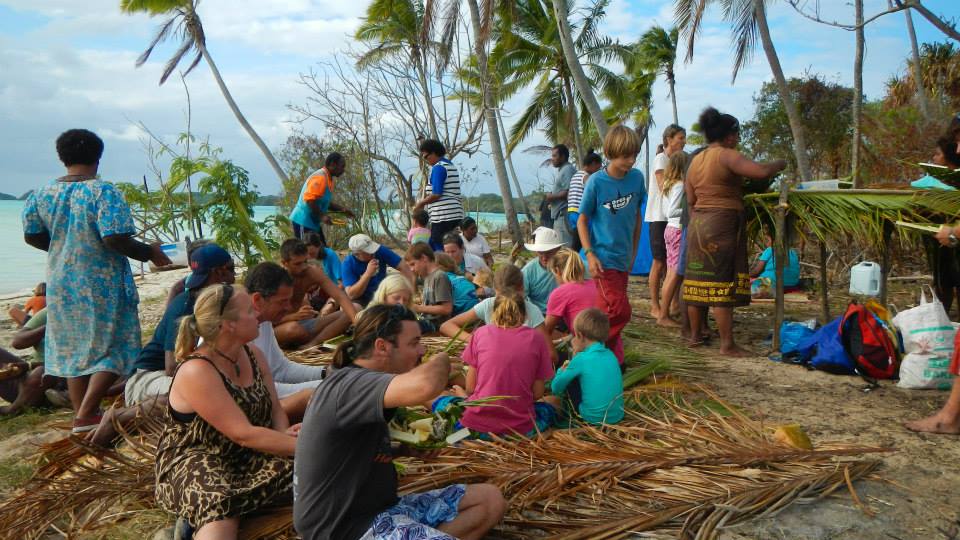
One of the best days at the sandspit anchorage was when we had a big picnic with people from the village. Two of the boats that were anchored near the village, including our friends on Lumbaz, ferried about 30 people from the village over to the beach near us. They put kasava in a lovo (underground oven), fished, caught crabs, dove for clams, made a table out and plates out of palm leaves, made coconut milk, and basically made sure that all of us yachties had a great time. I tried everything, even the raw clams and the crab guts, and they even seemed to like my pasta salad.

The beach picnic

We anchored four different places in Fulaga including near the pass and near the village, and Kid Boat Corner was by far our favorite.

Categories
Uncategorized

Our First Sevusevu

When we arrived in the anchorage near the village in Fulaga, Lumbaz had already been ashore and spoken to some people. They said it would be best to come back to the village at about 4pm, because during the day everyone is going to do some clean up on one of the beaches. We were glad to hear this, because we are always tired when we arrive, and this gave us some time to relax and settle in after the passage before getting dressed up and going ashore. In the meantime, Nautilus arrived, and this also gave us some time to catch up with them.

All three families went ashore together, and it was about a 20 minute walk over a hill from the anchorage to the village. There were friendly greetings from everyone we encountered, and we were soon guided to the Chief’s house to present our sevusevu. The Tauranga Ni Koro, or village headman (government, not tribal) went with us as our spokesman with the chief. Each family gave a bundle of Yaqona (dried pepper tree root from which they make kava, aka grog) to the Tauranga Ni Koro and we all sat in a circle in the chief’s house. The Tauranga Ni Koro presented our gifts to the Chief, and then an entire ceremony ensued in Fijian. There was much clapping, and I was never quite sure when were the right times for *us* to clap. Anyway, at the end we were advised that we were accepted as part of the village. Then the chief had each one of us approach him to personally introduce ourselves and tell him where we are from. The cutest was when 5 year old Nils from Lumbaz went up.

At the end of the ceremony, we were informed of the $50 per boat anchoring fee, but this was no surprise as we were well informed about this ahead of time. The $50 fee is for unlimited duration; you can stay as long as you like (within the limits of your visa, of course.) But what *did* come as somewhat of a surprise was that each of us was assigned a “host family” and it was explained that our host family is so that we always have a place to go in village when we come ashore. As the assignments were being made, I couldn’t quite tell based on the discussion in Fijian if our host family was happy or disappointed to get the Americans (the other two families are from Spain and Belgium).

Categories
Uncategorized

Fulaga (pronounced Foo-LONG-a)

Originally posted on June 13, 2015, by cruisingrunner

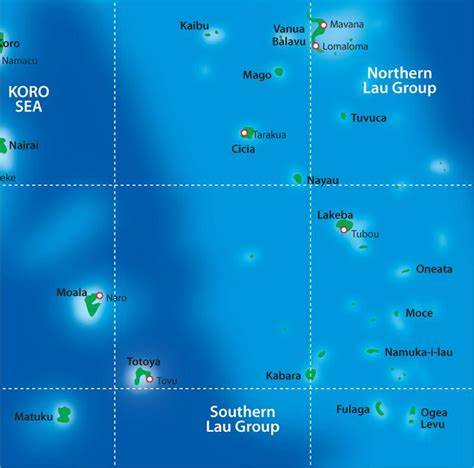
We beat to weather for a day and a half to get here, but it was worth it for so many reasons. Fulaga is in The Southern Lau Island group in Fiji, and on a rhum line from where we were in Taveuni, it is about 150 nmi at a heading of 145 deg true, which is SSE. Since the trade winds blow from the E to the SE, you can see why trying to go SSE might be a bit difficult. We basically picked a weather window where we could sail close hauled at a good speed and then the winds died, and we motored east. It was bumpy and bouncy pretty much the whole way, but like I said it was worth it. And here’s why:

1) Fulaga is somewhat off the beaten path. Within the big picture of tourism, it is actually TOTALLY off the beaten path. There is no tourism here. There is no airport and no cruise ships come here. A total of about 400 people live on the island spread across 3 villages, and here is largely subsistence living. A supply ship comes once a month with petrol and other items like flour and sugar. To pay for their shipments they export hand carvings to Suva to sell to tourists.

The reason I first said “somewhat” off the beaten path is that cruisers do come here, but it’s not on the main circuit. Mainly, because it is a pain to get here since, as I mentioned above, you have to beat against the trade winds to get here from any of the official ports of entry. Our track from Minerva Reef to Savusavu passes very close to here, but we couldn’t stop on the way, because you have to officially clear in to an official port of entry before you can visit any of the other islands. In the village here, they told us that last year they had a total of 60 yachts visit, and they are very proud of this growing number and the fact that people seem to always stay longer than they originally intend and that some yachts even return the following year. We were the fourth boat to sign the guest book this year.

2) It is absolutely beautiful. This is something I simply cannot describe with words. When we have internet, I will have to include some photos.

3) The people are hospitable and courteous. After completing our sevusevu with The Chief and being accepted into the village, we were assigned to a “host family” and it turns out our family’s clan is the chief’s clan. Our hosts are Simon and Senna, and Simon is the chief’s son. He explained to us that in the village there are many clans and each clan has a responsibility. For example, one clan has the responsibility for fishing, and another has the responsibility for managing water and food supplies.

We have heard from other people about islanders always asking for things and wanting the cruisers to fix their stuff (outboard engines, etc.) and we have had a few experiences along those lines ourselves. We are always happy to trade, donate, and help out, but it always feels a bit hollow when it’s continually asked for and expected. Here, it’s like there must be some sort of rule that the villagers not harass the yachties. At the sevusevu they request a $50 (Fijian) payment for anchorage in the lagoon. While some people have a problem with them charging an anchorage fee here, I don’t at all, especially if it’s part of what’s influencing their behavior towards us. I am suspecting that the fee they collect from us puts us on equal footing, from their perspective. They don’t need to try and get stuff from us, because we are paying them to be there. I think it’s a much more respectable position for them to be in. Yesterday, they also had a small market and fund raiser (for the school I think?) where they sold food and crafts to the yachties. I wasn’t able to go, but in theory, I really like the idea. Again, they aren’t just asking for stuff, they are providing goods and services in return for payment. When we were having lunch with Simon and Senna, Tim kept asking about community projects and if they needed or wanted any help for anything. He basically offered to help them fix anything that might need fixing and while Simon never said, “no,” he also never jumped at the chance like we were expecting based on stories we’ve heard from friends about other islands. They mostly just seem to be interested in sitting down and talking with us and serving us loads of food.

We joined them for church on Sunday, in fact, all of the cruisers here in the atoll went in for church. It is a Methodist church, and the entire service was in Fijian, but the singing was amazing. However, between the singing and the sermon, one of the men stood up and addressed us in English and welcomed us and asked us to bear with them as they have the service in their own language. It was a nice gesture.

Sort of a cute side story… our first evening here, Senna served us these little muffins with tea, and Brenden was hungry and seemed to really like the muffins so he had a couple. Senna was so pleased she kept offering him more and smiling and laughing, and in the end he ate something like 8 of them. The next time we went for lunch, after enjoying fish and rice and taro root there was some speaking and laughing in Fijian and the only word I recognized was “Brenden.” Then Senna brought out a huge plate of the muffins and set them right in front of Brenden. She was so tickled by how much he liked them, and she let him bring all the leftovers back to the boat.

Today, some of the people from the village are coming over to the beach where we are anchored to fish and catch crabs, and they said any of us can join them if we like. Then we will have a big picnic on the beach for lunch. The weather is pretty crappy; gray skies and 20 knot winds, so I hope it isn’t canceled, but we’ll see.

4) The geography is stunningly unique. We have been to many volcanic islands before, and we thought we had seen pretty much every stage in the life cycle, from the tall peaks of The Marquesas to the low lying atolls of The Tuamotus, but this one is unique to us. It is an atoll, with a pass and a lagoon, but it’s younger than the ones in the Tuamotus, so there is still a lot more land and there is even some elevation to the land. In fact, we have to walk over a hill to get from the anchorage to the village. It is older than the islands in The Societies, like Bora Bora, that have a large island in the middle of the lagoon, but unlike The Tuamotus, there are still small islands within the lagoon not just coral heads, and one of them is even inhabited. One of the most striking features has to be the small, mushroom shaped islets scattered around the lagoon. They give the geography some depth as you visually survey your surroundings, rather than just the uniform sea of turquoise of an older atoll.

5) The anchorages are numerous and flat calm. Between the fringing coral reef and the remaining fringing islands with their hills and numerous palm trees there is ample protection from the wind and sea of the Pacific Ocean. As I type this we are having 25 knot winds and, at least according to the forecast, something like 3 meter seas outside, but we are sitting on dead calm water as comfortable as ever. And if the wind direction changes, there’s another anchorage to go to in order to avoid a lee shore fetch within the lagoon. And when winds are light, you can pretty much anchor anywhere. We spent a couple days anchored near that pass when the weather was calm in order to enjoy easy access to pass snorkeling.

6) The underwater life is breathtaking. In this case I’m speaking from limited exposure and hearsay, since I don’t actually get in the water too often. The one pass snorkel that I did was during non-optimal conditions: on a dropping tide so the current in the pass was outgoing meaning poor visibility. If you go during a rising tide with the water rushing into the pass from the ocean, the water is much clearer and the visibility obviously much better. However, even with that “poor” visibility, it was very nice. All of the coral was alive and thriving and there were so many fishes of all sizes. In the area of the pass where the current flows the strongest there was a bunch of soft coral, not brightly colored, but still stunning as it flowed and swayed with the rushing water. We also snorkeled on a coral head in between the fringing reef and one of the islands, and it was every bit as good as the snorkeling on coral heads we did in Raroia (The Tuamotus), which at the time I described as snorkeling bliss!

7) There are white sand beaches, good for camping and running. For many days we anchored near a sandspit adjacent to a long white sand beach, the only thing was that it almost completely disappeared at high tide. That did not discourage the kids, though. Our first afternoon there, construction of the kid beach village began. They cleared a small patch of land that would stay dry as the tide rose, and they built huts of branches and palm fronds, pitched a total of 5 tents (4 for sleeping, one for “storage”), and kept a fire burning pretty much 24/7 (only having to call for help with the fire once.) They climbed the palm trees for coconuts and made things like woven mats (girls) and bow and arrows (boys). They slept there for three nights and even cooked some of their meals there. They loved the the freedom and adventure of it all.

The kids are not the only ones who have enjoyed the beach. At the right tide level, it was nice for long walks, sunset yoga, and of course, running. Our first morning I had to hit the beach at about 6:30am in order to run at low tide, but each day I was able to go a little bit later. It’s not too warm here, so running well after the sun rises isn’t a problem.

8) We have good friends here with us to share this experience. A place like this can only be made more special if you have special people to share it with. Out here, when you say good-bye to people you can never be quite sure you will see each other again, because we all have our own paths to take, and even if you make tentative plans, plans can easily change. Here in Fulaga we have had the good fortune to reunite not with just one, but four other buddy boats that we have previously spent time with. Two of them, Nirvana and Nautilus, left New Zealand about 3 weeks before we did, and we never knew if we would catch up. One of them Fluenta, left New Zealand after us bound for Tonga, so we certainly never thought we’d see them again at least in the near term. But they changed their plans mid-voyage and here they are in Fiji with us. The last one, Lumbaz, left New Zealand at the same time we did, and we had a lot of fun with them in Minerva Reef, but once getting to Fiji, who knew if our paths would lead the same way. But here we all are, in one of the most remote places in Fiji, together. The kids are having a great time, but don’t think it’s just the kids who are enjoying each other. It’s a great group of parents as well, and we are developing quite the little community. Thinking back, it’s pretty much the same group of kid boats who were “stuck” at Big Mama’s together in Tongatapu at the end of last year, waiting for a weather window to head to New Zealand. We know this little community is quite temporary, but we are enjoying it while it lasts, and it definitely has a positive impact on my overall impression of our experience in Fulaga.

I cannot stress enough that if you ever cruise the south pacific, this place is an absolutely DO NOT MISS. And I don’t toss those words around lightly. We currently have no plans for leaving, so I have no idea when we will have internet again. However, when we do, I will be sure to post some photos, which will almost certainly not do the beauty of this place justice.
Categories
Uncategorized

Bash to Fulaga

As we were prepping to drop the mooring at Paradise and depart for Fulaga, we had VHF radio contact with our friends on the boat Lumbaz, and they had departed Savusavu earlier that day and were also heading to Fulaga. They also told us that Fluenta would likely be departing the next day from Savusavu, so we were happy to find out we would be a party of 3 kid boats.

The weather window we picked wasn’t ideal, but it would get us there. With the wind direction there’s no way we could point directly at Fulaga (we love Exodus, but she really sucks going to weather), so our strategy was to just point as high as we could while the wind lasted and then when the wind died, as it was forecast to do, we would engine up in order to get east. This strategy worked, and luckily the forecast was spot on. It was quite an uncomfortable passage for most of the way since we were hard into 15-20 kts of wind, but it was short, and we were really looking forward to Fulaga, so it didn’t seem too bad. We had some difficulty with the autopilot the first night using wind vane mode. It would intermittently stop tracking the wind and then Exodus’s tremendous weather helm would cause us to get in irons. It happened maybe three times that night, and it hasn’t happened since, so we aren’t sure what the problem really was. (Note: Writing this 6 months later and it has happened several times while beating upwind to The Marshall Islands. There’s no problem with the autopilot, it’s just if we are pointing right at the edge of our ability, then if there’s a quick windshift forward it happens. I think it just means we need to stop bashing to weather so much.)

It was a two-night passage, and as we were getting close, I called to Lumbaz on VHF but didn’t receive an answer. Then imagine my surprise when I got a call back from Nirvana. They were over 20 miles away at the island of Komo, but we were able to read each other quite well on the radio. They were going to come to Fulaga the next day, but they told us that Nautilus had already departed Komo that morning bound for Fulaga. What great news! Nautilus had left New Zealand a few weeks before us, and we were hoping to catch them at some point, but I never quite got my hopes up that it would happen. So, forget our party of 3 kid boats, soon we would be a party of 5!

Categories
Uncategorized

The Lau Group Overview

The Lau Group is the eastern most island group in Fiji, and it’s the least touched by outside influences, so people still lead more or less traditional lifestyles. The island chain lies roughly north to south, and the geography is highly varied from low lying atolls to high volcanic islands. There is little to no tourism in that only two of the many islands even have airstrips or any sort of accommodations. Until only recently, access to these islands even by cruising boats was difficult in that you had to get a special cruising permit, which included a fee above and beyond all of the fees you pay simply to clear into the country. Today, access is open, and the Lau group is included on the standard cruising permit that every vessel applies for and gets when they arrive. However, that only addresses political access, there’s still the issue of weather.

There is no port of entry in the Lau Group, and all of the ports of entry, like Suva and Savusavu, lie upwind of the standard trade winds that blow during the cruising season. So, many yachts, especially those with limited time in Fiji, end up skipping Lau because they don’t have the time or patience to wait for a weather window and/or they don’t have the fortitude to bash upwind to get there. The two island gems of the group, based on what we had previously heard, are Vanuabalavu in the north and Fulaga in the south. We had originally planned to start at Vanuabalavu and hop down as weather windows pop up, but then we decided to make one long hop all the way down to Fulaga and work our way up. This didn’t quite pan out either, since once we arrived in Fulaga we didn’t want to leave, so instead of heading north we headed west, and we never did make it to Vanuabalavu. I guess there’s always next time.

Categories
Uncategorized

Southern Lau Route Recap

1 June – 26 June 2015

After a couple days at Paradise Taveuni, we took advantage of a marginal weather window to get all the way down to Fulaga in The Southern Lau Group. We departed Paradise on Monday night, June 1 and arrived in the morning on Wednesday to an absolutely stunning Lagoon. After a magical 2 and a half weeks in Fulaga we moved with the kid boat party to the island of Matuku, an overnight passage to the west. Matuku was amazing as well, but we stayed only 4 days before departing on Friday 26 June headed for Kadavu.

(Paradise Taveuni) –> Fulaga –> Matuku –> (Kadavu)

Categories
Uncategorized

Arrival Euphoria

Originally posted on October 15, 2015, by cruisingrunner

Arrival Euphoria is a very real condition experienced by cruisers when they arrive somewhere after a long or difficult passage and especially when the arrival marks a bit of a milestone along the cruising journey. The main symptom of the euphoria is that no matter how tired you are or what things are thrown your way, you just can’t shake an overwhelming sense of joy and relief. Smells are sweeter, drinks are tastier, and people are nicer. Arrival Euphoria is why I didn’t freak out when the Tsunami Alarm started going off within hours of us setting our anchors in Atuona and it’s also why I gave all of the meat, vegetables, dried beans, etc. that I had left on board to the officials in New Zealand with a smile on my face, thanking them like THEY were doing ME some sort of favor. You are just so happy to be where you are, nothing can get you down.

In all, I think I have experienced this Arrival Euphoria five times:
1) Ensenada, Mexico. For obvious reasons: it was our very first foreign port.
2) San Felipe, Mexico. After a night on passage in 45 knot winds, San Felipe was the city of my dreams.
3) Atuona, The Marquesas, French Polynesia. Twenty-two days at sea from Mexico to The Marquesas. Huge milestone getting to The South Pacific.
4) Opua, New Zealand. Daunting passage from the tropics to the temperate latitudes without even a hint of drama. Another huge milestone.

5) And most recently, Savusavu, Fiji. The sights and the smells were so reminiscent of our arrival in Atuona it felt like we’d been here before. It was lush, green, and HOT. We basked in the success of making it to AND from New Zealand without getting “hammered.” We enjoyed the feeling of being in a totally a new place again, totally different than where we’d spent the previous six months. We looked forward with tempered excitement to the months we would get to explore Fiji. We were grateful for our decision to save Fiji until this year so we could spend maximum time in both Tonga and Fiji, and we couldn’t wait to say our first, “Bula!” The whole season was in front of us and the safe arrival drinks couldn’t have been sweeter.

I’m not sure where we will get to experience our next euphoric moment. The Marshall Islands? Perhaps.

Ensenada, Mexico (March 2013)
San Felipe, Mexico (Oct 2013)
Atuona, The Marquesas, French Polynesia (April 2014)
Opua, New Zealand (Nov 2014)
Savusavu, Fiji (May 2015)
Categories
Uncategorized

Running in Paradise with Company

Originally posted on June 10, 2015, by cruisingrunner

We took a holiday from our holiday and hung out on a mooring ball at Paradise Taveuni, a dive resort on the island of Taveuni in Fiji. It’s not our typical cruising destination, and we were mostly there to see family who were there on their own dive vacation, but we couldn’t help enjoying the high life for a few days. The owners of the resort, Alan and Terri, are very welcoming of cruisers. In fact, there’s no charge for the mooring, and they were constantly telling us to feel free to use the pool, “towels are over there,” and their staff treated us like any of their other guests. It was a nice transition between the hustle and bustle of Savusavu, which is where we cleared into the country, and our expedition to the more remote islands of The Lau Group down in the southeast corner of Fiji.

And I got to go for a run. It was only my second one since arriving in Fiji, and to be honest my legs were still somewhat dead from 2 weeks at sea, but it was quite an enjoyable run, even if short. I was told that if you go left from the resort the road is hilly, but if you go right it’s relatively flat. So, I went right. As I was leaving the resort I saw Alan and his dogs, told him my intention to take the easy route, and headed out on my way. Immediately, I noticed I had some company. At first when I noticed the dogs take off in the same direction I was going it wasn’t obvious that they were going WITH me. They were good at playing it cool, but soon it became obvious. If I fell a little too far behind they would slow down or stop to wait for me. When a car came and I moved way off over to the side of the road, they followed my lead and did the same. At the fork in the road they waited to see which way I would go, but again, they were playing it cool just meandering about as if they weren’t even paying attention to me. But I knew better by then.

I’ve never run with dogs before, but these dogs were cracking me up. They were my personal guides and body guards for just that little bit while out for a run. Eventually, it was time to turn back, so I just called to them, and of course they came back with me. When we got back Alan said, “Did they go with you? I was looking all over for them.” And apparently they were wiped out the rest of the afternoon from the run, just like me.

We are currently in a remote corner of Fiji without internet, so I’m posting via email over our HF radio. When we are back in civilization again, I’ll post a photo of my doggy running companions.

Categories
Uncategorized

Kickin It Resort Style at Paradise Taveuni

The island of Taveuni is a large, lush island lying east of Vanua Levu (where Savusavu is located). On the southwest side of Taveuni is a dive resort called Paradise Taveuni, which is quite cruiser friendly. There’s actually a brief write-up about the resort in the Fiji Shores and Marinas 2015 guide, and they have a couple of mooring balls that are free of charge (although I’m sure they expect that you spend some money at the bar and/or restaurant.)

Our main, perhaps only, reason for going there was to see Tim and Fran, who are the parents of Tim’s brother’s wife. Got that? Tim and Fran have always been dear to us, but they have become especially dear since this whole cruising adventure began. Even before we left, they provided one of the few family voices of full and enthusiastic support for what we wanted to do, and since we’ve left, they’ve been some of our biggest followers. They are avid scuba divers. In fact, a couple of years ago when I ran the Cayman Island Marathon on Grand Cayman, they were there on a dive holiday at the same time! And now that we are in Fiji, we’ve had the stars align to once again be in the same place at the same time. They wrote us many months ago letting us know when they would be in Fiji to celebrate their anniversary, and at the time we thought that probably lined up with when we would be there, but it’s always difficult to predict exactly where we’ll be when. And there were so many factors working against us, well, mainly one big factor: the weather. We left NZ later than we thought and then we stayed at Minerva longer than we thought and then we needed a weather window to get from Savusavu to Taveuni. But it all worked out. From Savusavu to Taveuni, the winds went light right when we needed them to, and we were able to motor upwind to get there the last weekend Tim and Fran would be there.

It’s a modest, but extremely comfortable resort with private bures, an open air bar and restaurant, and a pool overlooking the ocean. They cater specifically to divers, and Tim and Fran were doing two dives each day. When we showed up it was as if we were VIPs, since Tim and Fran were staying there. Someone came out to help us pick up the mooring, and we headed to shore straight away for afternoon drinks with Tim and Fran and their friends, Randy and Sue.

(Note about the moorings: at a later date our friends on Chara were moored at Paradise Taveuni with a substantial blow, and they actually dragged one of the moorings. They are a large vessel and the winds were strong, but it’s just a reminder to always check the rating of a mooring when you use it.)

Our first afternoon while Tim and Fran were diving, Tim and Brenden went for some spear fishing, but didn’t have any luck. But we did have some luck in that it was “Fiji Night” at the resort, which included a four course meal, dancing, and kava drinking. Tim and Fran graciously treated us to dinner, and we were happy for the first opportunity to wear our traditional Fijian clothes that we bought in Savusavu. We went ashore for happy hour, and Brenden got the honor of beating the drum to announce the start. Our clothes were a big hit. I think every woman on the staff commented to me, “nice chumba!” Dinner was good, and so was the dancing. After dinner we had a kava ceremony, which was a lot of fun. After leaving Taveuni we would go on to drink kava many times with many different villages, so this night at Paradise Taveuni was our training session. Where they showed what you say, when to clap, and emphasized that in the end it’s all about fellowship and storytelling. When it’s your turn to drink you can ask for “low tide, medium tide, high tide, or even tsunami.” I had several “low tides” and that was enough for me. The kava in Fiji is much better tasting than what I had had in Tonga last year, though, which is good, cosidering how many times I would be drinking it.

The boys kept themselves entertained playing on a hammock and in the trees and also catching frogs. Later we learned that there are poisonous frogs on Taveuni, so either these weren’t the poisonous ones, or we just got really lucky.

The next night we had Tim and Fran out to Exodus for dinner. We cooked up the last of some of our fish, I can’t remember if it was tuna or mahi mahi. It was an enjoyable evening, and Tim brought his dive computer that needed fixing. It had leaked and stopped working, so Tim (Clepper) and Tim (Gresham) took it apart and cleaned it. We had some high percentage rubbing alcohol to use and Tim (Clepper) shared the tip with us that makeup applicators are good for cleaning electronics because they don’t leave behind cotton bits like cotton swabs. I told Tim (Clepper) that he’d fit in just nicely with the cruising community, because this is basically what the guys do. They fix things or talk about fixing things while they drink beer and swap knowledge. And of course Fran fits in too since she can bake, sew, and likes to drink wine. We told them they can crew with us any time!

Our last day at Paradise we went for a day sail with Tim and Fran and their friends Randy and Sue. The kitchen at the resort packed them all sorts of snacks so along with the stuff I had prepared we had quite the spread. We were a regular cruise ship! Sailing on flat seas in the lee of Taveuni was quite enjoyable, but we did sail down past the southern reef and out into open water for a little more realistic sail. Tim even caught a fish, which we ended up giving to someone that works at the resort.

The few days we spent at Paradise Taveuni with Tim and Fran were a lot of fun, but it was time to cut the cord to the resort scene and head south to more remote areas. A reasonable weather window opened up to get all the way down to Fulaga in one shot, so we jumped on it.