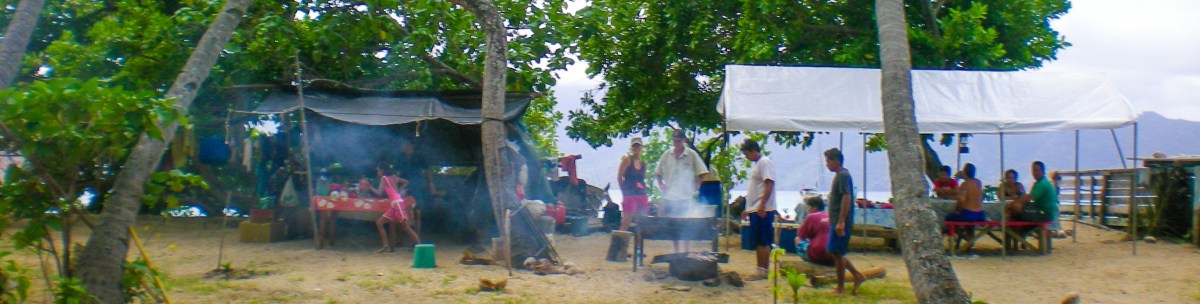
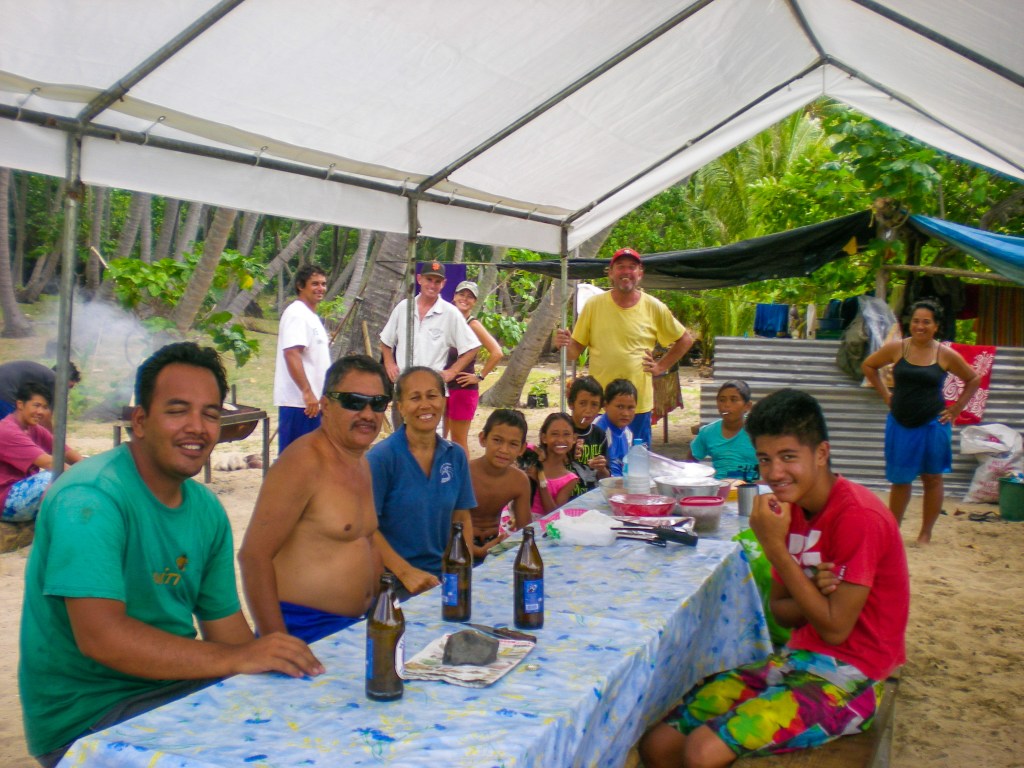
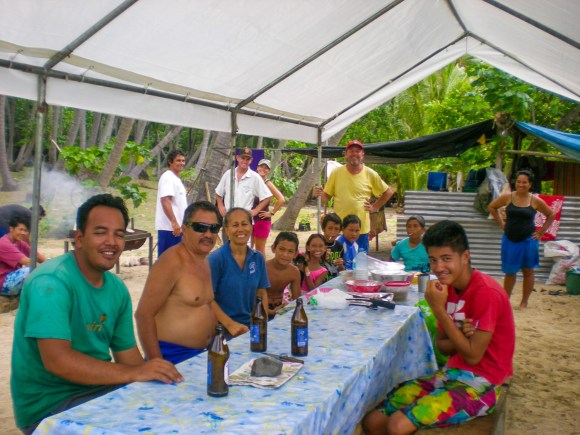
Our plan with the leftover meat from Steven was to find a suitable beach and have a proper beach cookout. So, in our first anchorage on Tahuata after we left Atuona, Tim and Steve went ashore to scout possibilities. They ended up meeting some locals, so they thought it polite to ask if we could make a pit on their beach for the cookout. They ended up welcoming us to use their BBQ, and oh by the way, why don’t we joint them for a huge feast the next afternoon. So, we ended up having a big Marquesan potluck with them and their extended family who are all enjoying a holiday at this relatively remote location on Tahuata.
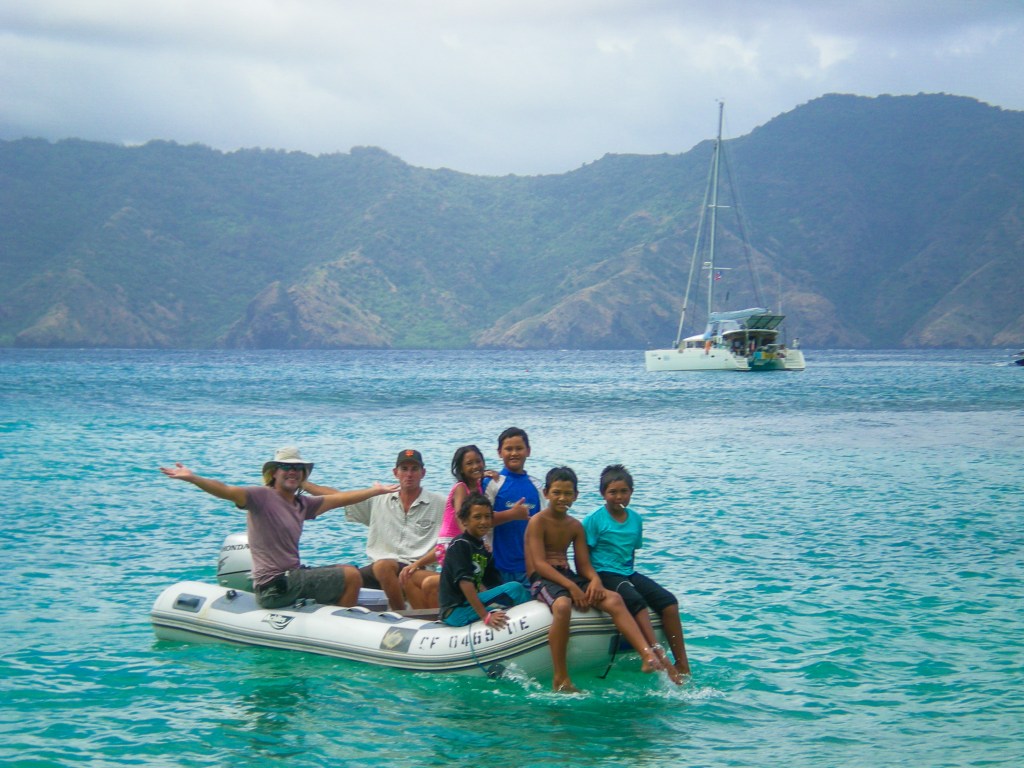
There were 5 kids among them, all in the same age range as our boys, and they all played on the surfboards together. Brenden has a harder time with the language barrier… Alex said he just told Brenden, “don’t say, just do.” It turns out all boys seem to understand the language of “let’s all try to knock each other off the surfboards.”
We learned that boiled bananas are quite good, and that coconut milk goes on everything. We grilled up some of the fish Tim caught, but I spiced it up a little too much for their liking. They were polite and tried our food too… my cucumber salad (made with banana vinegar) wasn’t such a big hit, and neither was Carolina’s pasta salad, but they seemed to like our banana bread. They were a really nice family, and one of the women is a retired teacher and she spoke English very well, so we were able to talk and learn a lot about them and how they cook.
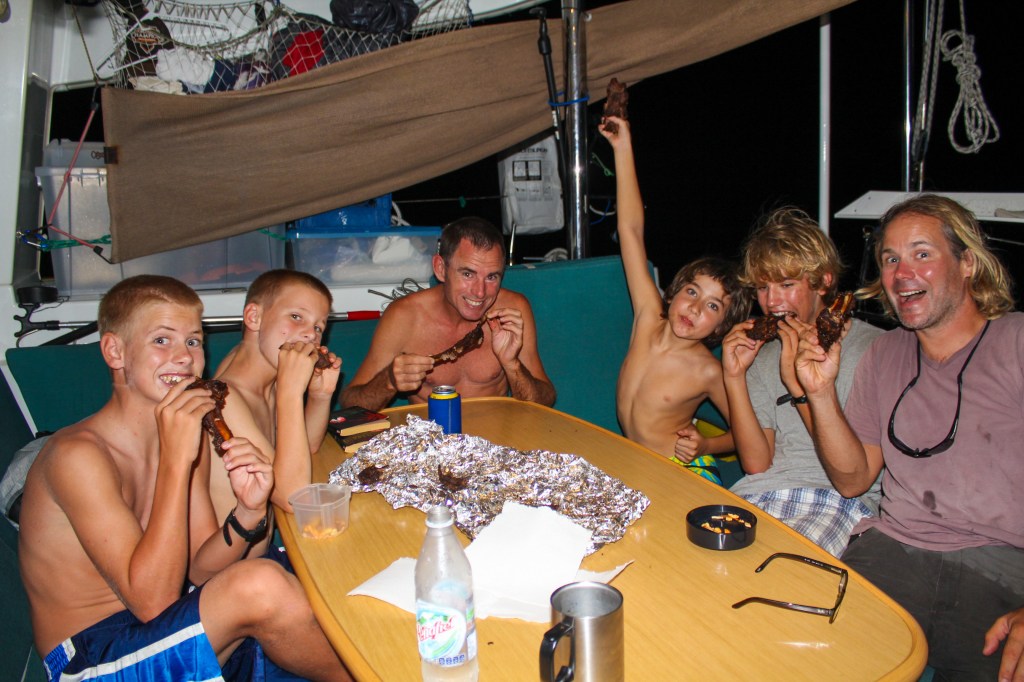
At the end of the day, we didn’t end up eating much of the meat, because we filled up on so many other things. So, later that night, we just had a big “meat party” on Exodus. No dishes or utensils. No other side dishes. Just, grab a big piece of meat and start knawing on it. It wasn’t very tender to begin with, and maybe was a bit overcooked, but it was good fun have a Flintstone’s style meal.
It was with a heavy heart that I learned in Atuona of the fate of Rebel Heart, one of our fellow kid boats who was also making the Pacific Crossing from Banderas Bay to The Marquesas. One of the girls was sick and they had some issues with the boat, so they were rescued at sea and Rebel Heart was scuttled. Thankfully, everyone was OK. But imagine my surprise when I do an internet search and the first article in the list is one whose focus is describing how they are being criticized for putting their family in “danger” and how they should have to pay for the rescue. Seriously?
I’ll address both of these points separately, starting with what careless parents they must be for taking their children to sea. There’s a general aspect to this and a specific one, and I can really only comment on the general one, and that is, I think it is absolutely appalling that people who know nothing about sailing or cruising rush to judgement about what a risk it is. What they are really saying is that it is unfamiliar to them, and it is potentially dangerous, therefore the risk must be unacceptable. Meanwhile, other dangerous activities have acceptable risk, simply because they are more familiar, like driving on the freeway. Many, many, people cruise on sailing and motor vessels all over the world. Many with families. Educate yourself before you judge. The specific aspect of this I cannot really comment on. Whether or not someone is taking undue risk crossing an ocean with their family has everything to do with the readiness of the crew and the seaworthiness of the vessel, and I didn’t know Rebel Heart well enough to make any sort of judgement here. I read online some people have read their blogs and have made specific criticism and it is based on those that they make judgements about the risk they took. That, I can understand. My point above is that people who know nothing about it make snap judgments that sailing across an ocean with your family is unacceptable because they hear about rescues.
The other point I’d like to address is that people have been saying that they should pay for the rescue. This is absolutely ridiculous, in my opinion. That’s just not how we’ve developed our rescue agencies in our society. People don’t pay the fire department directly, even when it is their fault their house catches on fire. Perhaps it would be a noble thing to do across the board to issue judgements when people are rescued and if it can be proven their negligence was the cause they should have to foot the bill. But is this really practical? If the purpose of this is to save taxpayer money, it probably defeats the purpose, because now you’ve introduced a whole layer of bureaucracy with its price tag along with it. And then just like our judicial system you run the risk of bad judgements being made, and people unfairly judged negligent and having to pay. Who should get to be judge? When people are rescued, it is a tremendously traumatic event, is this something we need to put people through afterward?
Like I said, I can’t comment on the specific readiness of Rebel Heart, and neither can a lot of people, but that doesn’t stop them from commenting. But no matter what, my heart truly goes out to them because I would not wish what they have had to go through on anyone.
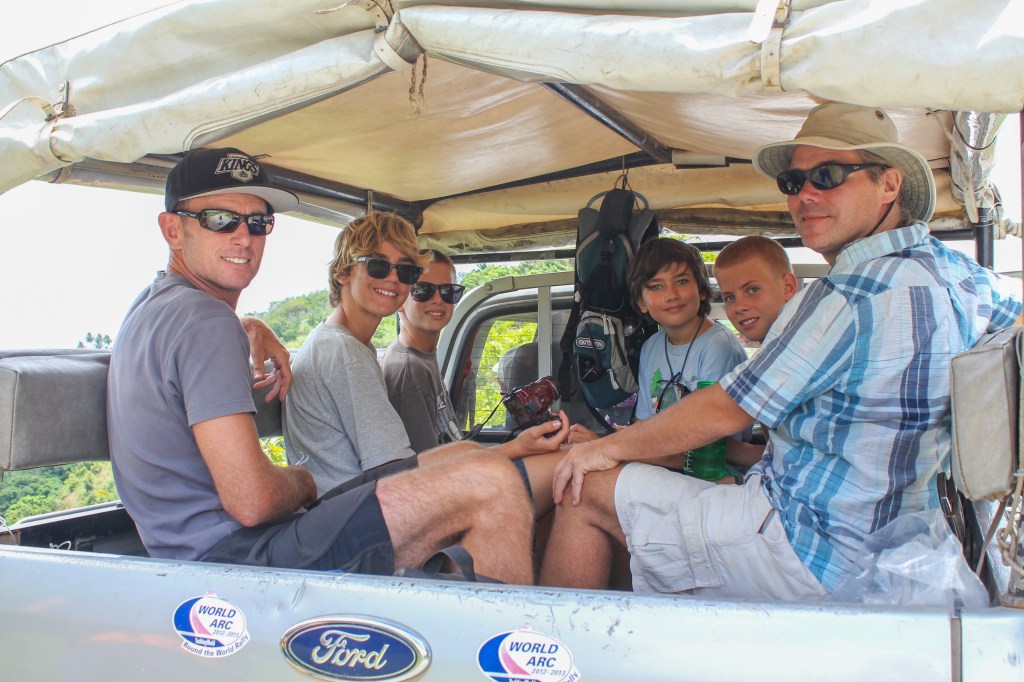
We stayed a little longer in Atuona than we likely otherwise would have, because we wanted to go on a group island tour, and we pulled it off for Tuesday, 8 April. The crews of Exodus, Lady Carolina, and True Blue V all piled inside and outside of Marie Jo’s pickup truck taking up all available sitting space. The back of the truck was covered and had benches, but since a lot of the route was a bumpy dirt road, it was still rather uncomfortable, and we made all the kids sit back there and then cycled the adults through.
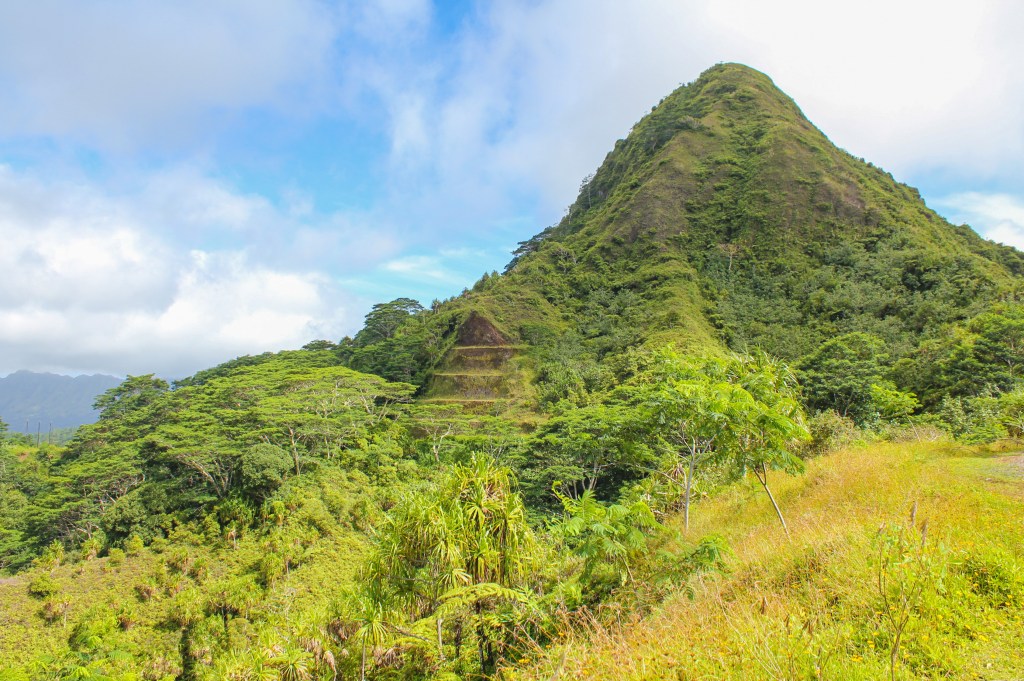
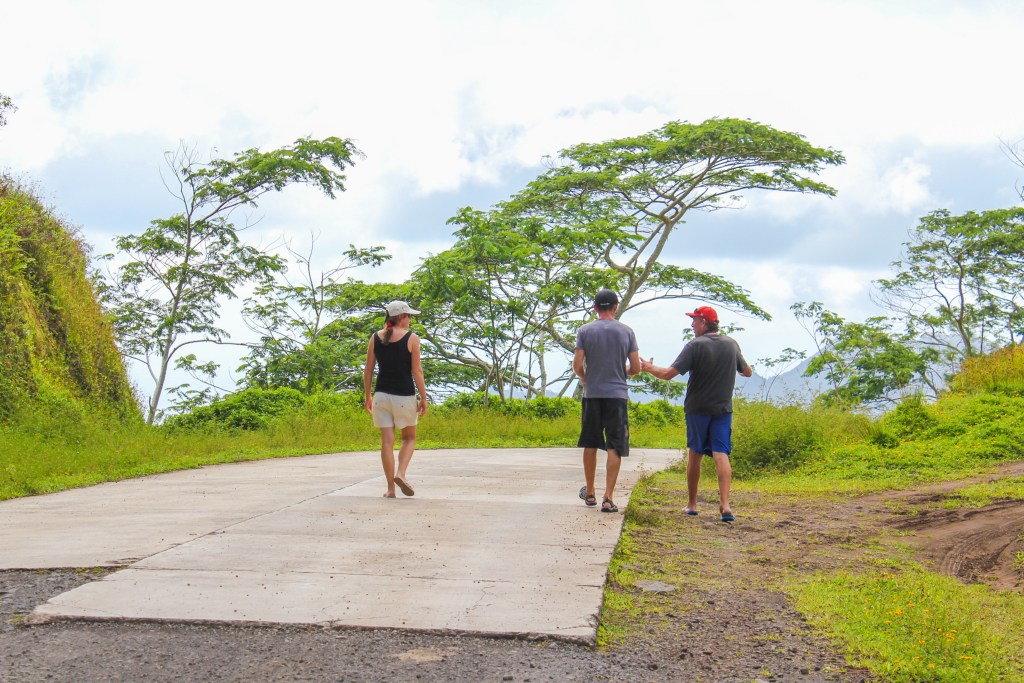
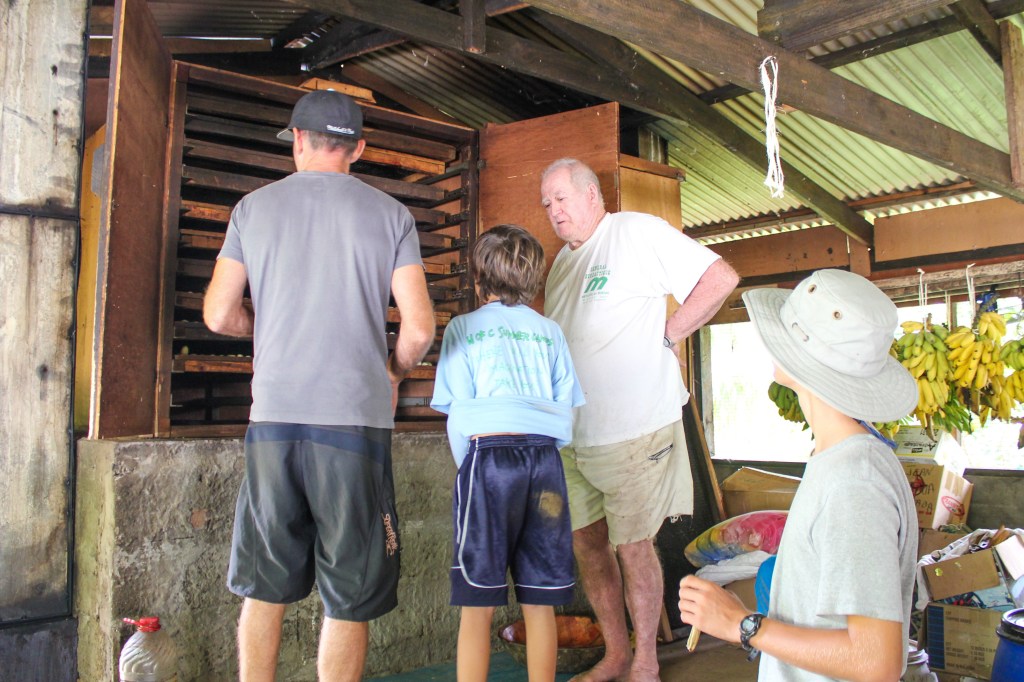
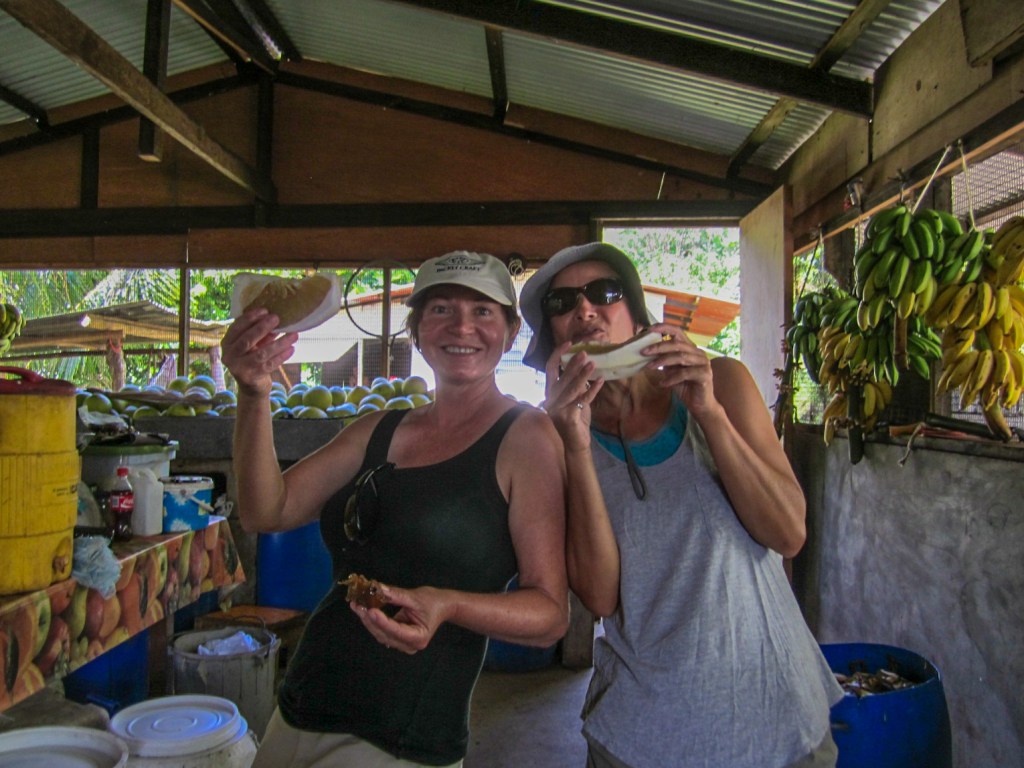
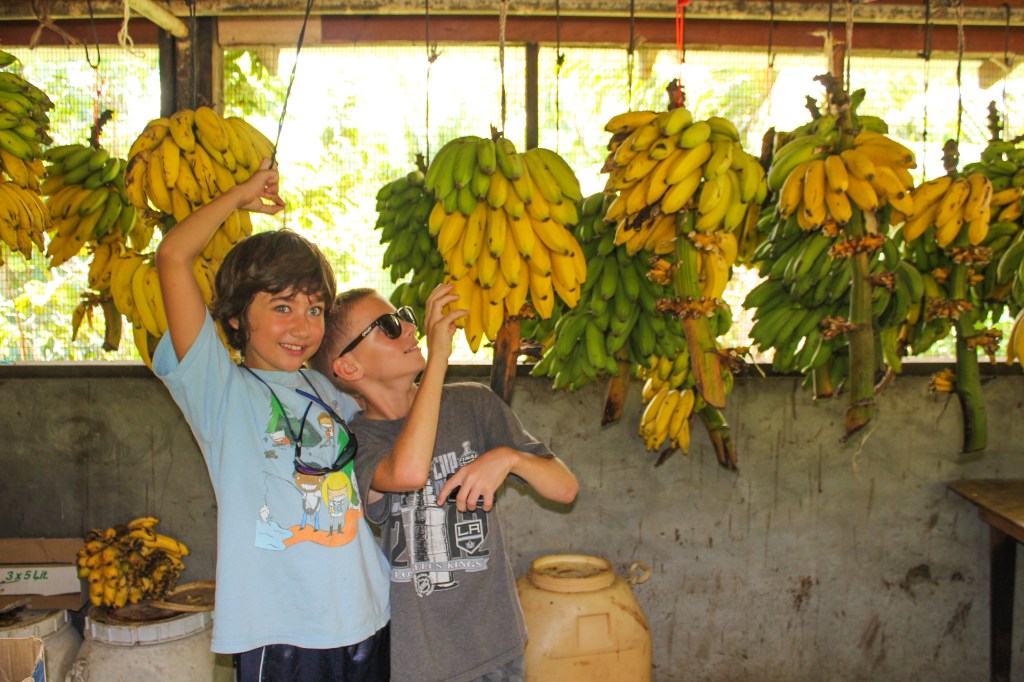
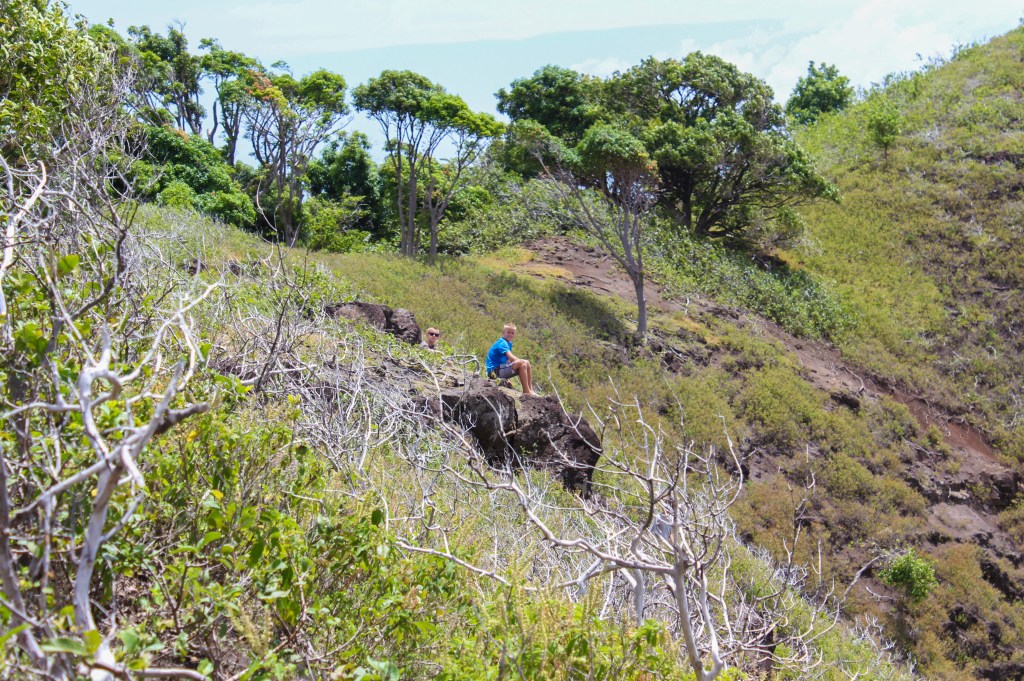
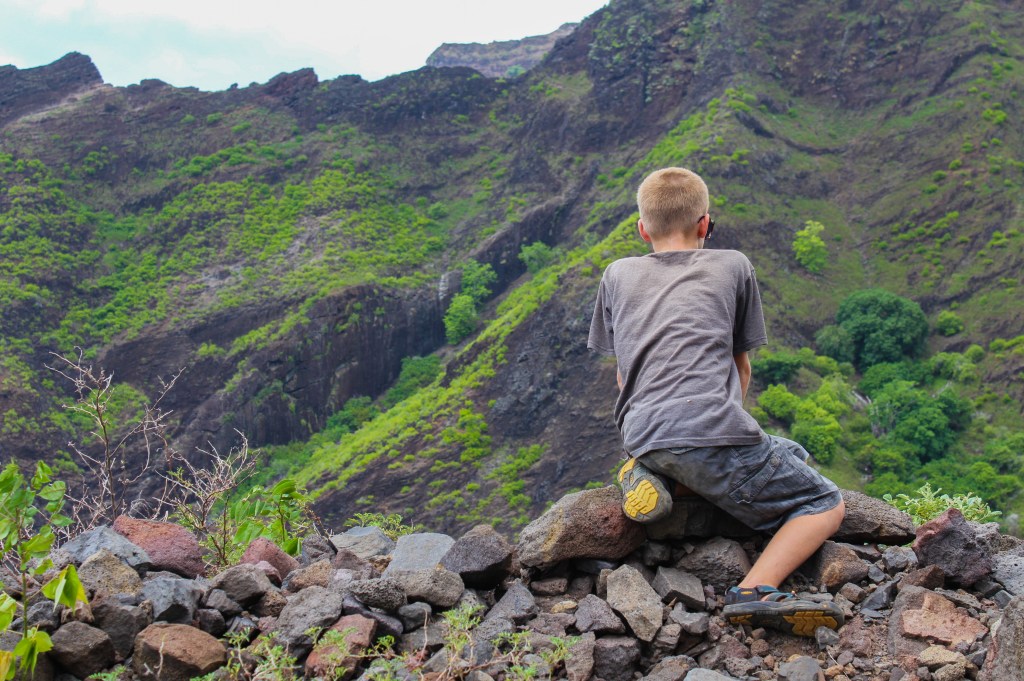
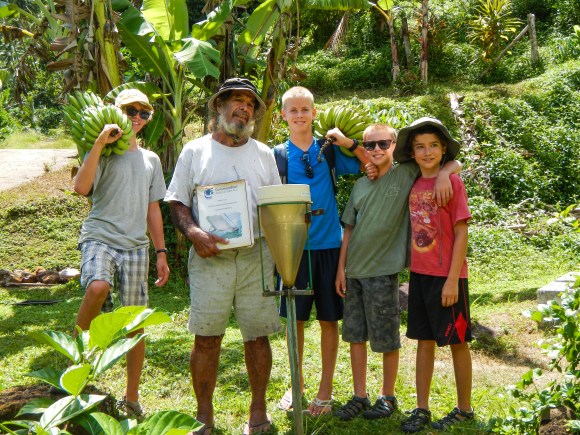
We headed northwest from Atuona, and our first stop was atop some cliffs overlooking the bays. Then we walked a bit then hopped back in the truck. Then when we were in what seemed like the heart of the jungle, almost as an afterthought, Marie Jo stopped the truck and asked if we wanted to go to the fruit stand. Not knowing what to expect we all answered an enthusiastic, sure, let’s go. Down a steep and muddy driveway down to what seemed like someone’s back shed, we found ourselves surrounded by pamplemousse and stalks of bananas. We met the proprietor, and he let us try many things, including dried bananas, which were sweet like candy, and pamplemousse. This was our first taste of this fruit, and the closest comparison I can make is to grapefruit, but it’s much sweeter than any grapefruit I’ve ever had. He showed us how he dries the bananas, and he also showed us how he makes banana vinegar. We all had a very magical experience there, and we opened our purses and wallets and purchased many a pamplemousse and pack of dried bananas. I even bought a bottle of the vinegar, and I’ve made many salad dressings with it.
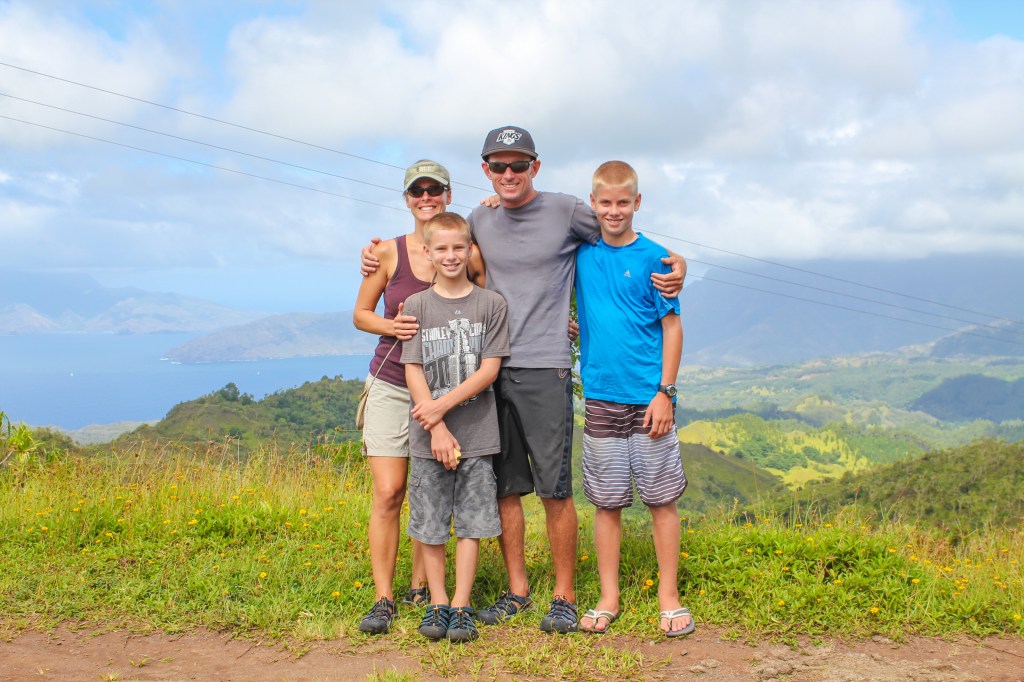
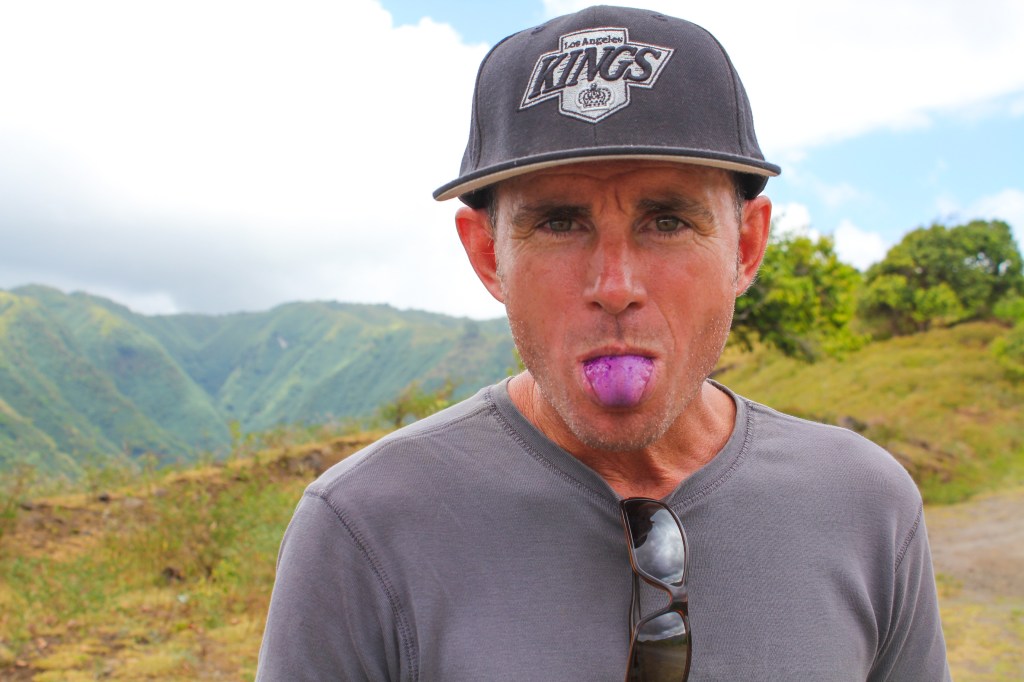
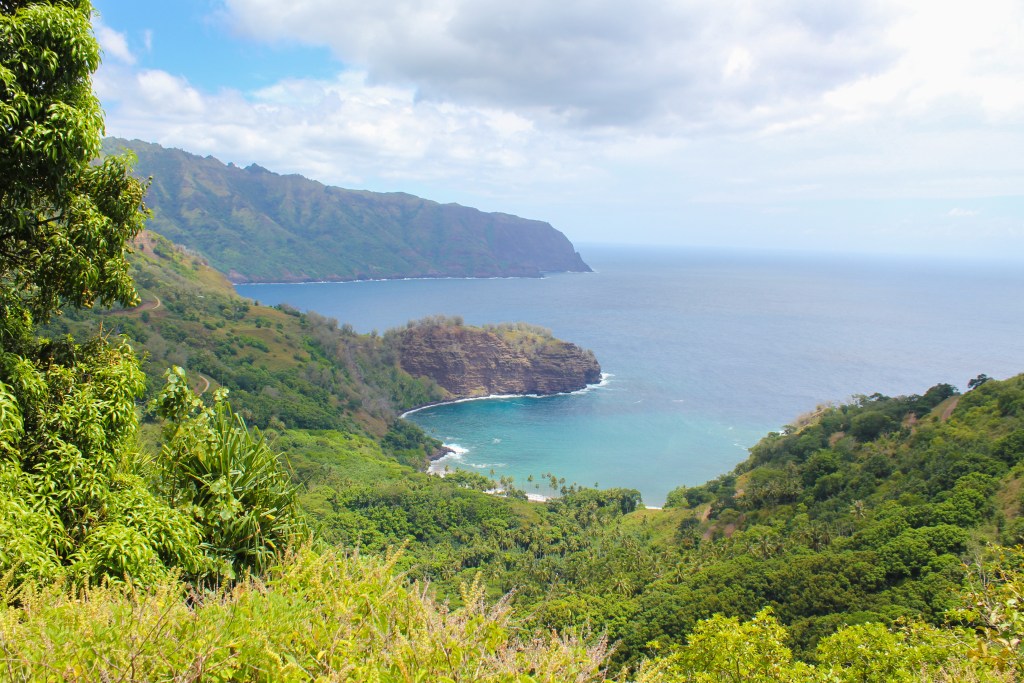
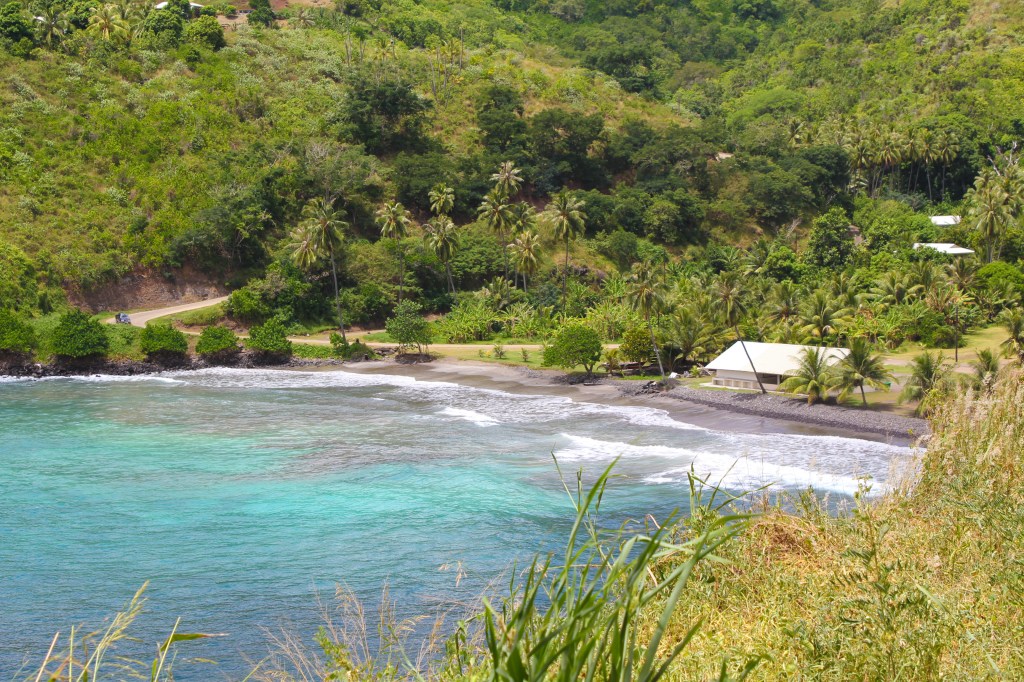
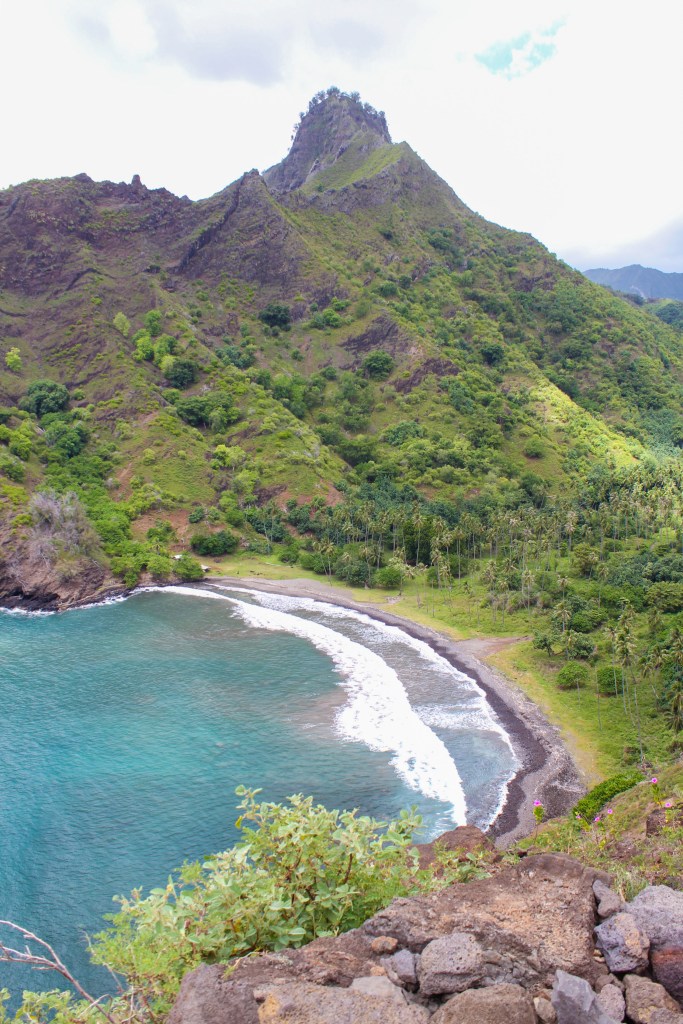
After our encounter with the fruit stand, Marie Jo must have realized how much we liked the local fruit, so she would stop anywhere there was something we could pick. First up were the dark purple fruits that looked like large grapes that she called Pistache but were in no way like a Pistachio nut. They weren’t very sweet, and I thought they made my mouth feel kind of dry and gritty. The boys (including Tim) like how they turned your entire mouth a dark purple. We also stopped to pick limes, star fruit, and tiny little chili peppers. We all had a lot of fun, and we felt comfortable since Marie Jo was choosing the places to gather fruit that it was OK, and we weren’t stealing anyone’s property. Along the way we had some amazing views of various bays.
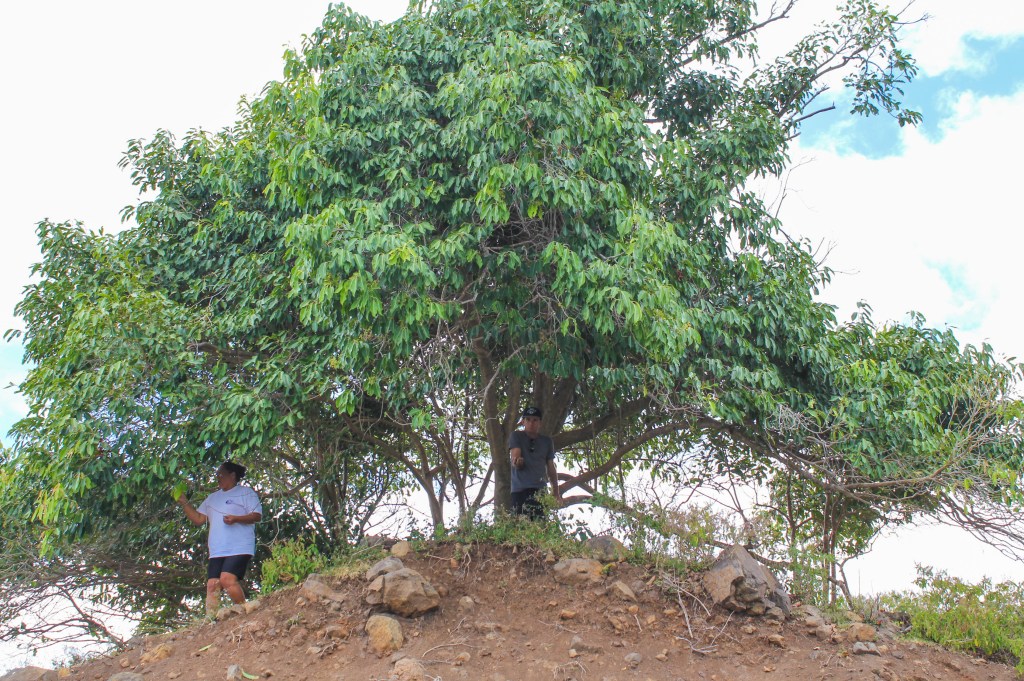
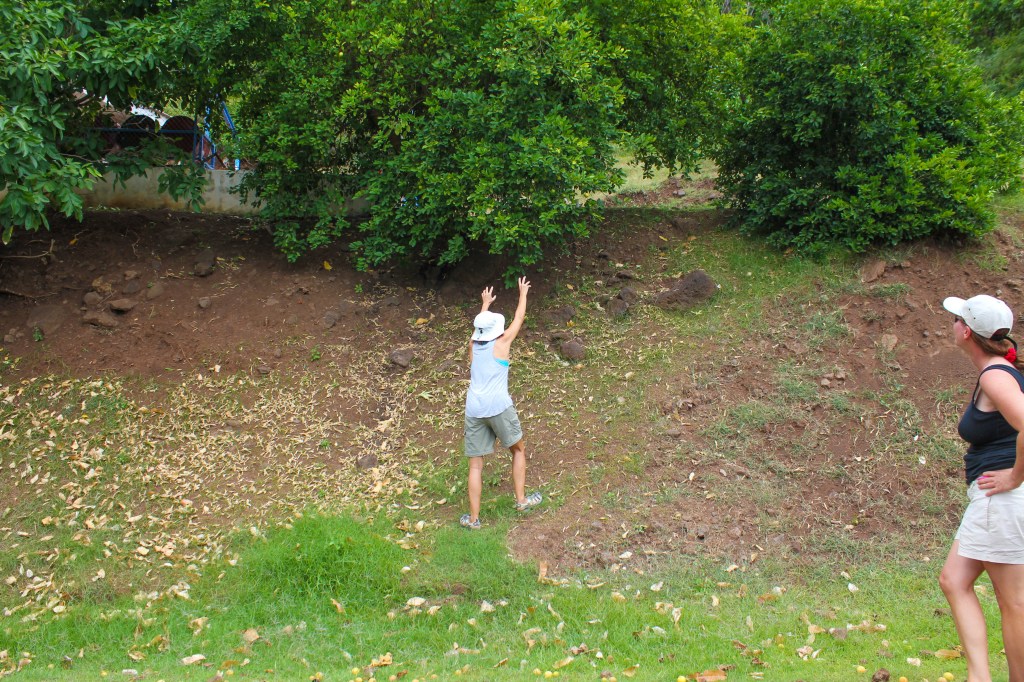
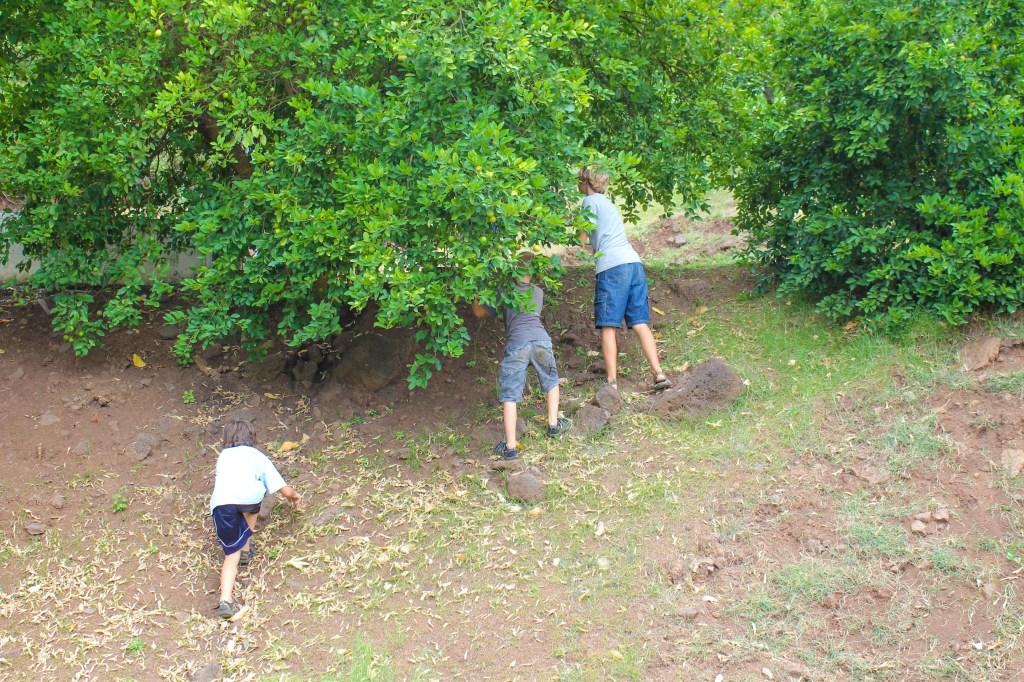
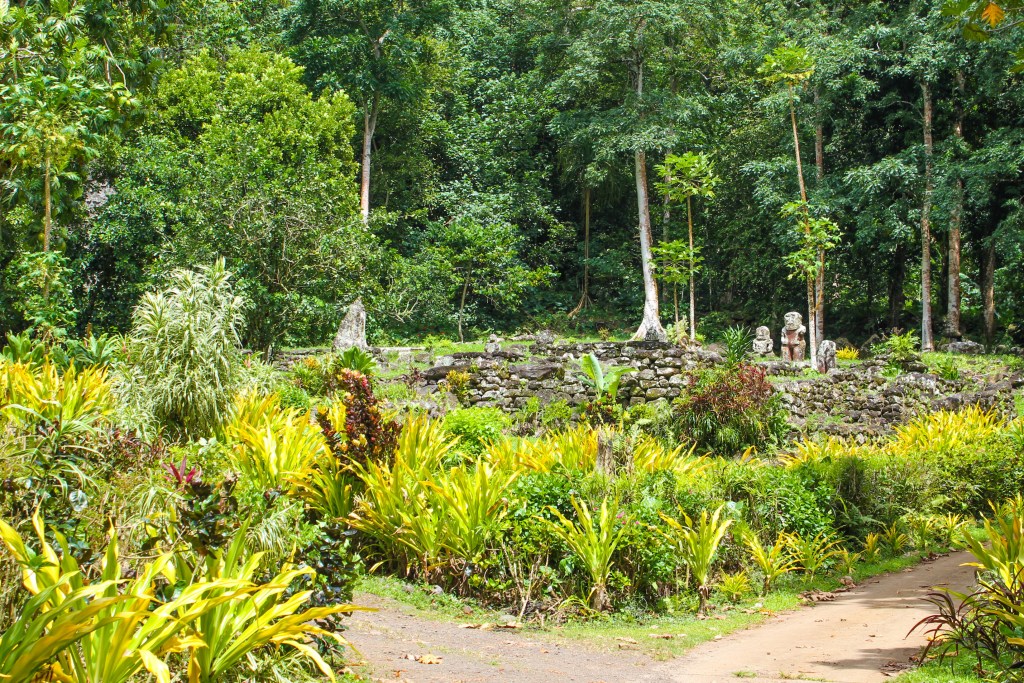
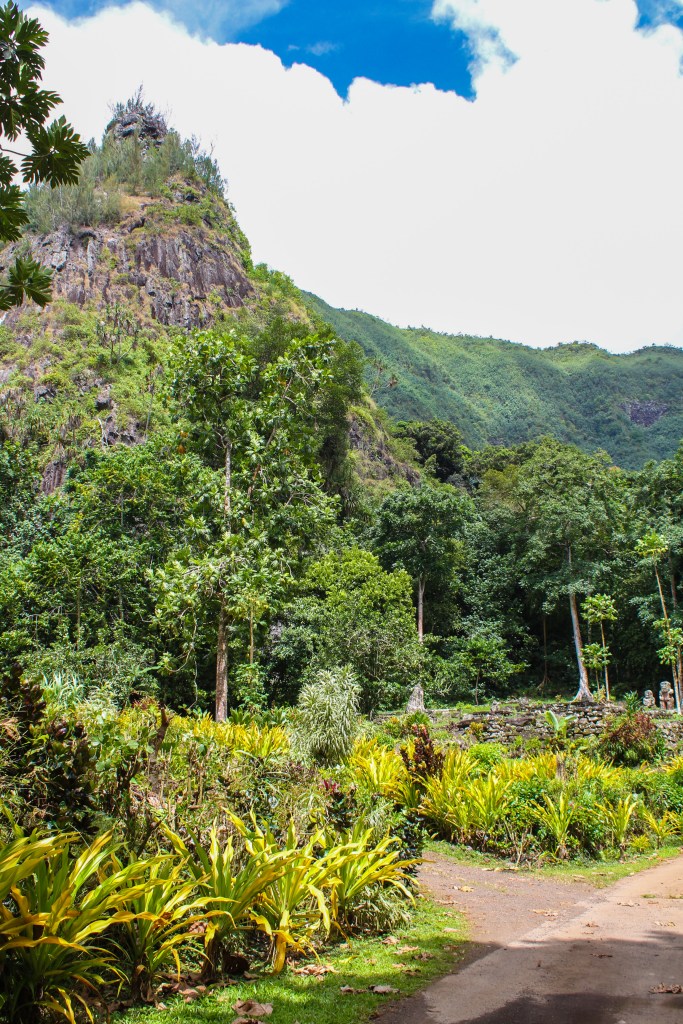
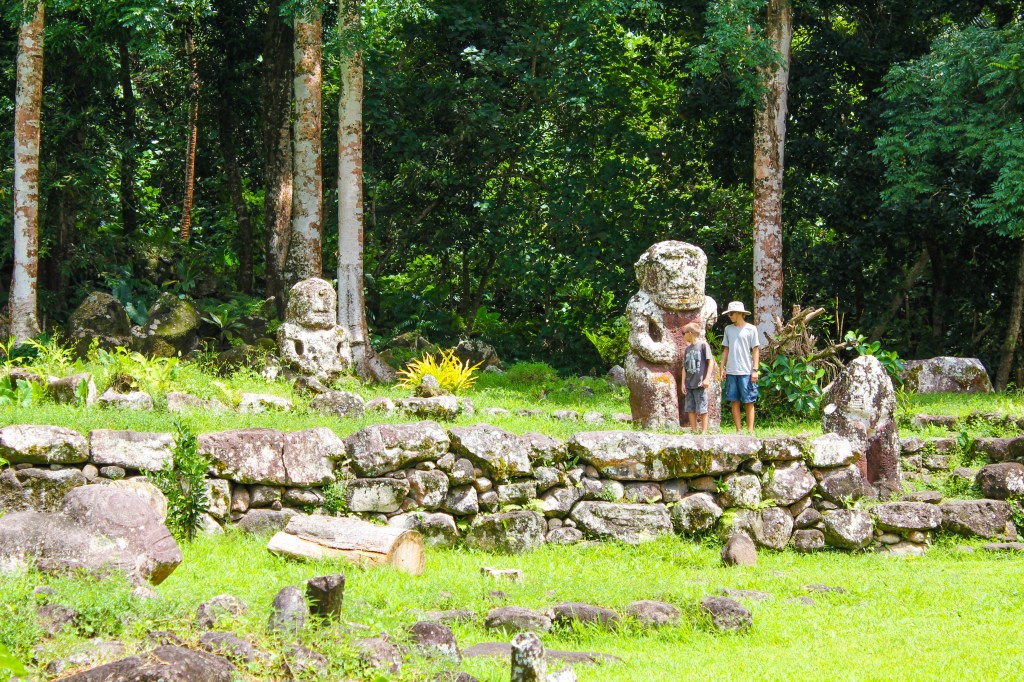
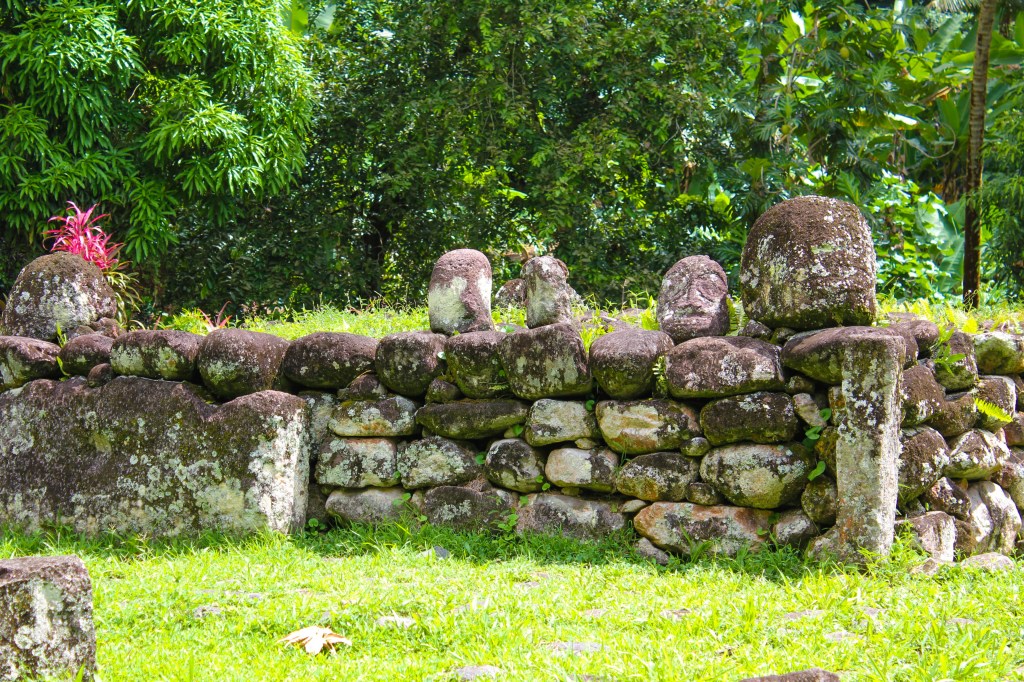
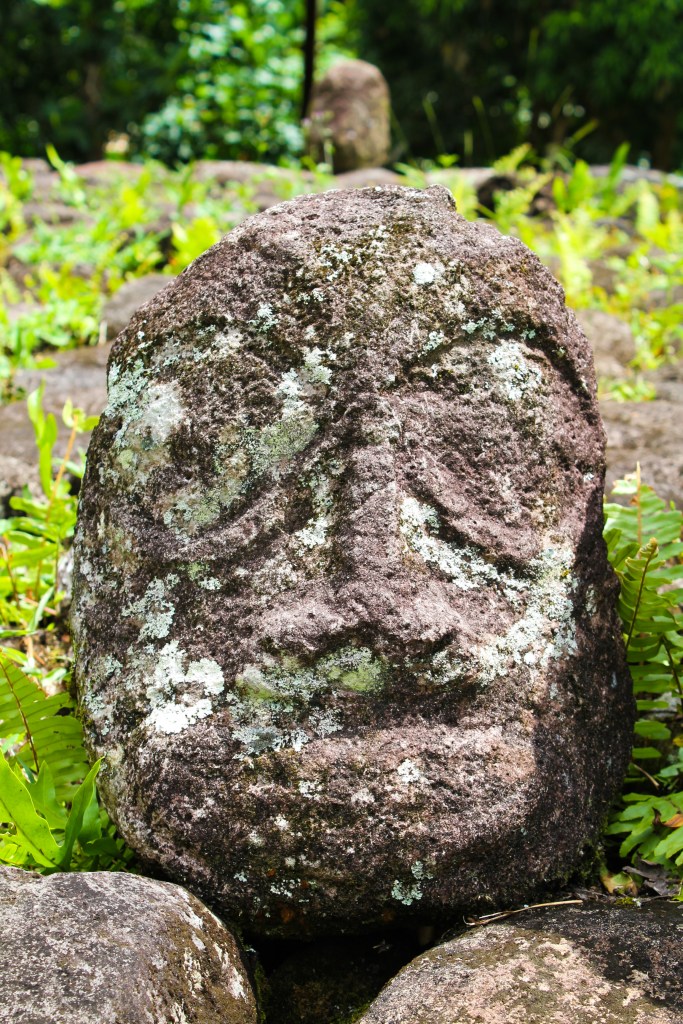
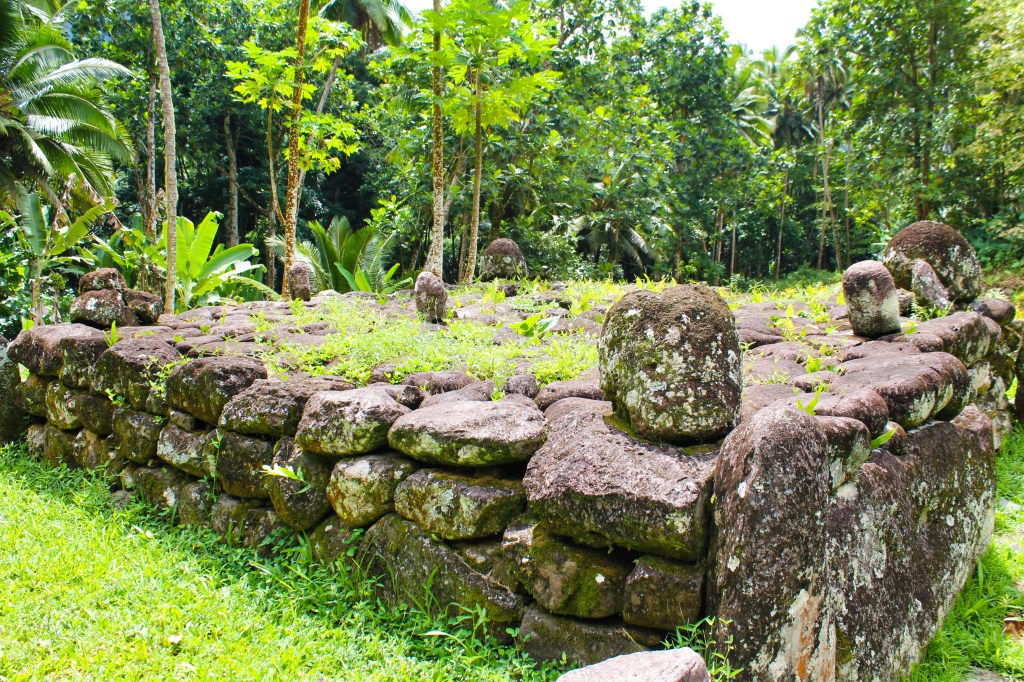
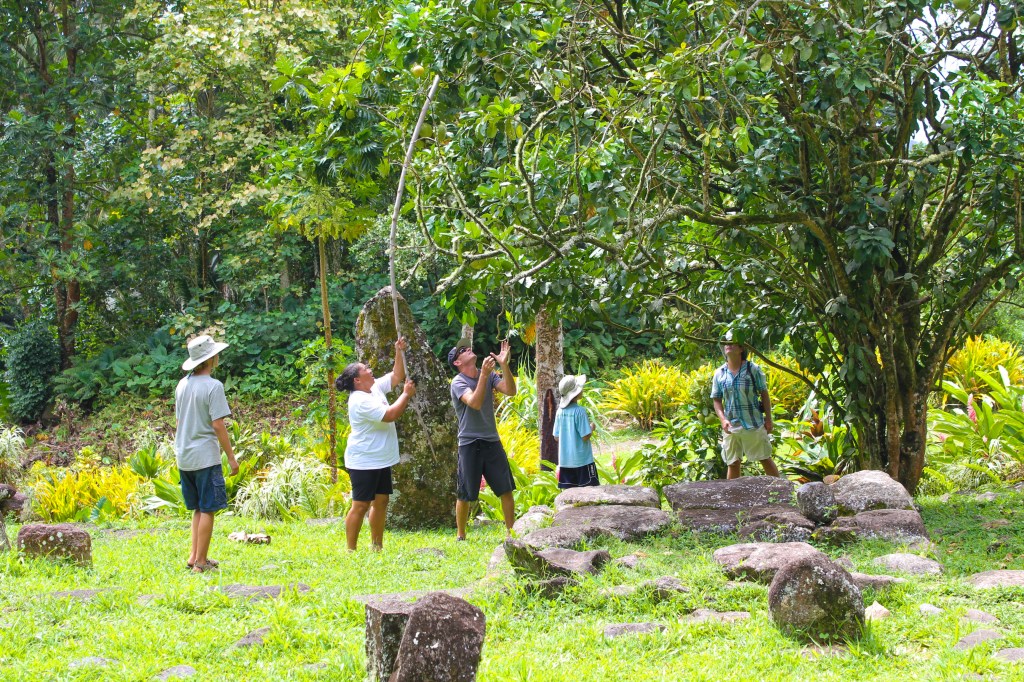
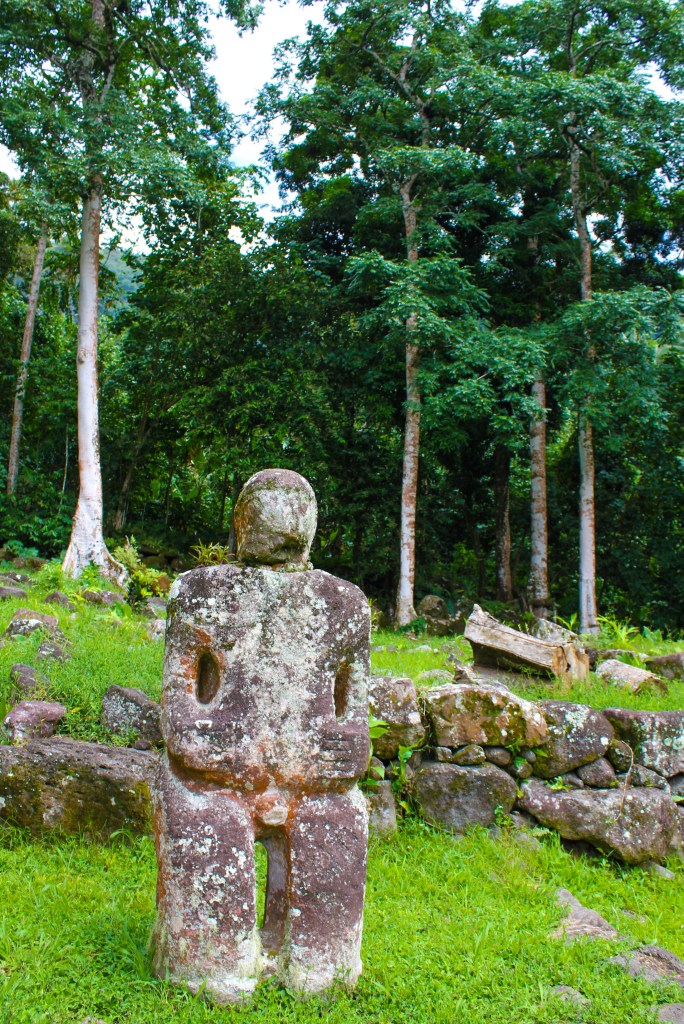
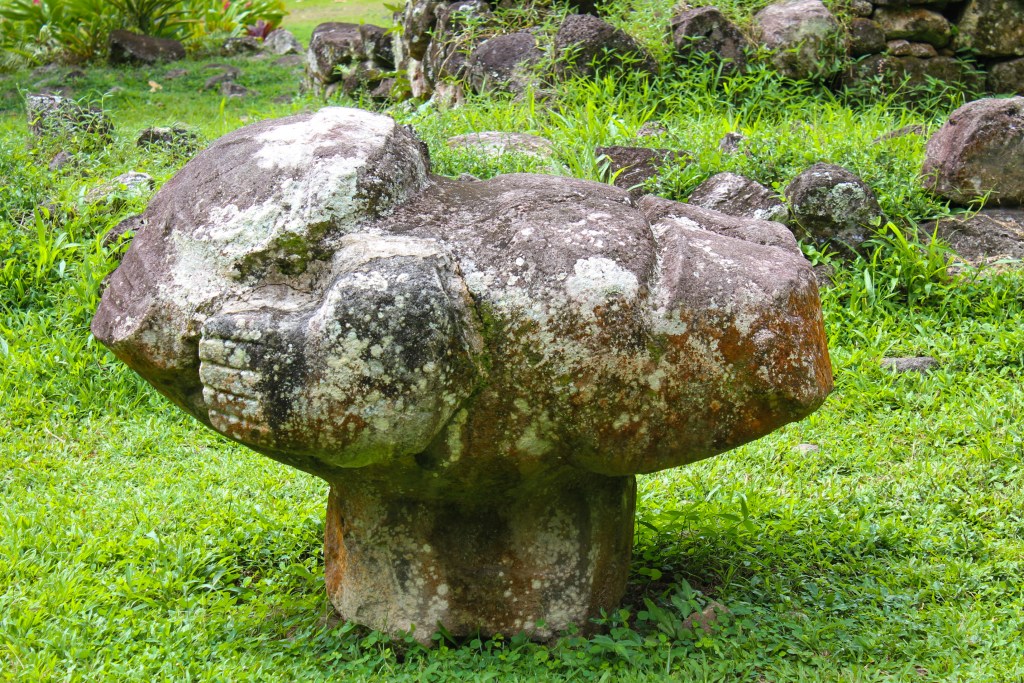
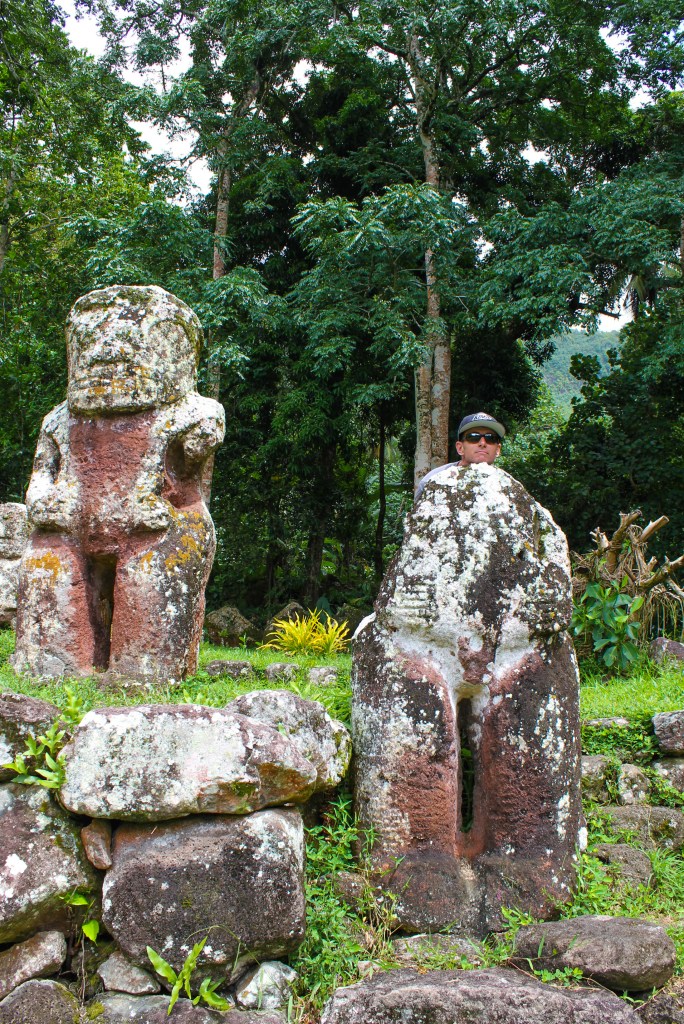
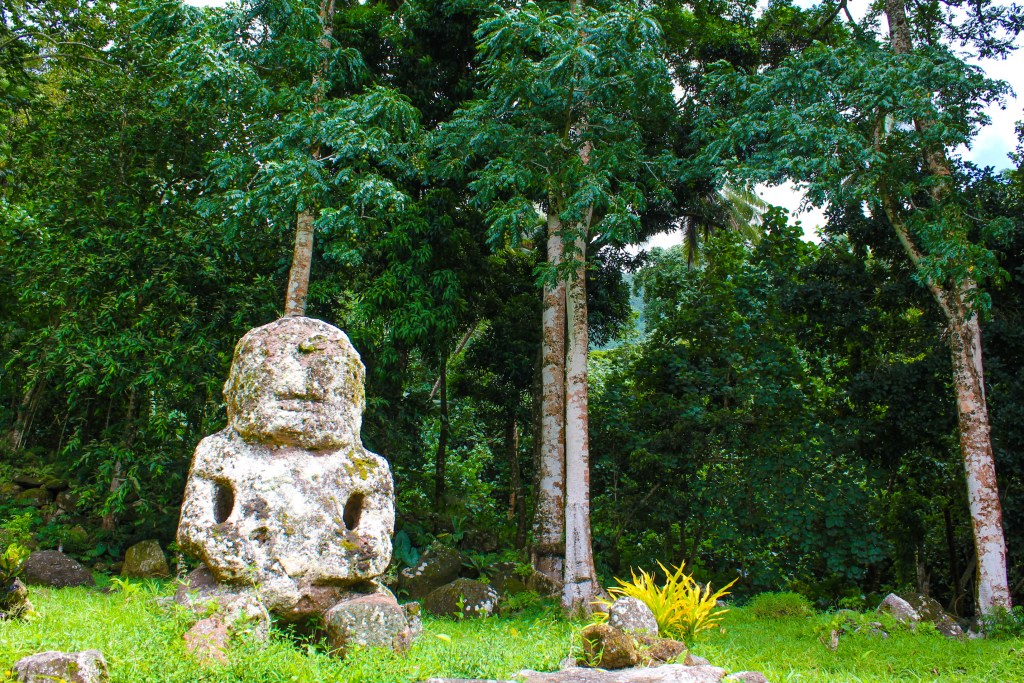
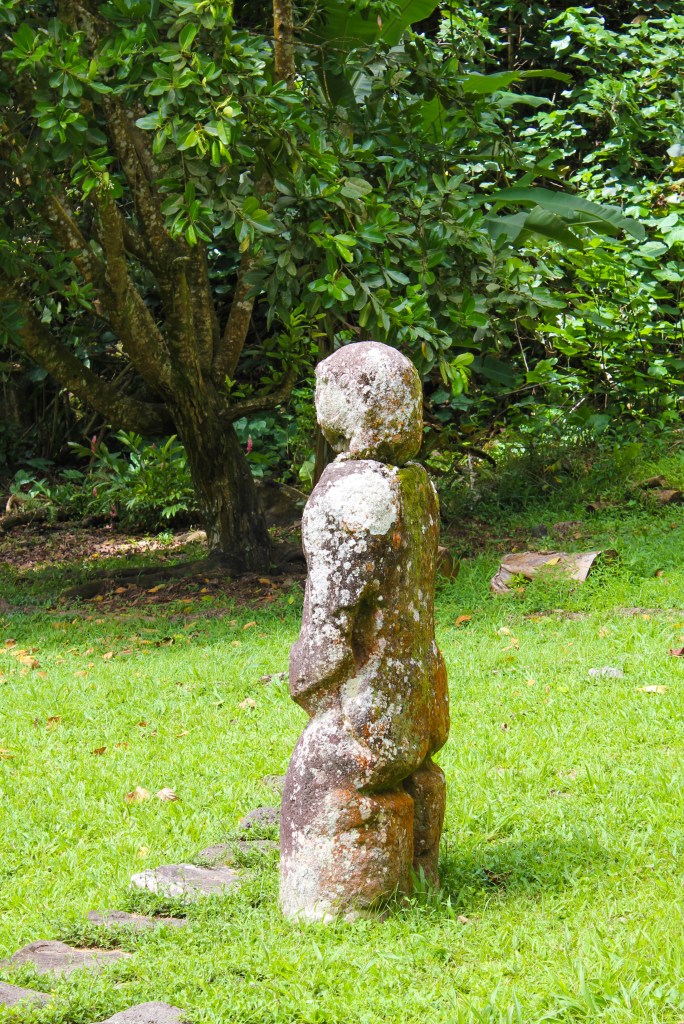
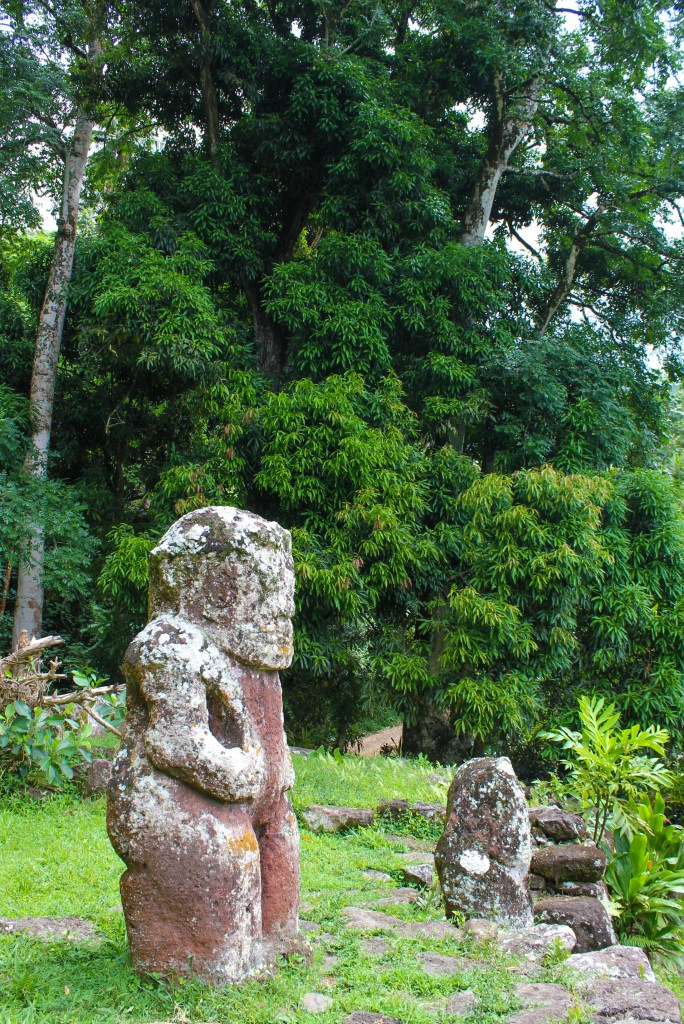
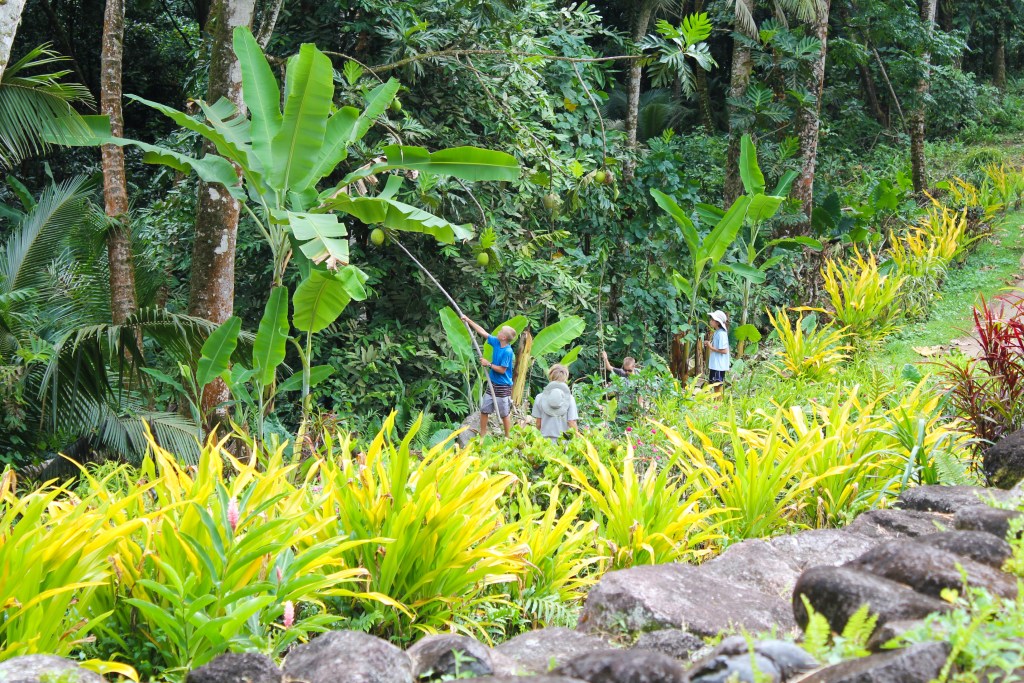
After a few hours we came to the primary destination of Puamau, a village situated on Baie Puamau, which is a large anchorage facing the northeast. Marie Jo drove us right up to one of the most amazing archaeological sites with several terraces and many, many Tikis. The guidebook says that one of the Tikis, Takaii, is the largest in the world standing 8 ft tall, but we didn’t know it at the time. We had fun observing all of the Tikis, but in the end our attention came to be focused on a large pamplemousse tree, and Marie Joe got a large stick and was knocking them down while Tim caught them. The boys explored a bit and found another pamplemousse tree, and engaged in their own fruit retrieval effort, successfully, I might add.
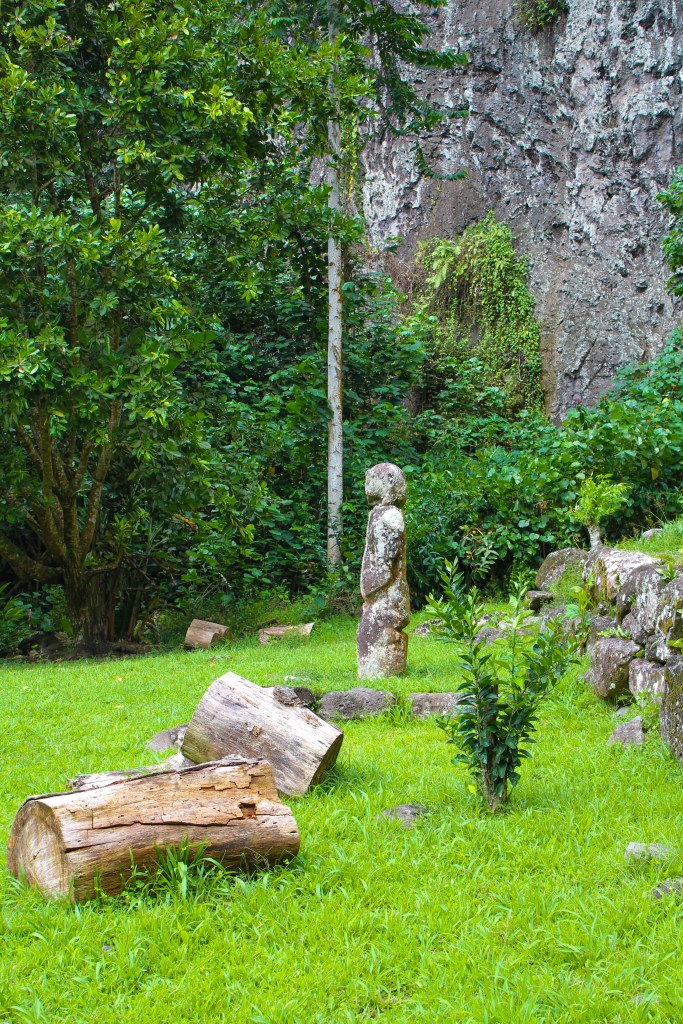
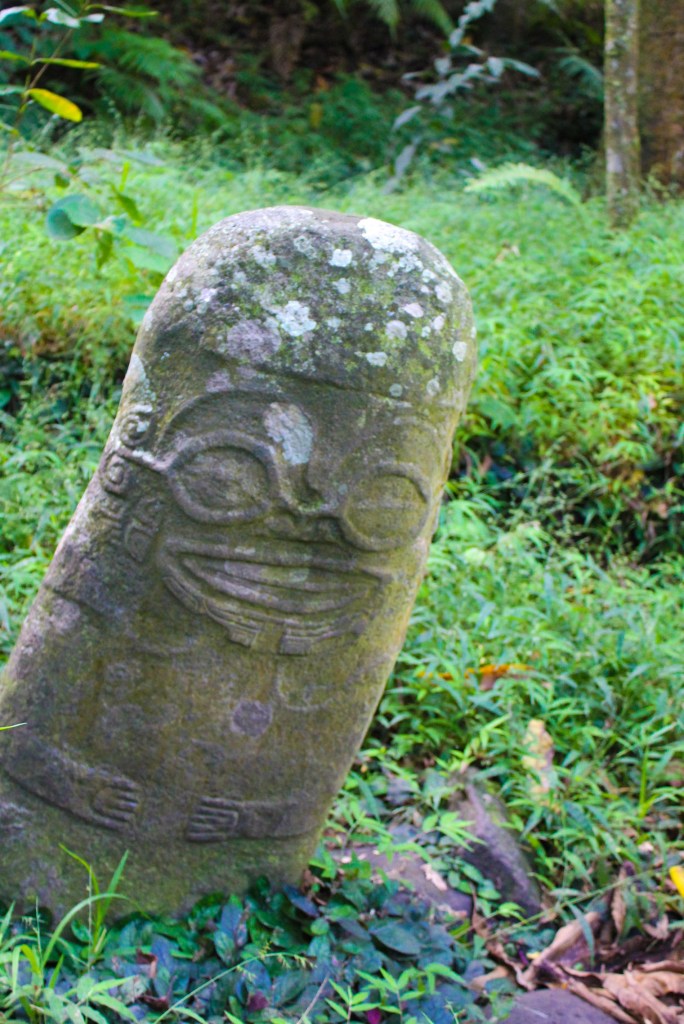
We made better time on the way back because we made fewer stops, but we did stop somewhat close to Atuona, to take a look at the smiling Tiki. It was a short trek into the “jungle” and it really was a smiling tiki. It was small, only coming up to about mid-thigh, and it had a rounded head, making it look like the minions in the movie Despicable Me. We took all the obligatory photos and then proceeded to gather all the tiny chili peppers we could find.
Our island tour was a bit different than we had expected. We kind of expected a real tour with an informative and historical narrative. This isn’t exactly what Marie Jo provided, but I think the kids especially had an even better time because gathering all the fruit was a real treat.
While in town at Atuona on a Saturday we were looking for a restaurant to have lunch, and Tim and Steve met a friendly Marquesan guy named Steve while they were trying to check out a food truck. Steven was drinking beers and he explained that on Saturdays he doesn’t eat, he only drinks. Everyone knows this, they know that Steven only drinks on Saturday. He told us where we might be able to get lunch at a pizza place on the way back to town.
Somehow, I’m not sure when or how, Tim and Steve ran into Steven again near the harbor, and he offered to guide them in one of our dinghies over to some villages where we could trade items for many different fruits, and he would also take them spear fishing. Of course, they accepted right away, and they were all three gone the better part of a day. I hope that at some point Tim or Steve write about their experience that day, because for me to write about it could never do it justice, so I won’t even try.
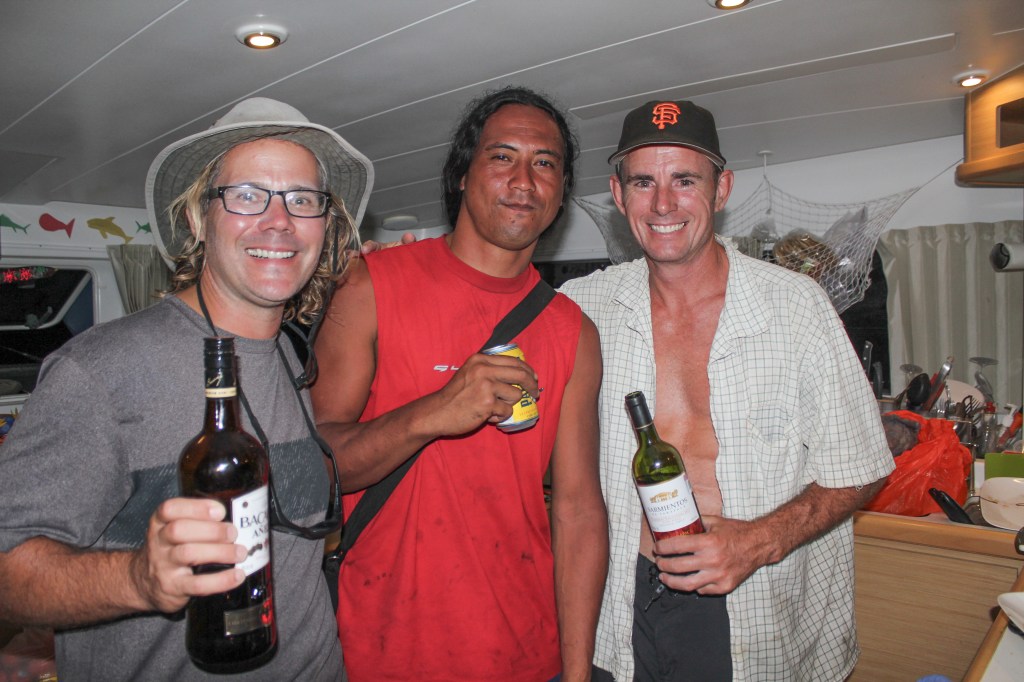
That evening we were planning a potluck on Exodus with Lady Carolina, True Blue V, Chara, and a young couple on s/v Eleutheria that I had met in town that day. Tim, Steve, and Steven arrived and in a flurry of activity they offloaded an enormous amount of fruit onto Exodus and onloaded several beers into the dinghy. They said they were getting meat and cooking breadfruit on shore, and did I mention it was a flurry. We were all like, “what?” Following a few more beer runs, they returned with breadfruit for everyone and about a half of a goat or sheep, we aren’t quite sure.
Then, they proceeded to turn my kitchen upside down. A Marquesan dinner was prepared in my galley, and the rest of us just drank and watched. At one point he passed around some meat and we were all to taste it, and it was basically just gristle, we all just chewed and chewed. That meant it wasn’t done enough. We all took turns grating coconut and then they pressed it through one of my kitchen rags (I hope it was a clean one). I inferred from my interaction with Steven that in the Marquesas cooking was a blue job (that is, for the men to do. As opposed to a pink job.) I was usually bustled out of the kitchen, which was fine by me, I just sat in the salon, watched, laughed, and drank. It was all good fun, and I was loving the experience of having Steven among us.
Then, the plastic top that regulates flow on the rum bottle came off. Well, it didn’t come off. The guys removed it, at Steven’s urging, and they started passing it around. Shortly after, Steven switched from your friendly neighborhood Polynesian to a drunken obnoxious, possibly dangerous Polynesian man.
I need to stress here that he never was actually dangerous. But at the time, my awareness became heightened, because I wasn’t really sure the direction he was going to go here. It went far downhill when our Australian friend, Craig from True Blue V, did some native New Zealand chanting in response to some of Steven’s Marquesan chanting. That really didn’t go over well. It was as if Craig inadvertently challenged Steven’s manhood. Steven continually called him “Australia Man” and fluctuated between being frighteningly aggressive and then friendly towards him. I was really worried Steven was going to try to fight him. Maybe that was because Steven kept saying he wanted to fight him. Luckily Craig, aka Australia Man, is a very good-natured fellow, and his response was always a very humorous, “I don’t want to fight you, man…”
I guess the guys kept “trying” to get the rum away from Steven, but finally I had had enough. They were all sitting int he cockpit, and I stood over them and said in a very stern voice, “Give me the rum. That’s my rum.” Steven obliged without any hesitation or question. But then he remembered that they were going to go midnight fishing. That was all the rumble, “Steven, Tim, Fishing!!!” Carolina and I had a little conference and we decided there was no way all these drunk men were going midnight fishing. So, she and the four boys went to Lady Carolina, and they took ALL the dinghies. We basically made it impossible, so that Steve and Tim didn’t have to say no to Steven. A little while later Kyle came back to give Craig and Steve rides home, and then that left, Tim, me, and Steven. Tim was the Polynesian whisperer that night and he was able to coax Steven to sleep in the cockpit, I have no idea how. Tim slept out in the cockpit with Steven until it started raining, and since Tim was on the outside bench, he was getting soaked, so he moved into the salon. Steven didn’t budge.
In the morning Steven went for a swim, drank coffee with us, and then showed Tim how to pan fry up the leftover breadfruit, and I have to say, this was amazing. Like French fries, but maybe a little better since you don’t usually let yourself indulge in something as yummy as French fries for breakfast. Curiously, when it came to pouring the coffee, Steven would not let Tim pour it for him. That was apparently a pink job. Tim cooked the breadfruit, and I poured the coffee. We wonder if that’s why Steven so easily gave up the rum to me the night before. Maybe women are in charge of drinks. Anyway, then he started asking for beer or wine. He yelled over to Lady Carolina, “Steven, give me a beer!!!” He also kept asking me which boat belonged to “Australia Man,” and he said that with a somewhat negative jeer. So, I was noncommittal, saying, “it’s that one over there,” while waving my arm in no particular direction.
We had an island tour arranged that morning, and we needed to be on shore by 9am. Steven came along, insisting that he would go with us. Once on shore both Sandra and Marie Jo (the lady giving us the tour) asked us if we really wanted Steven to come, and if not, they would tell him he could not come. Sadly, we took this route. There really wasn’t room in the truck, and we weren’t sure how his behavior would impact our day. He wanted wine, Steve gave him wine, and he went away. We learned later from Marie Jo that they’ve had to call the Gendarme to remove Steven from yachts in the past.
I recently asked Alex and Brenden what they remember of Steven. Brenden said that Steven taught him how to say hello in Marquesan, “Ka Oha Nuie.” He would tell Brenden to repeat, but it wasn’t loud enough, so Steven would yell, “KA OHA NUIE!” I guess this went on for a while, until Brenden achieved an acceptable decibel level. Alex remembered in the morning he and Brenden were in the dinghy and Steven tossed them a mango and told them to eat it. They were confused, because typically, we peel mangoes, so they hesitated. He yelled to eat it, and then he grabbed one himself and bit right through the skin. They laughed, but they never did bite the mango, they just drove away.
In hindsight, Steven was a lot of fun. We understood that he was one among many, and we continued to have many varied experiences with the local throughout French Polynesia.
One last note… we didn’t actually cook all the meat the Steven gave us that night. There was another half of the animal left, and thankfully, True Blue V volunteered to keep it in their freezer until we got to an anchorage where we could have a proper beach cookout. Spoiler alert: we had an amazing Marquesan cookout on the next island we would visit.
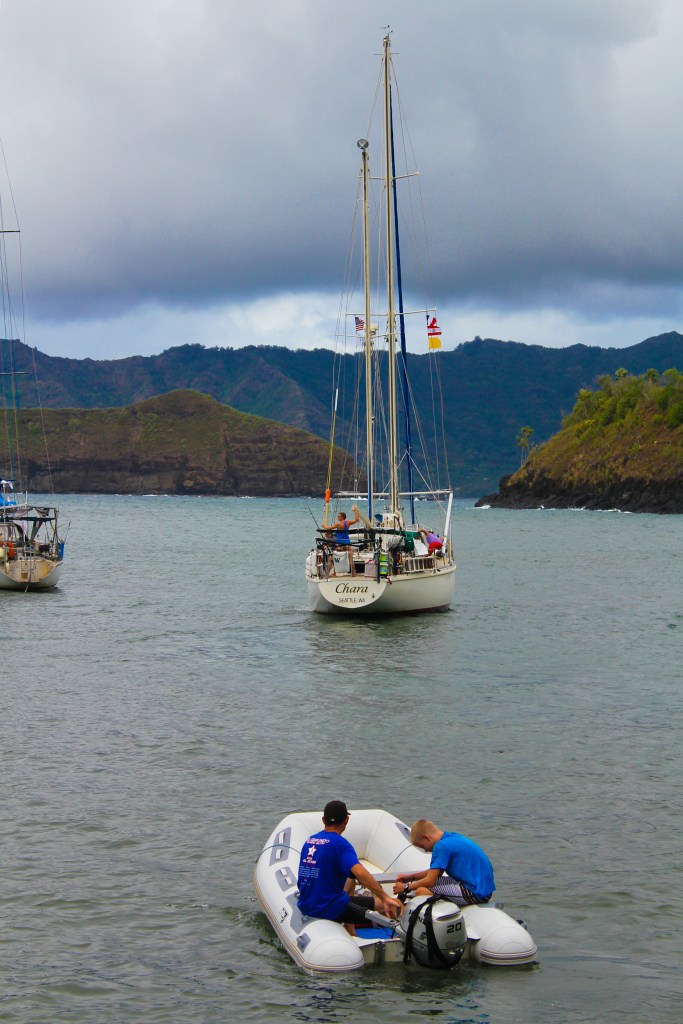
Our first day after arriving we spent holed up on our boat eating, drinking, and soaking in our own arrival euphoria. The second day we checked in and explored the town. On our THIRD day, the fun began as we were able to welcome two of our buddy boats who we travelled across the Pacific with. Chara arrived first, and Tim and Alex were in the dinghy ready to assist them with their stern anchor, if needed. But Chara eyed their spot, steered to the back of the anchorage, turned around, dropped the stern anchor, pulled forward, dropped the bow anchor, pulled back, and they totally nailed it. It was a beautiful thing to watch. We had picked up extra baguettes that morning, so even though they weren’t needed to assist with anchoring, Tim and Alex got to be the bread delivery men. The Chara crew were anxious to get to shore, so we offered to give them a ride in our dinghy whenever they were ready (since ours was already in the water and the outboard was already on). They made an appointment with Sandra (the agent that assisted us with check-in) and they were just going to relax until then.
Chara’s arrival
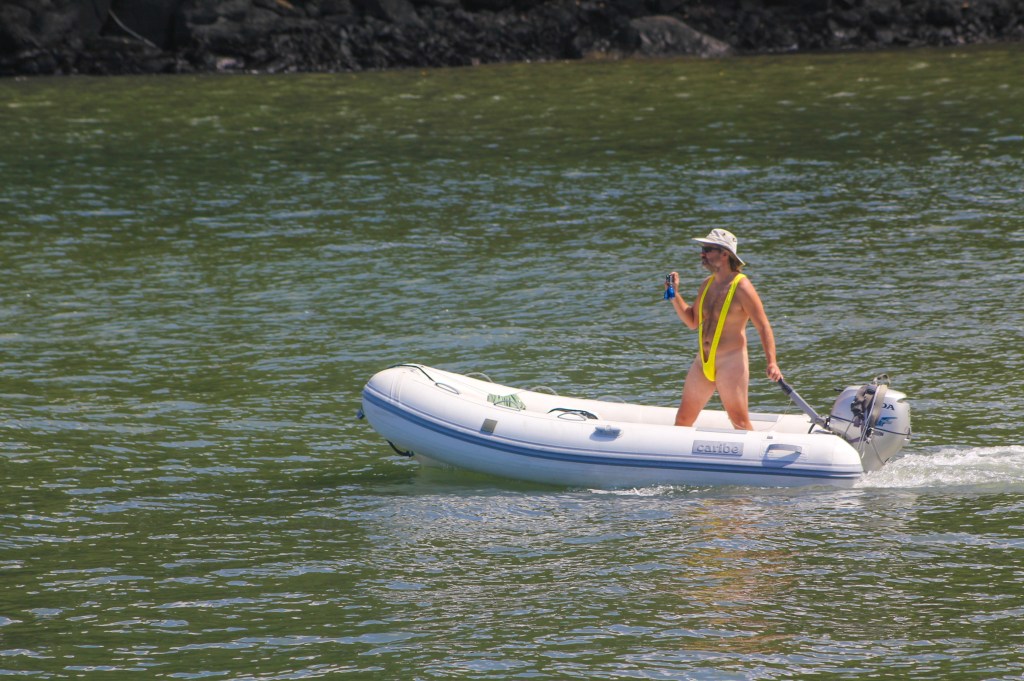
Next to arrive was Lady Carolina, not much after Chara. Their entrance lacked the professionalism of Chara’s spot-on anchoring, but it made up for it in, let’s just say, flare. As I did with Chara, I was taking pictures of them on their approach outside the harbor with the telephoto lens. At some point I get a reasonably clear glimpse into the cockpit, and I have to look away. Then I’m not sure of exactly what I saw, so I have to look again. This time, I’m sure. If you’ve seen the movie Borat, you will know what I’m talking about. Steve is wearing a bright yellow contraption. Picture a banana hammock with suspenders. And later I would learn it also sported a G-string. “Oh my god!” I yell across to Chara, “What is Steve WEARING!?!”
The Mankini
Steve proudly displayed his mankini to the anchorage as poor Kyle ducked at the stern in sheer embarrassment. And in typical Lady Carolina style, they had to circle the anchorage 2 or 3 times to pick their spot, then once they picked their spot and dropped, they decided that wasn’t good and moved. In the final anchoring spot, they enlisted Tim’s help in the dingy, so he got a front row show for the mankini. I do think at one point Steve did put shorts on, because there’s a fair amount of bending and lifting involved in anchoring a boat, so he was perhaps putting all of us out of our misery while making himself a bit more comfortable. Of course, through all this the time for Chara’s appointment came and went and they had to drop their own dinghy to get to shore anyway. Then we had an all-day happy hour on Exodus, complete with baguettes “four ways.” We had a good time catching up and chatting about our passages.
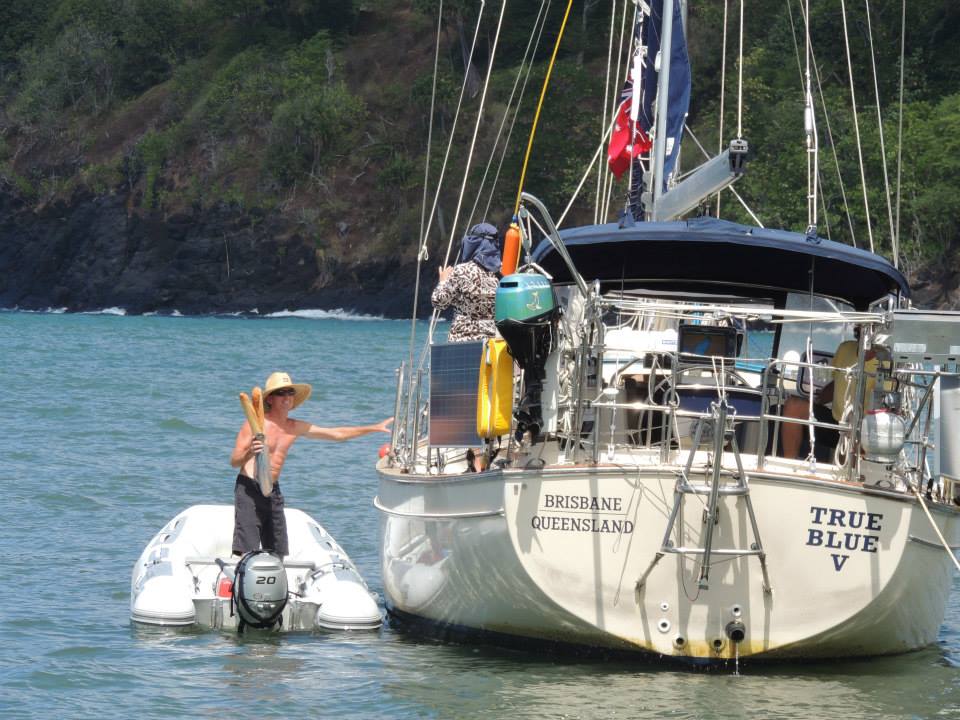
But no, the mankini adventures did not end that day. Our other buddy boat, True Blue V, arrived two days later, and since they had missed the original show, Steve was planning to make up for it. I had made some allusion to “Steve’s arrival attire” on one of our radio nets, so Craig and Leann knew that something might be up. As soon as they were heading past the breakwater, Steve donned his mankini and raced out in the dinghy, driving it while standing, as if he were driving a chariot. They almost died! The best part was that there was a tour boat of what sounded like teenage girls leaving the harbor at just the same time, and Steve faced them and gestured with arms high in the air, and whole harbor erupted in screams and squeals.
Once True Blue V got anchored, we had another lovely day of eating, drinking, and catching up. We were lucky on Exodus. We got to relive the arrival Euphoria several times, in addition to our own.
The checkin process was very simple and easy. No long waits. No drama. Of course, we hired an agent through the Pacific Puddle Jump registration and paid $200+ so if it hadn’t had been easy, that would have been a waste of money. The best part about the agent fee was getting an exemption from the bond requirement. You see, immigration is very tightly controlled in French Polynesia. Non-EU citizens are only allowed to stay for 3 months out of 6 months, so unlike Mexico where all you had to do was leave the country and re-enter, in French Polynesia you have to leave for a longer period of time. There are ways to get exceptions and extensions, but they involve either a lot of leg work ahead of time (with 2 visits to the French Embassy in your home country) or some sort of health or boat issue when you’re here. Anyway, I think the tight immigration is actually a good thing for French Polynesia in that it is probably preserving the Polynesian culture rather than opening it up to a bunch of rich western immigrants who want to get away and settle here.
Back to the bond requirement… when you arrive in French Polynesia you either have to have a return airline ticket already booked or if, like us, you are arriving via your own boat, you need to post a bond equal to the amount of an airline ticket back to your home country. Then when you clear out of the country, you get your money back (getting hit by an unfavorable exchange rate twice, presumably). So, by hiring this agent they arrange an exemption to the bond requirement. They also had a representative in Hiva Oa take us to the Gendarmerie and help us get checked in and arrange our duty-free fuel paperwork. The Hiva Oa rep’s name was Sandra, and she was immensely helpful in many ways. Sandra is the one we called when the tsunami sirens were going off.
When she took us to the Gendarmerie, we rode in the back of her pickup truck, which was covered, but it was stiflingly hot back there. We rode with another boat full of people, so we crowded in, and all cleared into the country together. At the Gendarmerie there was just one form to fill out, which included a section to declare all of your tobacco, firearms, medicines, and alcohol. I remembered one of the blogs I read said you could just write something like, “that which is needed for the household,” or something like that, but when I asked Sandra, she said I should simply write down exactly what we brought. Without my spreadsheet in hand there was no way I would be able to write exactly, but I took my best shot, and overall, I way underestimated our alcohol inventory.
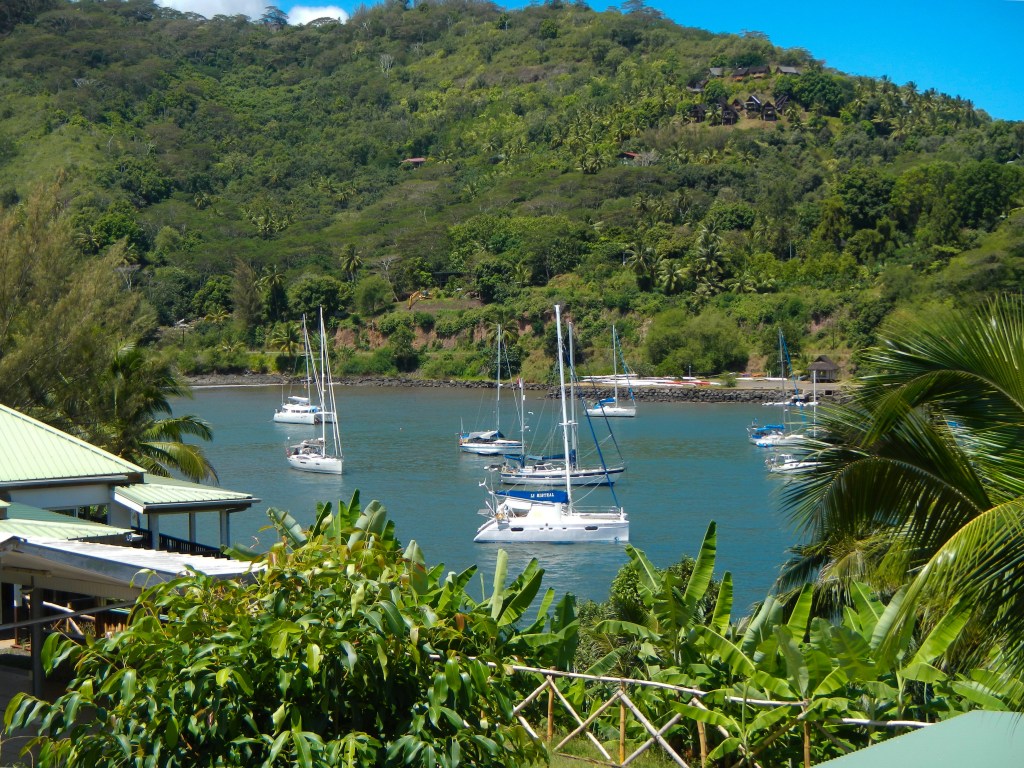
Atuona is the most windward official port of entry in French Polynesia, so many puddle jumpers make their first landfall there. The harbor, called Baie Taaoa (aka Traitor’s Bay) is small and it faces southwest. There is a breakwater reaching almost halfway out across the entrance to the bay to protect from some of the swell that comes in, but it is generally known as a pretty rolly anchorage. We found it quite pleasant while we were there. I guess when there is a particularly severe storm down in the Southern Ocean it can generate a lot of swells from the south which makes this anchorage pretty much untenable. Luckily, we didn’t experience that. When we arrived, there were 12 boats bow and stern anchored, and I think while we were there we saw as many as 18-20.
Boats packed in the anchorage
The town of Atuona is really nice even if it is quite a walk from the harbor. Traitor’s bay is actually a double lobed bay. Baie Tahauku is the eastern lobe where the harbor is, and Baie Atuona is the western lobe where, well, Atuona is. The walk takes about 30-40 minutes, and you get some nice views as you walk around the point between the lobes. But it’s also pretty easy to get a ride too. One time I was walking along alone, and someone stopped to give me a ride. At home, would I have ever accepted a ride like that from a stranger? He didn’t speak English, but I was able to tell him to drop me at the post office. Needless to say, the people there were quite nice. There are several stores, and provisioning was good. Our first trip to town I went a little crazy buying outrageously expensive fruit like pears and tangerines, since we had been out of fresh fruit for a while. But after a few days we were buried in the fresh local fruit, like pamplemousse, bananas, and mangoes, that people gave us. Contrary to all the hype among cruisers, you CAN get eggs here. I brought only enough eggs from Mexico for our crossing, and we’ve never been without eggs since arriving.
Our first trip to town we hit the Gendarmerie, the ATM (which had a much-loved air-conditioned kiosk), all of the stores, and one of the “snacks” in town for a pretty gross burger and a couple beers. We had a fine walk back to the harbor munching on baguettes the whole way. We learned that the gas station right on the harbor has baguettes in the morning, and you can pre-order, so you don’t have to go in crazy early to make sure you get some.
Snack Make Make
I thought the town smelled like Hawaii. Maybe it was all the tropical fruit and the moist air. But it definitely reminded me of Hawaii. It would rain a few times each day for just a short bit, making it a fire drill to get all the hatches closed on the boat so we don’t get drenched inside. This is where we made it part of the process when leaving the boat to make sure all hatches are closed. Yes, we learned the hard way.
Atuona was beautiful and smelled like Hawaii
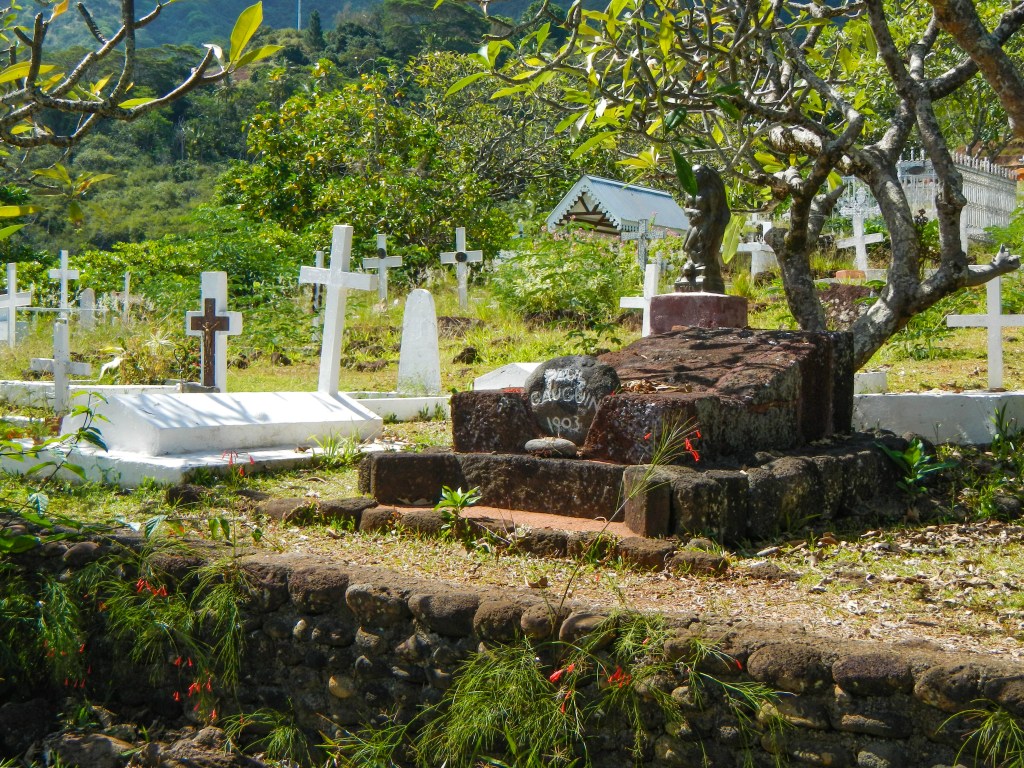
Any tourist propaganda you read about Atuona will include the fact that Paul Gaugin and Jaques Brel are buried there. I had never even heard of Jaques Brel, but apparently, he was a famous Belgian singer. Of course, I knew the French painter Paul Gaugin, and I kept mentioning we should walk up to the cemetery. I never had any takers. So, one of our last days there I headed into town alone to see the cemetery and pick up a few final provisions. It was a short, steep walk up to the cemetery, turning right just before the Gendarmerie. There was some roadwork being done on the very narrow road, and the workers stopped so that I could comfortably pass. The cemetery was quaint, and yes, I saw and photographed both graves, but the view of the town and the bay from up there was spectacular. I was OK having that moment alone.
Gaugin’s grave
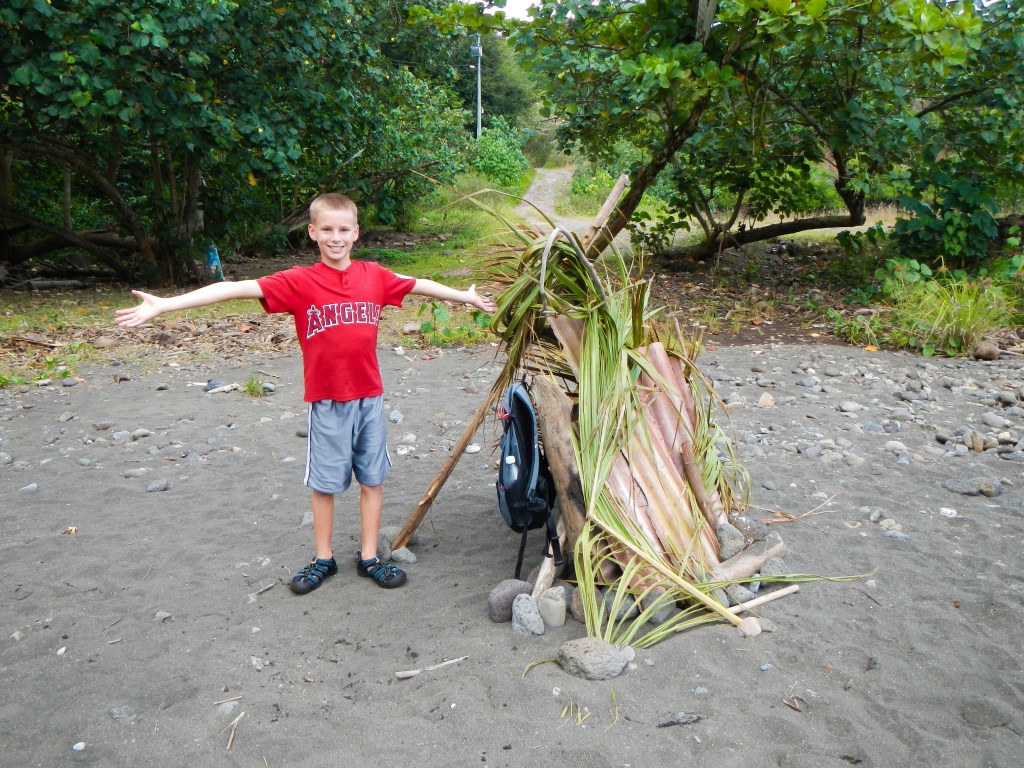
We met another kid boat there almost right away. They were on s/v Mojumbo and they were from Tasmania, finishing the final leg of a 4-year circumnavigation. Zeke is 14 (I think) and Nena is 12, and they were very welcoming to Alex and Brenden and took them to shore to play a couple times. Once Lady Carolina arrived, they were quite the gang, and when I just now asked Brenden what he remembered about Atuona, he said, “oh, that was my favorite place because we built really cool forts on the beach.”
While we were still a couple miles out of the Atuona harbor, I was picking up a couple boats on AIS, and I recognized one of the names, Senta. They weren’t anyone we had ever met, but they often checked in on the radio nets, and I was quite happy to see someone familiar. So, I hailed a couple times on VHF and finally got a response. Turns out it wasn’t the owners on board, but a hired crew to bring the boat here. The guy was really nice, told us there were 12 boats in the anchorage, and that he would be happy to help us with our stern anchor when we got there. 12 boats. I’d seen photos of the anchorage at seminars back in Mexico, and 12 seemed like a lot. Everyone was likely using stern anchors both to keep the boats pointed toward the harbor entrance, into the swell, and also so that everyone would fit.
When we arrived, we went immediately to the back of the anchorage near shore, because with a shallow draft and all, that’s just what cats do. We found a nice spot in what I felt like was too shallow of water, but there was room, and we totally nailed the bow/stern anchor setting. Alex and Brenden are such a good help at this, and since EVERYONE in the anchorage was watching the new boat come in, it’s good we didn’t give them any drama.
Our Euphoria was temporarily disrupted when a siren alarm started going off. Now, we knew about the earthquake that had happened off the coast of Chile (thanks Colin), so our first thought was, “oh no, tsunami!” No one else in the anchorage seemed to be taking any action and there wasn’t any radio traffic about it. So, I radioed Sandra, the agent on shore who would help us with our clearing in process the next day. She assured us it was just a test, and there was nothing to worry about. What a relief! We couldn’t imagine having to haul up anchor and head back out into the ocean right after we had gotten there.
Later we learned that is exactly what had happened to people the day before. They had a real tsunami warning and evacuated the harbor. I guess they learned they needed to test their system as a result. The skipper from Senta stopped by and we had a chat, and it turns out it’s a totally different Senta, not the one we knew of in Mexico after all.
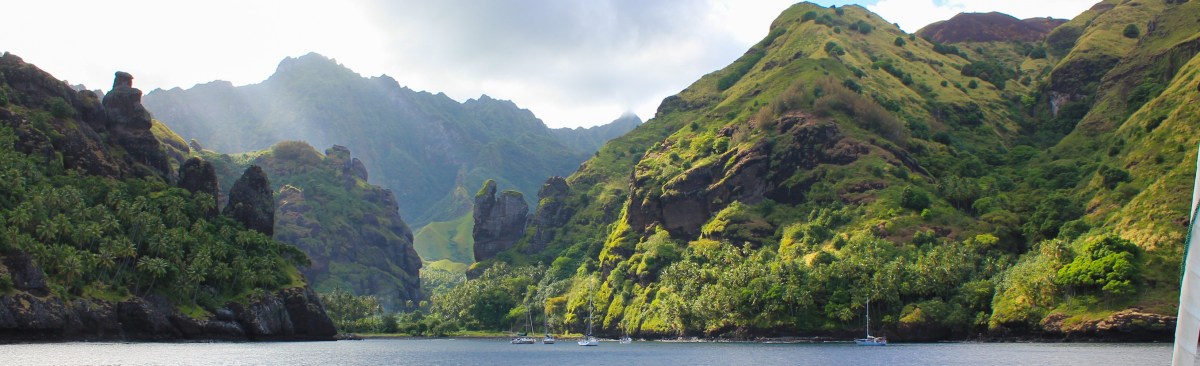
The Marquesas are the youngest of the islands in French Polynesia. But they must be older than the Hawaiian Islands, since there are not active volcanoes. (I’ve never googled that, though, so don’t quote me on it.) The landscapes are stunning with high peaks and lots of tropical greenery.
OK, I have to dip a little into the guidebook for some of the following history, however, I’m somewhat shocked that my “Guide to Navigation and Tourism in French Polynesia” still refers to the “discovery” of the islands. As if they didn’t exist before Europeans visited. But I digress.
Anyway, the islands were really first discovered and settled by people believed to have migrated from Melanesia, sometime around 1-20 AD. The first Europeans to *cough* discover *cough* them were the Spanish. They went to Fatu Hiva and Tahuata, but first they were like, “what,” and then they were like, “huh,” and then they just got bored. So, they didn’t stay long. The Marquesans are famous for repeatedly repelling occupation by various French, British, and American explorers, militaries, and missionaries. It was only in 1838 that French Catholic priests were there to stay on the island of Tahuata. During all the contact with the Europeans, the Marquesan population was severely decimated, in fact, they came close to disappearing altogether. While we were there, I noticed a concerted effort that has been made in recent decades to preserve the Marquesan language and culture. One archaeological display in Taiohae (on the island of Nuku Hiva) said the Marquesan language was almost entire replaced by Tahitian at one point. Fortunately, they are not reviving the practice of cannibalism, but the art of tattooing the body is making a strong come back. Their dancing is concentrated on a yearly festival where there are competitions among the islands. I heard it said that the missionaries frowned on the erotic and suggestive nature of the dancing, but I don’t know if that ever really came close to dying out.
The Marquesans are quite religious, with Catholicism being the most obvious Christian sect on the islands, and that is here to stay, there is no chance of the ancient Marquesan religions making a comeback.
They are in an odd time zone, being 9.5 hours set back from UTC time. Their currency is the French Polynesian Franc, and we didn’t notice any signs of any poverty. They are highly subsidized by the French, but at the same time they are a proud people who are proud to be Marquesan, not French. So, this creates a sort of love/hate relationship.
I loved the Marquesas, and I’m saddened by the fact that we had so little time there.
After 22+ days at sea we arrived in the town of Atuona, on the island of Hiva Oa, about mid-day on Wed, 2 April. We spent longer there than we thought we would, about a week, decompressing, welcoming our buddy boats, and seeing the island. And oh, my, the baguettes. But when the week was up, we were way more than ready to leave.
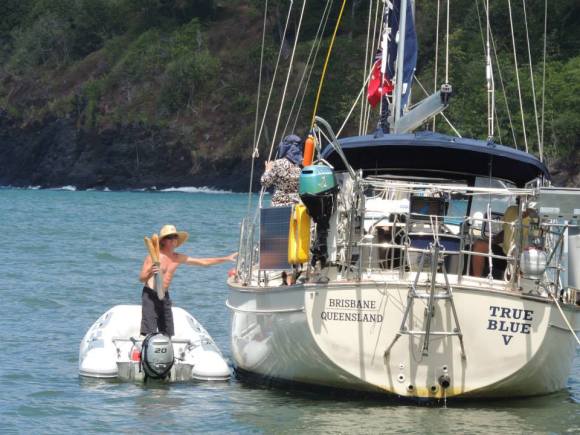
Tim delivering baguettes to True Blue V when they arrived
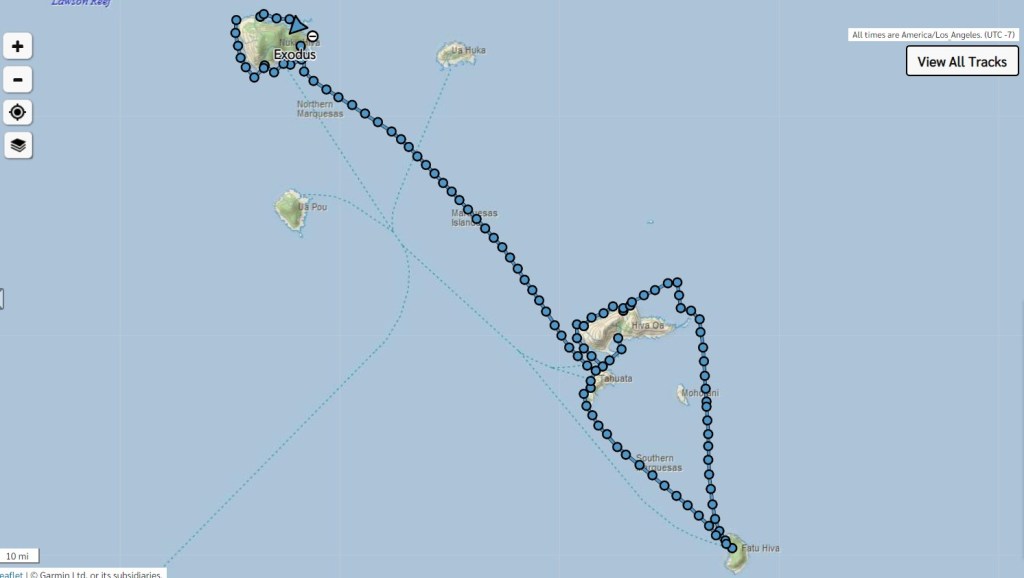
Our first stop after Atuona was a short sail across a channel to the northern end of the island of Tahuata to a “secret anchorage.” It was secret because Craig and Leann got the tip (and a waypoint) from a friend, and it isn’t described in the guidebook. It was a bit rolly, but we set a stern anchor to keep us pointed into the swell. Unlike most of Hiva Oa, there was a beautiful, white sand beach, and the boys were all very excited to be able to swim again. When Tim and Steve (Lady Carolina) went ashore they met an extended Marquesan family, and one of the women was a retired teacher, and she spoke very good English. We ended up having a huge potluck with them on shore the next day.
Potluck on Tahuata
Our next stop was the northern side of Hiva Oa. We had great winds as we once again crossed the channel, but then the wind died and became gusty when we got in the shadow of Hiva Oa. Then, when we rounded the northwest corner, we got blasted with 20+ knots wind right on the nose. We were headed for Hanaiapa, which is about midway along the northern side of the island, but True Blue V was ahead of us, and they said the wind just keeps getting worse, so we all decided to abort and pull into Baie Hanamenu just around the northeast corner. This was a pleasant anchorage, but we stayed only one night, and I never even bothered to go ashore. Tim’s notes in in our logbook says “Fresh water spring with pool on shore. Beautiful and Cold!!” (Yes, occasionally he writes something, and he tends to use a lot of exclamation points.) The next morning, we left on the early side so we could motor the 6 miles east to Haniapa before the winds kicked up, and we skirted the uncharted coastal section hoping to catch a fish. No white sand beach here, like most of the Marquesas, and we stayed a couple days including a shore excursion to the village and a visit to the “yacht club” although there were no services at all in town. We had good holding in the anchorage, but the guidebook wasn’t lying when it said don’t proceed too far into the bay due to scattered coral heads.
With William at the Hanaiapa Yacht Club
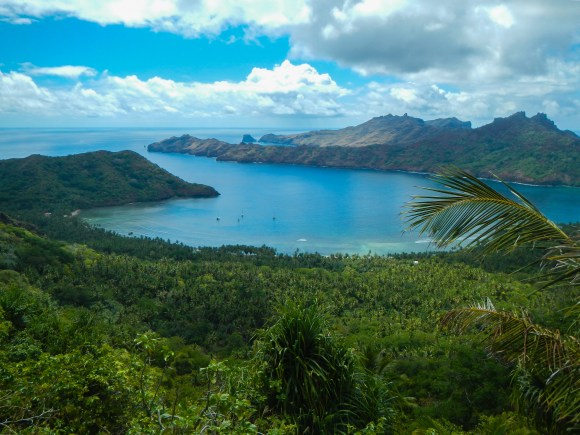
On 15 April (happy Tax Day) we were planning to leave Hiva Oa for an overnight passage down to Fatu Hiva, but we felt a little restless in the morning, so we moved around to the next bay, Hanatekuua, for the day. It had a beautiful beach, but we never left the boat, just prepped for the overnight passage. We left just before sundown, a little later than our buddy boats, and we knew it would be an upwind slog until we rounded the NW corner of Hiva Oa and headed south, so we just motor sailed while hugging the coast rather than attempt to sail north and tack. We still tacked a couple times (I learned the next morning, because all that action was on Tim’s watch), but we made it around pretty painlessly. Once headed south to Fatu Hiva we were still on a close haul, but we were able to make it there on one tack, which is good. It was a lumpy bumpy passage, and I was worried Fatu Hiva wouldn’t live up to all the hype, but when we approached the anchorage called Bay of Virgins, I was in awe. Absolutely stunning. People think the photos look like Jurassic Park. See below for all of our adventures in Fatu Hiva, including the much-hyped waterfall hike, but for now just know that we stayed 5 days, but we could have stayed much, much longer.
Fatu Hiva Arrival
We made an early morning departure and had a nice day sail back down to the island of Tahuata, this time working our way up the west side. We started at Hapatoni, where we got hammered by a squall right as we were arriving to anchor. This is a two lobed bay, and since we were anchored in the northern lobe, we were technically in Baie Hanatefau not Hapatoni. We had a group shore excursion with Lady Carolina, True Blue V, and Chara, and we didn’t find the guidebook quite accurate when it said this village has the friendliest people in the Marquesas. Not that they were unfriendly or anything, but they certainly didn’t stand out. Paddle boarding around the two bays was nice, and I also had my first and only snorkel in the Marquesas here. And again, contrary to what the guidebook said, it was NOT good snorkeling. We certainly weren’t in the Sea of Cortez anymore. Visibility was horrible, and there weren’t that many fish.
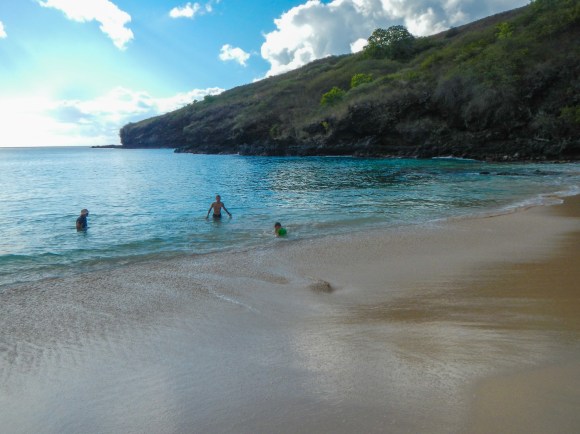
The next morning, we left a day ahead of our buddy boats and motored up the west side of Tahuata and did a drive by of the village of Vaitah, which has a nice, big anchorage where there were lots of boats. It’s supposedly a nice village, but it just didn’t draw us in, so we kept going north up to Hanamoenoa. This was a phenomenal anchorage with a beautiful white sand beach. We had a nice afternoon playing on the beach and a nice evening on board with just our family. I would say this was the perfect anchorage, except for two things. We didn’t think the holding in the anchorage was that great since it took us a few back downs to get the anchor to dig in, and, oh yeah, Alex got stung by a jellyfish, so that put a bit of a damper on things.
Playing on the white sand beach at Hanamoenoa
On 24 April we said good-bye to the southern Marquesas and headed for Nuku Hiva. We made the difficult decision of skipping Ua Huka, and we were going to leave Ua Pou as a game time decision, depending on how many anchorages we decided to go to on Nuku Hiva. Our first stop was Controller Bay in the SE corner of the island. It is a very large, deep bay with several lobes and different anchoring options. We were the first of our group to arrive, and we chose the main lobe off the village of Taipivai. Herman Mellville fans will note that this is the setting of his book Typee (which I keep trying to read but keep putting down in favor of some other tasty morsel.) It is a HUGE bay, and there was only one other boat when we arrived. We explored the town, hiked to another waterfall, and caught up with our old friends from Sara M and True Companion. Then we motor sailed just a bit west to the main bay, Baie de Taiohae, which also happens to be the administrative capital of The Marquesas. We spent 5 days in the very crowded anchorage getting all of our chores done and getting our wifi fix on before motor sailing just a few more miles west to Daniel’s Bay.
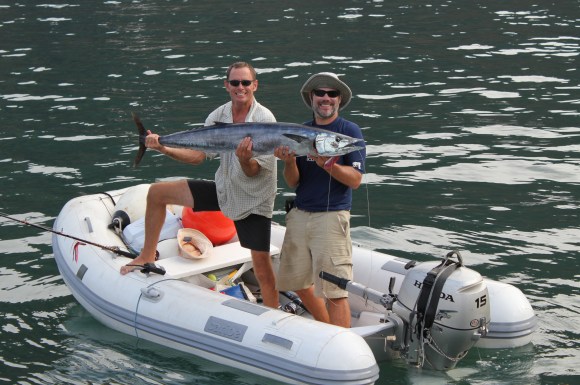
The official name of the bay is Baie de Taioa, but it is called Daniel’s Bay after a Marquesan man called Daniel who used to live there and was very friendly to cruisers. The story we heard of why he doesn’t live there anymore is that the TV series Survivor paid him to relocate, and they tore his house down and used the area as the setting for “Survivor Marquesas.” We heard that at one of the seminars back in Mexico, and I have no idea if it’s true. There was a small settlement on the shore and what seemed to be a bit of construction, so maybe he’s moving back? The highlight of our stay here had to be “Wahoo! Tuna!” when Tim and Steve came back from dinghy fishing. (If you haven’t seen the video yet, check it out, it’s hilarious.) Daniel’s bay was nice and sheltered and was one of the least rolly anchorages we had been in. Not to be missed there was a fantastic hike to yet another beautiful waterfall. Our friend Alan from s/v Sara M went with us, and that was lucky since he had been before and knew the way. Although he did throw Joel in the water at one of the river crossings. Or maybe it was Joel who threw Alan in the water. Or maybe Alan was just trying to help Joel and they both went down. Anyway, no one was hurt, but they were both a little wet. The waterfall was amazing, and I say that even though I never even saw it. The fall was embedded back within a vertical crevasse, and there was a large pool at the base. All the guys jumped in the water and were able to swim under some boulders to get to the pool at the base of the crevasse, and therefore, the base of the waterfall. They had a lot of fun. I just sat along the edge of the outside pool with my feet in the water not letting the crayfish nibble at my toes.
Wahoo!
When we left Daniel’s bay, we were headed up around to the north side of the island over to the NW corner to Baie de Anaho. But once again we had an aborted passage trying to go upwind on the north side of an island because we got slammed with 20+ knots of wind. We had heard that this island was easier to navigate around than Hiva Oa. We heard that the wind funnels through the valleys and if you stay close to shore on the north side, you’ll get a nice beam reach on your starboard side. WRONG. When we realized we wouldn’t make it all the way to Anaho, we pushed forward another couple miles to Hakaheu, but Lady Carolina turned around and went to Haahopu, which was actually on the west side of the island. Hakaheu was a nice bay, and we were the only boat there. It’s not discussed much in the guidebook, and it’s listed on our charts as uncharted, but it was a great place to duck into. We had planned to stay just the one night and then press on to Anaho, but Tim went to shore and met a father and son who live there named Albert and Germain. The boys and I joined them ashore, and they showed us all around their property where they have many animals and fruit trees. They were very nice, and their English was only slightly better than our French, so communication was challenging, but we all were pretty motivated and just tried our best. We had a nice time and Brenden especially like the baby goat that followed him all around. They loaded us up with Pamplemousse and invited us for a meal with them the next afternoon. There’s no way we would miss that, so we would stay an extra day. Lady Carolina joined us the next day for the meal on shore and since Albert was doing the cooking, Tim and I showed them around the property. They had a ton of dogs and Albert explained that they are for hunting pigs, which got Steve’s attention, and he asked if he and Tim could go hunting with him. They made a plan to go the next morning, so we would stay yet another night. They all got up very early but came back with backpacks full of fresh fruit but no pig meat. No worries, our freezer was full anyway.
We were pushing our stay in the Marquesas a bit long, but we still had one more bay to visit, Anaho, which the author of one of the guidebooks I used said was his favorite spot in all of the Marquesas. I could immediately see why, it’s one of the loveliest anchorages we had been in, well worth the bash to get here. Unfortunately, it rained quite a bit while we were there, so we didn’t quite get to fully enjoy it. On the 6 or so mile trip to get here from Hakaehu Lady Carolina landed a huge wahoo. We were on the radio with them, and Steve was telling us to go ahead and pull in our lines since we are set for fish for a while and then… whrrrrr…. fish on. Tim also wrestled aboard a 5.5 ft wahoo. So, then we were REALLY set for fish. We traded some with some locals for bananas, traded some to another boat for some dorado, and gave some away to another boat we’d seen several times previously at other anchorage. We had a HUGE wahoo dinner on Lady Carolina and another HUGE one on Exodus. Tim, Steve, Carolina, and I went on a hike (sans kids) up over a ridge to the next bay where there is a town and we heard you can get baguettes there. It was a long hike, and I enjoyed it because it gave me that same feeling I get from running (getting the heart rate a little bit up and then just pushing along). We scored some baguettes, but they were frozen and since it was such a small town, we tempered our desire to buy 8 each and cut it down to 4 each.
A view of the anchorage at Anaho
Tim, Steve, Carolina, and I also hiked over to an organic farm and picked our own green beans, lettuce, radishes, and eggplant, and we also got some tomatoes and peppers that were already picked. The owners of the farm were very friendly and gave us fresh coconuts to drink the water out of. They also let us try some of the various melons they had. The part of the hike back that was along a trail just off the beach was amazing and I regret I didn’t have my camera with me. White sand, blue water contrasted with dramatic black volcanic boulders. No, it wasn’t a quick trip to the store for veggies, but it was a journey worth taking. While we were at the farm the boys all hiked up to the top of the ridge the other direction towards the town in the next bay to collect mangoes. Would you believe they came back with 96 nice green mangoes? Our plan was to give or trade them to people in The Tuamotus, since we had heard they have far less access to fresh fruit than they do in The Marquesas.
Sadly, on Sat, 10 May, we said good-bye to the Marquesas and headed south to The Tuamotus.










 Gresham Family Exodus