There is this strange phenomenon among long time cruisers in Mexico. I don’t mean to generalize, because of course I didn’t get this from everyone, but many, many times when the conversation turns to future plans and I mention that we are going to the South Pacific, it’s like they immediately go on the defensive. Like just because you say you are leaving Mexico you must be wondering how come they are not, and maybe even be judging them for it. Sometimes I hear that was once their plan but they like Mexico so much they stayed. I get that. I respect that. I love Mexico, and I think it is amazing cruising, and I could stay here forever and be quite happy. Sometimes they say, “I have friends who have cruised the world and they say Mexico is the best cruising, so why leave?” OK, this I don’t get at all. Everybody has different perspectives and different priorities and different things they like, so why is that even relevant? Stay in Mexico if you want to, I totally get that, but don’t tell me other people say Mexico is the best, because the way I see it, even if we spend 2 years in the South Pacific and go to places like French Polynesia and Tonga, and I look back and I think, “you know what, Mexico was my favorite,” I would NEVER regret going. I would want to be able to say that for myself, I guess. I must admit, though, that I do hope Tim and I end up retired in Mexico playing Bocce Ball and Mexican Train. It’s a good life.
Category: Uncategorized
Categories
Lady Carolina Welcome Party
When we arrived back in La Cruz about mid-day, we pulled up alongside Lady Carolina, and it felt like home. They welcomed us back with drinks, snacks, and a fun afternoon just hanging out on Lady Carolina. I mean seriously, we felt really special the way they dropped what they were doing, and Carolina made a bunch of yummy appetizers and Steve, well, he poured the rum. After a few hours we headed to town for an early dinner at Los Twins, and let’s just say the evening turned into another one of those nights where we need a conch, and all you have is a ketchup bottle.

Categories
The Itchy Rash Mystery
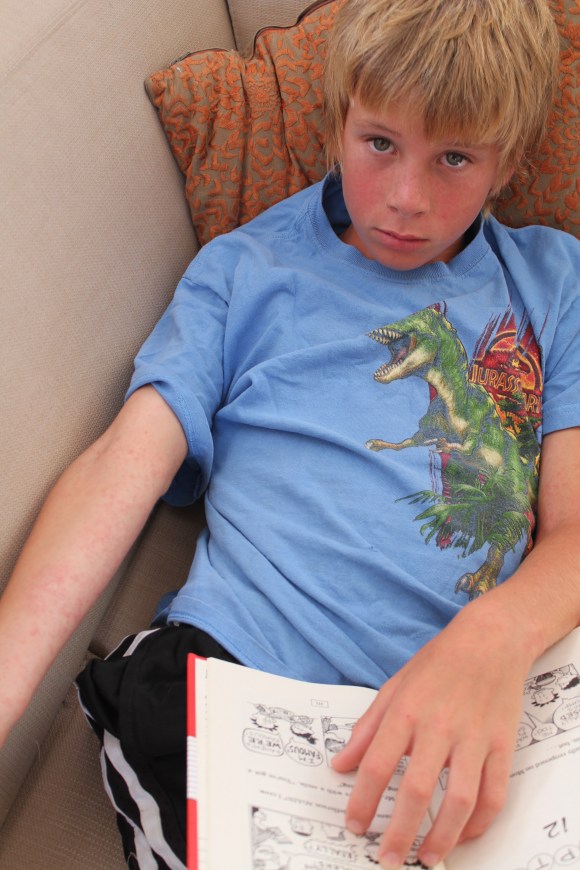
Brenden got sick almost right after we dropped anchor at Tenacatita. He had a low fever and a rash on his body that just kept getting worse. He was really disappointed, because Fluenta had joined us so, “being sick was seriously impacting his play time.” I asked about doctors in the area on the daily VHF net and got back a few options. We decided to cross the bay over to the town of La Manzanilla, where there is a pharmacy that has a doctor on site. The doctor was very pleasant, but she had no idea what was wrong, and when she took his temperature, it was under his armpit, and she concluded he didn’t have a fever (although I knew already for a fact that he did). She gave us amoxicillin, Benadryl, and some topical medication that you were supposed to dissolve in water. Seems like she was just covering all the bases. I didn’t start him on the amoxicillin right away because I wasn’t convinced it was bacterial. So, we were baseically back to square one, and we had no idea what was wrong with him. Then Brenden piped up and said, “maybe it can be the different soap.” Excuse me, what? What different soap? Brenden filled us in on how he’s been using the soap in the “blue bottle” since he’s been showering in our shower.
OK, mystery solved. Brenden had been washing himself with Head and Shoulders. And when he started getting a rash, we had him shower more frequently and since he kept washing with Head and Shoulders the rash kept getting worse. Once diagnosed, the rash cleared up quickly, and he was back to getting to enjoy his playtime with Fluenta. On the upside, I’m not sure we would have gone to La Manzanilla if we didn’t need to go to the doctor, and it was a very nice little town. It had its share of beachside palapas, and we had some very nice, very reasonable priced fish tacos at Pedro’s (a good recommendation from another cruiser). It seems a favorite pastime of both locals and tourists is flying kites, so there were lots of good kite flying sites as we walked down the beach. There is also a crocodile sanctuary, and the boys went and checked it out, but it was pretty sad and nothing like seeing the crocodiles in the wild when we did the jungle tour near San Blas.
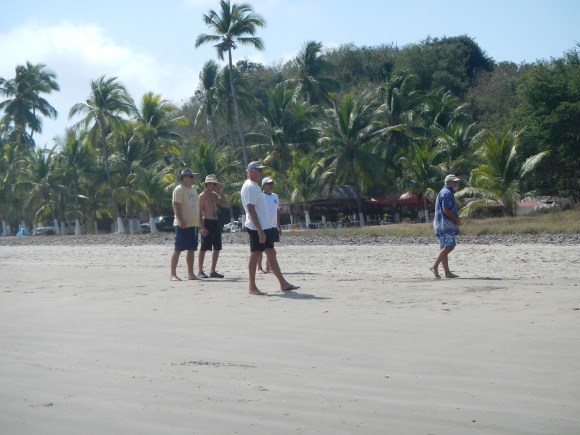
There is quite the retirement community in Bahia Tenacatita. And I’m not talking about a residential community, I mean the other cruisers that hang out there. It seems like there’s a group that spends their summers above the border and their winters on their boats in and around the vicinity of Tenacatita. They run a daily VHF radio net that reaches down as far south as Barra de Navidad, so we found out quickly that there’s a group of folks who swim to the beach in the afternoon and then hang out at the restaurant and drink beer. So, Tim and I decided to join them, and we quickly realized that we were smack dab in the middle of the retirement community. Tim played bocce ball with all the guys on the beach while I took a walk by myself down the beach. When I returned, everyone was at the restaurant and all the men were at one table drinking beer and all the women were at another table playing dominoes and drinking various things that were not beer. I ordered a beer and sat next to Tim for a while, and then I just decided to conform, and I went and joined the women’s table. They were nice and pleasant, and they let me join their game of Mexican Train. They had a few different rules than I was used to, but I got the hang of it, and was constantly laughing inside at how competitive they were. Some were chatty, and I tried to talk and get to know them, but others were focused on the game and always had to tell the rest of us when it was our turn. I think I came in last place, and I also think this endeared me to them in contrast to how it would have been received had I kicked their asses. Anyway, I just kept thinking, wow, they do this every day?
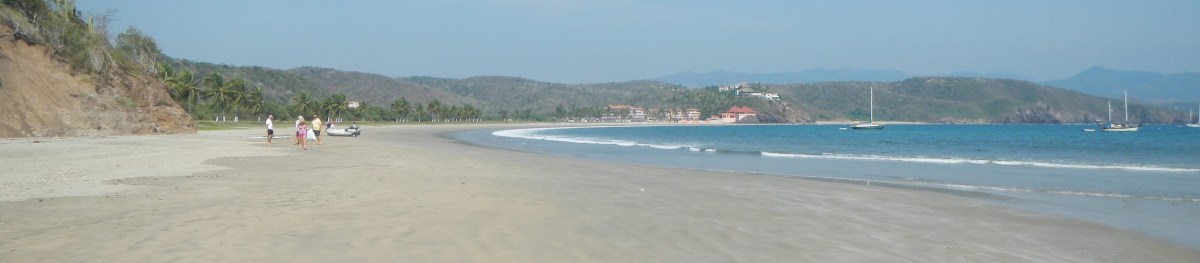
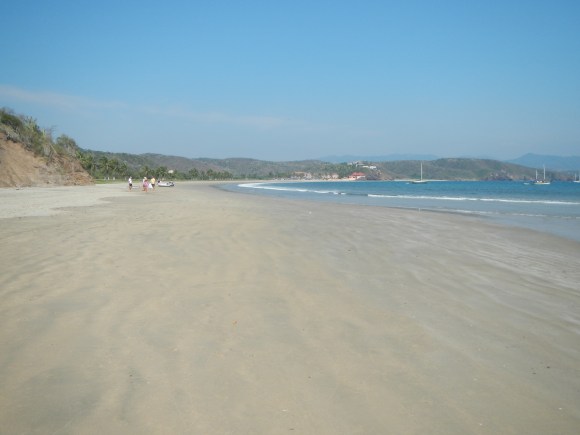
While I was walking alone down the beach, I decided to try to go all the way to the end. I don’t know why, but I like to walk the beaches we come to end to end and take photos from different perspectives. I walked past a pretty big hotel that looked majestic from afar, but as you got closer you could see that it was a bit weathered and run down. I kept going just a bit further until I got to some rocks that extended out into the water. I climbed up a bit trying to decide if I could get over them safely since I could see that the beach extended further past the rocks. Then I heard someone blowing a whistle. At first, I didn’t pay it any attention, since why would I think it was directed at me. Well, it turns out that it was. I noticed a hotel security guard walking towards me, so I abandoned my quest of climbing over the rocks and headed in his direction. He told me I couldn’t be over here and that I needed to go back to the hotel, and he asked me what I was doing. I was nice and polite and told him I was just walking to the end of the beach. I agreed immediately to turn back and apologized that he had to walk all the way over here to collect me. Then he started teasing me asking why I wanted to walk to the end of the beach, and I told him I just like to do that sort of thing. He kept teasing me and said I just wanted to go see the nudist beach. Nudist beach? Really? There’s a nudist beach over there? He said, don’t pretend like you didn’t know, you are a bad, bad girl. I never saw any nude people, so I have no idea if it really is a nudist beach or if he was just having a bit of fun with me. I asked the retirement community, but they had no idea.
Categories
Costelegre Route Recap

February 7-22, 2014
We escaped Banderas Bay to do a little bit of cruising south before heading back up to do final preparations for crossing the Pacific.
Costalegre is a stretch of the Mexican mainland coastline from Cabo Corrientes (the southern tip of Banderas Bay) to Punta Campos (the southern tip of Bahia de Manzanillo). It literally translates to “happy coast” and it is also commonly referred to as the “Gold Coast.” Although we didn’t get as far south as we would have like, we really enjoyed the anchorages we were able to visit.
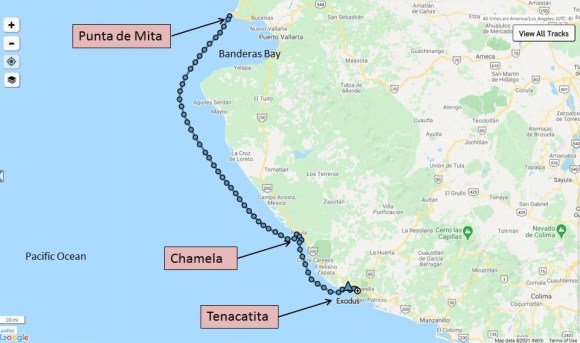
We left Punta de Mita on Friday, 7 Feb and had a great overnight sail to Bahia Chamela. We started on a light spinnaker run out of Banderas Bay and by the time we were rounding Cabo Corrientes we were flying along at 8 kts. We had that kind of speed until we dropped the spinnaker in the evening, just because it was getting dark. Of course, eventually the wind died and we limped along most of the night at about 2-3 kts, but it worked out fine since we approached the bay just as the sun was coming up. The boys caught a lot of fish on passage, and after 3 Jack Crevalles and 4 Skipjacks we were all a bit discouraged, but then they landed a Bonita late in the evening and we all had a nice sashimi snack.
Bahia Chamela is a large bay, and the main anchorage is tucked up with excellent protection from all directions but the south, but there was a little wraparound swell entering the bay. We’ve gotten used the the rollier anchorages on the mainland. Gone are the days when the anchorages were flat as glass, and you could pick from the plethera of anchorages around for one that had protection that matched the weather forecast. Chamela has a beautiful white sand beach with palapas dotting the shoreline, not unlike Chacala, but we never actually went ashore. We just wanted to “relax on the boat.” Another feature of Chamela are the many very small islands that are scattered throughout the large bay, and a couple provide an anchoring opportunity, so we took advantage and anchored off of a small beach on the northwest side of Isla Cocinas. This was a spectacular location, and where I got to spend my “39th” birthday. While there we made a dinghy day trip around to the other side of the small island and hung out at yet another beautiful little beach. We all snorkeled, and the boys even went out around the outside of the island to try some spearfishing. The novelty was an area where the water funneled in from the ocean side around the rocks and made a washing machine environment that the boys never got tired of playing in.
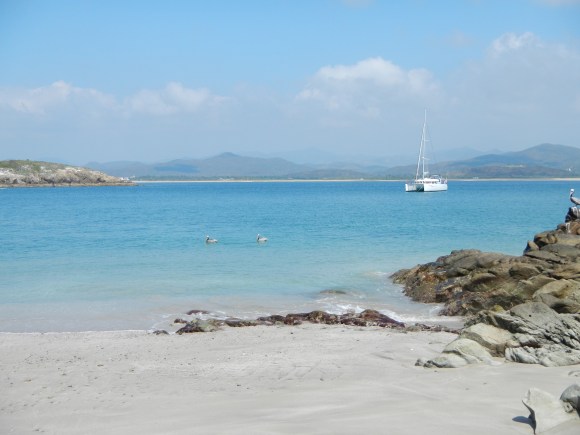
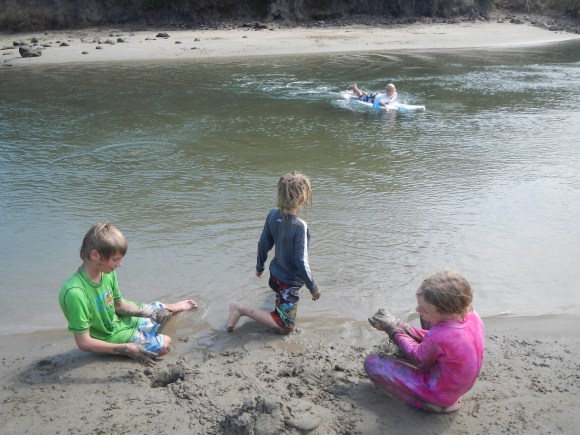
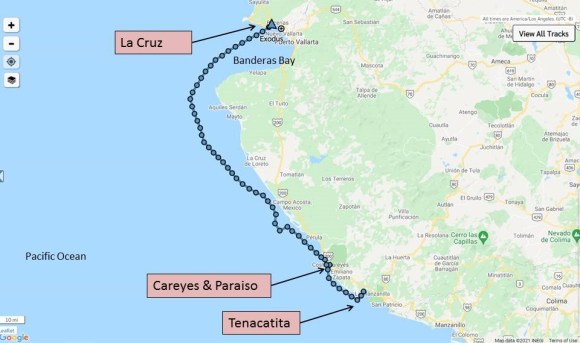
Our next move was a day passage down to the next major bay called Bahia Tenacatita, which has many possible anchoring locations. This is a major cruiser hangout, in fact they even have a daily VHF net like in La Paz, Puerto Escondido, and Banderas Bay. We started at the west most anchorage around the first point into the bay that is billed as having fantastic snorkeling, in fact it’s even called “The Aquarium” in the guidebook. It was here that Brenden started getting sick, so he and I didn’t snorkel, but Tim and Alex said it was nothing special. We were pleasantly surprised by the arrival of Fluenta, one of our buddy kid boats, so Alex spent a fair amount of time over there while Brenden was working through his illness. We ended up moving across the bay to anchor off the town of La Manzanilla for one night, in order to take Brenden to the doctor, and after that we headed for the main anchorage in Tenacatita where there were about 20 other boats anchored. We hung out there with Fluenta for a few more days, and then motor sailed north to a small anchorage between Tenacatita and Chamela called Bahia Careyes. We did a little bit of snorkeling when we got there, but again nothing special, since there was a lot of churn and the visibility was poor. The next morning we had another short passage to Bahia Paraiso, another small anchorage just south of Chamela. We were the only boat there, so we had plenty of room, but we chose to stern anchor anyway in order to keep our bow pointed at the swell. Here Tim and I did a fair amount of paddle boarding. We also noticed the weather was starting to turn warmer again, I guess winter was coming to a close. Cold showers in the evening were once again the norm. On Friday, 21 Feb, we had a horrendous overnight passage back to La Cruz, bashing against the wind under motor the whole way. But our arrival and reunion with Lady Carolina was heartfelt, and it was time to get down to the serious business of final preparations for the Pacific crossing.

Categories
Anchor Waypoints
February 2014
When we drop anchor our standard procedure (after lots of iterating) is for me to be at the helm and for Tim to be on the anchor. When Tim drops the anchor, I drop a waypoint on the chart plotter to more or less mark right where the anchor drops. It’s not exactly straightforward because our GPS unit isn’t right on the bow roller, it’s back by the helm, so depending on how deep the water is and how fast I’m backing down I hit the button about where I think the anchor will hit the ground. Then we plug that location into our anchor alarm, so we have a more reliable way of detecting whether we are dragging with very few false alarms. Of course, we haven’t dragged since we got our new anchor way back in La Paz, but better safe than sorry.
So, since we now have anchor waypoints for everywhere we’ve anchored I thought I’d start including them. Not that they will be of much use to the 3 people who actually read my essays, but someday I may post them for other cruisers, so I thought I’d start collecting them here. And this installation isn’t very exciting because we didn’t really go anywhere. (Dates are yearmonthday)
20140206 PuntaDeMita 20 45.930 N 105 31.205 W
20140204 LaCruz 20 45.010 N 105 22.045 W
20140122 LaCruz 20 44.995 N 105 22.149 W
20140123 PuntaDeMita 20 45.982 N 105 31.115 W
20131221 LaCruz 20 45.050 N 105 22.007 W
Categories
Punta de Mita
February 2014
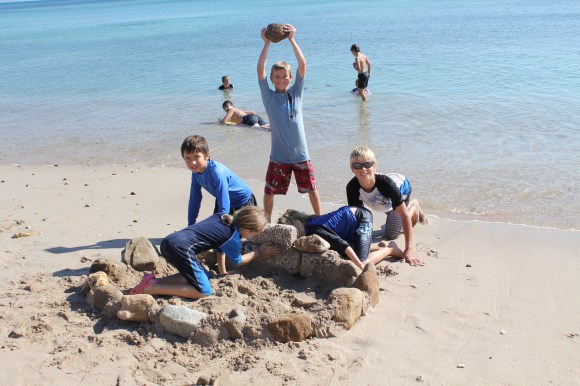
I’ve mentioned Punta de Mita a few times, so I thought I’d give a little more information about it. It is the northern point that defines Banderas Bay (Cabo Corrientes is the southern point), and the hook of land just inside the point has a small beach town. The anchorage is a popular spot amongst the cruisers for the surfing, and it is sort of a getaway spot when you feel like getting away from towns and crowds but still feel like staying within the Bay. Our first time there was actually by land when we took the bus from La Cruz. Shauna (s/v Sand Dollar) and I thought we’d take a our kids for a day outing for some boogie boarding and fun in the sand and sun. Of course, without consulting each other we both invited other kids to come along and when all was said and done it was me, Shauna, and 11 kids age 7 to 14. It was actually a lot of fun, but there was obsessive compulsive head counting going on when we were boarding and disembarking the buses. We parked ourselves on the sand in front of a palapa and ordered some drinks so we could sit there and let the kids play. The waves weren’t that great that day, so some of the older kids tried going to a few different spots, but it was pretty calm everywhere. That didn’t stop them from having fun and they played in the lapping surf and dug holes and built forts. We also stopped at the OXXO (convenience store, like 711) before grabbing the bus back, and they all got good and sugared up for their parents. Among the kids we took were Victoria and Jonathon from s/v Fuenta. Have I mentioned already how I would take those kids anywhere? Well, I would. They are fun, friendly, and very very low maintenance. Our second time at Punta de Mita was by way of Exodus when we anchored out for one night when Gary and Marsha were visiting. We found a spot close in where there was easy access to the surf, and this time there was surf to be found. Unfortunately, Alex had another ear infection, so he wasn’t able to play in the water, but Tim and Brenden took the boards out and had a lot of fun. A few of our friends (s/v’s Fluenta and Kenta Anae) had taken the bus up from La Cruz so they all did a little surfing together. Alex tried to get to shore to play with the kids, but the surf was too big for him to paddle in without the risk of falling in and getting his ear wet, so he had to abort the mission and turn back. Spoiler alert – we will spend more time at Punta de Mita in future installments, but for now these were our initiations to Punta de Mita.”
Categories
Haul Out in La Cruz
February 2014
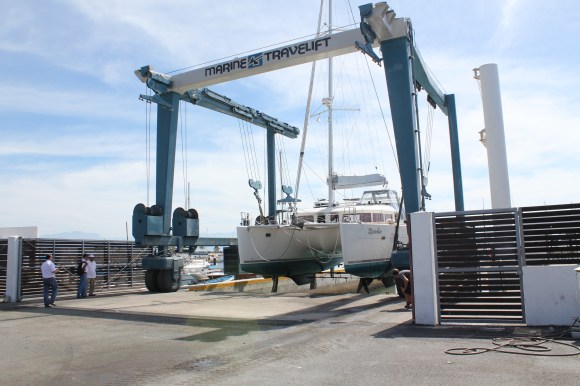
We ended up making a somewhat last minute decision to haul out in La Cruz. Most cruisers go down to Puerto Vallarta for haul out, because the word on the street is that it’s cheaper there, but unfortunately for Catamaran owners the travelift is not quite wide enough, so we are stuck with only one option in Banderas Bay. The main reason we decided to haul out was the anti-fouling on the saildrives needed to be redone. When we hauled out in La Paz, Tim had not intended to have them do anything with the saildrives, because the PropSpeed (specific prouduct used on props and saildrives) was still in good shape, but before he knew it the guys in the boatyard had sanded down one of them. So, they ended up painting them with the same paint we used on the bottom of the boat. I guess this wasn’t the best solution, since now, not even a year later, we had barnacles setting up shop within hours of cleaning them. So, the plan for this haulout was simply to reapply PropSpeed. When we hauled out in La Paz, we were pulled out on rails (like a train track) but this time we were lifted out by a travel lift. It was a little unnerving seeing your house lifted well off the ground and then moved around within the boatyard. There’s a video on the facebook page if you haven’t seen it already.
Once placed down on the blocks, everyone got to work. This is one of those times when my princess status is revoked and I have to pitch in with all the manual labor as well. We ended up deciding to repaint the bottom too since it looked pretty shabby and we were already out of the water and everything. So, overall I think we were in the yard for 5 days, and they let us stay on the boat during that time. Funny thing is everyone told us they didn’t let you live on the hard at that boatyard, that we would need to find a place to stay. We walked around to a couple of the hotels, but no one had vanancies, so Tim decided to just ask nicely if we could stay, and they said yes! Sometimes, all you have to do is ask.
The guy who we contracted with to do the work on Exodus was named Gabriel, and he isn’t the most well known one there in the yard, but overall he and his crew did a decent job. Tim’s only regret is that he didn’t insist that he apply the PropSpeed himself, because when they were doing it late in the afternoon, it was a bit rushed, and wasn’t as meticulous as Tim would have liked.
Gabriel would sometimes bring his 6 year old son, Christopher, with him to the yard, and one day we invited him to play on Exoudus. Communication was a little tough, but he had a great time playing with Alex and Brenden’s toys, particularly the hex bugs. He asked questions like where to we sleep so Tim took him on a little tour and he showed him our cabin. Christopher then asked where do I sleep (as in me, Deanne) but Tim had already started moving on and pointed out the bathroom to him. Christopher was shocked, “en el bano???” He thought Tim told him that I sleep in the bathroom. Then he laughed and laughed. It was so cute.
We were back in the water on 4 February ready to get out Banderas Bay and do some cruising again.
Categories
The Cockpit Floor
January 2104
One of the main reasons for going into the marina (as opposed to staying out in the anchorage) was to get some boat projects done prior to our Pacific crossing. There were many, many small projects on the list, but there were two big ones that needed to be addressed early so they didn’t end up delaying us in any way. They were the cockpit floor and the dinghy engine mount.
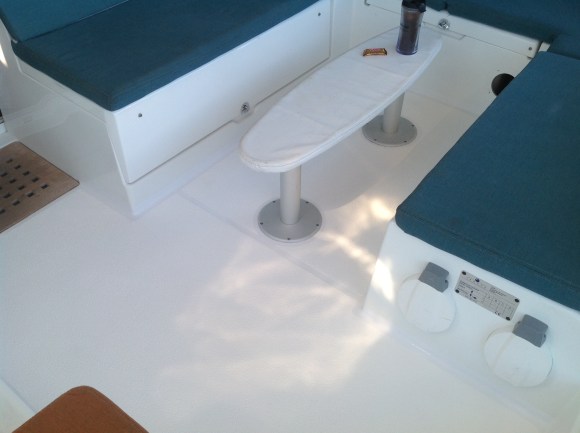
The cockpit floor is kind of a long story in that basically it was work in progress when we bought Exodus. From the factory, Exodus came with a stock gelcoat nonskid cockpit floor, but then the dealer replaced that with a Teak floor before selling it, I guess thinking it would be more marketable. Well, the previous owner, John, didn’t like the Teak, I think because it was too high maintenance, so he contracted to have it pulled up and then put a gelcoat floor back in. He wanted it to match the rest of the non-skid around the boat, so he found someone who would make a mold from another part of the boat to use in the cockpit. Sounds great, but there was a lot of drama surrounding the work because the guy left the country back to Mexico for a while and there was confusion about why he left and when he would return. It was incomplete when we went on the Baja Ha Ha, but it was supposed to be complete by the time we took possession of Exodus in early December. Of course, it wasn’t, and John gave us the option of waiting another week or taking Exodus and having the guy come up to Marina del Rey to finish it. We opted to take Exodus, and in hindsight maybe we were influenced by our excitement of becoming boat owners, because that turned into a HUGE hassle. First of all, when Tim inspected the work that had been done so far, it was crap. Basically, they had made a mold of the non-skid pattern from the top of the hard canopy, but then they just laid that down in the cockpit with the non-skid inverted. So, instead of little bumps on the floor to prevent slipping there were little cups, which as you can imagine just collect water and make the floor even more slippery, totally defeating the purpose of the non-skid floor. So, when the guy came up to “finish” the job, Tim insisted he pull it all out and start over. There were issues with this, and maybe, again in hindsight, we should have just cut him loose and found someone local to do the job, because we ended up having to pay for a hotel and even some gas to drive back and forth to San Diego. I can’t remember, but I think we split the expense with the previous owner, but in the end, it didn’t really matter, because even after it was completely redone the integrity of the floor didn’t last long. It wasn’t a few months into our journey that the floor was waterlogged and coming apart. Tim applied blue painters tape around the edges to keep the sharp edges contained so no one hurt themselves. We lived with the blue tape for quite a long time, so long that we almost didn’t notice it anymore. But we knew we needed to have a water tight floor, so in La Cruz Tim took on the huge task of redoing the floor himself. Well, not totally himself. Dan on Dazzler provided a lot of consulting ahead of time (since he had quite a bit of experience with this sort of work) and then when it came right down to it, he rolled up his sleeves and got down on his hands and knees and helped Tim with a lot of the labor too. It was quite the job, and it took a couple weeks to finish. The rain didn’t help, though. It rained pretty much our entire first week in the marina starting the day after Tim started ripping up the floor, of course. The finished product is a sight to be seen. Tim and Dan did an excellent job, and although they have a habit of inspecting close and searching for the imperfections, I certainly can’t say there are many to be found. They used Kiwi Grip as the non-skid surface, and, no, it doesn’t match the pattern of the rest of the non-skid, but it looks great, and if that had been done in the first place it would have saved us so much hassle.
Tim subcontracted out the work to build a support structure to mount our outboard, so it didn’t take nearly as much of his own labor, but he did have to design what he wanted and be able to communicate it to someone who spoke very little English. We go some translating help from a woman on s/v Go For Broke, and the contractor did very fast work. Within a couple days the new support structure was complete, and they also reinforced the dinghy davits, one of which had been ever so slightly (hence the reason we wanted to be able to remove the outboard from the dinghy onto its own support structure for an ocean passage). So, with the two main projects out of the way early, Tim could then slowly and consistently start checking off the myriad of other projects on “the list.
Categories
HAM Radio License
January 2014
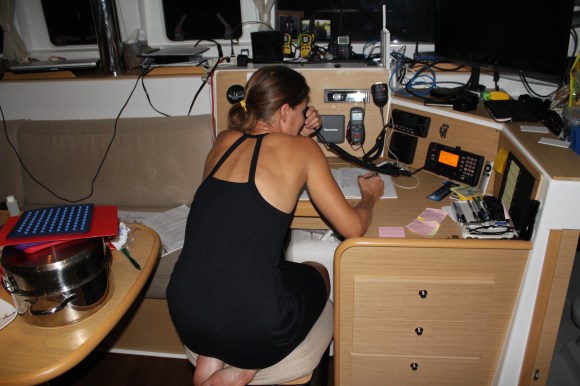
The radio frenquency spectrum is divided up and specific frequencies are allocated for specific uses. Our SSB radio operates in the HF spectrum (~3 – 30 MHz) and the frequencies in the range most often used by yachties are those allocated for marine use and those allocated for amatuer use. To transmit on the marine bands you need a ship station license for you boat and a marine operator permit for at least one person on board. These are easily obtained online from the FCC in the US. The ship station license is how you get your call sign (ours is WDG6445) and your MMSI number (which is used by DSC calling in both VHF and SSB radios). The marine operator permit seems like just one more way to squeeze money out of you, because you don’t have to pass a test or anything, you just pay for it and get it. Before we left home, I actually went one step further and did take a class and passed a test to get a marine operator license, because I thought I could stand to learn a thing or two. So, I’m actually qualified, licesne wise, to operate radios on commercial vessels if I ever feel like a career change. A lot of the radio nets in mexico were conducted on marine bands, so those were the ones I could check in to, and even net control for.
To transmit on the amateur frequencies you have to get a different license, known as a HAM license. HAM radio operators are by no means limited to marine uses, in fact most are land based. I never did bother to get a HAM license while still at home, because I didn’t think it was necessary and then I missed another opportunity to do it in La Paz, because I simply didn’t feel like studying. Once upon a time, you had to know morse code to pass the HAM license test, but since they did away with that requirement licenses are much more accessible, but I still didn’t feel like studying.
Then we spent the summer in the sea, and the main source of daily weather was a voice broadcast by Geary on the Sonrisa Net, which happened to be a HAM net. So, I could listen, but I could never check in. It was like not being allowed into the cool kids club. Well, not really, but I started to see that there may be a need for a HAM license as we proceed on our voyage because you never know what radio nets we’ll encounter and which ones we’ll want to participate in.
So, I started studying. They give the test monthly at the Yacht Club at Paradise Village, so when I started studying it was early January, and I had about a month to prepare. I learned that there are varying levels of licenses, and in order to trasmit on HF frequencies I actually had to pass two tests (technical and general classes). I started studying for the technical license figuring I would take that one and then the following month I would study for the general. Calling it “studying” is a bit generous. Basically, I just took the practice tests over and over again on qrz.com until I could consistently pass. Not a very noble way of passing the test since I was simply memorizing as opposed to learning and understanding the material, but it’s not like I’m going to build my own HAM radio shack, I just want to be able to transmit on HAM frequencies using my SSB radio. Two days before the test I realized that we may not be in Banderas Bay the following month, and if I didn’t get a chance to take the general I still wouldn’t be able to do that. So, I started cramming for the general test too. Pretty much non-stop the day before the test I sat on the computer taking practice test after practice test.
The day of the test I hitched a ride from La Cruz up to Paradise Village with Romany Star, and I was still studying a few topics I had jotted onto a post-it note. Turns out I’m the biggest geek every, because I passed the tests easily, and worried over nothing. So, now I’m KK4WYW (my HAM call sign) and I am now part of the cool kids club.
 Gresham Family Exodus