Categories
Uncategorized

Enijabro and Enejelar

The weather forecast said we were in for some stronger trades, so we joined three other boats (Pojean, Mariposa, and Anahata) up in the northernmost part of the atoll for some better protection. We anchored off the islet called Enijabro, and you can see the geography on the satellite image below:
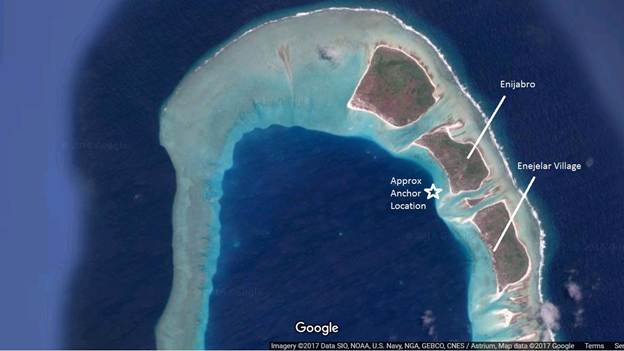
The northern tip of Ailuk

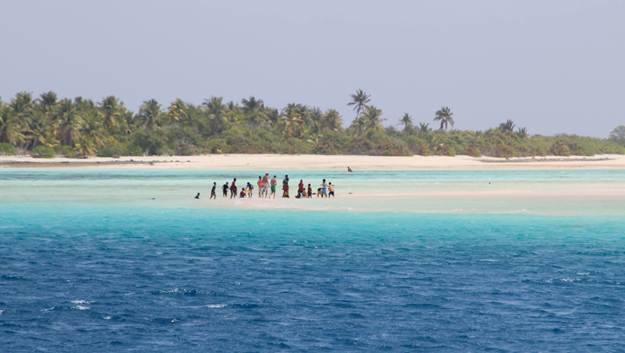
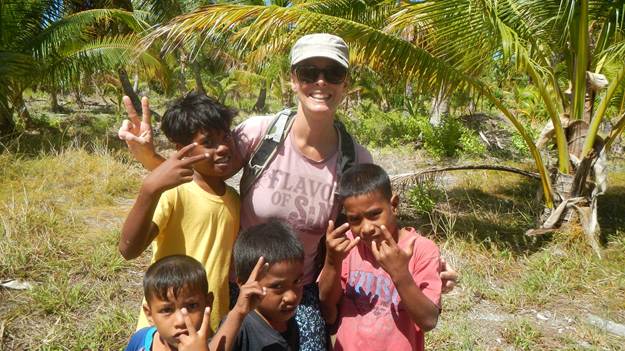
There is a small village on the nearby islet called Enejalar, and Tim and the boys also had some fun with the kids from that village skim boarding on the nearby sand bars. The northern most islet in the image above is the one where the guys harvest copra, so for a couple of days we gave the boys the option of doing school or going and helping with the copra, and Alex chose copra both times. Tim went lobstering twice with some men from the village and they were successful both times!

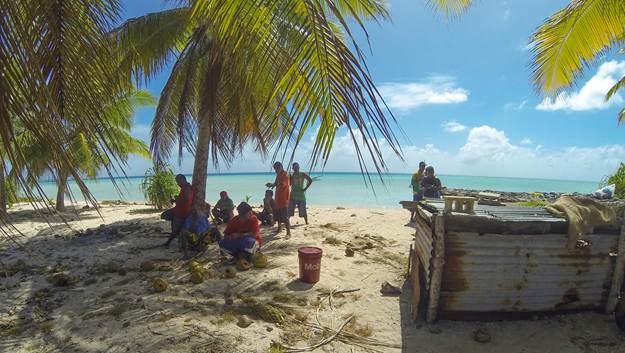
Since we had a group of boats together we decided to do something crazy and have our own pig roast. James from Pojean arranged to purchase a pig from some folks from the village on Enejelar, and we all pitched in. Part of the deal was that they would slaughter it for us, but that we would roast it ourselves. James was pretty much in a huff when he picked up the slaughtered pig since they had taken the ears, and apparently the ears are somewhat of a delicacy. Anyway, there is a homestead on Enijabro, and Tim talked to the guys there to get their permission for us to roast the pig, and it didn’t take long for them to volunteer to help. It’s a good thing too, because they knew what they were doing, and we clearly did not. We took our instant read meat thermometer ashore, and I’m sure they must have been mocking us in Marshallese about that!
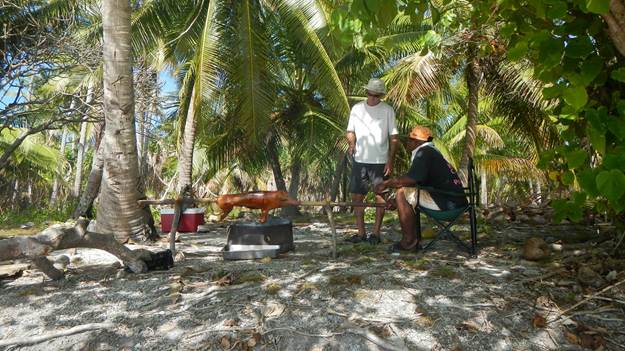
Tim gets a lesson on how to roast a pig
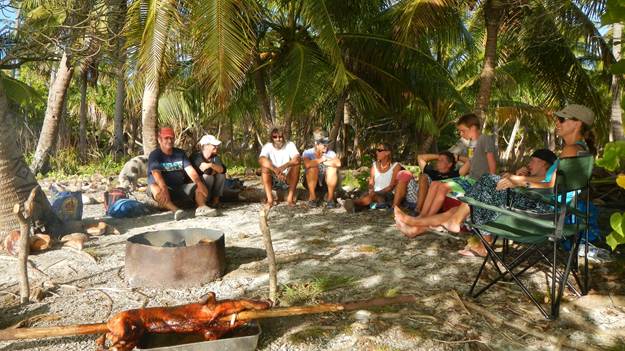
A cruisers’ pig roast feast

The morning after the pig roast, we went along with the other cruisers to the village in order to share some of the leftovers. I have to admit that I felt awkward and embarrassed at times, because I felt like we were acting like white saviors, arrogantly assuming these people needed our food handouts. And even if they did, it seemed like it could be handled in a more discrete way, in a way that allows a bit of dignity to be preserved. However, that all passed and the morning ended with some music: Jim belting out When the Saints Go Marching In and some of the locals singing the Ailuk Anthem, and we all relaxed together and enjoyed each other’s company. I spoke with a woman who has grown children and was very interested in our life on the boat, especially give the ages of the boys. These are my favorite moments on the islands, when I have a conversation with a woman and we are just two moms who can relate to each other.
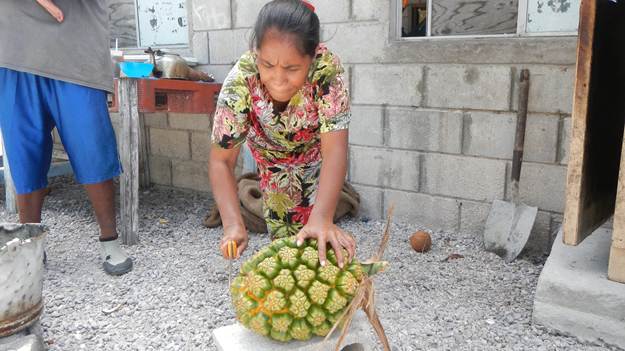
Learning how to eat Pandanas Fruit at Enejalar
Categories
Uncategorized

Harvesting Copra

At our location anchored at Ajirikku, every day we’d watch the outriggers head north in the morning and then south again in the evening, as the men of the village went to work each day harvesting copra. Not satisfied being simply a spectator, one day Tim decided he wanted to go to work with them. So, he had one of the boys dinghy him out to randomly intercept one of the outriggers as they were going by, and he flagged them down and asked if they would take him. Of course they agreed, and just like that he was gone for the day, helping them and learning about the copra operation.

It basically entails gathering coconuts on the ground, putting them in piles, then chopping them open and cutting the meat out and putting it in bags. Then they take the bags back to Ailuk where they dry the coconut meat and when the government ship ever comes then they export it for 25 cents per pound. Harvesting copra is something we’ve seen almost everywhere in the pacific, and from what I’ve read the world market for coconut oil doesn’t really support all the copra so usually it is heavily government subsidized. The men appreciated Tim’s participation. They told him he was different than the other yachties because he came to help them. I think this is a somewhat unfair assessment of the situation, because cruisers are always helping to fix things like generators and watermakers, but I suppose these sorts of efforts are more visible to the upper echelon of a village, while Tim helping with the copra was right in there with all the working men. One afternoon while Tim was out spearfishing some of the men stopped by the boat and I traded them some rice, DVD movies, and a flashlight for some more handicrafts, and they gave Brenden a ride on the canoe. One of the men told me that, “Tim is a very good man. He’s very kind.” I said, “Who?” No, not really, I said, “I think so too.”

The copra operation

Categories
Uncategorized

Ajirikku

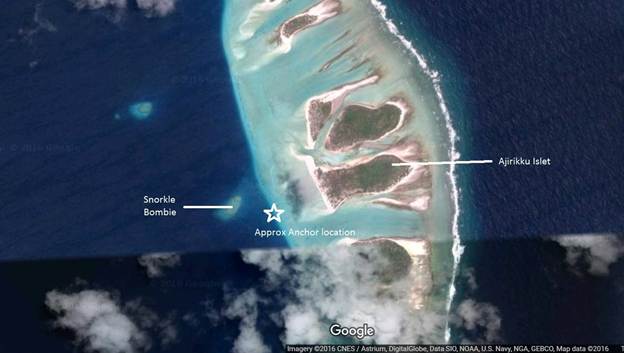
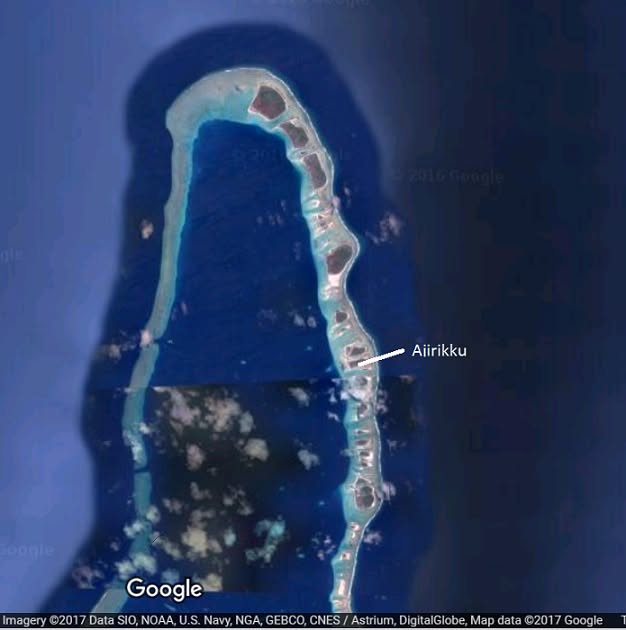
After five days at the village at Ailuk island we moved further north up the atoll to a collection of small, uninhabited islets, and we anchored closest to the one called Ajirikku. The satellite image below shows the location of Ajirikku in the northern tip of the atoll.

Location of Ajirikku within the Ailuk Atoll

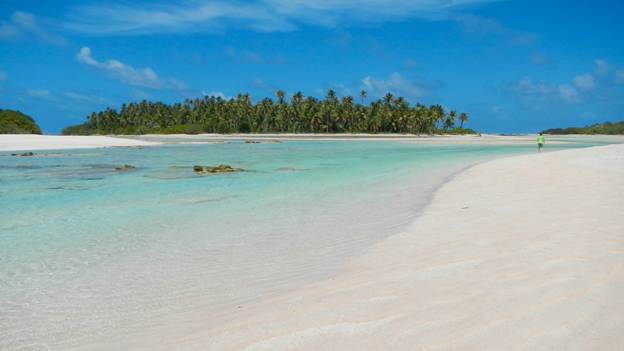
We ended up spending five days anchored here all by ourselves. I know that some people might have the impression that the cruising lifestyle is one of relative seclusion, but I have to say that it is a rare occurrence that we find ourselves anchored in a location without a village and without any other cruising neighbors. I have already written about the beauty of Ailuk, but it was really this location that in my mind solidified Ailuk as one of the most beautiful locations of our entire voyage. The islets are small and they run mostly lengthwise from ocean to lagoon and there are narrow, shallow passes between them where the water flows in and out with the tides. We spent our days exploring the little islands and the water passages and sand bars at different tide conditions and we relaxed and enjoyed having this little paradise all to ourselves.

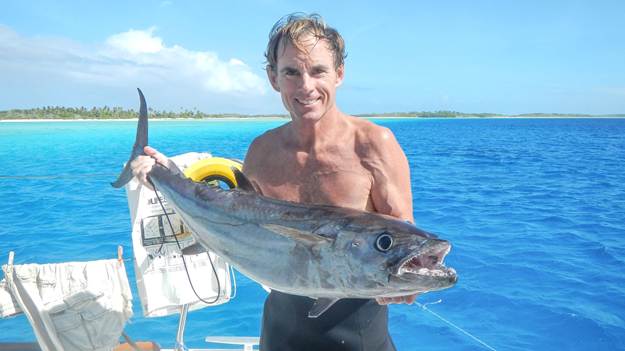
One day, Alex drove Tim a couple miles over to the pass and he was in and out of the water quickly with, ho hum, another dogtooth tuna. We gave most of it to one of the outriggers sailing past, but we enjoyed a fresh tuna dinner ourselves as well. He said it was ridiculous how many tuna there were, he had trouble deciding which one to shoot! Upon hearing about it, Brenden was disappointed he didn’t go! But he stayed to accompany me on a bombie snorkle near the boat, although visibility wasn’t nearly as nice as other bombie snorkles such as in Raroia in The Tuamotus.

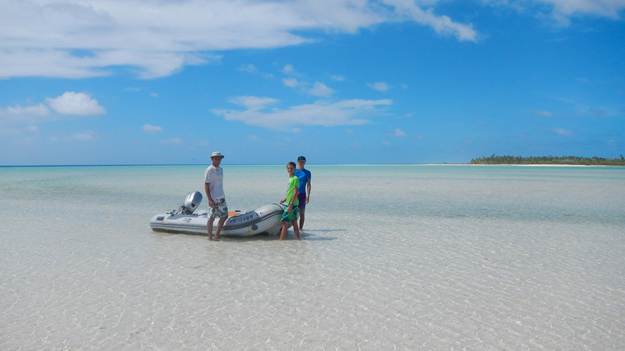
Parking the dinghy on a sandbar in order to explore the islets

Brenden enjoys some time off the boat running down the beach

Dogtooth Tuna anyone?

Closeup of our secluded spot

Categories
Uncategorized

Village Watermaker

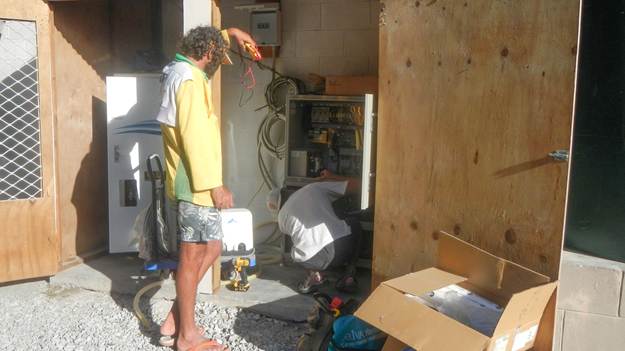
The village at Ailuk had a water desalinator, but it wasn’t working, so Tim and James (from s/v Pojean) tried their best to fix it. This is pretty common. Cruisers are known to be good at fixing things (they have to be in order to be self-sufficient), so if there’s something (or 15 somethings) in a village that needs fixing it won’t take long before the cruisers are on it. There were solar panels on the roof of the school and a battery and charge controller in a small access closet on the side. Meanwhile the boys and I watched the children throw rocks at birds in the trees. I think they were amped up on all the candy that Pojean gave them.

Anyway, Tim systematically troubleshooted the watermaker issue, and unfortunately isolated it to the battery charge controller. This isn’t something he could take apart and fix, the solution is basically that they would need a new one. It’s too bad, but this kind of thing happens a lot. Someone with good intentions donates something to a village but doesn’t maintain it and doesn’t teach the people of the village to maintain it, and it’s useful lifespan ends up only being a few months. No one was too distraught about it. They will depend on rainwater, just like they always do.

Getting to the bottom of the watermaker issue at the village on Ailuk

Categories
Uncategorized

The Longest Church Service Ever

We have made a habit of attending church services when we are visiting the more remote island villages. It’s a way to connect more with the people and gives a pretext for us to join them in the village which is slightly less awkward than just going ashore and walking around. Up to this point the award for the longest church service was Fijian Father’s Day on the island of Yadua with a close runner up being Easter Service on Fatu Hiva in The Marquesas. However, on this day on Ailuk, the Assembly of God church climbed into the top spot with a whopping two hour service on a day that wasn’t Father’s Day or Easter or anything like that. It was just any regular Sunday. But the thing is, it also took over the top spot as the most original service we had been to.

Let me explain.

First of all, the men don’t wear sulus or lava lavas. They wore everything from full business suits to pants and t-shirts. So, Alex and Brenden were quite happy to not have to don their sulus that we had bought back in Fiji and that they have had to wear on many occasions. Also, no one took their shoes off outside the church. They just went ahead and wore their shoes inside the church! We hadn’t seen this anywhere in any Pacific Island. Shoes are always removed when entering someones home or a church. We actually asked a couple people, just to make sure we were understanding things correctly.

The church service itself didn’t follow a typical service in any way. Most church services we had been to followed an expected flow, much like church services back home. Singing, sermon, collection plate, a little more singing, the end. No, this one was all over the place. Singing, speaking, singing, speaking, more singing, more speaking. This pattern kept giving us false hope that it was almost over, especially when we started reaching the hour mark.

But the best part was the sound system and the dancing. They had microphones and an amplifier, and they had someone playing on an electronic keyboard. When they would break out into singing it was lively and loud and everyone danced and had fun, including me! I’m pretty sure Pumpkin (the pastor) did the moonwalk in his rust-colored suit and glasses. It was surreal.

Categories
Uncategorized

Alex’s Debut

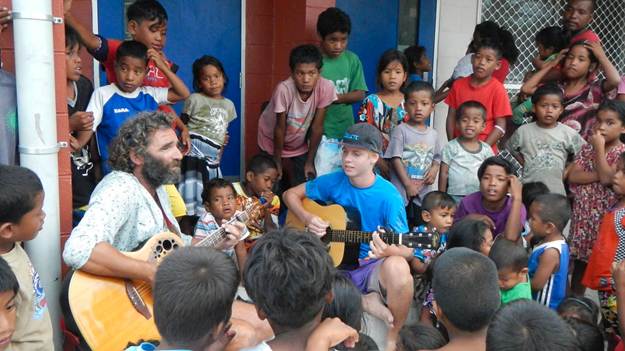
The couple from the sailboat called Pojean invited us to shore with them to play music for the kids. Yes, Alex made his public debut, and he was grateful to James who gave him some pointers and some new picks. Alex had dropped his last pick overboard, so he had been making due with one that he made himself out of a piece of plastic (that’s what you do when you live on a boat… improvise). The sing-along was fun, but the highlight had to be when we all joined hands in a big circle and did the hokey pokey! (Sorry, no photos of that.)

Alex’s debut

Categories
Uncategorized

The Kids of Ailuk

The kids of Ailuk were different than other places we had been in that they were. not. shy. at. all. From the first time we stepped on shore we were mobbed by kids of all ages wanting our attention. They wanted to say hi, give us high fives, touch us, follow us. At first, we thought it was really special how they were treating us, but then the first time we went to shore with another cruising couple who had spent several seasons cruising RMI we realized what was going on. Every time they went to shore, they took candy and balloons for the kids. So, the kids weren’t mobbing us because they were friendly or curious, they were mobbing us because they had been conditioned to want and expect stuff from us. This made me so sad.

We had decided a long time ago that that isn’t the way we want to interact with local children, so the next day Tim and the boys didn’t waste any time taking skim boards ashore to play. No candy, no balloons, just a whole lot of fun together. No need for words here, check out the video that Tim put together.

Skimboarding with the boys at Ailuk

Skimboarding video: https://youtu.be/VwYY3UOCdCg

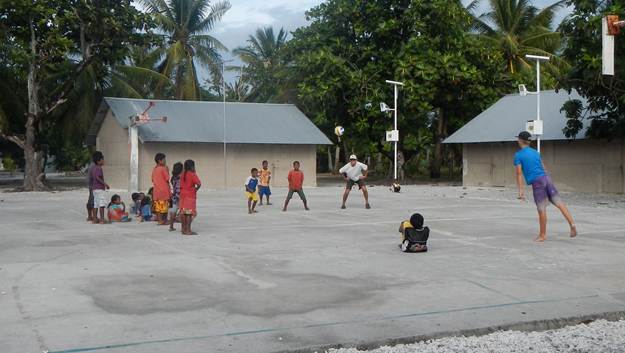
We also spent a few afternoons on shore playing games at the basketball courts. Leave it to Tim to teach the kids dodgeball!

More fun and games with the kids

One afternoon I went to shore on my own to visit some women from whom I had previously purchased some handicrafts, and I was immediately mobbed with requests for candy. I told them no, I don’t have any candy, plus candy is bad for your teeth. As you might imagine this didn’t exactly make me the most popular pulagi to ever visit the village, especially since on my own without Tim and the boys it wasn’t exactly obvious that I could make up for it with fun and games. Initially they scattered away from me, but one by one they found their way back to me and they helped me find my way around. They asked me questions, taught me some new words in the Marshallese language and laughed with me whenever I couldn’t say something correct the first time. We even sang some songs together. I know that they wanted candy, and I have no idea what they actually thought of me, but hopefully they saw me as more of a person just like them than a one-dimensional palagi who brings them stuff. Who knows, they were just kids after all.

Categories
Uncategorized

Special Delivery

While we were still in Majuro, word got around to all the cruisers that the mayor of Ailuk was looking for boats to volunteer to take supplies from Majuro to Ailuk. Since we were the only boat intending to go directly to Ailuk, I gave the mayor a call to let her know we could help. She arranged for a delivery at the wharf, and a couple days before we left, we loaded up Exodus with large bags of rice and flour and cases of motor oil.

Upon arrival in Ailuk, our first stop was to go to shore to say hello to Anious and his wife Emily. Anious is a minister at one of the churches in Ailuk, but all the cruisers know him by his radio callsign “Pumpkin.” There is an SSB cruisers radio net in The Marshalls called The Yokwe Net (Yokwe means hello in Marshallese), and Pumpkin is one of the weekly net controllers. They were expecting us, and after the pleasantries were dispensed with, they asked us about the supplies we brought from Majuro. Emily explained that it had been months since a supply ship had been there and that there was absolutely no rice or flour on the island. She asked if we brought more than what the Mayor had given us to bring, and when I said no, she was visibly distraught. Didn’t we know what they needed? Didn’t we know that we should have brought more? Didn’t we know the school has had to go to half days because the kids aren’t getting enough calories? No! No, we didn’t. And the idea of telling her that we brought what we could given the space available on board rang hollow in my head. They would look at our boat and judge it to be huge (and us to be rich). Anyway, after I got over my own pride of not being appreciated for what we *did* bring, and I realized that she wasn’t trying to make us feel bad but was just genuinely disappointed, I started to feel really, really bad. We probably could have squeezed another 15 lb bag of rice here or there, but when I asked Tim about it, if he thought we should have brought more, his response was priceless. “Well, it is what it is now.”

We didn’t waste any time getting in touch with friends back in Majuro to let them know how much Ailuk needed more supplies. With Pumpkin on the Yokwe net, I have no idea why this wasn’t previously communicated and disseminated among the cruisers more thoroughly.

We had our own supply of rice and flour on board, and I couldn’t resist it when kids from the village would come to the boat to see the boys and they would bring papaya or kasava to trade. I would ask them what they wanted to trade for and they would always say rice or flour. I would give them a sandwich bag full and their faces would light up and they’d smile from ear to ear. Eventually, word got around, and we were getting more requests than we could honor given it would still be weeks before we could reprovision for ourselves.

In the end, as our stay in Ailuk was drawing to a close, we decided to go directly from Ailuk to Kwajalein instead of stopping at more of the outer islands on the way. In Kwajalein it would be possible to provision, so that meant we could leave most of our dry good supplies with the people on Ailuk. We cleaned out our supply of flour, rice, ramen noodles, pasta, breakfast crackers, etc. Our dilemma is that we didn’t know what to do with it all. If we gave it to the acting mayor (the mayor herself was still in Majuro) then the supplies would go into the stores that are sold and any money earned from that would simply line the pockets of the people on the island who already have the most. We also questioned whether we should give it to Anious and Emily to distribute, because, let’s face it, churches can be as political as anything and we worried it wouldn’t necessarily go to the people who needed it most, especially considering that there were other churches on the island too. As it turns out, Tim had become friends with a young man with a family who spends most of his days harvesting copra (more about that later), and we decided to leave our supplies with him, and in return he brought us a bag full of handicrafts made by some of the women in the village, including his wife. If you are questioning why we would trade with them instead of just giving them the food, given that clearly they needed it and clearly we could spare it, then please read my cruising runner blog post that helps explain my thoughts about this.

Categories
Uncategorized

The Beauty and Uniqueness of Ailuk

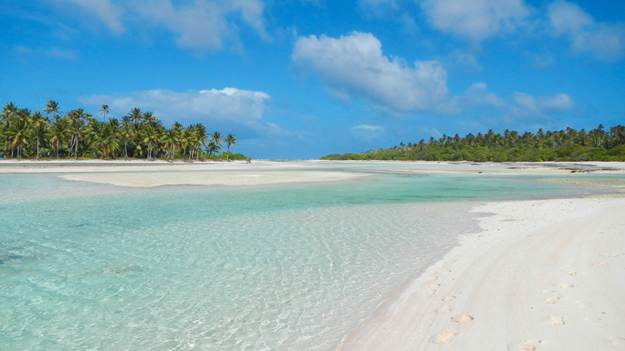
I had been complaining that I was sick of low-lying atolls. Since leaving Fiji we hadn’t seen even a foot of elevation, and honestly, I was craving even just a hill to climb. Well, Ailuk cured me of such a negative state of mind pretty quickly. I have to say that Ailuk was the most beautiful low-lying atoll we visited during our entire trip (and that includes The Tuamotus!) Since the definition of beauty is such a subjective and emotional thing, it’s difficult to describe exactly what made it so beautiful, but I will give it a shot: Most atolls have islets on the windward side, and those islets are typically long and skinny with the long dimension of the islet perpendicular to the direction breaking ocean waves on the outside of the atoll. In contrast, the windward side of Ailuk is dotted with many short and fat islets (as you can see in the satellite image above) and this creates much more stunning geography. It provides more waterways between the islets that shallow at low tide, which provide that idyllic turquoise water and plenty of striking sandbars that reach out into the lagoon. Perhaps a photo can do it better justice:

Waterways among the islets at Ailuk

We had some friends who were spending their second cyclone season down in New Zealand and were considering heading north to The Marshalls for the following season. So, of course they were curious about how we were liking it, and here is a summarized version of my initial response: “Overall, I’d say coming up here hasn’t given us any new or unique experience that we couldn’t get or haven’t gotten crossing the pacific from French Polynesia to Fiji, *however* coming up here is a great alternative to New Zealand for the cyclone season if, like I said, you want to keep cruising and aren’t ready for easy civilization (and don’t have boat projects to do that require any sort of marine infrastructure).” So, basically, nothing special, but a good alternative to New Zealand. After spending two weeks in Ailuk, I had to seriously amend this idea, because in addition to its incredible natural beauty, Ailuk offered a couple other totally unique experiences.

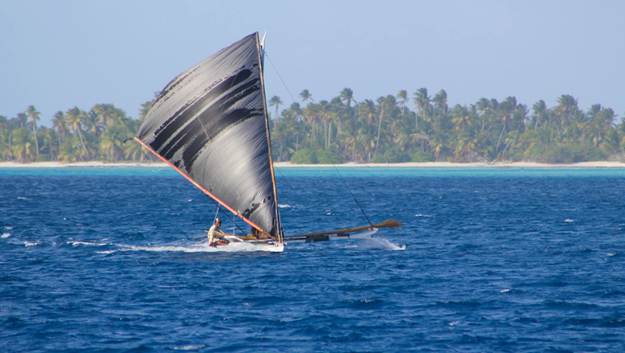
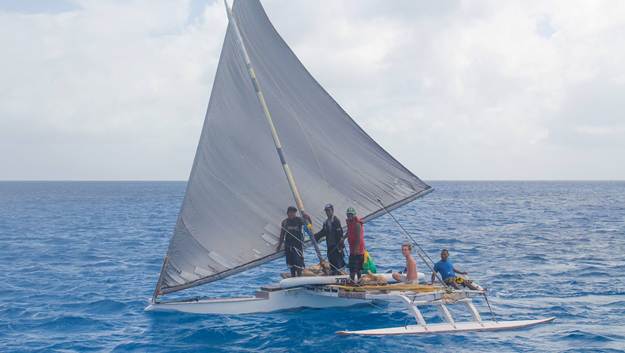
First of all, they still build traditional outrigger sailing canoes. And I don’t mean like in Majuro where they build them more as an art form in order to wow the tourists, no, I mean they build them in order to use them in their daily lives. On most of the other islands we’ve been to throughout the Pacific the people are dependent on more modern fiberglass fishing boats with outboard engines and gasoline. On Ailuk, they aren’t. They use their outrigger sailing canoes to zip up and down the atoll between villages and back and forth to the pass for fishing expeditions. When we were anchored near the main village, I’d enjoy watching all the men depart on the sailboats for the daily work as I was enjoying my morning coffee, and I’d watch them return in the evening as I was starting dinner preparations. Tim and Brenden were even each lucky enough to go for rides (on separate occasions).

Outrigger sailing canoe at Ailuk

Brenden gets a ride

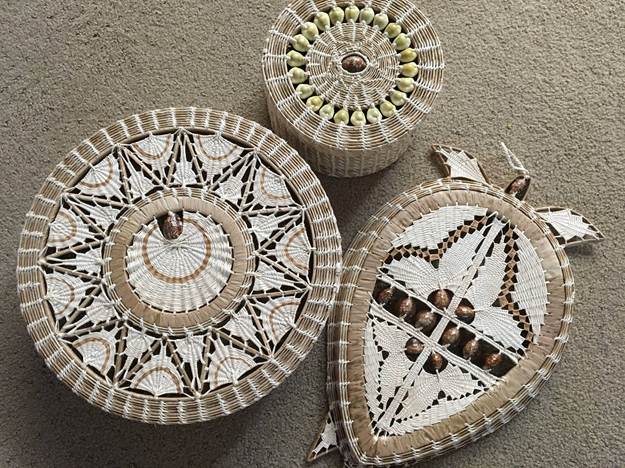
Another unique characteristic of The Marshalls is their handicrafts, and apparently Ailuk is known for having some of the most skilled women of all the islands. The weaving is much different than what we’ve seen throughout the rest of the pacific: it’s much more detailed and intricate and beautiful. They use pandanus leaves, coconut palm leaves, the ribs of the palm leaves, hibiscus fibers, to create beautifully ornate baskets, bowls, and wall hangings. (A few pieces from my collection are shown in the photo below.) On Ailuk it is a skill passed down from generation to generation. It’s a source of income for the island as most of their products are exported to Majuro to sell to tourists. The cruisers who go to Ailuk get to purchase directly from the women of the island, and they sell to us at the wholesale price rather than the marked-up Majuro price, and in many cases they prefer to trade for items they need rather than money.

Handicrafts from Ailuk

Categories
Uncategorized

Passage from Majuro to Ailuk

We waved good-bye to True Blue V as we dropped our mooring at Anemomet on the evening of Wed, Feb 24. We timed it so that we were heading out the pass just as the last bit of light left the sky, and we were immediately slammed with 3 meter seas on the nose. After a month of sitting flat calm on moorings inside the Majuro lagoon this was a bit of a wakeup call.

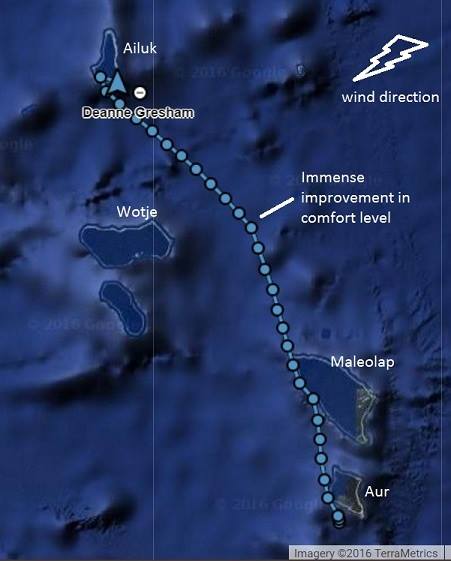
Exodus track from Majuro to Ailuk

The first night was ridiculous. I’m pretty sure I didn’t sleep a wink off-watch because I kept catching air while laying in bed. We got a little bit of relief from the sea state as we hugged the coast of Aur and Maleolap on our way by (see satellite image to the left).

The second night was a bit better, because once we reached the latitude equal with the island of Wotje we fell off the wind a bit and headed on a rumline to Ailuk.

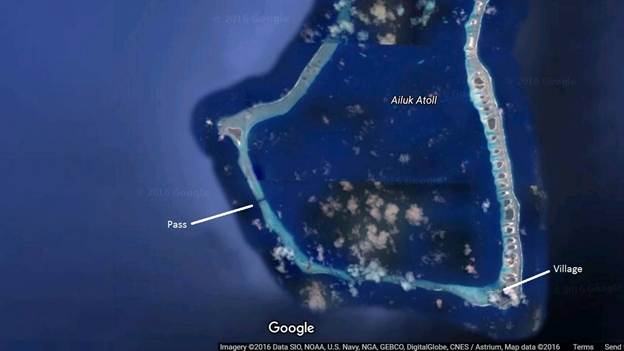
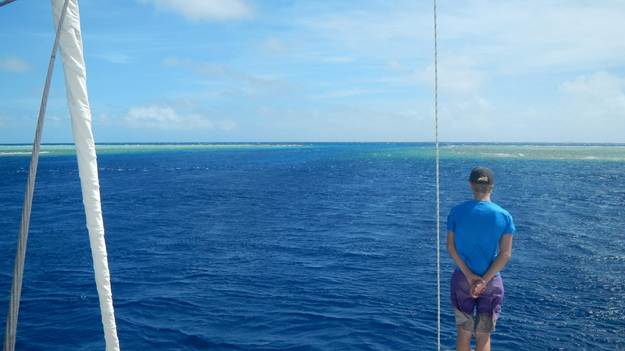
We entered the pass on the southwest side of the atoll. There are three more commonly used passes up on the northwest side, but we thought we could save some time if we used this pass and by all means it looked viable on the satellite imagery. Unfortunately we had poor timing and when we arrived we would have had the sun in our faces as we transited the lagoon over to the village. And we had been told that Ailuk has lots of bombies in its lagoon, so we decided to wait until the sun was a little more overhead before we went in. While we waited Tim and Alex dropped the dinghy and went on a scouting mission as Brenden and I just floated around in Exodus. Once we entered the lagoon we had a couple of miserable hours bashing upwind as I stood on the roof on bombie watch. In the end I’m not sure we saved that much time since both the sun angle and the wind angle from the northern passes to the village would have been a lot better. Oh well, it’s always an adventure, and you learn as you go.

We entered Ailuk through the SW pass which meant sun in our faces and wind on our nose as we crossed over to the village

Ready to enter the pass at Ailuk

Majuro to Ailuk Passage summary:

  • Duration: 1 day, 18 hrs, 47 minutes
  • Route miles: 225 nmi (this is the distance of the passage route we planned in the chartplotter.)
  • Track miles: 229 nmi (this is the actual distance over the ground that we traveled.)
  • Log miles: 243 nmi (this is the distance derived from the log paddle wheel, so it is influenced by the current.)
  • Average SOG: 5.4 kt (Speed over ground)
  • Average VMG: 5.3 kt (Velocity made good)

Engine summary: Port only 0:00, Starboard only 0:00, Both 4:17 hrs