We had a spinnaker dousing mishap that could have turned out much worse than it actually did. We were sailing from Alcatraz to La Gringa on a nice spinnaker run, and the wind was up around the low 20s. We’ve doused the spinnaker many times, usually Tim has me loosen up one side, either the sheet or the guy, and then when it depowers he pulls down the sock. This time we were having trouble getting it depowered. On the port side the guy and the sheet were configured so both were under load (if you don’t understand, it’s not essential) with the guy around the winch and the sheet around a cleat. While Tim was trying to loosen the sheet from around the cleat it slacked and then filled and it pulled him violently around and he leaned way over the lifelines before letting go. I was standing right there at the helm and I really thought he was going in, which would have meant I would have to get the spinnaker down myself, with help from the boys, before I could engine up and turn around to go get him. Quite a trick. We did eventually get it down, but not without Tim sustaining a broken toe as it banged against the toe rail when he almost went for a swim. And we’ve got another lesson learned in our ever growing file of lessons learned.
The first time the anchor windlass didn’t work was very early in our journey and the symptom that time was a “no sensor” error on the chain counter. So, the issue wasn’t with the motor at all but with the electrical contacts that count the rotation of the drum to be able to display how much chain is out. When that happens the windlass will work but only for a few seconds then it stops to tell you there’s no sensor. But if you just keep pushing the button you can get the chain up/down you just don’t know how much chain is out. So, on the to do list went remarking the chain with distance markers so we aren’t dependent on the chain counter display. Tim and Steve fixed that but when we got to BLA the night before the Regatta we encountered a whole new problem. When lowering the anchor the windlass stopped working and there was no power at all to the display. We cycled the breaker switch and it would work briefly and then shut off again. So, Tim disassembled the gypsy and gave it a good cleaning with fresh water, and that seemed to solve the problem and we were able to get the anchor set.
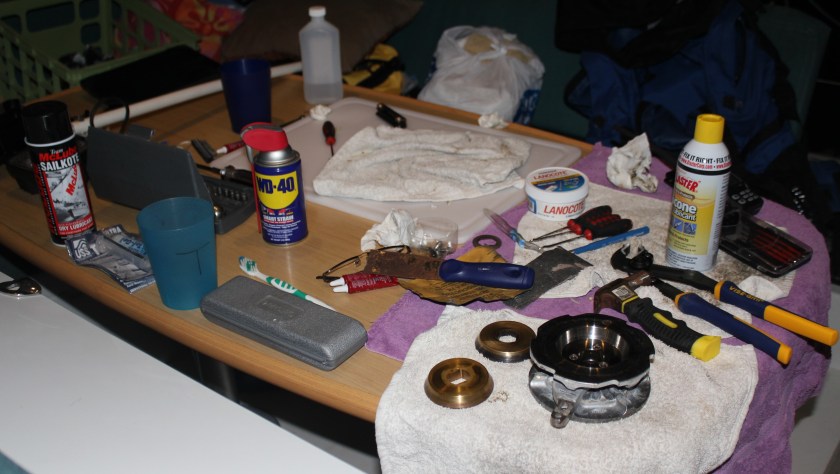
Given that we had this trouble the night before, in hindsight I’m not sure why we didn’t start the anchor raising process earlier before the regatta, just in case. As alluded to earlier, the windlass wouldn’t work the morning of the regatta, and no amount of water spraying or flipping the breaker switch would help, so we raised it manually. While raising it hand over hand, Tim was straddling the track where the chain is between the gypsy and the bow roller, and if Alex and I got a little ahead feeding the chain into the locker the tension would cause it to raise up and we got yelled at more than once for “busting my nuts!” I just reminded Tim of that and he doesn’t recall it with as much humor as I seem to. I guess perspective matters. After the regatta we chose a shallower spot to anchor and dropped it manually as well. The next day the boat was turned into a workshop and Tim with help from Steve as well as Alan (Sara M) trouble shooted the problem including taking apart the motor housing. They eventually traced the problem to a loose connection at the breaker switch and the simple fix of tightening that connection solved the problem. (Spoiler alert — at the time we thought it solved the problem, but stay tuned for the continuation of our anchor windlass woes in future essays)
Strong wind and big swells weren’t the only issues we had at the Isla Mitlan anchorage. On passage to get there the boys had caught a nice sized sierra, and Brenden was looking forward to some sashimi that evening. Unfortunately it was hanging on the stringer a little too close to one of the props, and no one remembered to move it before we used the engines to maneuver around and anchor. Before we had finished anchoring Brenden realized it was gone, so he suited up and was in the water seconds after the engines were off on a mission to find his sierra. He was unsuccessful in that mission, but he came back to get his spear reporting that there were parrot fish, and not long after that he came back with not one but two parrot fish. So, instead of sashimi that evening we had ourselves a huge bowlful of ceviche.
And that’s not where it stops. At the head of the anchorage there is a pinnacle rock identified in the guidebook with a GPS waypoint, and because there was already another boat there and we needed to fit Exodus and Lady Carolina in there as well, we tried to anchor inside of the other boat but not so far inside we would swing into the pinnacle rock if the wind shifted. We were cutting it close, and we knew we were cutting it close. We always drop a waypoint at the anchor, so I knew our distance and bearing to our anchor and our distance and bearing to the rock, and I was trying to calculate the distance from the anchor to the rock. I knew I had “side angle side” but for the life of me I couldn’t remember my trigonometry, so I texted my favorite retired math teacher (my dad) through the inreach and he reminded me of the law of cosines. And the resulting distance was well within the accuracy of GPS, so yeah, we were cutting it close. Tim decided to dive on the rock and he found it and marked it with a float, and determined we would be fine, and we didn’t need to move.
Apparently he changed his mind, because he woke me in the middle of the night declaring that, “we need to move.” When I got up I saw that the wind had shifted, and the float marking the rock was just off our port side, and it looked to be well inside our swing radius. So, we hauled anchor in the dark and moved to the outside of Lady Carolina out in much deeper water with less protection. It worked out OK. Tim was monitoring the situation and took action when the risk was clearly high enough. My only request in the aftermath was that we take precaution before the sun goes down whenever possible, since maneuvering around a small anchorage in the dark presents it’s own additional risks.
We had some excitement on passage between BLA village and La Gringa when I was rinsing my veggie bin and accidentally dropped it in the water. (While in an achorage I throw food scraps in a bin on the counter rather than in the trash. We often go a week or more between being able to dump trash, and it will start smelling if it’s in the trash. The bin we can dump in the water anytime we are moving in between anchorages.) We circled back to get it, and when we spotted it, without hesitation, Alex dove into the water off the port bow. He retrieved it, but then missed the back step as we circled around. Then it was like a man overboard drill… Brenden grabbed the pole and we pulled him in. I promise, grandparents, that at no time during this exercise was Alex in any danger. It was good fun, and Alex got to be the hero. Of course, he said next time it’s my turn, but he always says that.
There are a few other minor boat issues that have had to be resolved along the way: 1) Tim installed a fan inside the fridge and wired it to 12 V so it comes on when the fridge does in order to circulate air and keep the fridge colder. Seems to be working. 2) The fresh water pump acculumator needs to be “pumped up” every so often and Tim does that with a bicycle air pump. 3) Our navigation system “sea talk” network had intermittent issues in that sometimes some displays get data while others don’t. The order we turn on displays seems to help, but I decided to diagram the whole network just to see what we’re dealing with, and I discovered that the autopilot is connected twice, once via sea talk 1, and once via sea talk ng. According to one of the manuals I downloaded this seems to be a violation of correct network connectivity, but we don’t have the autopilot manual itself, so I didn’t want to disconnect anything before reading that. (Spoiler alert: We disconnected the sea talk 1 connection, and the autopilot still functions correctly, but it hasn’t fixed the intermittent communication problem. Tim’s also updated all the software on all the instrument displays and that hasn’t fixed it either, but it has caused us to have to recalibrate the autopilot, which is a whole other issue.
So, as you can see we are still learning, but I’m pretty pleased to say that we’ve met each challenge with creativity and flexibility and I’m getting more and more confident that we can handle whatever comes our way (with a little luck of course).


3 replies on “Boat Projects and Mishaps”
[…] Issues dropping spinnaker in strong winds. Tim injured toe, rope burns on hands. D-rope burn on foot. […]
LikeLike
[…] Issues with windlass again. Had to manually raise & lower. Got a late start in the regatta – came in 4th place (1. TBV 2. Trimaran 3. Sara M). Great sail up wind both ways. […]
LikeLike
[…] Reanchored in the middle of the night because we were too close to the pinnacle rock […]
LikeLike