January 2104
One of the main reasons for going into the marina (as opposed to staying out in the anchorage) was to get some boat projects done prior to our Pacific crossing. There were many, many small projects on the list, but there were two big ones that needed to be addressed early so they didn’t end up delaying us in any way. They were the cockpit floor and the dinghy engine mount.
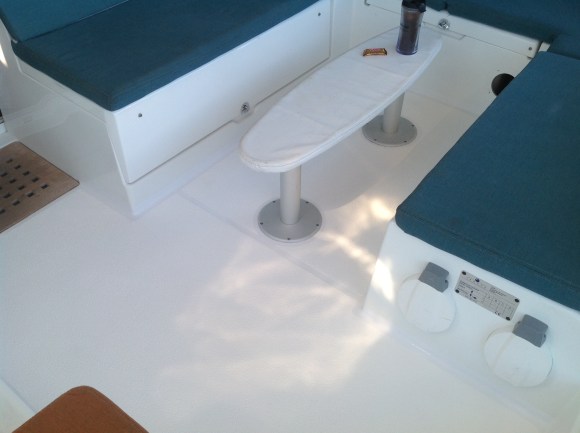
The cockpit floor is kind of a long story in that basically it was work in progress when we bought Exodus. From the factory, Exodus came with a stock gelcoat nonskid cockpit floor, but then the dealer replaced that with a Teak floor before selling it, I guess thinking it would be more marketable. Well, the previous owner, John, didn’t like the Teak, I think because it was too high maintenance, so he contracted to have it pulled up and then put a gelcoat floor back in. He wanted it to match the rest of the non-skid around the boat, so he found someone who would make a mold from another part of the boat to use in the cockpit. Sounds great, but there was a lot of drama surrounding the work because the guy left the country back to Mexico for a while and there was confusion about why he left and when he would return. It was incomplete when we went on the Baja Ha Ha, but it was supposed to be complete by the time we took possession of Exodus in early December. Of course, it wasn’t, and John gave us the option of waiting another week or taking Exodus and having the guy come up to Marina del Rey to finish it. We opted to take Exodus, and in hindsight maybe we were influenced by our excitement of becoming boat owners, because that turned into a HUGE hassle. First of all, when Tim inspected the work that had been done so far, it was crap. Basically, they had made a mold of the non-skid pattern from the top of the hard canopy, but then they just laid that down in the cockpit with the non-skid inverted. So, instead of little bumps on the floor to prevent slipping there were little cups, which as you can imagine just collect water and make the floor even more slippery, totally defeating the purpose of the non-skid floor. So, when the guy came up to “finish” the job, Tim insisted he pull it all out and start over. There were issues with this, and maybe, again in hindsight, we should have just cut him loose and found someone local to do the job, because we ended up having to pay for a hotel and even some gas to drive back and forth to San Diego. I can’t remember, but I think we split the expense with the previous owner, but in the end, it didn’t really matter, because even after it was completely redone the integrity of the floor didn’t last long. It wasn’t a few months into our journey that the floor was waterlogged and coming apart. Tim applied blue painters tape around the edges to keep the sharp edges contained so no one hurt themselves. We lived with the blue tape for quite a long time, so long that we almost didn’t notice it anymore. But we knew we needed to have a water tight floor, so in La Cruz Tim took on the huge task of redoing the floor himself. Well, not totally himself. Dan on Dazzler provided a lot of consulting ahead of time (since he had quite a bit of experience with this sort of work) and then when it came right down to it, he rolled up his sleeves and got down on his hands and knees and helped Tim with a lot of the labor too. It was quite the job, and it took a couple weeks to finish. The rain didn’t help, though. It rained pretty much our entire first week in the marina starting the day after Tim started ripping up the floor, of course. The finished product is a sight to be seen. Tim and Dan did an excellent job, and although they have a habit of inspecting close and searching for the imperfections, I certainly can’t say there are many to be found. They used Kiwi Grip as the non-skid surface, and, no, it doesn’t match the pattern of the rest of the non-skid, but it looks great, and if that had been done in the first place it would have saved us so much hassle.
Tim subcontracted out the work to build a support structure to mount our outboard, so it didn’t take nearly as much of his own labor, but he did have to design what he wanted and be able to communicate it to someone who spoke very little English. We go some translating help from a woman on s/v Go For Broke, and the contractor did very fast work. Within a couple days the new support structure was complete, and they also reinforced the dinghy davits, one of which had been ever so slightly (hence the reason we wanted to be able to remove the outboard from the dinghy onto its own support structure for an ocean passage). So, with the two main projects out of the way early, Tim could then slowly and consistently start checking off the myriad of other projects on “the list.
 Gresham Family Exodus
One reply on “The Cockpit Floor”
[…] Tim ripped up cockpit floor. […]
LikeLike